


Daniel 1:1
Bible text: King James Version (1769 Blayney text) · Public domain
Bible text: Berean Standard Bible · Public domain
Bible text: American Standard Version (1901) · Public domain
Bible text: World English Bible, Messianic edition · Public domain
Bible text: Geneva Bible (1599) · Public domain
Bible text: Young's Literal Translation · Public domain
- בִּשְׁנַתbish·Natin yearH8141Prep-b ¦ N-fscNoun Singular Feminine Constructבִּinשְׁנַתyear
- שָׁלוֹשׁsha·Lo·oshthreeH7969Adj-csAdjective Numerical Singular common gender Absolute
- לְמַלְכוּתle·mal·Khutof [the] reign ofH4438Prep-l ¦ N-fscNoun Singular Feminine Constructלְofמַלְכוּת[the] reign of
- יְהוֹיָקִיםye·ho·ya·KimJehoiakimH3079N-proper-mNoun Proper Masculine
- מֶלֶךְMe·lekh[the] king ofH4428N-mscNoun Singular Masculine Construct
- יְהוּדָהye·hu·DahJudahH3063N-properNoun Proper Location
- בָּאba'he cameH935V-Qal-Perf-3msVerb Qal Perfect 3rd Singular Masculine
- נְבוּכַדְנֶאצַּרne·vu·khad·ne·TzarNebuchadnezzarH5019N-proper-mNoun Proper Masculine
- מֶלֶךְMe·lekh[the] king ofH4428N-mscNoun Singular Masculine Construct
- בָּבֶלba·VelBabylonH894N-properNoun Proper Location
- יְרוּשָׁלִַםye·ru·sha·LimJerusalemH3389N-properNoun Proper Location
- וַיָּצַרvai·Ya·tzarand he laid siegeH6696Conj-w ¦ V-Qal-ConsecImperf-3msVerb Qal Consecutive Imperfect 3rd Singular Masculineוַandיָּצַרhe laid siege
- עָלֶיהָ'a·Lei·haon itH5921Prep ¦ 3fsPrepositionעָלֶיonהָit
English is a literal word-by-word gloss of the Hebrew, not the KJV's wording. Why?
This is the original text the KJV's translators worked from — each Hebrew word with its own literal English meaning in this verse, prepared by scholars at Tyndale House, Cambridge. The KJV translates whole sentences, not word by word, so its wording differs: one Hebrew word can become several English words, and the KJV may choose “the LORD” where the gloss reads “Yahweh”. Both are faithful — they answer different questions. For the KJV's own rendering, switch to the KJV text.
Details
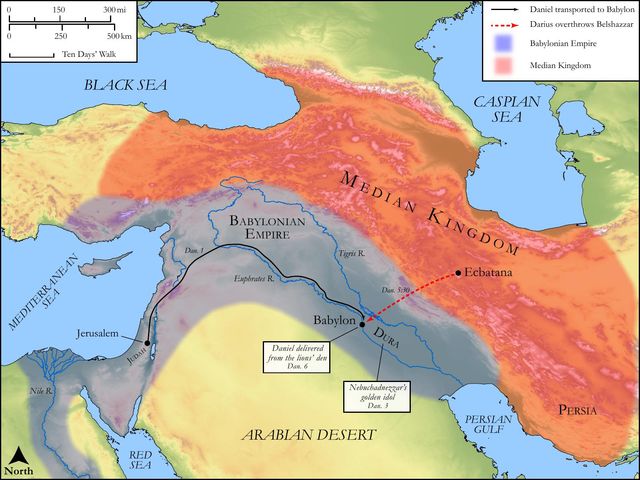
See on the biblical-era map
Study this verse
Public-domain commentary
Matthew Henry
From his Commentary on the Whole Bible. Henry comments on passages, not single verses — this entry covers Daniel 1:1–7. His four-level outline is real structure in the source text, so it is rendered as structure.
We have in these verses an account,
I.Of the first descent which Nebuchadnezzar, king of Babylon, in the first year of his reign, made upon Judah and Jerusalem, in the third year of the reign of Jehoiakim, and his success in that expedition (Dan 1:1, Dan 1:2.): He besieged Jerusalem, soon made himself master of it, seized the king, took whom he pleased and what he pleased away with him, and then left Jehoiakim to reign as tributary to him, which he did about eight years longer, but then rebelled, and it was his ruin. Now from this first captivity most interpreters think the seventy years are to be dated, though Jerusalem was not destroyed, nor the captivity completed, till about nineteen years after, In that first year Daniel was carried to Babylon, and there continued the whole seventy years (see Dan 1:21), during which time all nations shall serve Nebuchadnezzar, and his son, and his son's son, Jer 25:11. This one prophet therefore saw within the compass of his own time the rise, reign, and ruin of that monarchy; so that it was res unius aetatis - the affair of a single age, such short-lived things are the kingdoms of the earth; but the kingdom of heaven is everlasting. The righteous, that see them taking root, shall see their fall, Job 5:3; Pro 29:16. Mr. Broughton observes the proportion of times in God's government since the coming out of Egypt: thence to their entering Canaan forty years, thence seven years to the dividing of the land, thence seven Jubilees to the first year of Samuel, in whom prophecy began, thence to this first year of the captivity seven seventies of years, 490 (ten Jubilees), thence to the return one seventy, thence to the death of Christ seven seventies more, thence to the destruction of Jerusalem forty years.
II.The improvement he made of this success.
He did not destroy the city or kingdom, but did that which just accomplished the first threatening of mischief by Babylon. It was denounced against Hezekiah, for showing his treasures to the king of Babylon's ambassadors (Isa 39:6, Isa 39:7), that the treasures and the children should be carried away, and, if they had been humbled and reformed by this, hitherto the king of Babylon's power and success should have gone, but no further. If less judgments do the work, God will not send greater; but, if not, he will heat the furnace seven times hotter. Let us see what was now done.
1.The vessels of the sanctuary were carried away, part of them, Dan 1:2. They fondly trusted to the temple to defend them, though they went on in their iniquity. And now, to show them the vanity of that confidence, the temple is first plundered. Many of the holy vessels which used to be employed in the service of God were taken away by the king of Babylon, those of them, it is likely, which were most valuable, and he brought them as trophies of victory to the house of his god, to whom, with a blind devotion, he gave praise of his success; and having appropriated these vessels, in token of gratitude, to his god, he put them in the treasury of his temple. See the righteousness of God; his people had brought the images of other gods into his temple, and now he suffers the vessels of the temple to be carried into the treasuries of those other gods. Note, When men profane the vessels of the sanctuary with their sins it is just with God to profane them by his judgments. It is probable that the treasures of the king's house were rifled, as was foretold, but particular mention is made of the taking away of the vessels of the sanctuary because we shall find afterwards that the profanation of them was that which filled up the measure of the Chaldeans' iniquity, Dan 5:3. But observe, It was only part of them that went now; some were left them yet upon trial, to see if they would take the right course to prevent the carrying away of the remainder. See Jer 27:18.
2.The children and young men, especially such as were of noble or royal extraction, that were sightly and promising, and of good natural parts, were carried away. Thus was the iniquity of the fathers visited upon the children. These were taken away by Nebuchadnezzar,
(1.)As trophies, to be made a show of for the evidencing and magnifying of his success.
(2.)As hostages for the fidelity of their parents in their own land, who would be concerned to conduct themselves well that their children might have the better treatment.
(3.)As a seed to serve him. He took them away to train them up for employments and preferments under him, either out of an unaccountable affectation, which great men often have, to be attended by foreigners, though they be blacks, rather than by those of their own nation, or because he knew that there were no such witty, sprightly, ingenious young men to be found among his Chaldeans as abounded among the youth of Israel; and, if that were so, it was much for the honour of the Jewish nation, as of an uncommon genius above other people, and a fruit of the blessing. But it was a shame that a people who had so much wit should have so little wisdom and grace. Now observe,
[1.]The directions which the king of Babylon gave for the choice of these youths, Dan 1:4. They must not choose such as were deformed in body, but comely and well-favoured, whose countenances were indexes of ingenuity and good humour. But that is not enough; they must be skilful in all wisdom, and cunning, or well-seen in knowledge, and understanding science, such as were quick and sharp, and could give a ready and intelligent account of their own country and of the learning they had hitherto been brought up in. He chose such as were young, because they would be pliable and tractable, would forget their own people and incorporate with the Chaldeans. He had an eye to what he designed them for; they must be such as had ability in them to stand in the king's palace, not only to attend his royal person, but to preside in his affairs. This is an instance of the policy of this rising monarch, now in the beginning of his reign, and was a good omen of his prosperity, that he was in care to raise up a succession of persons fit for public business. He did not, like Ahasuerus, appoint them to choose him out young women for the service of his government. It is the interest of princes to have wise men employed under them; it is therefore their wisdom to take care for the finding out and training up of such. It is the misery of this world that so many who are fit for public stations are buried in obscurity, and so many who are unfit for them are preferred to them.
[2.]The care which he took concerning them. First, For their education. He ordered that they should be taught the learning and tongue of the Chaldeans. They are supposed to be wise and knowing young men, and yet they must be further taught. Give instructions to a wise man and he will increase in learning. Note, Those that would do good in the world when they grow up must learn when they are young. That is the learning age; if that time be lost, it will hardly be redeemed. It does not appear that Nebuchadnezzar designed they should learn the unlawful arts that were used among the Chaldeans, magic and divination; if he did, Daniel and his fellows would not defile themselves with them. Nay, we do not find that he ordered them to be taught the religion of the Chaldeans, by which it appears That he was at this time no bigot; if men were skilful and faithful, and fit for his business, it was not material to him what religion they were of, provided they had but some religion. They must be trained up in the language and laws of the country, in history, philosophy, and mathematics, in the arts of husbandry, war, and navigation, in such learning as might qualify them to serve their generation. Note, It is real service to the public to provide for the good education of the youth. Secondly, For their maintenance. He provided for them three years, not only necessaries, but dainties for their encouragement in their studies. They had daily provision of the king's meat, and of the wine which he drank, Dan 1:5. This was an instance of his generosity and humanity; though they were captives, he considered their birth and quality, their spirit and genius, and treated them honourably, and studied to make their captivity easy to them. There is a respect due to those who are well-born and bred when they have fallen into distress. With a liberal education there should be a liberal maintenance.
III.A particular account of Daniel and his fellows.
They were of the children of Judah, the royal tribe, and probably of the house of David, which had grown a numerous family; and God told Hezekiah that of the children that should issue from him some should be taken and made eunuchs, or chamberlains, in the palace of the king of Babylon. The prince of the eunuchs changed the names of Daniel and his fellows, partly to show his authority over them and their subjection to him, and partly in token of their being naturalized and made Chaldeans. Their Hebrew names, which they received at their circumcision, had something of God, or Jah, in them: Daniel - God is my Judge; Hananiah - The grace of the Lord; Mishael - He that is the strong God; Azariah - The Lord is a help. To make them forget the God of their fathers, the guide of their youth, they give them names that savour of the Chaldean idolatry. Belteshazzar signifies the keeper of the hidden treasures of Bel; Shadrach - The inspiration of the sun, which the Chaldeans worshipped; Meshach - Of the goddess Shach, under which name Venus was worshipped; Abed-nego, The servant of the shining fire, which they worshipped also. Thus, though they would not force them from the religion of their fathers to that of their conquerors, yet they did what they could by fair means insensibly to wean them from the former and instil the latter into them. Yet see how comfortably they were provided for; though they suffered for their fathers' sins they were preferred for their own merits, and the land of their captivity was made more comfortable to them than the land of their nativity at this time would have been.
Historical interpretation
Fifteen Centuries of Reception
5 surviving comments on this verse. Each one is dated, so this reads as a timeline rather than a list.
Select a marker to jump to its quote. Markers stagger vertically where authors wrote within a few decades of each other.
As I wish to give an accurate account of the times of the captivity of the children of Israel in Babylon, and to discuss the prophecies contained in the visions of the blessed Daniel, (as well as) his manner of life from his boyhood in Babylon, I too shall proceed to bear my testimony to that holy and righteous man, a prophet and witness of Christ, who not only declared the visions of Nebuchadnezzar the king in those times, but also trained youths of like mind with himself, and raised up faithful witnesses in the world. He is horn, then, in the time of the prophetic ministry of the blessed Jeremiah, and in the reign of Jehoiakim or Eliakim. Along with the other captives, he is carried off a prisoner to Babylon. Now there are born to the blessed Josiah these five sons-Jehoahaz, Eliakim, Johanan, Zedekiah, or Jeconiah, and Sadum. And on his father's death, Jehoahaz is anointed as king by the people at the age of twenty-three years. Against him comes up Pharaoh-Necho, in the third month of his reign; and he takes him (Jehoahaz) prisoner, and carries him into Egypt, and imposes tribute on the land to the extent of one hundred talents of silver and ten talents of gold. And in his stead he sets up his brother Eliakim as king over the land, whose name also he changed to Jehoiakim, and who was then eleven years old. Against him came up Nebuchadnezzar king of Babylon, and carries him off prisoner to Babylon, taking with him also some of the vessels of the house in Jerusalem. Thrown into prison as a friend of Pharaoh, and as one set up by him over the kingdom, he is released at length in the thirty-seventh year by Evil-Merodach king of Babylon; and he cut his hair short, and was counsellor to him, and ate at his table until the day that he died. On his removal, his son Jehoiakim reigns three years. And against him came up Nebuchadnezzar, and transports him and ten thousand of the men of his people to Babylon, and sets up in his stead his father's brother, whose name he changed also to Zedekiah; and after making agreement with him by oath and treaty, he returns to Babylon. This (Zedekiah), after a reign of eleven years, revolted from him and went over to Pharaoh king of Egypt. And in the tenth year Nebuchadnezzar came against him from (he land of the Chaldeans, and surrounded the city with a stockade, and environed it all round, and completely shut it up. In this way the larger number of them perished by famine, and others perished by the sword, and some were taken prisoners, and the city was burned with fire, and the temple and the wall were destroyed. And the army of the Chaldeans seized all the treasure that was found in the house of the Lord, and all the vessels of gold and silver; and all the brass, Nebuzaradan, chief of the slaughterers, stripped off, and carried it to Babylon. And the army of the Chaldeans pursued Zedekiah himself as he fled by night along with seven hundred men, and surprised him in Jericho, and brought him to the king of Babylon at Reblatha. And the king pronounced judgment upon him in wrath, because he had violated the oath of the Lord, and the agreement he had made with him; and he slew his sons before his face, and put out Zedekiah's eyes. And he cast him into chains of iron, and carried him to Babylon; and there he remained grinding at the mill until the day of his death. And when he died, they took his body and cast it behind the wall of Nineveh. In his case is fulfilled the prophecy of Jeremiah, saying, "(As) I live, saith the Lord, though Jeconiah son of Jehoiakim king of Judah should become the signet upon my right hand, yet will I pluck thee thence; and I will give thee into the hands of them that seek thy life, of them whose face thou fearest, even into the hands of the Chaldeans. And I will cast thee out, and thy mother that bare thee, into a country where thou wast not born; and there ye shall die. But to the land which they desire in their souls, I will not send thee back. Dishonoured is Jeconias, like an unserviceable vessel, of which there is no use, since he is cast out and expelled into a land which he knew not. O earth, hear the word of the Lord. Write this man, a man excommunicate; for no man of his seed shall prosper (grow up), sitting upon the throne of David, ruling any more in Judah." Thus the captivity in Babylon befell them after the exodus from Egypt. When the whole people, then, was transported, and the city made desolate. and the sanctuary destroyed, that the word of the Lord might be fulfilled which He spake by the mouth of the prophet Jeremiah, saying, "The sanctuary shall be desolate seventy years; " then we find that the blessed Daniel prophesied in Babylon, and appeared as the vindicator of Susanna.
"In the third year of the reign of Jehoiakim." The Scripture narrates these things, with the purpose of intimating the second captivity of the people, when Jehoiakim and the three youths with him, together with Daniel, were taken captive and carried off.
Verse 1. "In the third year of the reign of Joacim (Jehoiakim) king of Judah, Nebuchadnezzar king of Babylon came to Jerusalem and besieged it." Jehoiakim, son of the Josiah in whose thirteenth regnal year Jeremiah began to prophesy, and under whom the woman Hulda prophesied, was the same man as was called by the other name of Eliakim, and reigned over the tribes of Judah and Jerusalem eleven years. His son Jehoiachin surnamed Jeconiah, followed him in the kingship, and on the tenth day of the third month of his reign he was taken captive by Nebuchadnezzar's generals and brought to Babylon. In his place his paternal uncle Zedekiah, a son of Josiah, was appointed king, and in his eleventh year Jerusalem was captured and destroyed. Let no one therefore imagine that the Jehoiakim in the beginning of Daniel is the same person as the one who is spelled Jehoiachin in the commencement of Ezekiel. For the latter has "-chin" as its final syllable, whereas the former has "-kim." And it is for this reason that in the Gospel according to Matthew there seems to be a generation missing, because the second group of fourteen, extending to the time of Jehoiakim, ends with a son of Josiah, and the third group begins with Jehoiachin, son of Jehoiakim. Being ignorant of this factor, Porphyry formulated a slander against the Church which only revealed his own ignorance, as he tried to prove the evangelist Matthew guilty of error.
Naturally, at the outset, the king who ruled is revealed and the year made clear, when the capture first occurred. And so by calling to mind the king that reigned at that point, he [Daniel] demonstrates … that he is a prophet. For other prophets begin in the very same way.
"Daniel, whose name signifies "the judgment of God," was of the royal blood of the kings of Juda, and one of those that were first of all carried away into captivity....He is not commonly numbered by the Hebrews among the prophets, because he lived at court, and in high station in the world: but if we consider his many clear predictions of things to come, we shall find that no one better deserves the name and title of a prophet; which also has been given him by the Son of God himself. (Matthew xxiv.; Mark xiii.; Luke xxi.)
Continue studying Daniel 1:1 across the web’s major study libraries — every link below opens this exact verse, chapter, or book on the destination site.
Read & Compare
 BibleGatewayThis verse in more than 200 translations and 70 languages.
 Bible.comThe YouVersion reader — hundreds of translations, reading plans, and highlights.
 ESV.orgCrossway's official English Standard Version reader.
 NET BibleThe NET translation with 60,000+ translators' notes on every rendering decision.
 STEP BibleTyndale House's free study tool — original text, vocabulary, and scholarly resources.
 BibliaLogos Bible Software's free web reader.
 USCCBThe New American Bible (Revised Edition) with the U.S. bishops' study notes.
Commentaries
 BibleHub CommentariesDozens of classic commentaries on this verse, gathered on one page.
 StudyLightMore than 100 commentary sets — the largest collection on the web.
 BibleRefPlain-English commentary on what this verse means, verse by verse.
 Enduring WordDavid Guzik's free commentary on this chapter, widely used by Bible teachers.
 Bible Study ToolsVerse commentary alongside Greek and Hebrew study aids.
Original Language & Research
- BibleHub InterlinearThe verse word by word — original language, transliteration, and English.
- BibleHub LexiconEvery word's original-language definition and Strong's entry.
 Blue Letter BibleDeep-study tools — Strong's numbers, concordance, and word studies.
 SefariaThe Hebrew text with Rashi and centuries of Jewish commentary.
Sermons, Hymns & Audio


TrulyRandomVerse is not affiliated with these sites and doesn’t control their content. They’re linked because they’re genuinely useful.
Summary
Daniel 1:1 serves as the dramatic and historically precise opening to the book of Daniel, immediately immersing the reader in a pivotal moment for the nation of Judah. It meticulously records the beginning of the Babylonian captivity, detailing the specific year of King Jehoiakim's reign when Nebuchadnezzar, the formidable king of Babylon, launched his initial, decisive siege against Jerusalem. This verse not only grounds the subsequent prophetic visions and narratives of faithfulness in a concrete historical event but also subtly introduces the overarching theme of divine sovereignty amidst geopolitical upheaval and human disobedience.
Context
ShowHideLiterary Context
Daniel 1:1 functions as the crucial historical anchor for the entire book, providing the specific setting for the events and prophecies that unfold. It immediately follows the historical books of the Old Testament (like 2 Kings and Jeremiah), establishing continuity. The verse sets the stage for Daniel's personal narrative, explaining how he and his companions came to be in Babylon. The subsequent verses in Daniel 1:2-7 describe the initial deportation of choice young men, including Daniel, and the plundering of temple articles, directly flowing from the siege mentioned in this opening verse. This immediate transition from national crisis to personal testing establishes the dual focus of the book: God's sovereign plan for nations and His faithfulness to individuals within those plans.
Historical & Cultural Context
The "third year of the reign of Jehoiakim" corresponds to approximately 605 BC, a highly volatile period. The Neo-Babylonian Empire, under Nebuchadnezzar, was rapidly asserting its dominance, having recently defeated Egypt at the Battle of Carchemish (circa 605 BC). Judah, caught between these two superpowers, had first served Egypt, and was now facing the rising power of Babylon. King Jehoiakim, installed by Pharaoh Neco II, had a reign marked by spiritual apostasy and political instability, reversing the reforms of his righteous father, Josiah. The siege described here was not the final destruction of Jerusalem (which occurred in 586 BC, as detailed in 2 Kings 25:1-10), but the first of three major deportations, signifying the end of Judah's independence and the beginning of the prophesied 70-year Babylonian captivity.
Key Themes
ShowHideThis opening verse immediately introduces several foundational themes that permeate the book of Daniel. Firstly, it highlights Divine Sovereignty, demonstrating that even the rise of powerful pagan empires and the fall of God's chosen nation occur under God's ultimate control. Nebuchadnezzar's actions, though seemingly driven by imperial ambition, are implicitly part of God's disciplinary plan for Judah's persistent idolatry and covenant unfaithfulness. Secondly, it underscores the Consequences of Disobedience, as the siege and subsequent exile are direct judgments for Judah's spiritual decline under kings like Jehoiakim, contrasting sharply with the earlier revival under Josiah (see 2 Kings 23:1-25). Finally, by setting the stage for the exile, the verse implicitly introduces the theme of Faithfulness in Exile, as it paves the way for the stories of Daniel and his friends who would demonstrate unwavering devotion to God in a foreign land.
Exposition and Analysis
ShowHideKey Word Analysis
ShowHideFrom "Jehovah abbreviated" and "to raise," meaning "Jehovah will raise." This name, ironically, belongs to a Jewish king whose reign (609-598 BC) was characterized by spiritual apostasy and political maneuvering, directly contributing to Judah's decline and the onset of the Babylonian invasions.
A name of foreign derivation, identifying the powerful king of Babylon (605-562 BC). He is presented as the instrument of God's judgment against Judah, despite being a pagan ruler. His name becomes synonymous with formidable imperial power and divine judgment throughout the book of Daniel, setting up the dramatic confrontations between earthly kingdoms and God's eternal kingdom.
A primitive root meaning "to cramp, i.e., confine (in many applications, literally and figuratively, formative or hostile)." In this context, it specifically means to "lay siege" or "assault." This word vividly portrays the military action taken by Nebuchadnezzar against Jerusalem, indicating a hostile encirclement with the intent to capture and subdue the city, marking the beginning of its subjugation to foreign power.
Verse Breakdown
ShowHide"In the third year of the reign of Jehoiakim king of Judah"
This clause provides precise historical dating, anchoring the narrative firmly in time. The "third year" (605 BC) signifies not the final destruction, but the initial, pivotal phase of Babylonian dominance over Judah, occurring during the rule of a king known for his unrighteousness and defiance of God. This specific temporal marker lends credibility and historical weight to the events described.
"came Nebuchadnezzar king of Babylon unto Jerusalem"
This segment introduces the primary antagonist and the direct action. Nebuchadnezzar, the rising power of that day, is depicted as actively moving against Jerusalem, the capital of Judah and the spiritual center of God's people. His arrival signals an imminent confrontation and the beginning of a new, challenging era for Judah.
"and besieged it."
This final, concise phrase describes the military action taken by Nebuchadnezzar. The act of besieging implies a hostile encirclement with the intent to conquer. This was the first of several sieges that would ultimately lead to the city's destruction and the temple's desecration, marking a profound moment of national crisis and divine judgment.
Literary Devices
ShowHideDaniel 1:1 employs several key literary devices to establish its narrative and thematic foundations. The most prominent is Historical Narrative, as the verse functions as a precise, factual record, grounding the subsequent prophetic and visionary content in verifiable historical events. This historical precision is further emphasized by the use of a Chronological Marker ("In the third year of the reign of Jehoiakim"), which immediately situates the reader within a specific, critical period of Judah's history. The verse also serves as a Dramatic Opening, immediately plunging the reader into a moment of national crisis and impending judgment, creating a sense of tension and foreboding. Furthermore, there is an implicit Juxtaposition between the "king of Judah" and the "king of Babylon," highlighting the power shift and the impending clash between God's covenant people and a formidable pagan empire, setting the stage for the overarching theme of divine sovereignty over earthly kingdoms.
Theological and Thematic Connections
ShowHideDaniel 1:1 profoundly establishes the theological premise that God is sovereign over all nations and history, even when His people face judgment from pagan powers. The siege of Jerusalem, while a devastating human event, is presented as part of God's unfolding plan, a consequence of Judah's persistent unfaithfulness. This divine orchestration underscores that no earthly power, however mighty, operates outside the purview of the Almighty. The verse thus sets the stage for the book's central message: God's kingdom is supreme, enduring, and ultimately triumphant over all human empires, offering hope and a call to faithfulness even in the darkest of times.
Reflection and Application
ShowHideDaniel 1:1, though a historical account of national defeat, offers profound spiritual lessons for contemporary believers. It reminds us that even when circumstances appear chaotic, unjust, or overwhelming, God remains on His throne, actively working His purposes through human history. The fall of Jerusalem was not a sign of God's weakness, but a demonstration of His justice and sovereignty, fulfilling His warnings to a disobedient people. For us, this means that personal and global crises are not outside God's control; rather, they can be instruments of His discipline, refinement, or the advancement of His kingdom. It calls us to trust in His ultimate plan, even when we cannot discern its immediate contours, and to maintain faithfulness in the face of adversity, knowing that our God is sovereign over all earthly powers and circumstances.
Questions for Reflection
ShowHideFAQ
ShowHideWhat is the significance of the "third year of the reign of Jehoiakim"?
ShowHideThe "third year of the reign of Jehoiakim" corresponds to approximately 605 BC. This date is highly significant because it marks the first of three major deportations of the Jewish people to Babylon. While not the final, devastating destruction of Jerusalem and its Temple (which occurred in 586 BC under Nebuchadnezzar, as recorded in 2 Kings 25:1-10), this initial siege was a crucial turning point. It signaled the effective end of Judah's independence, the beginning of the prophesied 70-year Babylonian captivity, and the moment when Daniel and his companions were taken into exile, setting the stage for the entire book of Daniel.
Who was Jehoiakim and why is his reign important here?
ShowHideJehoiakim was king of Judah from 609-598 BC, placed on the throne by Pharaoh Neco II of Egypt after the death of his righteous father, Josiah. His reign was marked by spiritual apostasy, political instability, and a reversal of Josiah's reforms. He was a disobedient king who "did what was evil in the sight of the Lord" (2 Kings 23:37). His unfaithfulness and defiance of God's prophets (like Jeremiah) directly contributed to Judah's weakened state and made them vulnerable to the rising power of Babylon, ultimately bringing about the judgment described in Daniel 1:1. His reign serves as a stark example of the consequences of national disobedience.
What was the nature of Nebuchadnezzar's siege of Jerusalem at this time?
ShowHideThe siege mentioned in Daniel 1:1 was Nebuchadnezzar's first significant military campaign against Jerusalem, occurring shortly after his decisive victory over Egypt at the Battle of Carchemish (also in 605 BC). This was not a siege aimed at total destruction, but rather at asserting Babylonian dominance and securing tribute. As a result of this siege, Jehoiakim became the servant of Babylon, and Nebuchadnezzar carried off some of the temple treasures and a selection of the brightest and noblest young men from Jerusalem, including Daniel and his three friends (Daniel 1:2-7). This event established Babylon's control over Judah and initiated the long period of exile.
Christ-Centered Fulfillment
ShowHideDaniel 1:1, though depicting a moment of national defeat and exile, profoundly foreshadows the ultimate triumph of God's kingdom through Christ. The temporary victory of Nebuchadnezzar, a pagan king, over Jerusalem, the city of God, highlights the transient nature of all earthly kingdoms. Yet, even in this judgment, God's sovereign hand is evident, orchestrating events to fulfill His prophetic word. This divine control over history finds its ultimate expression in Jesus Christ, who is declared to have "all authority in heaven and on earth" (Matthew 28:18). Just as Daniel and his friends were taken into exile, humanity, through sin, finds itself in a spiritual exile from God. Christ, however, came to deliver us from "the domain of darkness and transferred us to the kingdom of his beloved Son" (Colossians 1:13). The earthly siege of Jerusalem points to the spiritual siege laid against humanity by sin and death, from which only Christ, the true King, can deliver. His kingdom is not of this world, yet it is the eternal kingdom that will ultimately consume and supersede all earthly powers, as prophesied throughout Daniel and fulfilled in the New Testament (Revelation 11:15). Thus, even in the desolation of Daniel 1:1, we glimpse the steadfastness of God's purpose, culminating in the reign of the Messiah who "upholds the universe by the word of his power" (Hebrews 1:3).