


2 Chronicles 36:5
Bible text: King James Version (1769 Blayney text) · Public domain
Bible text: King James Version with Strong's numbers · Public domain
Bible text: Berean Standard Bible · Public domain
Bible text: American Standard Version (1901) · Public domain
Bible text: World English Bible, Messianic edition · Public domain
Bible text: Geneva Bible (1599) · Public domain
Bible text: Young's Literal Translation · Public domain
- בֶּןben[was] a son ofH1121N-mscNoun Singular Masculine Construct
- עֶשְׂרִים'es·RimtwentyH6242N-mpNoun Plural Masculine Absolute
- וְחָמֵשׁve·cha·Meshand fiveH2568Conj-w ¦ N-csNoun Singular common gender Absoluteוְandחָמֵשׁfive
- שָׁנָהsha·Nahyear[s]H8141N-fsNoun Singular Feminine Absolute
- יְהוֹיָקִיםye·ho·ya·KimJehoiakimH3079N-proper-mNoun Proper Masculine
- בְּמָלְכוֹbe·ma·le·Khowhen he became kingH4427Prep-b ¦ V-Qal-Inf ¦ 3msVerb Qal Infinitive Constructבְּwhenמָלְכbecame kingוֹhe
- וְאַחַתve·'a·Chatand one [plus]H259Conj-w ¦ N-fscNoun Singular Feminine Constructוְandאַחַתone [plus]
- עֶשְׂרֵה'es·RehtenH6240N-csNoun Singular common gender Absolute
- שָׁנָהsha·Nahyear[s]H8141N-fsNoun Singular Feminine Absolute
- מָלַךְma·Lakhhe reignedH4427V-Qal-Perf-3msVerb Qal Perfect 3rd Singular Masculine
- בִּירוּשָׁלִָםbi·ru·sha·Limin JerusalemH3389Prep-b ¦ N-properNoun Proper LocationבִּinירוּשָׁלִָםJerusalem
- וַיַּעַשׂvai·Ya·'asand he didH6213Conj-w ¦ V-Qal-ConsecImperf-3msVerb Qal Consecutive Imperfect 3rd Singular Masculineוַandיַּעַשׂhe did
- הָרַעha·Ra'the evilH7451Art ¦ Adj-msAdjective Singular Masculine Absoluteהָtheרַעevil
- בְּעֵינֵיbe·'ei·Neiin [the] eyes ofH5869Prep-b ¦ N-fdcNoun Dual Feminine Constructבְּinעֵינֵי[the] eyes of
- יְהוָהYah·wehYahwehH3068N-properNoun Proper Title
- אֱלֹהָיו'e·lo·Havhis GodH430N-mpc ¦ 3msNoun Plural Masculine ConstructאֱלֹהָיGodוhis
English is a literal word-by-word gloss of the Hebrew, not the KJV's wording. Why?
This is the original text the KJV's translators worked from — each Hebrew word with its own literal English meaning in this verse, prepared by scholars at Tyndale House, Cambridge. The KJV translates whole sentences, not word by word, so its wording differs: one Hebrew word can become several English words, and the KJV may choose “the LORD” where the gloss reads “Yahweh”. Both are faithful — they answer different questions. For the KJV's own rendering, switch to the KJV text.
Details
See on the biblical-era maps
Study this verse
Public-domain commentary
Matthew Henry
From his Commentary on the Whole Bible. Henry comments on passages, not single verses — this entry covers 2 Chronicles 36:1–10.
The destruction of Judah and Jerusalem is here coming on by degrees. God so ordered it to show that he has no pleasure in the ruin of sinners, but had rather they would turn and live, and therefore gives them both time and inducement to repent and waits to be gracious. The history of these reigns was more largely recorded in the last three chapters of the second of Kings. 1. Jehoahaz was set up by the people (Ch2 36:1), but in one quarter of a year was deposed by Pharaoh-necho, and carried a prisoner to Egypt, and the land fined for setting him up, Ch2 36:2-4. Of this young prince we hear no more. Had he trodden in the steps of his father's piety he might have reigned long and prospered; but we are told in the Kings that he did evil in the sight of the Lord, and therefore his triumphing was short and his joy but for a moment. 2. Jehoiakim was set up by the king of Egypt, an old enemy to their land, gave what king he pleased to the kingdom and what name he pleased to the king! Ch2 36:4. He made Eliakim king, and called him Jehoiakim, in token of his authority over him. Jehoiakim did that which was evil (Ch2 36:5), nay, we read of the abominations which he did (Ch2 36:8); he was very wild and wicked. Idolatries generally go under the name of abominations. We hear no more of the king of Egypt, but the king of Babylon came up against him (Ch2 36:6), seized him, and bound him with a design to carry him to Babylon; but, it seems, he either changed his mind, and suffered him to reign as his vassal, or death released the prisoner before he was carried away. However the best and most valuable vessels of the temple were now carried away and made use of in Nebuchadnezzar's temple in Babylon (Ch2 36:7); for, we may suppose, no temple in the world was so richly furnished as that of Jerusalem. The sin of Judah was that they had brought the idols of the heathen into God's temple; and now their punishment was that the vessels of the temple were carried away to the service of the gods of the nations. If men will profane God's institutions by their sins, it is just with God to suffer them to be profaned by their enemies. These were the vessels which the false prophets flattered the people with hopes of the return of, Jer 27:16. But Jeremiah told them that the rest should go after them (Jer 27:21, Jer 27:22), and they did so. But, as the carrying away of these vessels to Babylon began the calamity of Jerusalem, so Belshazzar's daring profanation of them there filled the measure of the iniquity of Babylon; for, when he drank wine in them to the honour of his gods, the handwriting on the wall presented him with his doom, Dan 5:3, etc. In the reference to the book of the Kings concerning this Jehoiakim mention is made of that which was found in him (Ch2 36:8), which seems to be meant of the treachery that was found in him towards the king of Babylon; but some of the Jewish writers understand it of certain private marks or signatures found in his dead body, in honour of his idol, such cuttings as God had forbidden, Lev 19:28. 3. Jehoiachin, or Jeconiah, the son of Jehoiakim, attempted to reign in his stead, and reigned long enough to show his evil inclination; but, after three months and ten days, the king of Babylon sent and fetched him away captive, with more of the goodly vessels of the temple. He is here said to be eight years old, but in Kings he is said to be eighteen when he began to reign, so that this seems to be a mistake of the transcriber, unless we suppose that his father took him at eight years old to join with him in the government, as some think.
Continue studying 2 Chronicles 36:5 across the web’s major study libraries — every link below opens this exact verse, chapter, or book on the destination site.
Read & Compare
 BibleGatewayThis verse in more than 200 translations and 70 languages.
 Bible.comThe YouVersion reader — hundreds of translations, reading plans, and highlights.
 ESV.orgCrossway's official English Standard Version reader.
 NET BibleThe NET translation with 60,000+ translators' notes on every rendering decision.
 STEP BibleTyndale House's free study tool — original text, vocabulary, and scholarly resources.
 BibliaLogos Bible Software's free web reader.
 USCCBThe New American Bible (Revised Edition) with the U.S. bishops' study notes.
Commentaries
 BibleHub CommentariesDozens of classic commentaries on this verse, gathered on one page.
 StudyLightMore than 100 commentary sets — the largest collection on the web.
 BibleRefPlain-English commentary on what this verse means, verse by verse.
 Enduring WordDavid Guzik's free commentary on this chapter, widely used by Bible teachers.
 Bible Study ToolsVerse commentary alongside Greek and Hebrew study aids.
Original Language & Research
- BibleHub InterlinearThe verse word by word — original language, transliteration, and English.
- BibleHub LexiconEvery word's original-language definition and Strong's entry.
 Blue Letter BibleDeep-study tools — Strong's numbers, concordance, and word studies.
 SefariaThe Hebrew text with Rashi and centuries of Jewish commentary.
Sermons, Hymns & Audio


TrulyRandomVerse is not affiliated with these sites and doesn’t control their content. They’re linked because they’re genuinely useful.
Summary
This verse provides a succinct yet profound theological assessment of King Jehoiakim's reign, marking a critical juncture in the final decline of the Southern Kingdom of Judah. It details his age at ascension and the duration of his rule, but its primary emphasis is on the divine verdict that he "did that which was evil in the sight of the LORD his God," thereby highlighting the spiritual unfaithfulness that precipitated Judah's inevitable judgment and the Babylonian exile.
Context
ShowHideLiterary Context
2 Chronicles 36:5 is strategically positioned within the Chronicler's rapid recounting of Judah's last four kings—Jehoahaz, Jehoiakim, Jehoiachin, and Zedekiah—culminating in the destruction of Jerusalem and the Babylonian captivity. This section serves as the theological climax of the book, demonstrating that the exile was not a random historical event but the direct and just consequence of the persistent disobedience of the kings and the people to God's covenant. The immediate preceding narrative describes the righteous reign and tragic death of King Josiah, making Jehoiakim's introduction a stark contrast that underscores the precipitous spiritual and moral decline that engulfed Judah in its final decades. The brevity of the Chronicler's account of Jehoiakim, focusing almost exclusively on his spiritual failure, emphasizes the theological rather than political dimensions of his rule.
Historical & Cultural Context
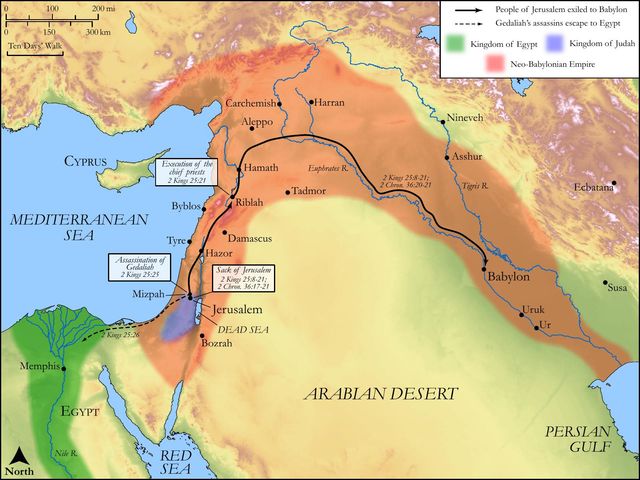
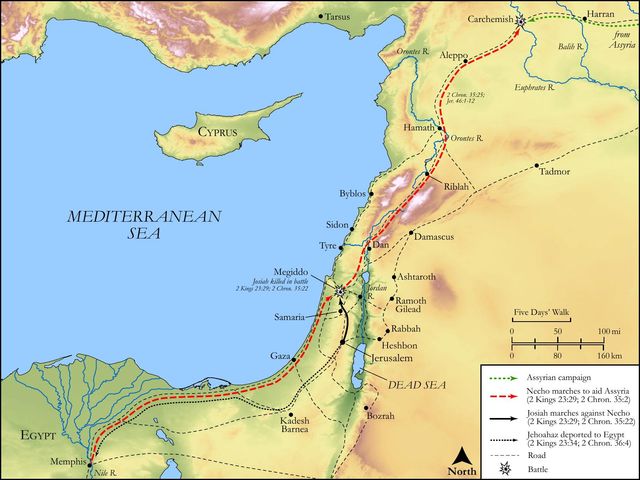
Jehoiakim reigned from 609 to 598 BC, a period of intense geopolitical flux among Egypt, Assyria, and Babylon. The once-dominant Assyrian Empire had collapsed, creating a power vacuum that was quickly filled by the rising empires of Egypt and Babylon. Judah, a small kingdom, found itself caught between these two formidable powers. Jehoiakim, originally named Eliakim, was placed on the throne by Pharaoh Neco of Egypt after the Egyptian victory at Megiddo, where Josiah was killed (2 Kings 23:34). This placed Jehoiakim under tribute to Egypt. However, Babylon's decisive defeat of Egypt at the Battle of Carchemish in 605 BC shifted regional dominance, forcing Jehoiakim to switch allegiance and become the servant of Babylon. Spiritually and culturally, Judah was in a state of profound apostasy, despite Josiah's earlier reforms. Idolatry, oppression, and a widespread disregard for God's law were rampant, as vehemently denounced by contemporary prophets such as Jeremiah and Habakkuk. Jehoiakim notoriously rejected and actively suppressed these prophetic warnings, even burning Jeremiah's scroll (Jeremiah 36:23).
Key Themes
ShowHideThis verse profoundly contributes to several overarching theological themes woven throughout Chronicles and the broader biblical narrative. Firstly, it powerfully illustrates the theme of Covenant Faithfulness and Unfaithfulness, presenting Jehoiakim's reign as a blatant and active violation of the Mosaic Covenant's demands for exclusive worship of Yahweh and righteous governance. This stands in stark opposition to the righteous standards God had established for His people. Secondly, it underscores the Consequences of Disobedience, demonstrating how Jehoiakim's persistent wickedness directly accelerated the divine judgment that culminated in the Babylonian exile. This highlights the profound national repercussions of a leader's moral and spiritual choices. Thirdly, the recurring phrase "in the sight of the LORD his God" emphasizes the Divine Standard and Accountability, asserting that all human actions, particularly those of rulers, are ultimately judged by God's absolute righteousness, not by human political expediency or popular opinion. This reinforces God's active sovereignty over history and His unwavering commitment to justice, a principle deeply rooted in the covenant warnings found in passages like Deuteronomy 28.
Exposition and Analysis
ShowHideKey Word Analysis
ShowHideThis name, derived from the Hebrew for "Jehovah will raise" or "Yahweh establishes," carries profound and tragic irony in light of the king's actions and ultimate fate. While he was indeed "raised up" to the throne, it was by the hand of Pharaoh Neco, not as a divinely appointed and faithful Davidic king. His reign was characterized by active rebellion against Yahweh, leading to Judah's downfall and destruction rather than its establishment or upliftment. The name thus serves as a powerful theological commentary on his character, standing in stark contrast to his ungodly rule.
This term is far more than a simple description of moral badness; it denotes that which is actively harmful, destructive, and fundamentally contrary to God's revealed will and covenant. In the context of Israelite kingship, "evil" encompasses a range of transgressions including idolatry (worship of foreign gods and practices), injustice (oppression of the vulnerable, disregard for legal equity), and a general, deliberate rejection of God's commands. Jehoiakim's "evil" was notoriously manifest in his burning of Jeremiah's prophetic scroll (Jeremiah 36:23) and his oppressive, self-serving building projects (Jeremiah 22:13-17), demonstrating a profound and active defiance of divine authority.
As part of the crucial phrase "in the sight of the LORD his God," this word (literally "eye" or "face") emphasizes the divine perspective and ultimate accountability. It signifies that Jehoiakim's actions were not merely judged by human standards, political expediency, or the opinions of his subjects, but by the direct, discerning gaze of Yahweh, the covenant God of Israel. This recurring Deuteronomistic phrase underscores God's omnipresence and His role as the ultimate judge of all human conduct, particularly that of those entrusted with leadership. It asserts that God's moral standard is absolute and His judgment is the final and true assessment of a reign's spiritual quality.
Verse Breakdown
ShowHide"Jehoiakim [was] twenty and five years old when he began to reign"
This clause establishes the age at which Jehoiakim ascended to the throne, indicating that he was a mature adult, fully accountable for his decisions and actions. This detail highlights that his subsequent wickedness was not a result of youthful inexperience or naiveté but was a deliberate and responsible choice made by a king old enough to know better.
"and he reigned eleven years in Jerusalem"
This specifies both the duration and the geographical center of his rule. An eleven-year reign, while not exceptionally long compared to some predecessors (e.g., Josiah's 31 years), was sufficient for Jehoiakim to solidify his ungodly policies and further accelerate Judah's spiritual and political decay. The mention of "Jerusalem" underscores his rule over the capital city, the heart of Judah's religious and political life, making his evil actions particularly impactful on the nation's spiritual health and its relationship with God.
"and he did [that which was] evil in the sight of the LORD his God"
This is the theological core of the verse, delivering the divine verdict on Jehoiakim's reign. It is a standard formula used throughout Kings and Chronicles to characterize unfaithful monarchs, signifying a profound spiritual and moral failure. For Jehoiakim, this encompassed active idolatry, oppressive governance, and a defiant rejection of prophetic warnings. The phrase "his God" emphasizes the unique covenant relationship that Jehoiakim, as king of Judah, was obligated to uphold, making his rebellion all the more egregious. His actions were not merely politically inept or socially undesirable but a direct affront to the God who had chosen, sustained, and covenanted with Israel.
Literary Devices
ShowHideThe Chronicler employs several potent literary devices in this concise summary of Jehoiakim's reign. Formulaic Language is prominently featured, as the phrase "did that which was evil in the sight of the LORD his God" is a standard Deuteronomistic assessment used repeatedly to characterize unfaithful kings throughout the historical books. This repetition creates a consistent theological pattern, highlighting Judah's persistent spiritual failure and the Chronicler's overarching framework of divine judgment based on obedience or disobedience. There is also a powerful Juxtaposition at play; immediately following the detailed account of Josiah's righteous reign and his efforts at reform, the abrupt introduction of Jehoiakim's evil reign emphasizes the rapid and tragic spiritual decline of Judah, underscoring the fragility of reform without sustained commitment from leadership. Furthermore, a poignant Irony is present in Jehoiakim's very name, which means "Yahweh raises up," as his reign was marked by active rebellion against Yahweh, ultimately leading to Judah's downfall and the exile rather than its upliftment or establishment.
Theological and Thematic Connections
ShowHideJehoiakim's reign, succinctly condemned in 2 Chronicles 36:5, serves as a stark illustration of the cumulative effect of covenant unfaithfulness and the inevitability of divine judgment. His deliberate choice to "do evil in the sight of the LORD" represents a profound rejection of God's kingship and the foundational principles of the Mosaic Covenant, which mandated justice, righteousness, and exclusive worship of Yahweh. The Chronicler, writing from a post-exilic perspective, uses Jehoiakim's story as a crucial part of the larger narrative explaining why the exile occurred: it was not a random geopolitical event, but the just and necessary consequence of generations of sin, particularly the spiritual failures of its leaders. God's holiness demands accountability, and His justice ensures that persistent rebellion does not go unpunished. This verse underscores that true authority and enduring stability for a nation, especially one in covenant with God, derive not from political maneuvering or worldly alliances, but from unwavering obedience to divine standards.
Reflection and Application
ShowHideJehoiakim's story, though brief in this verse, offers profound and enduring lessons for contemporary believers regarding leadership, accountability, and the far-reaching consequences of moral choices. His reign, characterized by active defiance of God despite clear prophetic warnings, powerfully reminds us that positions of power do not exempt individuals from divine scrutiny; rather, they heighten the spiritual stakes, as a leader's choices can have profound and lasting impacts on those they govern. We are therefore called to examine our own lives, recognizing that all our actions, whether in public leadership or private spheres, are always performed "in the sight of the LORD our God." This compels us to prioritize spiritual integrity and unwavering obedience to God's word above worldly expediency, personal gain, popular approval, or political pressures. Jehoiakim's tragic end serves as a sober warning against rejecting divine counsel and embracing practices contrary to God's revealed will, emphasizing that true prosperity, lasting peace, and genuine flourishing for individuals and communities flow ultimately from faithfulness to the Creator.
Questions for Reflection
ShowHideFAQ
ShowHideWhat was the significance of Jehoiakim's age and length of reign?
ShowHideJehoiakim's age of twenty-five when he began to reign signifies that he was a mature adult, fully capable of making responsible and informed decisions. His subsequent wickedness was therefore a deliberate choice, not an error of youthful inexperience. His eleven-year reign, while not exceptionally long, was sufficient for him to solidify his policies of idolatry, injustice, and defiance, actively contributing to Judah's rapid spiritual and moral decay. The brevity of his reign, especially following the long and righteous reign of his father Josiah, also highlights the swiftness of divine judgment and the accelerating pace of Judah's decline towards the inevitable Babylonian exile.
How did Jehoiakim's reign differ from his father Josiah's?
ShowHideJehoiakim's reign stood in stark and tragic contrast to that of his father, Josiah, who is widely regarded as one of Judah's most righteous kings. Josiah initiated extensive religious reforms, purging idolatry from the land, restoring the Temple, and leading the people back to the covenant law of God after the discovery of the Book of the Law (2 Chronicles 34-35). Jehoiakim, however, quickly reversed these reforms. He actively promoted idolatry, engaged in oppressive and unjust building projects without paying his workers (Jeremiah 22:13-17), and notoriously defied God's word by burning the scroll containing Jeremiah's prophecy (Jeremiah 36:23). While Josiah sought to honor God and uphold the covenant, Jehoiakim actively rebelled against it, plunging Judah further into sin and closer to divine judgment.
Why does the text emphasize "in the sight of the LORD his God"?
ShowHideThe phrase "in the sight of the LORD his God" is a crucial theological statement that appears frequently in the historical books of the Old Testament. It emphasizes that Jehoiakim, despite being an earthly king with significant power, was ultimately accountable to a higher authority: Yahweh, the covenant God of Israel. It means that his actions were not judged merely by human standards, political expediency, or the opinions of his subjects, but by God's absolute and unchanging standard of righteousness and holiness. This highlights God's sovereignty over human rulers and His active involvement in judging the moral and spiritual state of His people. It underscores that God sees and evaluates every action, and His judgment is the ultimate and true assessment of a leader's reign and a nation's spiritual condition.
Christ-Centered Fulfillment
ShowHideThe tragic reign of Jehoiakim, marked by his persistent evil "in the sight of the LORD his God," stands in profound and illuminating contrast to the perfect kingship of Jesus Christ. Jehoiakim's abject failure to uphold the covenant, his active rebellion against God, and his direct contribution to Judah's exile highlight humanity's desperate need for a truly righteous and faithful king. While Jehoiakim's name ironically means "Yahweh raises up," he was raised up by human power and led his people to ruin. In glorious contrast, God truly "raised up" Jesus, the ultimate Davidic King, not to temporary earthly power but to eternal, universal rule, establishing a kingdom of righteousness, peace, and justice. Where Jehoiakim oppressed his people and defiantly burned God's word, Christ perfectly obeyed the Father's will, even to the point of sacrificial death on a cross (Philippians 2:8). Jehoiakim's reign contributed to the physical exile of Judah, a direct consequence of sin; Christ, the Lamb of God who takes away the sin of the world, came to reverse humanity's spiritual exile from God, bringing reconciliation and eternal life for all who believe (2 Corinthians 5:18-19). Thus, Jehoiakim's story, a dark chapter in Israel's history, ultimately points forward to the glorious reign of the Messiah, who alone perfectly fulfills the ideal of a king who does "that which is good in the sight of the LORD his God" (Hebrews 1:8-9).