


2 Chronicles 36:6
- עָלָיו'a·Lavon himH5921Prep ¦ 3msPrepositionעָלָיonוhim
- עָלָה'a·Lahhe came upH5927V-Qal-Perf-3msVerb Qal Perfect 3rd Singular Masculine
- נְבוּכַדְנֶאצַּרne·vu·khad·ne·TzarNebuchadnezzarH5019N-proper-mNoun Proper Masculine
- מֶלֶךְMe·lekh[the] king ofH4428N-mscNoun Singular Masculine Construct
- בָּבֶלba·VelBabylonH894N-properNoun Proper Location
- וַיַּאַסְרֵהוּvai·ya·'as·Re·huand he bound himH631Conj-w ¦ V-Qal-ConsecImperf-3ms ¦ 3msVerb Qal Consecutive Imperfect 3rd Singular Masculineוַandיַּאַסְרֵhe boundהוּhim
- בַּנְחֻשְׁתַּיִםban·chush·Ta·yimwith <the> bronze fettersH5178Prep-b ¦ N-fdNoun Dual Feminine Absoluteבַּwith <the>נְחֻשְׁתַּיִםbronze fetters
- לְהֹלִיכוֹle·ho·li·Khoto take himH1980Prep-l ¦ V-Hiphil-Inf ¦ 3msVerb Hiphil Infinitive Constructלְtoהֹלִיכtakeוֹhim
- בָּבֶלָהba·Ve·lahBabylon towardsH894N-proper ¦ SfxNoun Proper LocationבָּבֶלָBabylonהtowards
English is a literal word-by-word gloss of the Hebrew, not the KJV's wording. Why?
This is the original text the KJV's translators worked from — each Hebrew word with its own literal English meaning in this verse, prepared by scholars at Tyndale House, Cambridge. The KJV translates whole sentences, not word by word, so its wording differs: one Hebrew word can become several English words, and the KJV may choose “the LORD” where the gloss reads “Yahweh”. Both are faithful — they answer different questions. For the KJV's own rendering, switch to the KJV text.
Details
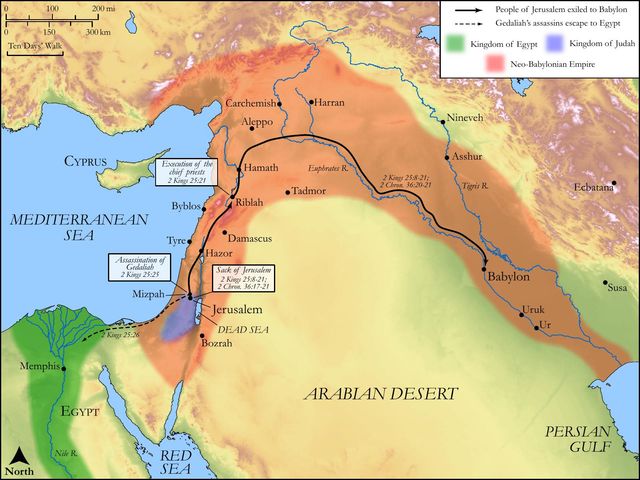
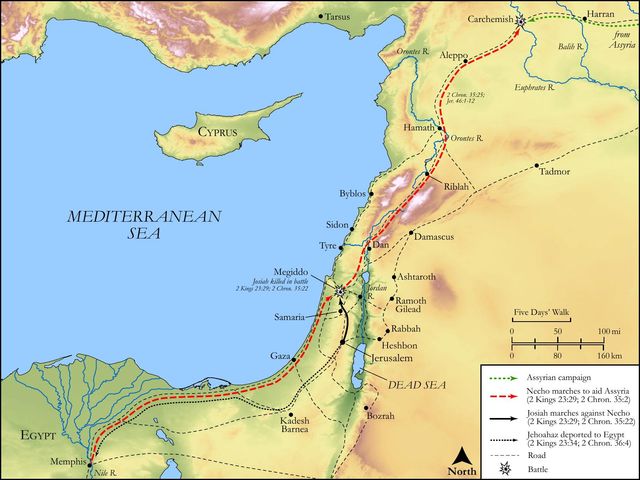
See on the biblical-era map
Study this verse
Public-domain commentary
Matthew Henry
From his Commentary on the Whole Bible. Henry comments on passages, not single verses — this entry covers 2 Chronicles 36:1–10.
The destruction of Judah and Jerusalem is here coming on by degrees. God so ordered it to show that he has no pleasure in the ruin of sinners, but had rather they would turn and live, and therefore gives them both time and inducement to repent and waits to be gracious. The history of these reigns was more largely recorded in the last three chapters of the second of Kings. 1. Jehoahaz was set up by the people (Ch2 36:1), but in one quarter of a year was deposed by Pharaoh-necho, and carried a prisoner to Egypt, and the land fined for setting him up, Ch2 36:2-4. Of this young prince we hear no more. Had he trodden in the steps of his father's piety he might have reigned long and prospered; but we are told in the Kings that he did evil in the sight of the Lord, and therefore his triumphing was short and his joy but for a moment. 2. Jehoiakim was set up by the king of Egypt, an old enemy to their land, gave what king he pleased to the kingdom and what name he pleased to the king! Ch2 36:4. He made Eliakim king, and called him Jehoiakim, in token of his authority over him. Jehoiakim did that which was evil (Ch2 36:5), nay, we read of the abominations which he did (Ch2 36:8); he was very wild and wicked. Idolatries generally go under the name of abominations. We hear no more of the king of Egypt, but the king of Babylon came up against him (Ch2 36:6), seized him, and bound him with a design to carry him to Babylon; but, it seems, he either changed his mind, and suffered him to reign as his vassal, or death released the prisoner before he was carried away. However the best and most valuable vessels of the temple were now carried away and made use of in Nebuchadnezzar's temple in Babylon (Ch2 36:7); for, we may suppose, no temple in the world was so richly furnished as that of Jerusalem. The sin of Judah was that they had brought the idols of the heathen into God's temple; and now their punishment was that the vessels of the temple were carried away to the service of the gods of the nations. If men will profane God's institutions by their sins, it is just with God to suffer them to be profaned by their enemies. These were the vessels which the false prophets flattered the people with hopes of the return of, Jer 27:16. But Jeremiah told them that the rest should go after them (Jer 27:21, Jer 27:22), and they did so. But, as the carrying away of these vessels to Babylon began the calamity of Jerusalem, so Belshazzar's daring profanation of them there filled the measure of the iniquity of Babylon; for, when he drank wine in them to the honour of his gods, the handwriting on the wall presented him with his doom, Dan 5:3, etc. In the reference to the book of the Kings concerning this Jehoiakim mention is made of that which was found in him (Ch2 36:8), which seems to be meant of the treachery that was found in him towards the king of Babylon; but some of the Jewish writers understand it of certain private marks or signatures found in his dead body, in honour of his idol, such cuttings as God had forbidden, Lev 19:28. 3. Jehoiachin, or Jeconiah, the son of Jehoiakim, attempted to reign in his stead, and reigned long enough to show his evil inclination; but, after three months and ten days, the king of Babylon sent and fetched him away captive, with more of the goodly vessels of the temple. He is here said to be eight years old, but in Kings he is said to be eighteen when he began to reign, so that this seems to be a mistake of the transcriber, unless we suppose that his father took him at eight years old to join with him in the government, as some think.
Continue studying 2 Chronicles 36:6 across the web’s major study libraries — every link below opens this exact verse, chapter, or book on the destination site.
Read & Compare
 BibleGatewayThis verse in more than 200 translations and 70 languages.
 Bible.comThe YouVersion reader — hundreds of translations, reading plans, and highlights.
 ESV.orgCrossway's official English Standard Version reader.
 NET BibleThe NET translation with 60,000+ translators' notes on every rendering decision.
 STEP BibleTyndale House's free study tool — original text, vocabulary, and scholarly resources.
 BibliaLogos Bible Software's free web reader.
 USCCBThe New American Bible (Revised Edition) with the U.S. bishops' study notes.
Commentaries
 BibleHub CommentariesDozens of classic commentaries on this verse, gathered on one page.
 StudyLightMore than 100 commentary sets — the largest collection on the web.
 BibleRefPlain-English commentary on what this verse means, verse by verse.
 Enduring WordDavid Guzik's free commentary on this chapter, widely used by Bible teachers.
 Bible Study ToolsVerse commentary alongside Greek and Hebrew study aids.
Original Language & Research
- BibleHub InterlinearThe verse word by word — original language, transliteration, and English.
- BibleHub LexiconEvery word's original-language definition and Strong's entry.
 Blue Letter BibleDeep-study tools — Strong's numbers, concordance, and word studies.
 SefariaThe Hebrew text with Rashi and centuries of Jewish commentary.
Sermons, Hymns & Audio


TrulyRandomVerse is not affiliated with these sites and doesn’t control their content. They’re linked because they’re genuinely useful.
Summary
This verse chronicles the pivotal moment when Nebuchadnezzar, the formidable king of Babylon, asserted his dominance over King Jehoiakim of Judah, initiating the first major deportation of the Southern Kingdom's leadership. It starkly depicts Jehoiakim's capture and humiliation, bound in chains with the intent of being carried to Babylon, thereby marking the tangible beginning of Judah's seventy-year exile and the unfolding of divine judgment for its persistent unfaithfulness.
Context
ShowHideLiterary Context
The book of 2 Chronicles concludes with a somber theological reflection on the decline and ultimate fall of the Southern Kingdom of Judah, emphasizing the direct correlation between covenant obedience and national well-being, or conversely, disobedience and divine judgment. Chapter 36 rapidly recounts the reigns of Judah's final, increasingly unfaithful kings—Jehoahaz, Jehoiakim, Jehoiachin, and Zedekiah—each reign serving as a further step towards the nation's catastrophic downfall. Verse 6 specifically focuses on King Jehoiakim, whose eleven-year rule (as noted in 2 Chronicles 36:5) was characterized by persistent wickedness in the eyes of the Lord. This verse immediately precedes the account of Nebuchadnezzar's subsequent actions against Jerusalem and the temple, including the plundering of sacred vessels and the deportation of Jehoiachin and other prominent citizens (2 Chronicles 36:7-10). It serves as the initial, decisive blow in a series of events that would culminate in the complete destruction of Jerusalem and the temple under Zedekiah, leading to the full seventy-year Babylonian Captivity, as precisely foretold by the prophet Jeremiah (2 Chronicles 36:21).
Historical & Cultural Context
The late 7th and early 6th centuries BCE were a period of cataclysmic geopolitical shifts in the Ancient Near East. The once-dominant Assyrian Empire had crumbled, paving the way for the meteoric rise of the Neo-Babylonian Empire under the formidable Nebuchadnezzar II. Judah, a small kingdom precariously situated between the declining regional powers and the ascendant Babylon, found itself caught in a dangerous power struggle. Jehoiakim, initially installed as a puppet king by Pharaoh Neco of Egypt (2 Kings 23:34), later submitted to Babylon as a vassal. His subsequent rebellion against Nebuchadnezzar, despite urgent prophetic warnings from Jeremiah, directly precipitated the events described in 2 Chronicles 36:6. The practice of binding a defeated king in "fetters" and deporting him to the imperial capital was a standard, brutal tactic employed by ancient Near Eastern empires. This was designed not only to humiliate the monarch and dismantle the local power structure but also to prevent future insurrections by removing key leaders and skilled populations to the heart of the empire, thereby integrating conquered territories. This specific event marks the first of three significant deportations of Judah's population to Babylon, setting a grim precedent for the nation's future.
Key Themes
ShowHideThis verse powerfully encapsulates several overarching themes central to 2 Chronicles and the broader Deuteronomistic History. Firstly, it vividly illustrates Divine Judgment and Consequences, showcasing the severe repercussions of Judah's persistent idolatry, covenant unfaithfulness, and moral corruption, particularly under Jehoiakim, who "did that which was evil in the sight of the LORD his God" (2 Chronicles 36:5). The capture and intended deportation are direct manifestations of God's promised discipline for disobedience, as clearly warned in the Mosaic covenant (e.g., Deuteronomy 28:36-37). Secondly, it underscores the Sovereignty of God in History. Even through a pagan king like Nebuchadnezzar, God orchestrates historical events to fulfill His divine purposes, using foreign powers as instruments of His righteous judgment against His own people, as powerfully articulated in the prophetic declarations of Isaiah 10 and Jeremiah 25:9. Finally, 2 Chronicles 36:6 marks the Beginning of the Babylonian Captivity, a pivotal period of national humiliation, spiritual purification, and a profound re-evaluation of Israel's relationship with Yahweh. This exile was not merely punishment but a crucible for refining God's people and fostering a renewed understanding of His covenant faithfulness, even in foreign lands, as foretold by prophets like Jeremiah 25:11.
Exposition and Analysis
ShowHideKey Word Analysis
ShowHideFrom the primitive root H5927, this verb signifies "to ascend," "to go up," or "to arise." In military contexts, it denotes a hostile advance or invasion, emphasizing the aggressive and dominant posture of Nebuchadnezzar's forces against Judah. It implies a forceful, deliberate movement towards conquest, highlighting the overwhelming power dynamic at play.
Derived from the primitive root H631, this word means "to yoke or hitch," and by analogy, "to fasten in any sense" or "to bind." Its use here vividly portrays the physical act of Jehoiakim's capture and restraint. It conveys the complete loss of freedom and the subjugation of the king, reducing him from a sovereign ruler to a helpless prisoner, stripped of all dignity and power.
This noun (H5178) refers to "copper" or "brass," and by extension, something made of that metal, such as "a fetter" or "chain." The use of this term specifically for the means of binding underscores the harsh, unyielding, and often humiliating nature of the captivity. It implies heavy, strong chains, symbolizing the inescapable grip of Babylonian power and the severity of the judgment falling upon Judah's king.
Verse Breakdown
ShowHide"Against him came up Nebuchadnezzar king of Babylon"
This opening clause immediately establishes the primary agent of action and the overwhelming force confronting Judah. Nebuchadnezzar, the powerful monarch of the burgeoning Neo-Babylonian Empire, is presented as the instrument of God's judgment against Jehoiakim. His "coming up" signifies a military campaign, an invasion, and a decisive assertion of imperial dominance over Judah, a rebellious vassal state. This highlights the irresistible nature of the divine decree being executed through human means.
"and bound him in fetters"
This phrase details the immediate, physical act of subjugation. Jehoiakim, the reigning king of Judah, is stripped of his royal authority and personal liberty, reduced to a common prisoner. The specific mention of "fetters" (chains, likely of bronze or copper) underscores the severity and indignity of his capture, symbolizing not only the king's personal humiliation but also the complete loss of Judah's independence and the profound degradation of its leadership. This act marks a dramatic reversal of fortune for the Davidic monarchy.
"to carry him to Babylon"
This final clause reveals the ultimate objective and consequence of Nebuchadnezzar's action: the deportation of Jehoiakim to the imperial capital. This was a standard, calculated practice for ancient empires to consolidate control, remove potential instigators of rebellion, and display their absolute power over conquered territories. For Judah, this intention, whether fully realized for Jehoiakim or not, marked the definitive beginning of the long-prophesied Babylonian exile, initiating a period of profound national displacement, spiritual reckoning, and the dismantling of the kingdom's political and religious structures.
Literary Devices
ShowHideThe verse employs several potent literary devices to convey its stark message of judgment and consequence. The direct, declarative statement of Nebuchadnezzar's arrival and action creates a sense of Immediacy and Inevitability, reflecting the swift and decisive nature of divine judgment that Judah could not escape. The use of "fetters" is a powerful Symbolism, representing not only Jehoiakim's physical bondage but also the spiritual and national enslavement of Judah due to its persistent sin. It signifies the complete loss of freedom, sovereignty, and dignity that resulted from their unfaithfulness to God's covenant. The concise description of a once-powerful king being reduced to a chained prisoner creates a stark Contrast, highlighting the dramatic reversal of fortune and the severe consequences of rebellion against God. Furthermore, the phrase "to carry him to Babylon" functions as a chilling Foreshadowing, hinting at the larger national deportation that would soon follow, marking the definitive beginning of the seventy-year exile for the entire nation.
Theological and Thematic Connections
ShowHide2 Chronicles 36:6 stands as a stark testament to the principle of divine retribution and the unwavering sovereignty of God over human history. It vividly illustrates that God, in His righteous judgment, uses even pagan rulers and empires as instruments of His will against His own people when they persist in covenant disobedience and idolatry. This event is not merely a political defeat but a profound theological consequence, fulfilling the curses of the Mosaic covenant (specifically Leviticus 26:33 and Deuteronomy 28:49-50) and the specific prophecies of Jeremiah concerning the seventy-year exile. It underscores that God's patience is not infinite and His warnings, delivered through His prophets, are to be heeded with utmost seriousness. Yet, even in judgment, there is an underlying redemptive purpose: the exile was intended to purify Judah, to bring them to repentance, and to renew their understanding of their unique relationship with Yahweh, ultimately preparing them for restoration.
Reflection and Application
ShowHideThe account of Jehoiakim's downfall in 2 Chronicles 36:6 offers profound and enduring lessons for contemporary believers and communities. It serves as a potent reminder that persistent disobedience, a disregard for God's revealed will, and a neglect of prophetic warnings inevitably lead to severe consequences, both individually and corporately. Just as Judah faced the painful reality of exile for its idolatry and unfaithfulness, we too must critically examine our lives and our societies for areas where we might be rebelling against God's commands or neglecting His gentle (or sometimes stern) promptings. This verse challenges us to cultivate a posture of humility, repentance, and immediate responsiveness to divine instruction, recognizing that God's discipline, though painful in the short term, is ultimately intended for our purification, restoration, and deeper conformity to His will. It also reinforces the comforting truth of God's ultimate sovereignty; even in the midst of seemingly chaotic, oppressive, or unjust circumstances, God remains on His throne, orchestrating events to fulfill His eternal purposes. This should inspire profound trust and resilient perseverance, knowing that even through hardship, God is actively working for His glory and our ultimate good, continually calling us to repentance and a more profound reliance on Him alone.
Questions for Reflection
ShowHideFAQ
ShowHideDid Jehoiakim actually go to Babylon as stated in this verse?
ShowHideThe biblical accounts present a nuanced picture that scholars have long sought to reconcile. While 2 Chronicles 36:6 states Nebuchadnezzar "bound him in fetters, to carry him to Babylon," the parallel account in 2 Kings 24:6 notes that "Jehoiakim slept with his fathers," implying a death in Judah. Furthermore, the prophet Jeremiah, in Jeremiah 22:18-19, prophesied that Jehoiakim would not receive a proper burial but would be "cast out beyond the gates of Jerusalem, unburied, like a donkey." Many scholars reconcile these accounts by suggesting that Nebuchadnezzar's initial intention was indeed to deport Jehoiakim, as stated by the Chronicler who focuses on the intent and humiliation. However, Jehoiakim may have died or been killed before reaching Babylon, perhaps during the siege of Jerusalem, shortly after being captured, or even en route. Alternatively, he might have been taken to Babylon and died there, with his body then being disposed of ignominiously, fulfilling Jeremiah's prophecy of a dishonorable end. The Chronicler's primary emphasis is on the beginning of the Babylonian subjugation and the symbolic end of Judah's independence, rather than the precise details of Jehoiakim's final resting place.
Christ-Centered Fulfillment
ShowHideWhile 2 Chronicles 36:6 vividly portrays the consequences of Judah's unfaithfulness and the judgment brought through a foreign king, it also subtly points forward to the ultimate fulfillment of God's redemptive plan in Jesus Christ. The binding of Jehoiakim in fetters, symbolizing the nation's enslavement to sin and its impending exile, serves as a powerful type foreshadowing humanity's universal bondage to sin and death. Yet, unlike Jehoiakim, who was bound for judgment because of his rebellion, Jesus Christ, the true and faithful King of Israel, willingly allowed Himself to be bound, arrested, and led away to suffer for the sins of the world (Matthew 27:2). He did not rebel against God but perfectly obeyed His Father's will, even to the point of death on a cross (Philippians 2:8). Through His sacrificial death and glorious resurrection, Jesus broke the spiritual fetters that bind humanity, offering true liberation from the dominion of sin and the curse of the law (Galatians 5:1). The exile to Babylon, a consequence of unfaithfulness, ultimately led to a remnant's return and a longing for a greater, eternal deliverance. This longing is fully satisfied in Christ, who gathers His people from every nation, bringing them into His eternal kingdom, a new and better "Babylon" (referring to the new Jerusalem) from which there will be no more exile, no more tears, and no more curse, for God Himself will dwell with His people (Revelation 21:3-4). He is the faithful King who secures true freedom and an everlasting inheritance for all who trust in Him, fulfilling the promises of God far beyond any earthly restoration.