


Ezekiel 48:16
Bible text: King James Version (1769 Blayney text) · Public domain
Bible text: King James Version with Strong's numbers · Public domain
Bible text: Berean Standard Bible · Public domain
Bible text: American Standard Version (1901) · Public domain
Bible text: World English Bible, Messianic edition · Public domain
Bible text: Geneva Bible (1599) · Public domain
Bible text: Young's Literal Translation · Public domain
- וְאֵלֶּהve·'e·Lehand theseH428Conj-w ¦ PrtParticle Demonstrativeוְandאֵלֶּהthese
- מִדּוֹתֶיהָmi·do·tei·Ha[will be] its measurementsH4060N-fpc ¦ 3fsNoun Plural Feminine Constructמִדּוֹתֶי[will be] measurementsהָits
- פְּאַתpe·'At[the] side ofH6285N-fscNoun Singular Feminine Construct
- צָפוֹןtza·Fon[the] northH6828N-fsNoun Singular Feminine Absolute
- חֲמֵשׁcha·Mesh[will be] fiveH2568Adj-cscAdjective Numerical Singular common gender Construct
- מֵאוֹתme·'Othundred<s>H3967Adj-fpAdjective Numerical Plural Feminine Absolute
- וְאַרְבַּעַתve·'ar·Ba·'atand fourH702Conj-w ¦ Adj-cscAdjective Numerical Singular common gender Constructוְandאַרְבַּעַתfour
- אֲלָפִים'a·la·Fimthousand [cubits]H505Adj-cpAdjective Numerical Plural common gender Absolute
- וּפְאַתu·fe·'atand [the] side ofH6285Conj-w ¦ N-fscNoun Singular Feminine Constructוּandפְאַת[the] side of
- נֶגֶבNe·gev[the] southH5045N-msNoun Singular Masculine Absolute
- חֲמֵשׁcha·Mesh[will be] fiveH2568Adj-cscAdjective Numerical Singular common gender Construct
- מֵאוֹתme·'othundred<s>H3967Adj-fpAdjective Numerical Plural Feminine Absolute
- וְאַרְבַּעַתve·'ar·Ba·'atand fourH702Conj-w ¦ Adj-cscAdjective Numerical Singular common gender Constructוְandאַרְבַּעַתfour
- אֲלָפִים'a·la·Fimthousand [cubits]H505Adj-cpAdjective Numerical Plural common gender Absolute
- וּמִפְּאַתu·mi·pe·'Atand from [the] side ofH6285Conj-w ¦ Prep-m ¦ N-fscNoun Singular Feminine Constructוּandמִfromפְּאַת[the] side of
- קָדִיםka·Dim[the] eastH6921N-msNoun Singular Masculine Absolute
- חֲמֵשׁcha·Mesh[will be] fiveH2568Adj-cscAdjective Numerical Singular common gender Construct
- מֵאוֹתme·'Othundred<s>H3967Adj-fpAdjective Numerical Plural Feminine Absolute
- וְאַרְבַּעַתve·'ar·Ba·'atand fourH702Conj-w ¦ Adj-cscAdjective Numerical Singular common gender Constructוְandאַרְבַּעַתfour
- אֲלָפִים'a·la·Fimthousand [cubits]H505Adj-cpAdjective Numerical Plural common gender Absolute
- וּפְאַתu·fe·'atand [the] side ofH6285Conj-w ¦ N-fscNoun Singular Feminine Constructוּandפְאַת[the] side of
- יָמָּהYa·mahwest -wardH3220N-ms ¦ SfxNoun Singular Masculine Absoluteיָמָּwestה-ward
- חֲמֵשׁcha·Mesh[will be] fiveH2568Adj-cscAdjective Numerical Singular common gender Construct
- מֵאוֹתme·'othundred<s>H3967Adj-fpAdjective Numerical Plural Feminine Absolute
- וְאַרְבַּעַתve·'ar·Ba·'atand fourH702Conj-w ¦ Adj-cscAdjective Numerical Singular common gender Constructוְandאַרְבַּעַתfour
- אֲלָפִים'a·la·Fimthousand [cubits]H505Adj-cpAdjective Numerical Plural common gender Absolute
English is a literal word-by-word gloss of the Hebrew, not the KJV's wording. Why?
This is the original text the KJV's translators worked from — each Hebrew word with its own literal English meaning in this verse, prepared by scholars at Tyndale House, Cambridge. The KJV translates whole sentences, not word by word, so its wording differs: one Hebrew word can become several English words, and the KJV may choose “the LORD” where the gloss reads “Yahweh”. Both are faithful — they answer different questions. For the KJV's own rendering, switch to the KJV text.
Details
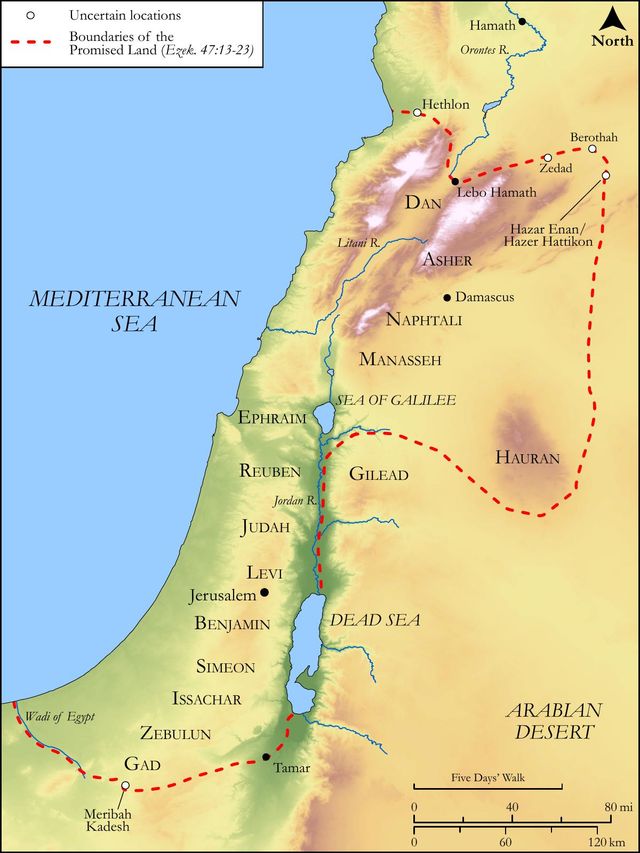
See on the biblical-era map
Study this verse
Historical interpretation
Historical reception
1 surviving comment on this verse from the historical church.
(Verse 16) And the measurements of it, towards the North side, five hundred and four thousand: and towards the South side, five hundred and four thousand: and towards the East side, five hundred and four thousand: and towards the West side, five hundred and four thousand. What it says: And the measurements of it, it must be understood, of the city. For at the end of the previous chapter it is stated: And the city shall be in the midst of it, that is, the land. And first it begins from the North and extends towards the South. And again it matches like with like: so that it places the Western side opposite the Eastern side, that is, the sea: and each side of the city has four thousand and five hundred paces; which in total, approximately eleven thousand and eighty-five paces, so that the entire city, as it is written at the end of this volume, has a circumference of eighteen thousand paces, which is equivalent to forty-four thousand three hundred and forty. Also, the forty-fourth Psalm, which is titled 'For those who will be changed' and belongs to Idithun, that is, to the beloved of the Lord, or as Aquila has interpreted it, ‘For the lilies,’ and Symmachus, ‘For the flowers,’ contains the sacraments of the Church, which is the city of the Lord, about which it is written in the same psalm: At Your right hand stood the queen in a garment adorned with gold, surrounded with variety (Psalm 44:10). And again: All the glory of the daughter of the king is within (Ibid., 14): so that it may not be like the whitened sepulchers outside, but both inside and outside it may wash away all things with the perfume of myrrh (Matthew 23). And when we have moved away from the North, with a very cold wind, we pass to the South, and after the rising of the light of knowledge in us, we fear the setting of fortitudes, considering not the past but the future, neither possessing a certain possession of virtue, but daily saying in prayer: Lead us not into temptation, which we cannot endure (Matthew 86:13).
Continue studying Ezekiel 48:16 across the web’s major study libraries — every link below opens this exact verse, chapter, or book on the destination site.
Read & Compare
 BibleGatewayThis verse in more than 200 translations and 70 languages.
 Bible.comThe YouVersion reader — hundreds of translations, reading plans, and highlights.
 ESV.orgCrossway's official English Standard Version reader.
 NET BibleThe NET translation with 60,000+ translators' notes on every rendering decision.
 STEP BibleTyndale House's free study tool — original text, vocabulary, and scholarly resources.
 BibliaLogos Bible Software's free web reader.
 USCCBThe New American Bible (Revised Edition) with the U.S. bishops' study notes.
Commentaries
 BibleHub CommentariesDozens of classic commentaries on this verse, gathered on one page.
 StudyLightMore than 100 commentary sets — the largest collection on the web.
 BibleRefPlain-English commentary on what this verse means, verse by verse.
 Enduring WordDavid Guzik's free commentary on this chapter, widely used by Bible teachers.
 Bible Study ToolsVerse commentary alongside Greek and Hebrew study aids.
Original Language & Research
- BibleHub InterlinearThe verse word by word — original language, transliteration, and English.
- BibleHub LexiconEvery word's original-language definition and Strong's entry.
 Blue Letter BibleDeep-study tools — Strong's numbers, concordance, and word studies.
 SefariaThe Hebrew text with Rashi and centuries of Jewish commentary.
Sermons, Hymns & Audio


TrulyRandomVerse is not affiliated with these sites and doesn’t control their content. They’re linked because they’re genuinely useful.
Summary
Ezekiel 48:16 meticulously details the precise dimensions of the "holy oblation," a sacred, perfectly square portion of land central to Ezekiel's visionary blueprint for the restored land of Israel. This verse specifies that each of its four sides—north, south, east, and west—measures four thousand and five hundred units, emphasizing the divine order, perfect symmetry, and immense scale of the area set apart for God's sanctuary, the priests, and the Levites. It powerfully underscores the unchangeable precision of God's design for His dwelling place and the future, divinely ordered community.
Context
ShowHideLiterary Context
Ezekiel 48:16 is positioned within the climactic section of Ezekiel's prophecy, specifically chapters 40-48, which present a detailed, architectural vision of a new temple, a reordered priesthood, and a meticulously reallocated land for the tribes of Israel. This grand vision, delivered to Ezekiel during the Babylonian exile, served as a profound message of hope, restoration, and the reaffirmation of God's covenant faithfulness to a dispossessed people. Chapter 48, in particular, meticulously outlines the final division of the land among the twelve tribes, culminating in the precise dimensions of the "holy oblation" (or "sacred contribution"), a central, consecrated block of land. Verse 16 specifies the exact square dimensions of the central part of this oblation, which is designated for the temple, the priests, and the Levites. The meticulous measurements found throughout these chapters, from the detailed descriptions of the temple gates and courtyards in Ezekiel 40 to the land divisions, underscore the divine blueprint for a perfectly ordered future, with God's presence at its very heart.
Historical & Cultural Context
Ezekiel's prophetic ministry unfolded against the backdrop of the profound national trauma of the Babylonian exile, which commenced with the destruction of Jerusalem and Solomon's Temple in 586 BC. For ancient Israel, the temple was the physical locus of God's presence, and its destruction, along with the loss of their land, was a catastrophic theological and cultural blow. In this context, Ezekiel's vision of a new, glorious temple and a re-divided land offered not just hope, but a comprehensive divine reordering of reality. The concept of a sacred, set-apart space for God's dwelling was deeply ingrained in Israelite religion, stemming from the Tabernacle (e.g., Exodus 25) and Solomon's Temple. The detailed measurements within Ezekiel's vision reflect the exactness of the tabernacle and Solomon's temple and of the division of the land, which carried profound symbolic and theological meaning. The emphasis on a perfectly square, symmetrical holy area would have resonated with ancient ideals of perfection, order, and divine presence, providing a stark contrast to the chaos, defilement, and destruction that had befallen Judah.
Key Themes
ShowHideThe meticulous measurements presented in Ezekiel 48:16 are integral to several overarching themes that permeate Ezekiel's prophecy. Firstly, they powerfully convey the theme of Divine Order and Precision. The identical dimensions for all four sides of the holy oblation underscore God's meticulous planning and the absolute perfection of His future dwelling place and kingdom. This divine precision signifies completeness, stability, and the absence of human error or imperfection in God's design, standing in stark contrast to the human failures and disobedience that led to the exile. Secondly, the designation of this specific square area as the holy portion highlights the profound theme of Holiness and Separation. It is set apart entirely for sacred use, emphasizing the absolute holiness required for God to dwell among His people. This concept is a recurring motif in Scripture, echoing the call for Israel to be a holy nation set apart for God (e.g., Leviticus 11:44). Finally, this verse, as an integral part of the broader vision, speaks to the Future Restoration and Idealism of Israel. It presents an ideal, divinely structured community under God's direct rule, a time of profound peace, perfectly ordered worship, and unwavering divine presence. This vision offers a powerful hope for God's ultimate plan for His people and creation, a hope that transcends the immediate suffering of exile and anticipates a new covenant reality, as promised in passages like Ezekiel 36:26-27.
Exposition and Analysis
ShowHideKey Word Analysis
ShowHideFeminine of מַד. This term fundamentally signifies "extension," "height," or "breadth," and more broadly, a "measure" including its standard. In Ezekiel 48:16, it denotes the precise, divinely ordained dimensions or boundaries of the sacred portion of land. The use of this word emphasizes the exactness and predetermined nature of God's blueprint, leaving no room for human estimation or alteration. It highlights the meticulous detail with which God plans for His dwelling and the organization of His people, ensuring everything is according to His perfect standard.
A primitive numeral meaning "five." While "five" is only a component of the full numerical value "four thousand and five hundred," its presence contributes to the specific, divinely appointed quantity. The precise numerical values, repeated for all four sides, underscore the exactitude of the divine plan. In the context of the larger number, "five" contributes to the perfect symmetry and completeness of the holy oblation, symbolizing divine order and the totality of God's design.
From an unused root meaning "to roar." Primarily meaning "sea" (as breaking in noisy surf) or a large body of water, it is locally used to denote the "west" because the Mediterranean Sea lay to the west of Israel. Its inclusion here, alongside north, south, and east, completes the description of the square's perimeter, emphasizing its perfect orientation and boundaries according to the cardinal directions. This reinforces the idea that the holy oblation is a perfectly aligned and divinely established territory, fixed and unchangeable in its dimensions, a testament to God's comprehensive ordering.
Verse Breakdown
ShowHide"And these [shall be] the measures thereof;"
This introductory clause serves as a declarative statement, setting the stage for the precise numerical details that follow. It announces that the subsequent numbers represent the exact, divinely appointed dimensions for the holy portion of land. The phrase "measures thereof" refers back to the "oblation" or "contribution" of land described in the preceding verses (Ezekiel 48:8-14), specifically the square portion designated for the sanctuary, priests, and Levites, emphasizing that these are not arbitrary figures but divinely ordained specifications.
"the north side four thousand and five hundred,"
This clause specifies the length of the northern boundary of the holy oblation. The "four thousand and five hundred" units (most likely cubits, a standard ancient measurement) indicate a significant linear distance, establishing the first of four identical sides. This immediate precision sets the tone for the entire description.
"and the south side four thousand and five hundred,"
This clause provides the identical length for the southern boundary, perfectly mirroring the northern side. The immediate repetition signals the square shape and perfect symmetry of the area, reinforcing the concept of divine order and balance from the outset.
"and on the east side four thousand and five hundred,"
The eastern boundary is also specified to be of the exact same length, further solidifying the perfect square dimensions. This consistent measurement across three sides leaves no doubt about the intended geometric perfection.
"and the west side four thousand and five hundred."
Finally, the western boundary is given the identical measurement, completing the description of a perfectly equilateral square. The consistent repetition of the precise number for all four sides is a powerful rhetorical device, emphasizing divine order, completeness, and the unchangeable, stable nature of this sacred space.
Literary Devices
ShowHideThe primary literary device employed in Ezekiel 48:16 is Repetition. The phrase "four thousand and five hundred" is meticulously repeated for each of the four cardinal directions (north, south, east, and west). This insistent repetition serves to emphasize the absolute precision, perfect symmetry, and divine order of the holy oblation. It leaves no ambiguity regarding the dimensions, underscoring God's meticulous attention to detail in His blueprint for the future. Beyond mere descriptive emphasis, this repetition also functions as a form of Symbolism, where the perfect square symbolizes completeness, stability, and divine perfection. In ancient thought, a perfect square often represented an ideal, harmonious, and unchangeable reality, reflecting the nature of God's dwelling and the eternal stability of His kingdom. The detailed numerical specificity itself can be seen as a form of Precision Detailing, intended to convey the concrete reality and divine authority of the vision, even if its ultimate fulfillment is spiritual or eschatological rather than purely literal. This level of detail lends an air of divine blueprint, distinct from human design.
Theological and Thematic Connections
ShowHideEzekiel 48:16, with its precise measurements of the holy oblation, profoundly speaks to the theological truth of God's nature as a God of order, perfection, and intentionality. The meticulously defined sacred space is not merely a land allocation but a tangible manifestation of God's desire to dwell among His people in a perfectly ordered and holy environment. This vision stands in stark contrast to the chaos and defilement that led to Israel's exile, presenting a future where God's presence is central, unblemished, and precisely established. It highlights that God's plan for restoration is not haphazard or improvisational but is executed with divine precision, ensuring a dwelling place worthy of His holiness and a community perfectly aligned with His will. The perfectly square shape, a universal symbol of completeness, stability, and balance, further reinforces the eternal and unshakeable nature of God's kingdom and His covenant faithfulness. This divine blueprint assures a future where God's presence is perfectly integrated into the life of His people.
Reflection and Application
ShowHideEzekiel 48:16, though initially appearing as a dry list of numbers, offers profound spiritual insights and practical applications for contemporary believers. The meticulous precision with which God outlines the dimensions of His dwelling place reminds us that God is a God of infinite detail, perfect order, and intentional design. He is not a God of chaos or imprecision, but one who orchestrates all things, from the grand sweep of redemptive history to the minute details of our individual lives, with divine purpose and exactitude. This truth should inspire profound trust in His providential care, knowing that even when our lives feel disordered or uncertain, God's ultimate plan is one of perfect harmony and divine alignment. Furthermore, the setting apart of a perfectly measured holy area underscores the sanctity of God's presence and the profound call for His people to live lives consecrated to Him. As New Testament believers, our bodies are declared to be temples of the Holy Spirit, and we are called to be holy as He is holy. This verse serves as a powerful reminder that our lives, like that sacred space, are meant to be set apart for God's purposes, reflecting His order, purity, and beauty in a world often characterized by disorder and moral decay. We are invited to participate in God's perfect design by aligning our lives with His holy will.
Questions for Reflection
ShowHideFAQ
ShowHideWhat is the significance of the "four thousand and five hundred" measurement?
ShowHideThe "four thousand and five hundred" units (most likely cubits, which would equate to approximately 1.5 miles or 2.4 kilometers per side) repeated for each direction signifies a perfectly square area. This precise and symmetrical measurement emphasizes several key theological points: divine order, completeness, stability, and the immense scale of the sacred space. It highlights that God's dwelling place and the surrounding holy area are perfectly designed, stable, and unchangeable, reflecting His own perfect and immutable nature. This precision contrasts sharply with the imperfection and chaos of human endeavors and underscores the divine authority behind the entire vision. While the exact numerical value holds symbolic weight for some, its primary function is to convey absolute exactitude and symmetry in God's blueprint for His holy dwelling.
Is Ezekiel's temple vision, including these measurements, meant to be taken literally?
ShowHideThe interpretation of Ezekiel's temple vision, including the detailed measurements described in Ezekiel 48, varies significantly among biblical scholars and theological traditions. Some interpret it literally, believing it describes a future, physical temple that will be built in Jerusalem, often associated with a millennial reign of Christ. Others view it symbolically, seeing it as a blueprint for an ideal spiritual reality, representing God's perfect dwelling among His people in the church age or the new heavens and new earth. A third perspective sees it as a prophetic picture that finds its ultimate fulfillment in Christ and the New Covenant, where the need for a physical temple is superseded by God dwelling among His people through the Holy Spirit. Regardless of the literal or symbolic interpretation, the emphasis on precision, holiness, God's abiding presence, and the establishment of His perfect order remains central to its meaning and enduring theological significance.
Christ-Centered Fulfillment
ShowHideEzekiel 48:16, with its vision of a perfectly measured, holy dwelling place for God, finds its ultimate and most profound fulfillment not in a literal reconstruction of a physical temple, but in the person and redemptive work of Jesus Christ. Christ Himself is the true and ultimate temple, the very dwelling place of God among humanity, as beautifully articulated in John 1:14, where the Word "tabernacled" among us. The meticulous dimensions of the holy oblation, symbolizing divine order, perfection, and stability, are perfectly embodied in Christ, who is the exact representation of God's being and the one through whom all things are held together and find their coherence (Hebrews 1:3 and Colossians 1:17). Furthermore, through Christ's atoning sacrifice and resurrection, believers are incorporated into Him, becoming living stones in a spiritual house, a holy priesthood offering spiritual sacrifices acceptable to God (1 Peter 2:5). Thus, the church, as the body of Christ, becomes the dwelling place of God by the Spirit (Ephesians 2:21-22), a reality far exceeding any physical structure. The vision of a perfectly ordered holy space ultimately points to the new heavens and new earth, where God's presence is fully and eternally established, and the New Jerusalem, described as a perfect cube in Revelation 21:16, has no need for a temple because the Lord God Almighty and the Lamb are its temple (Revelation 21:22). In Christ, the precision, holiness, and divine presence envisioned in Ezekiel are realized, not in brick and mortar, but in a living, spiritual reality where God perfectly dwells among His redeemed people for all eternity.