


Ezekiel 48:17
Bible text: King James Version (1769 Blayney text) · Public domain
Bible text: King James Version with Strong's numbers · Public domain
Bible text: Berean Standard Bible · Public domain
Bible text: American Standard Version (1901) · Public domain
Bible text: World English Bible, Messianic edition · Public domain
Bible text: Geneva Bible (1599) · Public domain
Bible text: Young's Literal Translation · Public domain
- וְהָיָהve·ha·Yahand it will belongH1961Conj-w ¦ V-Qal-ConsecPerf-3msVerb Qal Consecutive Perfect 3rd Singular Masculineוְandהָיָהit will belong
- מִגְרָשׁmig·Rashopen landH4054N-msNoun Singular Masculine Absolute
- לָעִירla·'Irto the cityH5892Prep-l ¦ N-fsNoun Singular Feminine Absoluteלָto theעִירcity
- צָפוֹנָהtza·Fo·nahnorth -wardH6828N-fs ¦ SfxNoun Singular Feminine Absoluteצָפוֹנָnorthה-ward
- חֲמִשִּׁיםcha·mi·ShimfiftyH2572Adj-mpAdjective Numerical Plural Masculine Absolute
- וּמָאתַיִםu·ma·Ta·yimand two hundred [cubits]H3967Conj-w ¦ Adj-fdAdjective Numerical Dual Feminine Absoluteוּandמָאתַיִםtwo hundred [cubits]
- וְנֶגְבָּהve·Neg·bahand south -wardH5045Conj-w ¦ N-ms ¦ SfxNoun Singular Masculine Absoluteוְandנֶגְבָּsouthה-ward
- חֲמִשִּׁיםcha·mi·ShimfiftyH2572Adj-mpAdjective Numerical Plural Masculine Absolute
- וּמָאתָיִםu·ma·Ta·yimand two hundred [cubits]H3967Conj-w ¦ Adj-fdAdjective Numerical Dual Feminine Absoluteוּandמָאתָיִםtwo hundred [cubits]
- וְקָדִימָהve·ka·Di·mahand east -wardH6921Conj-w ¦ N-ms ¦ SfxNoun Singular Masculine Absoluteוְandקָדִימָeastה-ward
- חֲמִשִּׁיםcha·mi·ShimfiftyH2572Adj-mpAdjective Numerical Plural Masculine Absolute
- וּמָאתַיִםu·ma·Ta·yimand two hundred [cubits]H3967Conj-w ¦ Adj-fdAdjective Numerical Dual Feminine Absoluteוּandמָאתַיִםtwo hundred [cubits]
- וְיָמָּהve·Ya·mahand west -wardH3220Conj-w ¦ N-ms ¦ SfxNoun Singular Masculine Absoluteוְandיָמָּwestה-ward
- חֲמִשִּׁיםcha·mi·ShimfiftyH2572Adj-mpAdjective Numerical Plural Masculine Absolute
- וּמָאתָיִםu·ma·Ta·yimand two hundred [cubits]H3967Conj-w ¦ Adj-fdAdjective Numerical Dual Feminine Absoluteוּandמָאתָיִםtwo hundred [cubits]
English is a literal word-by-word gloss of the Hebrew, not the KJV's wording. Why?
This is the original text the KJV's translators worked from — each Hebrew word with its own literal English meaning in this verse, prepared by scholars at Tyndale House, Cambridge. The KJV translates whole sentences, not word by word, so its wording differs: one Hebrew word can become several English words, and the KJV may choose “the LORD” where the gloss reads “Yahweh”. Both are faithful — they answer different questions. For the KJV's own rendering, switch to the KJV text.
Details
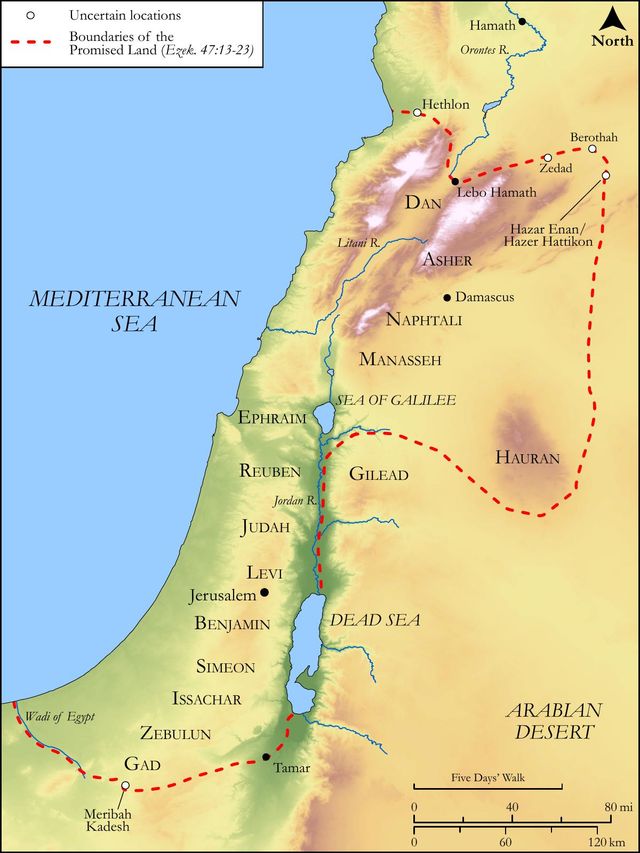
See on the biblical-era map
Study this verse
Historical interpretation
Historical reception
1 surviving comment on this verse from the historical church.
(Verse 17.) The suburbs of the city on the north side shall be two hundred and fifty cubits in length, on the south side two hundred and fifty cubits in length, on the east side two hundred and fifty cubits in length, and on the west side two hundred and fifty cubits in length. As for the suburbs, which are called "Magras" in Hebrew, they have again transferred the distance of seventy times seventy cubits, that is, a space. And what is said, two hundred and fifty on each side, is understood to refer to reeds, which are six cubits and one palm in length, and on each side they make six hundred and seventeen and a little less steps, and in total one thousand reeds, making two thousand four hundred and sixty-eight steps: these spaces surround the walls of the city in a circle, so as to divide the city from the rest. From this it is shown that none of these spaces have the right to engage in the work of the city and to gather its fruits, but rather to be free from the use and work of men, so that the areas around the city walls, with their naturally growing shrubs and herbs, and other things that the land produces, may have beauty.
But the remaining length, according to the holy area, shall be ten thousand cubits toward the east and ten thousand toward the west: and it shall be over against the holy sanctuary. And the fruits thereof shall be for food, and the leaf thereof for medicine. And the workers of the city, that work therein, shall serve it out of all the tribes of Israel. All the fruits thereof shall be for the service of the holy city, and the priests of the sanctuary, who shall go in and out of the house of the Lord, shall eat it. And it shall be a place for a habitation unto them. And the separated cities shall be in the midst of that which shall be for the possession of the prince: and the possession of the holy place shall be in the midst of the portion of the Levites. He wants to designate the remaining part of the firstfruits of the sanctuary, ten thousand baskets extending towards the East, and another ten thousand baskets extending towards the West, to be allocated to those who work for the city for various purposes, whatever the city needs: so that the workers who build or restore the city walls, when necessary, may be nourished from the crops that grow on this land, and so that the city may have its adornment and the repaired roofs be restored. And this, not only in Israel or in the possession of the Holy Land, is contained spiritually in the mystery of the Church, but we also approve that it happens under Roman authority, so that certain villas belong to the rights of cities, either through royal generosity or through the inheritance and donation of many, so that buildings are not gradually ruined and public buildings, which are an ornament to the city, are not long neglected. But the workers, he said, or those who serve in the works of the city, will be from all the tribes of Israel: so that no one may consider themselves exempt from the work of the city, but all may eagerly build up the Church. This is also what we read was done in the tabernacle, that for the diversity of strengths, one offers gold and silver, scarlet, fine linen, and purple, and various and diverse coverings: others offer skins and the hair of goats: and although there were different gifts according to the quality of the substance, the reward of those who gave was one: indeed, greater than those who offered little, but more according to their abilities, as an example of the poor widow, who sent two small coins as gifts to the treasury; she was praised by the judgment of the Lord, saying: Truly I say to you, this widow, poor as she is, has put in more than all the others. For they have all contributed from their surplus wealth to the offerings of God, but she, from her poverty, has offered her whole livelihood. Therefore, as we have said about the works of the city, it must be briefly stated that all the first fruits of the sanctuary, and the possession of the city calculated together in a square, amount to two thousand four hundred and sixty-six, and a third part. For if twenty-five thousand reeds, which have six cubits and one palm, make ours, that is, Roman sixty, and one thousand, and six hundred and sixty-seven paces; there is no doubt that these, when multiplied by four, exceed the previous number. From which we understand that all things are to be understood spiritually, the possession of the Church is much broader than it was in Judea, who did not even receive a part of the holy land: but from each tribe they received forty-eight cities, not the full possession, but habitation and hospitality: so also the laity themselves, although they have not reached the priestly and Levitical degree, if they work in the city of the Lord, they may partake of the holy land, the land of meekness, and the land of believers, of whom one said: I believe to see the good things of the Lord, in the land of the living (Ps. 27:13).
Continue studying Ezekiel 48:17 across the web’s major study libraries — every link below opens this exact verse, chapter, or book on the destination site.
Read & Compare
 BibleGatewayThis verse in more than 200 translations and 70 languages.
 Bible.comThe YouVersion reader — hundreds of translations, reading plans, and highlights.
 ESV.orgCrossway's official English Standard Version reader.
 NET BibleThe NET translation with 60,000+ translators' notes on every rendering decision.
 STEP BibleTyndale House's free study tool — original text, vocabulary, and scholarly resources.
 BibliaLogos Bible Software's free web reader.
 USCCBThe New American Bible (Revised Edition) with the U.S. bishops' study notes.
Commentaries
 BibleHub CommentariesDozens of classic commentaries on this verse, gathered on one page.
 StudyLightMore than 100 commentary sets — the largest collection on the web.
 BibleRefPlain-English commentary on what this verse means, verse by verse.
 Enduring WordDavid Guzik's free commentary on this chapter, widely used by Bible teachers.
 Bible Study ToolsVerse commentary alongside Greek and Hebrew study aids.
Original Language & Research
- BibleHub InterlinearThe verse word by word — original language, transliteration, and English.
- BibleHub LexiconEvery word's original-language definition and Strong's entry.
 Blue Letter BibleDeep-study tools — Strong's numbers, concordance, and word studies.
 SefariaThe Hebrew text with Rashi and centuries of Jewish commentary.
Sermons, Hymns & Audio


TrulyRandomVerse is not affiliated with these sites and doesn’t control their content. They’re linked because they’re genuinely useful.
Summary
Ezekiel 48:17 meticulously details the uniform dimensions of the open land, or "suburbs," surrounding the holy city within the visionary sacred district. This precise measurement—two hundred and fifty reeds on each of the four sides—underscores the divine order, holiness, and meticulous planning inherent in God's future kingdom, providing a buffer zone that both separates and sustains the sacred core.
Context
ShowHideLiterary Context
Ezekiel 48:17 is situated within the climactic section of Ezekiel's prophecy, specifically chapters 40-48, which detail a visionary blueprint for a new temple, a reorganized priesthood, and a re-divided land for Israel. This particular verse describes the precise dimensions of the "suburbs" (Hebrew: migrash) surrounding the holy city, which itself is part of the larger "holy oblation" (or sacred district) designated for the priests, Levites, and the prince, as outlined in Ezekiel 48:8-20. The meticulous measurements throughout this section, including the "two hundred and fifty" reeds mentioned here, are consistent with the detailed architectural and land division plans established from the beginning of this vision, where the measuring reed is introduced in Ezekiel 40:5. The uniformity of these dimensions across all four sides emphasizes the perfection and symmetry of this divinely ordained future, highlighting God's absolute precision in His redemptive plan.
Historical & Cultural Context
The prophet Ezekiel received this elaborate vision during the Babylonian exile (c. 593-571 BC), a time of profound national despair for the Israelites following the destruction of Jerusalem and the First Temple. In this context, the vision served as a powerful message of hope, restoration, and God's enduring faithfulness, assuring the exiles of a glorious future beyond their present desolation. The concept of "suburbs" (Hebrew: migrash) was familiar from earlier Israelite law, particularly in relation to the Levitical cities, where open land was designated around cities for pasture and common use. This cultural precedent lends a practical dimension to the visionary plan, even as its immense scale and precision elevate it to a symbolic representation of divine order. The unit of measurement, the "reed," established in Ezekiel 40:5, was six cubits long, indicating the immense scale of these visionary dimensions, far surpassing anything known in their historical experience.
Key Themes
ShowHideThe meticulous detail in Ezekiel 48:17 contributes significantly to several overarching themes in Ezekiel's prophecy. Firstly, Divine Order and Precision is paramount; the extreme specificity of the measurements, down to the exact dimensions of the suburbs, underscores God's meticulous planning and the perfect, unblemished order of His future kingdom. Every aspect is divinely ordained and precisely measured, reflecting a God who is sovereign over all details. Secondly, Holiness and Separation is a core theme; the designated "suburbs" (Hebrew: migrash) served to create a buffer zone, separating the holy city from the surrounding profane world. This boundary emphasizes the city's sacredness and the necessity of distinct spaces for divine presence, echoing the call for God's people to be set apart, as seen in Leviticus 11:44. Thirdly, God's Provision is evident; this land, being part of the larger "holy oblation," signifies God's comprehensive provision for His people, ensuring not only space for worship and governance but also for common use and sustenance around the spiritual center. Finally, the entire vision, including these precise measurements, carries profound Symbolism of the Future; many scholars interpret these detailed plans as symbolic of God's ultimate spiritual kingdom, perhaps even pointing toward the New Jerusalem described in Revelation, where God's presence is perfectly established, and divine order reigns supreme and eternally.
Exposition and Analysis
ShowHideKey Word Analysis
ShowHideThis term (H4054) refers to open pasture land or common land surrounding a city. In ancient Israel, it was often associated with the Levitical cities, providing space for cattle and sustenance. In Ezekiel's vision, its inclusion emphasizes both the practical and orderly nature of the future holy city, ensuring ample space around its sacred core while also serving as a boundary for holiness and a margin for the divine presence.
This word (H5892) denotes a fortified or guarded place, a town, or a city in the broadest sense. In Ezekiel 48, it refers to the holy city within the sacred district, distinct from the temple area but intrinsically linked to the divine presence. The "suburbs" define the immediate perimeter of this significant urban center, establishing its boundaries and character.
While primarily meaning "sea" (H3220), referring to the Mediterranean Sea from the perspective of Israel, this term is consistently used to denote the western direction due to the sea's geographical location relative to the land. Its inclusion here, alongside north, south, and east, completes the description of the four cardinal directions, emphasizing the comprehensive and symmetrical nature of the measurements, encompassing all sides.
Verse Breakdown
ShowHide"And the suburbs of the city shall be toward the north two hundred and fifty"
This clause introduces the specific area being measured—the "suburbs" or open land immediately surrounding the holy city. It then specifies the dimension of this area on its northern side as two hundred and fifty (reeds, understood from the broader context of Ezekiel 40-48). This precise numerical value immediately conveys a sense of divine order and intentionality, setting the pattern for the subsequent measurements.
"and toward the south two hundred and fifty"
This continues the description, indicating that the southern side of the suburbs will also measure two hundred and fifty reeds. The repetition of the exact measurement underscores the perfect symmetry and balance of the divine design, reinforcing the idea that God's plan is meticulously balanced and without flaw.
"and toward the east two hundred and fifty"
Following the pattern, the eastern side of the suburbs is likewise specified to be two hundred and fifty reeds. This consistent dimension across all directions reinforces the geometric perfection and comprehensive nature of the plan, ensuring that every approach to the holy city is equally ordered and protected.
"and toward the west two hundred and fifty"
Finally, the western side is also given the identical measurement of two hundred and fifty reeds. The complete enumeration of all four cardinal directions with uniform dimensions highlights the meticulousness of God's blueprint, ensuring a perfectly square or symmetrical area around the holy city, symbolizing completeness and divine perfection.
Literary Devices
ShowHideEzekiel 48:17 employs several literary devices to convey its message with impactful clarity. The most prominent is Repetition, specifically the insistent reiteration of "two hundred and fifty" applied to each of the four cardinal directions (north, south, east, west). This insistent repetition not only emphasizes the precise and uniform dimensions but also creates a compelling sense of immutable order, divine perfection, and comprehensive design. The consistent enumeration of directions also functions as a form of Enumeration or detailed listing, a characteristic feature of Ezekiel's later chapters, which meticulously catalog every aspect of the visionary temple and land. This detailed cataloging serves as a literary technique to convey the absolute comprehensiveness and divine authority of the blueprint, leaving no room for ambiguity. Furthermore, the entire passage is steeped in Symbolism. The precise numbers and dimensions, while literal within the vision, also symbolize God's meticulousness, His desire for holiness, and the perfect order of His future kingdom. The "suburbs" themselves symbolize a necessary buffer, a sacred boundary that separates the holy from the common, reflecting a profound theological principle of distinction and the sanctity of God's dwelling place.
Theological and Thematic Connections
ShowHideEzekiel 48:17, with its precise and uniform measurements of the holy city's suburbs, speaks volumes about the character of God and the nature of His kingdom. It reveals a God of meticulous order, who leaves nothing to chance and designs everything with perfect symmetry and purpose. This divine precision underscores the sanctity of the space—the holy city and its surroundings—emphasizing that God's dwelling place and the life around it are governed by divine standards, not human caprice. The concept of a designated "suburb" or common land also highlights God's comprehensive provision for His people, ensuring practical space for sustenance even within a highly sacred context. The vision, therefore, serves as a powerful assurance of God's faithfulness to restore and establish a perfectly ordered and holy community, a testament to His sovereign control over all things and His desire for His people to dwell in security and abundance.
Reflection and Application
ShowHideEzekiel 48:17, though a verse detailing ancient prophetic measurements, offers profound insights for contemporary believers. It reminds us that our God is a God of order, precision, and holiness. In a world often characterized by chaos, uncertainty, and moral ambiguity, this vision provides a comforting assurance of God's meticulous planning and ultimate control. Just as the holy city had its precisely defined "suburbs" to maintain its distinctiveness and sacredness, so too are believers called to cultivate areas of "holy separation" in their lives. This involves setting intentional boundaries—in our thoughts, actions, relationships, and digital consumption—that protect our spiritual walk and distinguish us as God's people. It encourages us to live lives that reflect the holiness God calls us to in 1 Peter 1:16, demonstrating that our lives are ordered by His divine principles and set apart for His glory. Furthermore, recognizing God's provision in these details can inspire confidence that He provides not only for our spiritual needs but also for the practical aspects of our existence, sustaining us as we live within His kingdom and pursue His purposes.
Questions for Reflection
ShowHideFAQ
ShowHideWhat is the significance of the precise measurements in Ezekiel 48:17?
ShowHideThe precise measurements of "two hundred and fifty" reeds on each side of the holy city's suburbs are highly significant. They underscore God's meticulous attention to detail and His absolute sovereignty. In a time when Jerusalem lay in ruins, these exact dimensions conveyed a message of hope and certainty: God's future restoration would be perfectly ordered, divinely planned, and utterly comprehensive. It emphasizes that God is not a God of chaos but of perfect order, and His future kingdom will be established with divine precision, reflecting His holiness and glory. This detailed blueprint assures the exiles that God's promises are concrete and reliable, not vague hopes, pointing to a future where divine order reigns supreme, as seen in the ultimate heavenly city described in Revelation 21:16.
What were these "suburbs" for in Ezekiel's vision?
ShowHideThe "suburbs" (Hebrew: migrash) in Ezekiel 48:17 refer to the open, common land immediately surrounding the holy city within the larger sacred district. Culturally, such land was known from the Levitical cities in Numbers 35:2, where it provided pasture for livestock and space for common use. In Ezekiel's visionary context, these suburbs serve multiple purposes: they act as a buffer zone, physically separating the sacred city from the profane world outside, thereby emphasizing its holiness and distinctiveness. They also represent God's comprehensive provision, ensuring that the holy community has not only a place of worship and governance but also practical space for sustenance and daily life, all within a divinely ordered framework. This demonstrates God's holistic care for His people, addressing both their spiritual and practical needs within His perfectly designed kingdom.
Christ-Centered Fulfillment
ShowHideWhile Ezekiel 48:17 describes a literal vision of a future temple and city, its ultimate theological fulfillment and spiritual resonance are found in Christ and the New Covenant. The meticulous order and perfect dimensions of the "suburbs" around the holy city foreshadow the perfect, unblemished nature of God's eternal kingdom established through Jesus Christ. Christ Himself is the ultimate embodiment of divine order and holiness, the one through whom God's presence truly dwells among His people, not in a physical temple but in the community of believers, who are built together into a spiritual house, a holy temple in the Lord (Ephesians 2:19-22). The "suburbs" can be seen as a symbolic representation of the expansive reach and inclusive nature of God's kingdom under Christ, where boundaries are not for exclusion but for the preservation of holiness and the provision of abundant life for all who believe. The ultimate reality toward which Ezekiel's vision points is the New Jerusalem described in Revelation 21-22, where God's dwelling is with humanity, and Christ is its light and temple (Revelation 21:22-23). In this eternal city, the perfect order and boundless provision symbolized by Ezekiel's precise measurements are fully realized in the presence of the Lamb, who makes all things new and perfectly ordered for His redeemed people (Revelation 21:5), ensuring eternal peace and perfect communion.