


Ezekiel 48:18
Bible text: King James Version (1769 Blayney text) · Public domain
Bible text: King James Version with Strong's numbers · Public domain
Bible text: Berean Standard Bible · Public domain
Bible text: American Standard Version (1901) · Public domain
Bible text: World English Bible, Messianic edition · Public domain
Bible text: Geneva Bible (1599) · Public domain
Bible text: Young's Literal Translation · Public domain
- וְהַנּוֹתָרve·ha·no·Tarand <the> [what] remainsH3498Conj-w ¦ Art ¦ V-Niphal-Prtcpl-msVerb Niphal Participle Singular Masculine Absoluteוְandהַ<the>נּוֹתָר[what] remains
- בָּאֹרֶךְba·'O·rekhin the lengthH753Prep-b ¦ N-msNoun Singular Masculine Absoluteבָּin theאֹרֶךְlength
- לְעֻמַּתle·'u·Mat<to> close toH5980Prep-l ¦ N-fscNoun Singular Feminine Constructלְ<to>עֻמַּתclose to
- תְּרוּמַתte·ru·Mat[the] contribution ofH8641N-fscNoun Singular Feminine Construct
- הַקֹּדֶשׁha·Ko·desh<the> holinessH6944Art ¦ N-msNoun Singular Masculine Absoluteהַ<the>קֹּדֶשׁholiness
- עֲשֶׂרֶת'a·Se·ret[will be] tenH6235N-fscNoun Singular Feminine Construct
- אֲלָפִים'a·la·Fimthousand [cubits]H505Adj-cpAdjective Numerical Plural common gender Absolute
- קָדִימָהka·Di·maheast -wardH6921N-ms ¦ SfxNoun Singular Masculine Absoluteקָדִימָeastה-ward
- וַעֲשֶׂרֶתva·'a·Se·retand tenH6235Conj-w ¦ N-fscNoun Singular Feminine Constructוַandעֲשֶׂרֶתten
- אֲלָפִים'a·la·Fimthousand [cubits]H505Adj-cpAdjective Numerical Plural common gender Absolute
- יָמָּהYa·mahwest -wardH3220N-ms ¦ SfxNoun Singular Masculine Absoluteיָמָּwestה-ward
- וְהָיָהve·ha·Yahand it will beH1961Conj-w ¦ V-Qal-ConsecPerf-3msVerb Qal Consecutive Perfect 3rd Singular Masculineוְandהָיָהit will be
- לְעֻמַּתle·'u·Mat<to> close toH5980Prep-l ¦ N-fscNoun Singular Feminine Constructלְ<to>עֻמַּתclose to
- תְּרוּמַתte·ru·Mat[the] contribution ofH8641N-fscNoun Singular Feminine Construct
- הַקֹּדֶשׁha·Ko·desh<the> holinessH6944Art ¦ N-msNoun Singular Masculine Absoluteהַ<the>קֹּדֶשׁholiness
- וְהָיְתָהve·ha·ye·Tahand it will becomeH1961Conj-w ¦ V-Qal-ConsecPerf-3fsVerb Qal Consecutive Perfect 3rd Singular Feminineוְandהָיְתָהit will become
- תְבוּאָתוֹte·vu·'a·toits produceH8393N-fsc ¦ 3msNoun Singular Feminine Constructתְבוּאָתproduceוֹits
- לְלֶחֶםle·Le·chem<into> foodH3899Prep-l ¦ N-msNoun Singular Masculine Absoluteלְ<into>לֶחֶםfood
- לְעֹבְדֵיle·'oe·Deifor [the] workers ofH5647Prep-l ¦ V-Qal-Prtcpl-mpVerb Qal Participle Plural Masculine Constructלְforעֹבְדֵי[the] workers of
- הָעִירha·'Irthe cityH5892Art ¦ N-fsNoun Singular Feminine Absoluteהָtheעִירcity
English is a literal word-by-word gloss of the Hebrew, not the KJV's wording. Why?
This is the original text the KJV's translators worked from — each Hebrew word with its own literal English meaning in this verse, prepared by scholars at Tyndale House, Cambridge. The KJV translates whole sentences, not word by word, so its wording differs: one Hebrew word can become several English words, and the KJV may choose “the LORD” where the gloss reads “Yahweh”. Both are faithful — they answer different questions. For the KJV's own rendering, switch to the KJV text.
Details
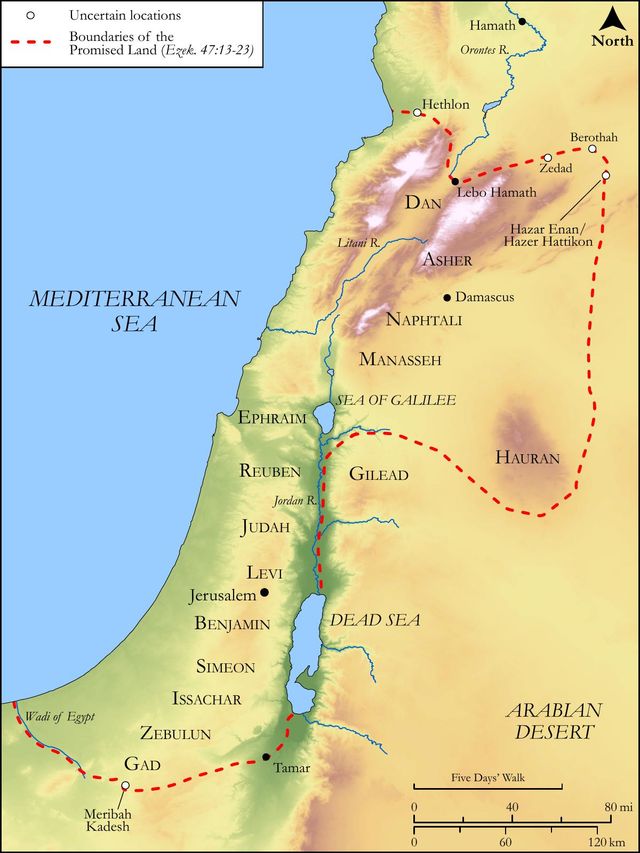
See on the biblical-era map
Study this verse
Continue studying Ezekiel 48:18 across the web’s major study libraries — every link below opens this exact verse, chapter, or book on the destination site.
Read & Compare
 BibleGatewayThis verse in more than 200 translations and 70 languages.
 Bible.comThe YouVersion reader — hundreds of translations, reading plans, and highlights.
 ESV.orgCrossway's official English Standard Version reader.
 NET BibleThe NET translation with 60,000+ translators' notes on every rendering decision.
 STEP BibleTyndale House's free study tool — original text, vocabulary, and scholarly resources.
 BibliaLogos Bible Software's free web reader.
 USCCBThe New American Bible (Revised Edition) with the U.S. bishops' study notes.
Commentaries
 BibleHub CommentariesDozens of classic commentaries on this verse, gathered on one page.
 StudyLightMore than 100 commentary sets — the largest collection on the web.
 BibleRefPlain-English commentary on what this verse means, verse by verse.
 Enduring WordDavid Guzik's free commentary on this chapter, widely used by Bible teachers.
 Bible Study ToolsVerse commentary alongside Greek and Hebrew study aids.
Original Language & Research
- BibleHub InterlinearThe verse word by word — original language, transliteration, and English.
- BibleHub LexiconEvery word's original-language definition and Strong's entry.
 Blue Letter BibleDeep-study tools — Strong's numbers, concordance, and word studies.
 SefariaThe Hebrew text with Rashi and centuries of Jewish commentary.
Sermons, Hymns & Audio


TrulyRandomVerse is not affiliated with these sites and doesn’t control their content. They’re linked because they’re genuinely useful.
Summary
Ezekiel 48:18 meticulously describes the allocation of a specific strip of land bordering the sacred "holy portion" within the prophet's visionary blueprint for a restored Israel. This designated territory, extending ten thousand cubits eastward and westward, was not merely a boundary but a productive area. Its agricultural yield was explicitly intended to provide sustenance for those who served the city, thereby underscoring God's precise and abundant provision for those dedicated to the administration and spiritual life of His people in the new, divinely ordered commonwealth.
Context
ShowHideLiterary Context
Ezekiel 48:18 is found within the climactic final section of Ezekiel's prophecy, specifically chapters 40-48, which detail an elaborate vision of a new temple, a reorganized land, and a holy city. This comprehensive vision, beginning with Ezekiel 40, provides a meticulous blueprint for a future, ideal Israel, emphasizing divine order, holiness, and God's abiding presence. Chapter 48 meticulously outlines the division of the land among the twelve tribes, with a significant central allocation for the sanctuary, priests, and Levites—referred to as the "holy portion" or "oblation." Verse 18 then elaborates on the practical support system for those who would serve in this divinely ordered community, detailing the land immediately bordering the sacred precinct and its specific purpose. It follows the descriptions of the portions for the prince and the various tribes, setting the stage for the practicalities of sustaining the holy city.
Historical & Cultural Context
Ezekiel's prophecy was delivered to the Jewish exiles in Babylon, a people dispossessed of their land, temple, and national identity. The vision of a restored temple and a re-divided land offered profound hope and a clear picture of God's faithfulness to His covenant promises, particularly in the face of national devastation. In ancient Israelite society, land was foundational to identity, sustenance, and covenant blessings. The concept of a "holy portion" (Hebrew: terumah) was deeply rooted in the Levitical laws concerning offerings and dedicated portions for the priests and Levites, ensuring their sustenance as they served God (e.g., Numbers 18:21-24). The meticulous measurements and allocations in Ezekiel's vision reflect a divine re-establishment of order and justice, contrasting sharply with the chaos and injustice that led to the exile. The provision for those who "serve the city" highlights the ancient understanding of a symbiotic relationship between the spiritual and civic life, where those dedicated to religious and administrative duties were to be sustained by the community.
Key Themes
ShowHideThis verse contributes significantly to several overarching themes in Ezekiel's vision. Firstly, Divine Provision is paramount, demonstrating God's meticulous care for those who serve Him and His people. The land's produce directly supports the servants, echoing the principle of supporting those dedicated to spiritual work, as seen in 1 Corinthians 9:14. Secondly, Order and Precision are emphasized through the exact measurements ("ten thousand eastward, and ten thousand westward"), highlighting God's intentionality and the perfect divine design for His kingdom. This contrasts with the disorder that characterized Israel before the exile. Thirdly, a Sacred Economy is established, where even the "secular" land adjacent to the holy portion is purposed to support the sacred activities centered in the temple and city, creating a self-sustaining and divinely ordered community that prioritizes the well-being of its spiritual and administrative leaders. Finally, the theme of Holiness permeates the vision, as the surrounding land is intimately connected to the "holy portion," implying that all aspects of life in the restored community are to be ordered in a way that honors God's sanctity.
Exposition and Analysis
ShowHideKey Word Analysis
ShowHideFrom a primitive root meaning "to jut over or exceed; by implication, to excel; (intransitively) to remain or be left; causatively, to leave, cause to abound, preserve." In this context, "residue" refers to the remaining portion of land, specifically that which is left over or adjacent to the primary "holy portion." It signifies a designated remainder, not an afterthought, but a purposefully allocated segment.
From a root meaning "to lift up" or "to raise." It denotes "a present (as offered up), especially in sacrifice or as tribute." Here, it specifically refers to the large, dedicated portion of land set apart for the sanctuary, priests, and Levites, indicating its sacred, consecrated nature as an offering to God.
A primitive root meaning "to work (in any sense); by implication, to serve, till, (causatively) enslave, etc." In this context, it refers to those who are engaged in the work or service of the city, encompassing both spiritual (priestly, Levitical) and administrative duties necessary for the functioning of the holy community.
Verse Breakdown
ShowHide"And the residue in length over against the oblation of the holy [portion shall be] ten thousand eastward, and ten thousand westward:"
This clause specifies the dimensions and location of the land. "The residue" refers to the land bordering the sacred "oblation" (the holy portion set apart for the sanctuary, priests, and Levites). This land extends precisely "ten thousand" (cubits, understood from context) in length, both to the east and to the west of the holy portion. This highlights the meticulous planning and symmetrical design of the divinely ordered territory, ensuring a balanced and ample supporting area.
"and it shall be over against the oblation of the holy [portion];"
This repetition emphasizes the direct adjacency and intimate relationship of this land to the central sacred precinct. It reinforces that this "residue" is not disconnected but is functionally and spatially linked to the holy oblation, underscoring its supportive role. The proximity signifies its purpose is tied to the sacred.
"and the increase thereof shall be for food unto them that serve the city."
This final clause reveals the explicit purpose of this land. "The increase thereof" refers to its agricultural produce or yield. This produce is designated "for food" to sustain "them that serve the city." This includes those who minister in the temple, administer the city, and perform other essential functions. It demonstrates God's provision for His servants, ensuring their physical needs are met so they can devote themselves fully to their duties without distraction or want.
Literary Devices
ShowHideEzekiel 48:18 employs several significant literary devices. Precision and Detailing are evident in the exact measurements ("ten thousand eastward, and ten thousand westward"), which underscore the divine architect's meticulous planning and the tangible, ordered nature of the restored kingdom. This numerical specificity lends an air of reality and divine intentionality to the vision. Repetition is used effectively with the phrase "over against the oblation of the holy [portion]," which appears twice. This repetition serves to emphasize the critical spatial relationship and functional connection between this productive land and the central sacred area, reinforcing that the land's purpose is intrinsically linked to the sanctity and service of the holy portion. Furthermore, there is an element of Symbolism, where the physical provision from the land for the city's servants symbolizes God's faithfulness to sustain those dedicated to His work, a principle that transcends the literal land division to speak of divine care for His people.
Theological and Thematic Connections
ShowHideEzekiel 48:18 provides profound theological insight into God's character as a meticulous provider and an orderly sovereign. It illustrates that divine provision is not haphazard but is carefully planned and integrated into the very structure of His kingdom. The allocation of land for the sustenance of those who serve the city underscores God's commitment to ensuring that His workers are cared for, enabling them to focus on their sacred duties without worldly anxieties. This principle extends beyond the literal vision of the land, affirming that God always makes provision for those He calls into service, whether in ancient Israel or in the contemporary church. It speaks to a divine economy where resources are purposed to support spiritual and communal well-being, reflecting God's holistic concern for His people.
Reflection and Application
ShowHideEzekiel 48:18, though set in a visionary context, offers timeless principles for contemporary believers. It reminds us that God is a God of order and intentionality, who meticulously plans for the well-being and sustenance of His people, especially those dedicated to His service. For us, this means trusting in God's faithful provision in our own lives as we seek to serve Him. Just as the land's produce sustained those who served the city, God provides for us in various ways—through our work, through the generosity of others, and through unexpected blessings—so that we can fulfill our calling without being consumed by worldly anxieties. It also challenges us to consider how we, as the body of Christ, contribute to the sustenance and support of those who serve in ministry, recognizing that their ability to focus on spiritual work is vital for the health of the church. This verse encourages us to live with a deep sense of security in God's care, knowing that as we prioritize His kingdom, He will ensure our needs are met, enabling us to be faithful stewards of our gifts and resources for His glory.
Questions for Reflection
ShowHideFAQ
ShowHideWhat is the "holy portion" mentioned in this verse?
ShowHideThe "holy portion" (Hebrew: terumah or oblation) refers to a large, specially designated area of land within Ezekiel's visionary temple and land division. As described in Ezekiel 45:1-8, this central sacred precinct was set apart for the sanctuary, the priests, and the Levites. It was considered God's dedicated portion, ensuring a holy space for worship and providing sustenance for those who ministered there. The land described in Ezekiel 48:18 is directly adjacent to and supports this holy portion.
Who are "them that serve the city" and what do they do?
ShowHide"Them that serve the city" refers to the inhabitants and workers of the holy city in Ezekiel's vision. This would primarily include those involved in the administration and maintenance of the city, as distinct from the priests and Levites who served directly in the temple within the holy portion. While the priests and Levites had their own specific land allocation within the holy portion, the "servants of the city" would be those who ensured the civic, economic, and practical functioning of the community. Their service would be essential for the overall well-being and order of the divinely established commonwealth, and this verse ensures their provision from the land's produce.
Christ-Centered Fulfillment
ShowHideEzekiel 48:18, with its meticulous provision for those who serve the city, finds its ultimate and profound fulfillment in Jesus Christ and the New Covenant. While Ezekiel's vision describes a physical land and a literal city, it foreshadows the spiritual reality of God's perfect provision for His people in Christ. Jesus Himself is the ultimate "increase" and "food" for His people, declaring, "I am the bread of life; whoever comes to me shall not hunger and "my flesh is true food, and my blood is true drink". In the New Covenant, the "city" we serve is not an earthly Jerusalem but the "heavenly Jerusalem" and the "city of the living God" (Hebrews 12:22), the church, which is Christ's body. Believers are called to "serve the Lord with all humility" (Acts 20:19) and to "serve one another humbly in love" (Galatians 5:13). Just as the land provided for the physical needs of the city's servants, Christ provides for every need of those who serve in His spiritual kingdom, both physically and spiritually. He ensures that those who "seek first his kingdom and his righteousness" (Matthew 6:33) will have all their needs met. The meticulous order and provision in Ezekiel's vision point to the perfect, unfailing care of Christ for His church, empowering His servants to fulfill their mission without anxiety, sustained by His grace and truth.