


Ezekiel 48:19
Bible text: King James Version (1769 Blayney text) · Public domain
Bible text: Berean Standard Bible · Public domain
Bible text: American Standard Version (1901) · Public domain
Bible text: World English Bible, Messianic edition · Public domain
Bible text: Geneva Bible (1599) · Public domain
Bible text: Young's Literal Translation · Public domain
- וְהָעֹבֵדve·ha·'o·Vedand the workerH5647Conj-w ¦ Art ¦ V-Qal-Prtcpl-msVerb Qal Participle Singular Masculine Absoluteוְandהָtheעֹבֵדworker
- הָעִירha·'Irthe cityH5892Art ¦ N-fsNoun Singular Feminine Absoluteהָtheעִירcity
- יַעַבְדוּהוּya·'av·Du·huthey will serve itH5647V-Qal-Imperf-3mp ¦ 3msVerb Qal Imperfect 3rd Plural Masculineיַעַבְדוּthey will serveהוּit
- מִכֹּלmi·Kolfrom allH3605Prep-m ¦ N-mscNoun Singular Masculine Constructמִfromכֹּלall
- שִׁבְטֵיshiv·Tei[the] tribes ofH7626N-mpcNoun Plural Masculine Construct
- יִשְׂרָאֵלYis·ra·'ElIsraelH3478N-properNoun Proper Location
English is a literal word-by-word gloss of the Hebrew, not the KJV's wording. Why?
This is the original text the KJV's translators worked from — each Hebrew word with its own literal English meaning in this verse, prepared by scholars at Tyndale House, Cambridge. The KJV translates whole sentences, not word by word, so its wording differs: one Hebrew word can become several English words, and the KJV may choose “the LORD” where the gloss reads “Yahweh”. Both are faithful — they answer different questions. For the KJV's own rendering, switch to the KJV text.
Details
See on the biblical-era map
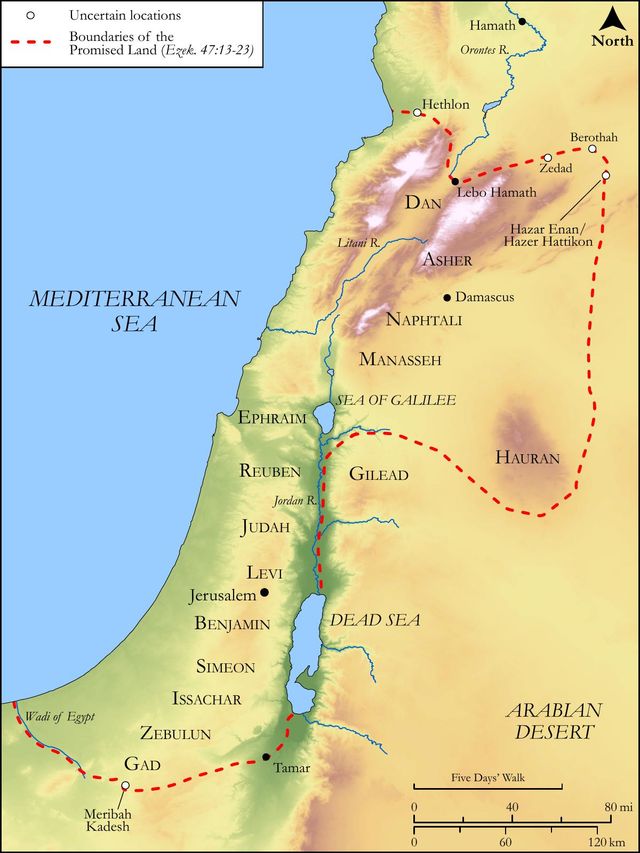
Study this verse
Continue studying Ezekiel 48:19 across the web’s major study libraries — every link below opens this exact verse, chapter, or book on the destination site.
Read & Compare
 BibleGatewayThis verse in more than 200 translations and 70 languages.
 Bible.comThe YouVersion reader — hundreds of translations, reading plans, and highlights.
 ESV.orgCrossway's official English Standard Version reader.
 NET BibleThe NET translation with 60,000+ translators' notes on every rendering decision.
 STEP BibleTyndale House's free study tool — original text, vocabulary, and scholarly resources.
 BibliaLogos Bible Software's free web reader.
 USCCBThe New American Bible (Revised Edition) with the U.S. bishops' study notes.
Commentaries
 BibleHub CommentariesDozens of classic commentaries on this verse, gathered on one page.
 StudyLightMore than 100 commentary sets — the largest collection on the web.
 BibleRefPlain-English commentary on what this verse means, verse by verse.
 Enduring WordDavid Guzik's free commentary on this chapter, widely used by Bible teachers.
 Bible Study ToolsVerse commentary alongside Greek and Hebrew study aids.
Original Language & Research
- BibleHub InterlinearThe verse word by word — original language, transliteration, and English.
- BibleHub LexiconEvery word's original-language definition and Strong's entry.
 Blue Letter BibleDeep-study tools — Strong's numbers, concordance, and word studies.
 SefariaThe Hebrew text with Rashi and centuries of Jewish commentary.
Sermons, Hymns & Audio


TrulyRandomVerse is not affiliated with these sites and doesn’t control their content. They’re linked because they’re genuinely useful.
Summary
Ezekiel 48:19 concludes a profound prophetic vision detailing the restoration of the land, the temple, and a new holy city in post-exilic Israel. This verse specifically addresses the administration and population of this sacred urban center, declaring that those who serve the city will be drawn from all the tribes of Israel. It powerfully emphasizes a future of profound unity and shared responsibility among God's people in His eschatological kingdom, overcoming historical divisions and ensuring that every segment of the nation contributes actively to the spiritual and administrative well-being of the divinely ordained capital.
Context
ShowHideLiterary Context
Ezekiel 48:19 is situated within the climactic final section of the Book of Ezekiel, encompassing chapters 40-48. This comprehensive vision, given to Ezekiel during the Babylonian exile, offers a detailed blueprint of a new temple, a re-divided land, and a meticulously designed holy city, serving as a powerful message of hope and restoration to a dispossessed and dispirited people. Chapters 40-42 meticulously describe the dimensions and architectural features of the new temple, while chapters 43-46 outline the temple worship and its associated ordinances. Chapter 47 vividly portrays a life-giving river flowing from the temple, bringing healing and abundant fruitfulness to the land. Finally, chapter 48 delineates the precise division of the land among the twelve tribes, the allocation of a sacred district for the temple and priestly service, and the intricate layout of the holy city. Verse 19 specifically addresses the inhabitants and administrators of this central city, which is ultimately named Jehovah-Shammah, "The LORD is There", thereby establishing its ultimate purpose as the locus of God's manifest presence. It immediately follows the description of the city's dimensions and its surrounding suburbs, setting the stage for who will occupy and maintain this vital spiritual and administrative hub.
Historical & Cultural Context
Ezekiel prophesied during the traumatic period of the Babylonian exile (circa 597-571 BC), following the destruction of the Jerusalem temple, the overthrow of the Davidic monarchy, and the deportation of the Jewish people from their homeland. In this context of national devastation and despair, visions of restoration, a rebuilt temple, and a re-gathered Israel held immense significance, offering a beacon of divine faithfulness amidst human failure. The concept of "tribes of Israel" was fundamental to Israelite identity, rooted in the patriarchal promises to Jacob and the original land distribution under Joshua. However, historical reality saw the kingdom fractured into Judah and Israel (e.g., 1 Kings 12:16-19), leading to centuries of disunity, idolatry, and eventual scattering. Ezekiel's vision, therefore, transcends these historical failures, projecting an ideal future where a unified Israel serves God wholeheartedly. Furthermore, the "city" in Israel was the administrative, religious, and commercial heart of the nation, as Jerusalem was in the days of David and Solomon. Ezekiel's vision elevates this concept to a divine standard, portraying a city perfectly ordered by God.
Key Themes
ShowHideEzekiel 48:19 contributes significantly to several overarching themes within Ezekiel's prophecy. A primary theme is Restoration and New Creation, where God promises to bring His people back to the land, rebuild their spiritual center, and renew their covenant relationship. This restoration is not merely physical but profoundly spiritual, marked by the impartation of a new heart and spirit (as promised in Ezekiel 36:26-27). Another crucial theme is Divine Order and Holiness, evident in the meticulous details of the temple, the precise land division, and the city's administration. Everything is precisely ordered according to God's perfect design, emphasizing His absolute sovereignty and the sacredness of His dwelling place. The mention of "all the tribes of Israel" powerfully highlights the theme of Unity and Universal reach, directly contrasting with the historical fragmentation and disunity of the nation. It signifies a future where tribal distinctions contribute harmoniously to a cohesive whole, serving a common purpose under God's righteous rule. Finally, the concept of "serving the city" speaks directly to Worship and Service, implying that the life of the restored community is fundamentally oriented towards God, with all its members participating actively in the upkeep and spiritual integrity of His dwelling place.
Exposition and Analysis
ShowHideKey Word Analysis
ShowHideThis word (H5647) is a primitive root with a broad semantic range, encompassing "to work," "to labor," "to minister," "to cultivate," and "to serve." Crucially, it can also imply "to worship" or "to be in bondage/enslave." Its dual appearance in Ezekiel 48:19 emphasizes diligent, devoted, and continuous service to the city. This service transcends mere civic duty, carrying deep spiritual implications that suggest a consecrated effort towards the well-being and holiness of the community, akin to priestly or cultic service rendered to God.
The term (H5892) refers to a city in its widest sense, often implying a place that is "guarded by waking or a watch." In Ezekiel's vision, this is the holy city, distinct from the temple complex but central to the sacred district. Its significance is amplified by its eventual name, "The LORD is There" (Ezekiel 48:35), indicating it is the primary locus of God's presence and divine administration. The service rendered to this city is therefore understood as service to God's dwelling place and His perfectly ordered kingdom.
This word (H7626) literally means a "stick," "rod," or "scepter," but figuratively refers to a "clan" or "tribe." Its use here signifies the distinct tribal divisions of Israel, which, despite their historical fragmentation and rivalries, are envisioned as contributing collectively and harmoniously to the holy city. The term underscores the corporate identity of God's people, even as it highlights the individual components that make up the unified whole, all working together for a common, sacred purpose.
Verse Breakdown
ShowHide"And they that serve the city"
This initial clause introduces the primary subjects of the verse – those individuals who are dedicated to the upkeep, administration, and spiritual flourishing of the holy city. The verb "serve" (ʻâbad) here implies a profound commitment to labor and minister on behalf of this sacred urban center, which is envisioned as the very heart of the restored nation and the dwelling place of God.
"shall serve it"
The immediate repetition of the verb "serve" (ʻâbad) functions as an intensifier, underscoring the nature and importance of the activity. It emphasizes the continuous, dedicated, and perhaps even sacrificial nature of the service. This is not a casual or temporary task but a fundamental, ongoing role in the life of the city, indicating a deep, unwavering commitment to its function, purpose, and holiness.
"out of all the tribes of Israel."
This concluding phrase carries immense theological weight. It specifies the comprehensive origin of those who will serve the city – they will not be drawn from a single tribe, a select priestly class, or an exclusive few, but inclusively "out of all the tribes of Israel." This highlights the profound unity, shared responsibility, and comprehensive participation of the entire restored nation in the life and administration of the holy city, thereby overcoming the historical divisions, rivalries, and spiritual failures that had long plagued Israel.
Literary Devices
ShowHideEzekiel 48:19 employs several potent literary devices to convey its powerful and hopeful message. The most prominent is Repetition, specifically the double use of the verb "serve" (Hebrew, ʻâbad'). This repetition functions as an intensifier, emphasizing the diligence, dedication, and pervasive nature of the service required for the holy city. It underscores that this is not a casual or optional task but a fundamental and ongoing commitment from all participants. Symbolism is also central to the verse; "the city" itself is a potent symbol of God's restored presence and perfectly ordered kingdom, a place where His glory dwells and His righteous administration is enacted. Likewise, "all the tribes of Israel" symbolizes the complete, unified, and fully restored nation, transcending historical divisions and embodying the ideal community under God's righteous rule. The phrase "out of all the tribes" also powerfully conveys Universal Reach and Unity, a thematic device that deliberately contrasts with Israel's past disunity and highlights God's ultimate plan for a harmonious and devoted people.
Theological and Thematic Connections
ShowHideEzekiel 48:19 offers a profound theological statement about God's eschatological kingdom and the nature of His redeemed people. It paints a vivid picture of a perfectly ordered society, centered on God's presence, where every segment of the nation participates actively in its upkeep and spiritual vitality. This vision of "all the tribes" serving the holy city speaks to the divine ideal of unity and shared purpose, transcending the historical fragmentation and failures of Israel. It emphasizes that in God's ultimate plan, His people are not merely passive recipients of blessing but active participants in His redemptive purposes, contributing their diverse gifts and callings to the common good of His dwelling place. This service is not just administrative or civic but inherently an act of worship, reflecting a deep devotion to God and the advancement of His kingdom.
Reflection and Application
ShowHideEzekiel 48:19, while rooted in a specific prophetic vision for Israel's future, offers timeless and profound principles for believers today. The call for service "out of all the tribes" resonates deeply with the New Testament understanding of the Church as the unified body of Christ, composed of diverse members from every nation, tribe, people, and language. It serves as a powerful reminder that unity in purpose and shared responsibility are paramount in God's kingdom. Just as the future inhabitants of the holy city would diligently serve its needs, so too are believers called to active, devoted service within the spiritual "city" – the Church – and in the world at large. Our service, whether in practical duties, spiritual ministry, or daily vocations, should be seen as an act of worship, contributing to the flourishing of God's people and the advancement of His redemptive purposes. This verse challenges us to overcome divisions, embrace our unique gifts, and collaborate wholeheartedly for the glory of God, recognizing that every member has a vital and indispensable role in building His kingdom and manifesting His presence in the world.
Questions for Reflection
ShowHideFAQ
ShowHideWhat is the significance of "all the tribes of Israel" serving the city?
ShowHideThe phrase "all the tribes of Israel" is profoundly significant because it directly addresses and overcomes the historical reality of deep-seated division within Israel. After the reign of Solomon, the kingdom tragically split into two (e.g., 1 Kings 12:16-19), leading to centuries of disunity, rivalry, idolatry, and eventual exile for both the northern and southern kingdoms. Ezekiel's vision, therefore, portrays a future, ideal Israel where this fragmentation is completely healed. It signifies a complete, unified nation, where every tribal identity contributes harmoniously to the central, holy city. This emphasizes universal reach, shared responsibility, and a collective devotion to God's presence and administration, reflecting a perfect divine order and the restoration of God's people to their intended unity.
Is this "city" a literal place or a symbolic representation?
ShowHideWithin the immediate context of Ezekiel's prophecy (chapters 40-48), the city is described with meticulous, literal dimensions and details, suggesting a future, physical manifestation of a restored holy city. This level of detail implies a tangible reality. However, like many prophetic visions, it also carries profound symbolic meaning. It represents the ideal dwelling place of God among His people, a center of divine order, holiness, and administration. While many interpreters believe in a future literal fulfillment during the millennial reign of Christ, its spiritual principles of God's abiding presence, unified worship, and collective service transcend a purely physical interpretation, pointing ultimately towards the New Jerusalem (Revelation 21) as the eternal dwelling of God with His redeemed people.
Christ-Centered Fulfillment
ShowHideEzekiel 48:19 finds its ultimate Christ-centered fulfillment in the person and redemptive work of Jesus, and in the establishment of His spiritual kingdom, the Church. While Ezekiel's vision speaks to a restored physical Israel, Christ inaugurates a new spiritual Israel, composed of believers from "every tribe and language and people and nation" (Revelation 5:9). Jesus is the true Lamb of God who takes away the sin of the world, who, through His sacrifice, breaks down the dividing wall of hostility between Jew and Gentile (Ephesians 2:14), thereby creating one new humanity. The "city" that is served in Ezekiel's vision foreshadows the New Jerusalem, the heavenly city of God, which ultimately descends from heaven (Revelation 21:2). In this ultimate reality, Christ is the light and the temple (Revelation 21:22-23), and all who are in Him, the true Israel of God, serve Him as a kingdom of priests (Revelation 1:6). Thus, the unity, shared service, and divine presence envisioned in Ezekiel 48:19 are fully realized in Christ and His Church, culminating in the eternal dwelling of God with His redeemed people.