


Nehemiah 11:36
- וּמִןu·minand some ofH4480Conj-w ¦ PrepPrepositionוּandמִןsome of
- הַלְוִיִּםhal·vi·Yimthe LevitesH3881Art ¦ N-mpNoun Gentilic Plural Masculine AbsoluteהַtheלְוִיִּםLevites
- מַחְלְקוֹתmach·le·Kot[the] divisions ofH4256N-fpcNoun Plural Feminine Construct
- יְהוּדָהye·hu·DahJudahH3063N-properNoun Proper Location
- לְבִנְיָמִיןle·vin·ya·Min[belonged] to BenjaminH1144Prep-l ¦ N-proper-mNoun Proper Masculineלְ[belonged] toבִנְיָמִיןBenjamin
English is a literal word-by-word gloss of the Hebrew, not the KJV's wording. Why?
This is the original text the KJV's translators worked from — each Hebrew word with its own literal English meaning in this verse, prepared by scholars at Tyndale House, Cambridge. The KJV translates whole sentences, not word by word, so its wording differs: one Hebrew word can become several English words, and the KJV may choose “the LORD” where the gloss reads “Yahweh”. Both are faithful — they answer different questions. For the KJV's own rendering, switch to the KJV text.
Details
See on the biblical-era map
Study this verse
Public-domain commentary
Matthew Henry
From his Commentary on the Whole Bible. Henry comments on passages, not single verses — this entry covers Nehemiah 11:20–36.
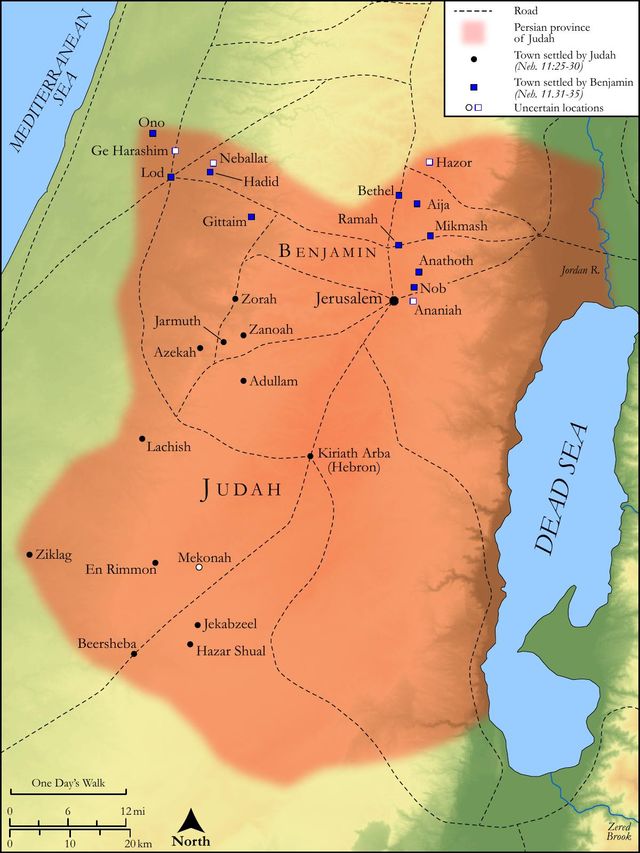
Having given an account of the principal persons that dwelt in Jerusalem (a larger account of whom he had before, Ch1 9:2, etc.), Nehemiah, in these verses, gives us some account of the other cities, in which dwelt the residue of Israel, Neh 11:20. It was requisite that Jerusalem should be replenished, yet not so as to drain the country. The king himself is served of the field, which will do little service if there be not hands to manage it. Let there therefore be no strife, no envy, no contempt, no ill will, between the inhabitants of the cities and those of the villages; both are needful, both useful, and neither can be spared. 1. The Nethinims, the posterity of the Gibeonites, dwelt in Ophel, which was upon the wall of Jerusalem (Neh 3:26), because they were to do the servile work of the temple, which therefore they must be posted near to, that they might be ready to attend, Neh 11:21. 2. Though the Levites were dispersed through the cities of Judah, yet they had an overseer who resided in Jerusalem, superior of their order and their provincial, to whom they applied for direction, who took care of their affairs and took cognizance of their conduct, whether they did their duty, Neh 11:22. 3. Some of the singers were appointed to look after the necessary repairs of the temple, being ingenious men, and having leisure between their hours of service; they were over the business of the house of God, Neh 11:22. And, it seems, the king of Persia had such a kindness for their office that he allotted a particular maintenance for them, besides what belonged to them as Levites, Neh 11:23. 4. Here is one that was the king's commissioner at Jerusalem. He was of the posterity of Zerah (Neh 11:24); for of that family of Judah there were some new settled in Jerusalem, and not all of Pharez, as appears by that other catalogue, Ch1 9:6. He is said to be at the king's hand, or on the king's part, in all matters concerning the people, to determine controversies that arose between the king's officers and his subjects, to see that what was due to the king from the people was duly paid in and what was allowed by the king for the temple service was duly paid out, and happy it was for the Jews that one of themselves was in this post. 5. Here is an account of the villages, or country towns, which were inhabited by the residue of Israel - the towns in which the children of Judah dwelt (Neh 11:25-30), those that were inhabited by the children of Benjamin (Neh 11:31-35), and divisions for the Levites among both, Neh 11:36. We will now suppose them safe and easy, though few and poor, but by the blessing of God they were likely to increase in wealth and power, and they would have been more likely if there had not been that general profaneness among them, and lukewarmness in religion, with which they were charged in God's name by the prophet Malachi, who, it is supposed, prophesied about this time, and in whom prophecy ceased for some ages, till it revived in the great prophet and his forerunner.
Historical interpretation
Historical reception
1 surviving comment on this verse from the historical church.
And concerning the Levites, portions of Judah and Benjamin, it indicates that the Levites received their share in the possession of the children of Judah and Benjamin according to the decree of the law. Let these few words be said about the history. Concerning all these things, if we also wish to hear an allegorical sense that fits our actions, Judah is interpreted as confessing, Benjamin as the son of the right hand, Levi as taken up. Tribes of all these partly live in Jerusalem, and partly in subordinate cities given to them by God, because the gains of the faithful are many and diverse, for which there are also many mansions in the house of the Father in the heavens, as we taught above. Some are content to keep the general commandments of God: not to kill, not to commit adultery, not to steal, not to bear false witness against their neighbor; to honor father and mother, and to love neighbors as themselves. Others try to take a stricter way of a perfect life, yet all praise and confess the grace of their Creator according to their calling and are children of the eternal kingdom, which is at His right hand; and they are taken up by Him into life, when the time of that judgment comes, in which two will be in the field, one will be taken, two women grinding at the mill, one will be taken, and one left (Matthew XXIV).
Continue studying Nehemiah 11:36 across the web’s major study libraries — every link below opens this exact verse, chapter, or book on the destination site.
Read & Compare
 BibleGatewayThis verse in more than 200 translations and 70 languages.
 Bible.comThe YouVersion reader — hundreds of translations, reading plans, and highlights.
 ESV.orgCrossway's official English Standard Version reader.
 NET BibleThe NET translation with 60,000+ translators' notes on every rendering decision.
 STEP BibleTyndale House's free study tool — original text, vocabulary, and scholarly resources.
 BibliaLogos Bible Software's free web reader.
 USCCBThe New American Bible (Revised Edition) with the U.S. bishops' study notes.
Commentaries
 BibleHub CommentariesDozens of classic commentaries on this verse, gathered on one page.
 StudyLightMore than 100 commentary sets — the largest collection on the web.
 BibleRefPlain-English commentary on what this verse means, verse by verse.
 Enduring WordDavid Guzik's free commentary on this chapter, widely used by Bible teachers.
 Bible Study ToolsVerse commentary alongside Greek and Hebrew study aids.
Original Language & Research
- BibleHub InterlinearThe verse word by word — original language, transliteration, and English.
- BibleHub LexiconEvery word's original-language definition and Strong's entry.
 Blue Letter BibleDeep-study tools — Strong's numbers, concordance, and word studies.
 SefariaThe Hebrew text with Rashi and centuries of Jewish commentary.
Sermons, Hymns & Audio


TrulyRandomVerse is not affiliated with these sites and doesn’t control their content. They’re linked because they’re genuinely useful.
Summary
Nehemiah 11:36 concludes a vital administrative record, providing a concise yet profoundly significant detail concerning the post-exilic community's reorganization. It highlights the strategic "divisions" or assigned settlements of the Levites throughout the territories of Judah and Benjamin. This verse underscores their indispensable role in the spiritual and administrative re-establishment of the returned exiles beyond the immediate confines of Jerusalem, emphasizing the meticulous planning involved in ensuring spiritual oversight, instruction, and the maintenance of proper worship were accessible across the re-inhabited land.
Context
ShowHideLiterary Context
Nehemiah 11:36 serves as the concluding statement in a detailed administrative record that commences in Nehemiah 11:1. Following the successful completion of Jerusalem's walls and the profound covenant renewal ceremony meticulously documented in Nehemiah 8-10, the narrative shifts to the practical, yet equally crucial, challenge of repopulating the capital city and systematically organizing the wider community. This chapter methodically lists the chief men, priests, and Levites who took up residence in Jerusalem and the surrounding villages. Verse 36 specifically finalizes the enumeration of the Levites, emphatically indicating their widespread distribution not merely within the capital but throughout the broader tribal areas of Judah and Benjamin. This precise administrative detail underscores the comprehensive and painstaking nature of the post-exilic restoration efforts, ensuring every aspect of national life was addressed.
Historical & Cultural Context
This verse is situated firmly within the post-exilic period, approximately 444 BC, under the governorship of Nehemiah during the Persian Empire's dominion. After decades endured in Babylonian captivity, the returned exiles confronted the monumental task of rebuilding not just physical structures but also the very fabric of their national and religious identity. The Levites, as direct descendants of Levi, held a uniquely crucial and divinely ordained role in ancient Israel. Their responsibilities encompassed temple service, the authoritative teaching of the Mosaic Law, leading communal worship, and often serving as scribes and judicial figures. Their "divisions" or assigned settlements throughout the land were a deliberate echo of the original distribution of Levitical cities in ancient Israel, as meticulously outlined in Numbers 35. This strategic placement was absolutely vital for ensuring that spiritual guidance, comprehensive instruction in the Law, and the maintenance of proper worship practices were readily accessible to the scattered communities, thereby reinforcing a centralized religious life anchored around the newly rebuilt Temple in Jerusalem.
Key Themes
ShowHideThe inclusion of Nehemiah 11:36 within this detailed census highlights several pivotal themes central to the book of Nehemiah and the broader post-exilic narrative. Firstly, it powerfully emphasizes Order and Organization, reflecting a meticulous and divinely inspired effort by Nehemiah and the other leaders to bring structure, stability, and divine alignment to a community that had been profoundly fragmented by exile. This unwavering commitment to doing all things decently and in order was absolutely essential for fostering genuine national and spiritual revival. Secondly, it underscores the Strategic Placement of Spiritual Leadership. The Levites were not merely confined to Jerusalem; their deliberate distribution ensured that spiritual instruction and oversight were available throughout the territories of Judah and Benjamin, echoing the ancient, divinely established practice of assigning cities to the Levites. This strategic dispersion facilitated the comprehensive Re-establishment of the Nation's Spiritual Infrastructure, demonstrating a painstaking process of rebuilding not just physical walls but the very spiritual and social fabric of Israelite society, including its foundational religious and educational systems.
Exposition and Analysis
ShowHideKey Word Analysis
ShowHideThis term (מַחֲלֹקֶת, H4256) derives from the root חָלַק (chalaq), meaning "to divide" or "to apportion." It denotes a "section," "course," or "portion," often referring to an organized group or a specific assignment. In the context of Nehemiah 11:36, it signifies a deliberate, organized deployment or assignment of Levites to specific areas within Judah and Benjamin. This was not a random scattering but a structured distribution designed to ensure their spiritual influence and service extended beyond the immediate vicinity of the Temple in Jerusalem, reflecting a commitment to comprehensive spiritual care for the returned exiles. The usage here aligns with its application in Chronicles for the organized "courses" of priests and Levites for temple service (e.g., 1 Chronicles 24:1).
This term (לֵוִי, H3881) refers to the descendants of Levi, one of the twelve sons of Jacob. From the time of Moses, the tribe of Levi was set apart by God for special service, particularly in relation to the Tabernacle and later the Temple. Their duties included assisting the priests, maintaining the sanctuary, teaching the Mosaic Law, leading worship, and often serving as scribes and judges. Their presence and organized distribution were fundamental to the spiritual health and adherence to the Mosaic Law within the post-exilic community, as they served as the primary educators and facilitators of worship for the people, ensuring the continuity of covenant faithfulness.
These refer to the two primary tribal territories inhabited by the returned exiles. Judah (יְהוּדָה, H3063), meaning "celebrated," was the name of Jacob's fourth son and the dominant tribe of the Southern Kingdom. Benjamin (בִּנְיָמִין, H1144), meaning "son of the right hand," was Jacob's youngest son and the tribe that remained loyal to Judah during the divided monarchy. While other Israelites from various tribes returned, the vast majority were from the former Southern Kingdom of Judah, which included the tribe of Benjamin. These territories formed the geographical and demographic core of the re-established Jewish community in the post-exilic period, encompassing Jerusalem and its surrounding towns and villages. The mention of these two territories signifies the complete geographical scope of the Levites' organized presence across the entire re-inhabited land.
Verse Breakdown
ShowHide"And of the Levites were divisions"
This clause emphasizes the intentional, structured arrangement concerning the Levites. It signifies that their presence throughout the land was not haphazard but was part of a deliberate, divinely guided plan for their organized deployment. This "division" speaks to their assigned roles and areas of service, ensuring that their unique spiritual functions—teaching, leading worship, and maintaining the Law—were distributed systematically across the re-established community. It highlights the administrative foresight and unwavering commitment to spiritual order by Nehemiah and the leaders, reflecting God's desire for His people to be well-ordered.
"[in] Judah, and in Benjamin"
This specifies the precise geographical scope of the Levites' organized settlements. It indicates that these "divisions" were established across the entire inhabited territory of the returned exiles, encompassing the core tribal lands of Judah and Benjamin. This detail reinforces the idea that spiritual oversight and instruction were not confined to Jerusalem or the Temple precincts but were intentionally extended to all communities within the core region of the post-exilic Jewish state, ensuring comprehensive spiritual coverage and accessibility for the entire population.
Literary Devices
ShowHideNehemiah 11:36, as an integral component of a larger administrative record, primarily employs Listing and Census as its foundational literary devices. The meticulous enumeration of various groups and their assigned settlements throughout chapter 11 serves to document the painstaking and comprehensive efforts of repopulation and reorganization. The verse also subtly utilizes Synecdoche, where the specific mention of "Judah" and "Benjamin" effectively represents the entirety of the returned exilic community or the re-established Jewish state in the land. This specific naming of the two tribes efficiently encapsulates the core demographic and geographical reality of the post-exilic remnant. The overall effect of this precise detail is a powerful Emphasis on the thoroughness, intentionality, and divine wisdom of the leaders in rebuilding not merely the physical city walls but the very spiritual and social fabric of the nation, highlighting the crucial importance of every component, especially the divinely appointed Levites, in the grand process of restoration.
Theological and Thematic Connections
ShowHideNehemiah 11:36, while appearing to be a mere administrative detail within a census, carries profound theological implications. It powerfully underscores God's unwavering commitment to order, His meticulous provision for His people's spiritual well-being, and the divine value of distributed spiritual leadership. The strategic placement of the Levites throughout the territories of Judah and Benjamin demonstrates the enduring divine principle that access to the Law, proper worship, and spiritual instruction should not be limited to a central sanctuary but should permeate the entire community. This reflects God's deep desire for His truth to be widely accessible and for His people to be continually nurtured in their faith, even amidst the challenging and arduous context of national rebuilding. It also speaks profoundly to the importance of every part of the body contributing to the whole, with the Levites faithfully fulfilling their specific, divinely ordained calling for the ultimate benefit and spiritual flourishing of all.
Reflection and Application
ShowHideThe meticulous record of the Levites' "divisions" in Nehemiah 11:36 offers a powerful and enduring contemporary lesson on the strategic deployment of spiritual resources and the indispensable importance of every believer's unique place in God's overarching plan. Just as the Levites were intentionally positioned throughout Judah and Benjamin to provide essential spiritual guidance, instruction, and to facilitate communal worship, so too are believers today called to be "salt and light" in every sphere of society. This verse profoundly challenges us to consider where God has strategically placed us – whether within our families, workplaces, neighborhoods, or broader communities – as our specific "division" for ministry and divine influence. It encourages us to prayerfully leverage our unique spiritual gifts, talents, and callings to contribute meaningfully to the spiritual well-being and divine order of the body of Christ and the world around us. We must recognize that our service to God is not confined to traditional church buildings but extends dynamically to every corner and aspect of our daily lives. Our very presence, like that of the Levites, should be a consistent source of spiritual nourishment, divine truth, and godly order in an increasingly chaotic and fragmented world.
Questions for Reflection
ShowHideFAQ
ShowHideWhy is the distribution of Levites so important in this verse?
ShowHideThe distribution of Levites was profoundly crucial because they were the divinely designated spiritual leaders, authoritative teachers of the Law, and essential facilitators of worship for the nation of Israel. Their widespread presence throughout the territories of Judah and Benjamin ensured that spiritual instruction, faithful adherence to God's commands, and proper worship practices were readily accessible to all the returned exiles, not just those residing in Jerusalem. This comprehensive spiritual oversight was absolutely vital for the successful re-establishment and sustained spiritual health of the post-exilic community, effectively preventing spiritual drift and fostering a unified commitment to God's covenant. It demonstrates a deliberate and strategic effort to rebuild the nation's spiritual infrastructure from the ground up, ensuring that the people were continually discipled in the ways of the Lord, much like the Levites' teaching role described in Deuteronomy 33:10.
What does "divisions" specifically mean in the context of Nehemiah 11:36?
ShowHideIn this context, "divisions" (Hebrew: maḥlĕqōṯ, H4256) refers to organized assignments or courses, rather than a random scattering or mere separation. It signifies a deliberate and systematic deployment of the Levites to specific towns and regions within Judah and Benjamin. This organizational structure was reminiscent of the Levitical cities established in ancient Israel (as meticulously detailed in Joshua 21) and the priestly and Levitical courses for Temple service (as seen in 1 Chronicles 24). It highlights the meticulous planning by Nehemiah and the other leaders to ensure that spiritual guidance, the administration of religious duties, and the teaching of God's Law were effectively distributed across the re-inhabited land, thereby providing comprehensive and accessible spiritual coverage for the entire community.
Christ-Centered Fulfillment
ShowHideNehemiah 11:36, detailing the strategic distribution of the Levites throughout Judah and Benjamin, finds its ultimate and most profound fulfillment in the person and work of Jesus Christ and the establishment of His New Covenant community. The Levites, in their Old Testament role, served as essential mediators, diligent teachers of the Law, and dedicated facilitators of worship, thereby continually pointing to humanity's deep need for a perfect intercessor and a complete, final revelation of God's truth. Jesus, however, is the Great High Priest who offered the perfect, once-for-all sacrifice, thereby making direct and unhindered access to God possible for all believers. He is the true Temple, the very embodiment of God's presence dwelling among His people. Furthermore, the strategic placement of the Levites powerfully foreshadows the universal, boundless reach of the Gospel through the Church. Under the glorious New Covenant, all believers are declared a "royal priesthood" in Christ, called not merely to receive ministry but to actively minister and proclaim His excellencies to the world. The Great Commission, where Jesus commands His disciples to "go and make disciples of all nations", echoes the Levites' ancient distribution, but on an infinitely grander, global scale. Just as the Levites were spread throughout Judah and Benjamin to bring spiritual nourishment and order, so too is the Body of Christ strategically placed in every "division" of the world, carrying the life-giving message of the Gospel and extending God's kingdom to the very ends of the earth, ensuring that all humanity has access to the ultimate spiritual provision found exclusively in Christ.