


Nehemiah 11:35
Bible text: King James Version (1769 Blayney text) · Public domain
Bible text: Berean Standard Bible · Public domain
Bible text: American Standard Version (1901) · Public domain
Bible text: World English Bible, Messianic edition · Public domain
Bible text: Geneva Bible (1599) · Public domain
Bible text: Young's Literal Translation · Public domain
- לֹדlodLodH3850N-properNoun Proper Location
- וְאוֹנוֹve·'o·Noand OnoH207Conj-w ¦ N-properNoun Proper LocationוְandאוֹנוֹOno
- גֵּיgeivalley ofH1516N-cscNoun Singular common gender Construct
- הַחֲרָשִׁיםha·cha·ra·Shimthe craftsmenH2796Art ¦ N-mpNoun Gentilic Plural Masculine Absoluteהַtheחֲרָשִׁיםcraftsmen
English is a literal word-by-word gloss of the Hebrew, not the KJV's wording. Why?
This is the original text the KJV's translators worked from — each Hebrew word with its own literal English meaning in this verse, prepared by scholars at Tyndale House, Cambridge. The KJV translates whole sentences, not word by word, so its wording differs: one Hebrew word can become several English words, and the KJV may choose “the LORD” where the gloss reads “Yahweh”. Both are faithful — they answer different questions. For the KJV's own rendering, switch to the KJV text.
Details
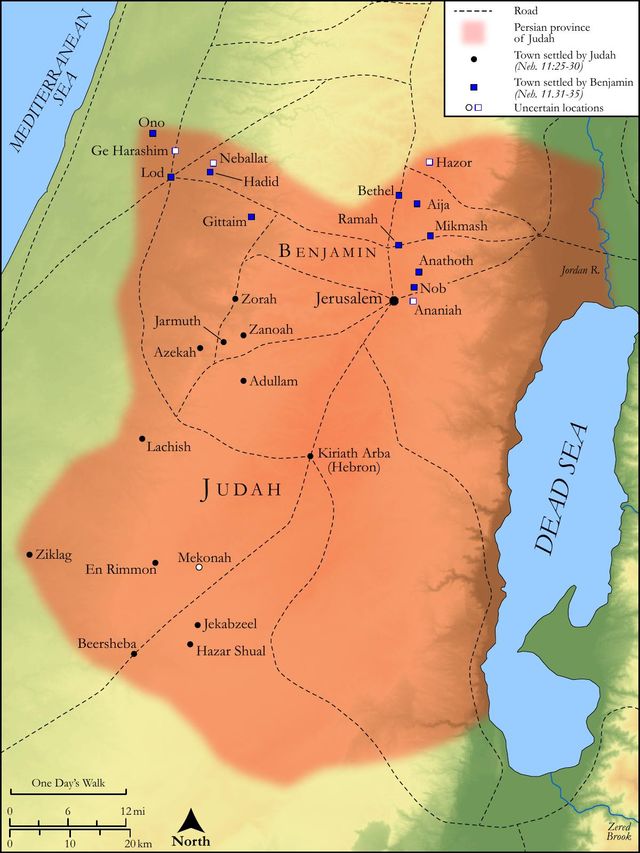
See on the biblical-era map
Study this verse
Public-domain commentary
Matthew Henry
From his Commentary on the Whole Bible. Henry comments on passages, not single verses — this entry covers Nehemiah 11:20–36.
Having given an account of the principal persons that dwelt in Jerusalem (a larger account of whom he had before, Ch1 9:2, etc.), Nehemiah, in these verses, gives us some account of the other cities, in which dwelt the residue of Israel, Neh 11:20. It was requisite that Jerusalem should be replenished, yet not so as to drain the country. The king himself is served of the field, which will do little service if there be not hands to manage it. Let there therefore be no strife, no envy, no contempt, no ill will, between the inhabitants of the cities and those of the villages; both are needful, both useful, and neither can be spared. 1. The Nethinims, the posterity of the Gibeonites, dwelt in Ophel, which was upon the wall of Jerusalem (Neh 3:26), because they were to do the servile work of the temple, which therefore they must be posted near to, that they might be ready to attend, Neh 11:21. 2. Though the Levites were dispersed through the cities of Judah, yet they had an overseer who resided in Jerusalem, superior of their order and their provincial, to whom they applied for direction, who took care of their affairs and took cognizance of their conduct, whether they did their duty, Neh 11:22. 3. Some of the singers were appointed to look after the necessary repairs of the temple, being ingenious men, and having leisure between their hours of service; they were over the business of the house of God, Neh 11:22. And, it seems, the king of Persia had such a kindness for their office that he allotted a particular maintenance for them, besides what belonged to them as Levites, Neh 11:23. 4. Here is one that was the king's commissioner at Jerusalem. He was of the posterity of Zerah (Neh 11:24); for of that family of Judah there were some new settled in Jerusalem, and not all of Pharez, as appears by that other catalogue, Ch1 9:6. He is said to be at the king's hand, or on the king's part, in all matters concerning the people, to determine controversies that arose between the king's officers and his subjects, to see that what was due to the king from the people was duly paid in and what was allowed by the king for the temple service was duly paid out, and happy it was for the Jews that one of themselves was in this post. 5. Here is an account of the villages, or country towns, which were inhabited by the residue of Israel - the towns in which the children of Judah dwelt (Neh 11:25-30), those that were inhabited by the children of Benjamin (Neh 11:31-35), and divisions for the Levites among both, Neh 11:36. We will now suppose them safe and easy, though few and poor, but by the blessing of God they were likely to increase in wealth and power, and they would have been more likely if there had not been that general profaneness among them, and lukewarmness in religion, with which they were charged in God's name by the prophet Malachi, who, it is supposed, prophesied about this time, and in whom prophecy ceased for some ages, till it revived in the great prophet and his forerunner.
Continue studying Nehemiah 11:35 across the web’s major study libraries — every link below opens this exact verse, chapter, or book on the destination site.
Read & Compare
 BibleGatewayThis verse in more than 200 translations and 70 languages.
 Bible.comThe YouVersion reader — hundreds of translations, reading plans, and highlights.
 ESV.orgCrossway's official English Standard Version reader.
 NET BibleThe NET translation with 60,000+ translators' notes on every rendering decision.
 STEP BibleTyndale House's free study tool — original text, vocabulary, and scholarly resources.
 BibliaLogos Bible Software's free web reader.
 USCCBThe New American Bible (Revised Edition) with the U.S. bishops' study notes.
Commentaries
 BibleHub CommentariesDozens of classic commentaries on this verse, gathered on one page.
 StudyLightMore than 100 commentary sets — the largest collection on the web.
 BibleRefPlain-English commentary on what this verse means, verse by verse.
 Enduring WordDavid Guzik's free commentary on this chapter, widely used by Bible teachers.
 Bible Study ToolsVerse commentary alongside Greek and Hebrew study aids.
Original Language & Research
- BibleHub InterlinearThe verse word by word — original language, transliteration, and English.
- BibleHub LexiconEvery word's original-language definition and Strong's entry.
 Blue Letter BibleDeep-study tools — Strong's numbers, concordance, and word studies.
 SefariaThe Hebrew text with Rashi and centuries of Jewish commentary.
Sermons, Hymns & Audio


TrulyRandomVerse is not affiliated with these sites and doesn’t control their content. They’re linked because they’re genuinely useful.
Summary
Nehemiah 11:35 meticulously records the re-establishment of two historically significant towns, Lod and Ono, along with the economically vital "valley of craftsmen," as part of the post-exilic repopulation efforts in Judah and Benjamin. This verse underscores the comprehensive nature of Israel's restoration, extending beyond Jerusalem to strategically re-establish stable communities and essential economic activity in the surrounding regions, thereby rebuilding the nation's social, demographic, and economic fabric after generations in Babylonian exile.
Context
ShowHideLiterary Context
Nehemiah 11 immediately follows the successful completion and dedication of Jerusalem's walls, and the profound covenant renewal ceremony detailed in Nehemiah 8-10. With the capital city secured and its spiritual foundations reaffirmed, the narrative pivots to the crucial task of repopulating not only Jerusalem itself but also the surrounding towns and villages of Judah. This chapter provides a meticulous roster of the families and leaders who settled in these areas, whether by divine lot or by voluntary commitment, demonstrating a strategic and comprehensive effort to strengthen the nation demographically and economically. The inclusion of specific towns like Lod and Ono in this detailed register highlights the widespread nature of this repopulation, extending the reach of the restored community beyond the immediate vicinity of the capital to encompass vital regional centers.
Historical & Cultural Context
The historical setting for Nehemiah 11:35 is the post-exilic period, specifically during the mid-5th century BCE under the benevolent rule of the Persian Empire. Following the devastating Babylonian conquest of Jerusalem in 586 BCE and the subsequent exile, the land of Judah lay largely desolate. The return of Jewish exiles, initiated by Persian decrees (e.g., Ezra 1:1-4), marked the beginning of a protracted process of rebuilding. Lod and Ono were ancient towns situated in the fertile plain of Sharon, northwest of Jerusalem, strategically positioned along important trade routes connecting the coast to the interior. Their repopulation was vital not only for establishing a secure Jewish presence in a historically significant region but also for re-establishing agricultural productivity and commercial activity. The mention of "the valley of craftsmen" points to a recognized hub of specialized labor, essential for providing the goods and services necessary for a rebuilding society, from tools and implements to construction materials.
Key Themes
ShowHideThis verse, embedded within the broader context of Nehemiah 11, powerfully contributes to several overarching themes central to the book. Firstly, it exemplifies the theme of Rebuilding and Restoration, illustrating God's unwavering faithfulness in bringing His people back to their ancestral land and empowering them to reconstruct their society, not merely spiritually but also physically and economically. This tangible act of resettlement is a fulfillment of prophetic promises of return and renewal (e.g., Jeremiah 29:10-14). Secondly, it emphasizes Settlement and Community, highlighting the foundational importance of establishing stable homes and functional communities as the bedrock for national identity, security, and long-term viability. The deliberate act of settling in these towns was crucial for laying down roots and ensuring the enduring presence of the post-exilic nation. Lastly, the specific mention of "the valley of craftsmen" underscores the theme of Economic Activity and Vocational Contributions, recognizing the inherent dignity of labor and the essential role of skilled trades in sustaining a thriving society. This detail demonstrates that God's comprehensive plan for His people includes their material well-being and productivity, not just their spiritual devotion.
Exposition and Analysis
ShowHideKey Word Analysis
ShowHideFrom an unused root of uncertain signification, Lod was a significant ancient town located in the plain of Sharon, northwest of Jerusalem. Its mention here, and in earlier biblical texts (e.g., 1 Chronicles 8:12) and lists of returnees from exile (e.g., Ezra 2:33), signifies the re-establishment of a vital Jewish presence in a historically important and fertile region, crucial for the demographic and economic recovery of Judah.
Prolonged from אוֹן (strength), Ono means "strong" and refers to another ancient town situated near Lod in the plain of Sharon. Like Lod, Ono appears in the lists of those who returned from Babylonian captivity (e.g., Ezra 2:33) and was linked to the tribal territory of Benjamin. Its inclusion alongside Lod reinforces the strategic importance of repopulating this specific area for both defense and economic purposes, demonstrating a concerted effort to reclaim and revitalize the land.
This term is the plural of חָרָשׁ (charash), referring to mechanics or skilled artisans. While the root (H2791, cheresh) can imply "magical craft" or "cunning," in this context, the plural form H2798 specifically denotes skilled workers such as smiths, carpenters, masons, or other tradesmen. The phrase "valley of craftsmen" (גֵּי הַחֲרָשִׁים, Ge Ha-Charashim) points to a specific geographical area renowned for its concentration of such skilled labor. This detail is highly significant, indicating a vital economic hub providing essential goods and services—from tools and weapons to pottery and construction materials—for the rebuilding community.
Verse Breakdown
ShowHide"Lod, and Ono"
These clauses identify two distinct and historically significant towns that were part of the tribal territory of Benjamin. Their joint mention in post-exilic lists of returnees underscores the deliberate and systematic efforts to repopulate not only Jerusalem but also critical outlying areas. This re-establishment of these towns was vital for reclaiming ancestral lands and strengthening the demographic presence of the returned exiles, forming a network of communities beyond the capital.
"the valley of craftsmen"
This phrase serves as a descriptive geographical and economic identifier for the region associated with Lod and Ono. It highlights the specialized economic function of this area, indicating it was a recognized center for skilled trades and manufacturing. This detail is crucial for understanding the practical aspects of the national restoration, as a thriving economy and a skilled workforce were as vital for the long-term sustainability of the nation as a secure capital and a renewed spiritual life. It signifies the re-establishment of essential economic infrastructure.
Literary Devices
ShowHideNehemiah 11:35 primarily employs Topographical Listing, a common biblical literary device used to enumerate places, tribes, or families. In this context, it meticulously documents the repopulation of Judah and Benjamin, lending legitimacy and comprehensiveness to the post-exilic restoration narrative. This detailed enumeration serves to establish a historical record and demonstrate the fulfillment of God's promises regarding the return to the land. The phrase "the valley of craftsmen" also functions as a form of Metonymy, where a characteristic (the presence of skilled artisans) stands in for the place itself, emphasizing its primary identity and economic significance. Furthermore, the inclusion of such a specific detail amidst a list of towns demonstrates Emphasis through Detail, highlighting that the restoration was not merely about physical return but about the comprehensive re-establishment of a fully functional, economically viable, and socially stable society.
Theological and Thematic Connections
ShowHideNehemiah 11:35, though seemingly a mere geographical listing, carries profound theological weight, demonstrating God's holistic concern for His people. His redemptive plan extends beyond spiritual and political restoration to encompass their physical and economic well-being. The repopulation of these towns and the re-establishment of economic centers like the "valley of craftsmen" signify God's faithfulness in providing for His covenant people, enabling them to thrive in the land He promised. This detail underscores that God's redemptive plan is comprehensive, encompassing all aspects of human life and society, ensuring that His people are not only spiritually renewed but also materially sustained and secure. It reflects the truth that God cares about the practical, everyday details of His people's lives, including their work, their communities, and their economic flourishing, all contributing to His ultimate purpose for their shalom.
Reflection and Application
ShowHideNehemiah 11:35 offers a powerful reminder that God's work of restoration often involves practical, tangible steps and the diverse contributions of His people. Just as the craftsmen of the valley were essential for rebuilding ancient Israel's infrastructure and economy, every individual's skills, talents, and vocations are invaluable in building up communities today, whether in a family, a church, or a broader society. This verse dignifies labor, affirming that all legitimate work, when performed with excellence and for the common good, contributes to God's broader purposes. It challenges us to recognize and value the often unseen, everyday contributions that sustain our communities, from the skilled artisan who builds and repairs to the dedicated caregiver who nurtures and supports. It encourages us to consider how our own unique abilities can be leveraged to foster stability, productivity, and flourishing within the spheres God has placed us, actively participating in His ongoing work of restoration and shalom in the world.
Questions for Reflection
ShowHideFAQ
ShowHideWhy are these specific towns, Lod and Ono, mentioned in such detail in Nehemiah 11?
ShowHideLod and Ono were significant ancient towns, strategically located in the fertile plain of Sharon, northwest of Jerusalem. Their detailed mention in Nehemiah 11:35 and other post-exilic lists (e.g., Ezra 2:33) highlights their importance for several reasons. Firstly, they were likely ancestral homes for some of the returning exiles, making their repopulation a return to heritage and a reclaiming of tribal lands. Secondly, their location made them crucial for re-establishing a secure and economically viable presence beyond the immediate capital, especially for agriculture and control of important trade routes. The meticulous listing underscores the comprehensive nature of the repopulation effort, demonstrating that the restoration of Judah extended far beyond Jerusalem's walls to encompass the broader tribal territories and ensure national stability.
What kind of "craftsmen" are implied by "the valley of craftsmen," and why is this detail significant for the post-exilic community?
ShowHideThe Hebrew term charashim (craftsmen) is quite broad, encompassing various skilled trades such as metalworkers (smiths), carpenters, potters, masons, weavers, and other artisans. The "valley of craftsmen" (Ge Ha-Charashim) was a region known for its concentration of these skilled workers. This detail is highly significant because it points to a vital economic hub within the post-exilic community. A thriving and self-sufficient society requires more than just farmers and soldiers; it needs skilled individuals to produce tools, build structures, create household goods, facilitate trade, and maintain infrastructure. The presence of such a specialized region indicates a level of economic organization and productivity essential for the long-term sustainability and flourishing of the restored nation. It underscores that God's plan for His people includes their material and vocational well-being, recognizing the dignity and necessity of all legitimate labor.
Christ-Centered Fulfillment
ShowHideThe physical rebuilding and repopulation of Israel, exemplified by the re-establishment of towns like Lod and Ono and the economic activity of the "valley of craftsmen," finds its ultimate spiritual fulfillment in Jesus Christ. While Nehemiah records the restoration of a physical nation and its earthly infrastructure, Christ inaugurates and builds a spiritual kingdom, His Church, which is the true Israel of God (Galatians 6:16). The meticulous listing of settlements and the emphasis on diverse contributions among the returning exiles foreshadow the New Testament understanding of the Church as a unified body with many members, each uniquely gifted and essential for its growth and flourishing (1 Corinthians 12:12-27). Jesus, the ultimate Master Builder (Matthew 16:18), is continually at work, not just restoring individuals to God through His atoning sacrifice and making them new creations (2 Corinthians 5:17-19), but also equipping His people with diverse spiritual gifts to build up one another in love and unity (Ephesians 4:11-16). The "valley of craftsmen" thus points to the rich tapestry of vocations, talents, and spiritual gifts within the body of Christ, all working together under the headship of Christ to fulfill God's redemptive purposes and extend His kingdom throughout the world.