


Numbers 34:13
Bible text: King James Version (1769 Blayney text) · Public domain
Bible text: King James Version with Strong's numbers · Public domain
Bible text: Berean Standard Bible · Public domain
Bible text: American Standard Version (1901) · Public domain
Bible text: World English Bible, Messianic edition · Public domain
Bible text: Geneva Bible (1599) · Public domain
Bible text: Young's Literal Translation · Public domain
- וַיְצַוvay·Tzavand he commandedH6680Conj-w ¦ V-Piel-ConsecImperf-3msVerb Piel Consecutive Imperfect 3rd Singular Masculineוַandיְצַוhe commanded
- מֹשֶׁהmo·ShehMosesH4872N-proper-mNoun Proper Masculine
- אֶת'et<obj.>H853DirObjMParticle Object Indicator
- בְּנֵיbe·Nei[the] people ofH1121N-mpcNoun Plural Masculine Construct
- יִשְׂרָאֵלYis·ra·'ElIsraelH3478N-properNoun Proper Location
- לֵאמֹרle·Mor<to> sayingH559Prep-l ¦ V-Qal-InfVerb Qal Infinitive Constructלֵ<to>אמֹרsaying
- זֹאתzotthisH2063PrtParticle Demonstrative
- הָאָרֶץha·'A·retz[is] the landH776Art ¦ N-fsNoun Singular Feminine Absoluteהָ[is] theאָרֶץland
- אֲשֶׁר'a·SherwhichH834RelParticle Relative
- תִּתְנַחֲלוּtit·na·cha·Luyou will inheritH5157V-Hithpael-Imperf-2mpVerb Hithpael Imperfect 2nd Plural Masculine
- אֹתָהּ'o·Tah<obj.> itH853DirObjM ¦ 3fsParticle Object Indicatorאֹתָ<obj.>הּit
- בְּגוֹרָלbe·go·Ralby lotH1486Prep-b ¦ N-msNoun Singular Masculine Absoluteבְּbyגוֹרָלlot
- אֲשֶׁר'a·SherwhichH834RelParticle Relative
- צִוָּהtzi·Vahhe has commandedH6680V-Piel-Perf-3msVerb Piel Perfect 3rd Singular Masculine
- יְהוָהYah·wehYahwehH3068N-properNoun Proper Title
- לָתֵתla·Tetto giveH5414Prep-l ¦ V-Qal-InfVerb Qal Infinitive Constructלָtoתֵתgive
- לְתִשְׁעַתle·tish·'Atto [the] nineH8672Prep-l ¦ Adj-cscAdjective Numerical Singular common gender Constructלְtoתִשְׁעַת[the] nine
- הַמַּטּוֹתha·ma·Totthe tribesH4294Art ¦ N-fpNoun Plural Feminine Absoluteהַtheמַּטּוֹתtribes
- וַחֲצִיva·cha·Tziand [the] half ofH2677Conj-w ¦ N-mscNoun Singular Masculine Constructוַandחֲצִי[the] half of
- הַמַּטֶּהha·ma·Tehthe tribeH4294Art ¦ N-msNoun Singular Masculine Absoluteהַtheמַּטֶּהtribe
English is a literal word-by-word gloss of the Hebrew, not the KJV's wording. Why?
This is the original text the KJV's translators worked from — each Hebrew word with its own literal English meaning in this verse, prepared by scholars at Tyndale House, Cambridge. The KJV translates whole sentences, not word by word, so its wording differs: one Hebrew word can become several English words, and the KJV may choose “the LORD” where the gloss reads “Yahweh”. Both are faithful — they answer different questions. For the KJV's own rendering, switch to the KJV text.
Details
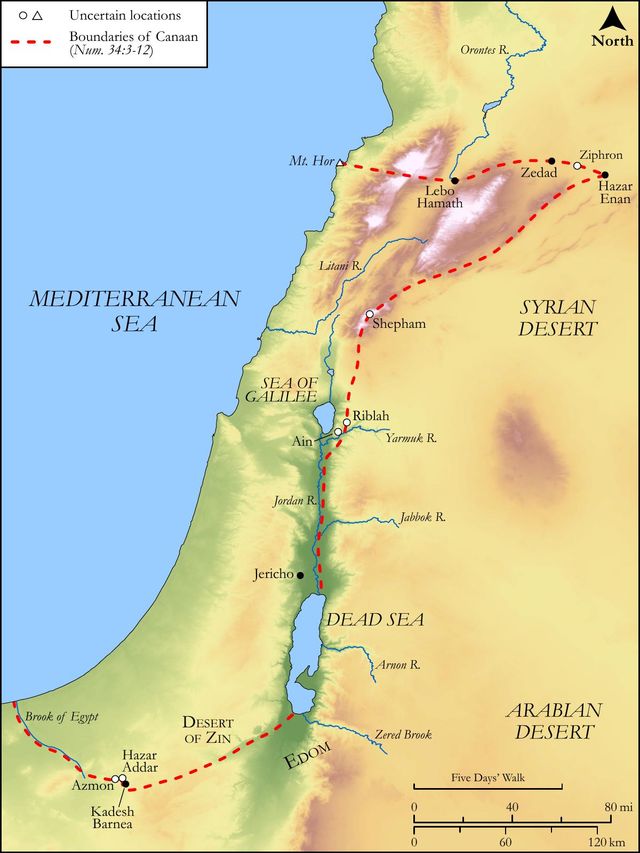
See on the biblical-era map
Study this verse
Continue studying Numbers 34:13 across the web’s major study libraries — every link below opens this exact verse, chapter, or book on the destination site.
Read & Compare
 BibleGatewayThis verse in more than 200 translations and 70 languages.
 Bible.comThe YouVersion reader — hundreds of translations, reading plans, and highlights.
 ESV.orgCrossway's official English Standard Version reader.
 NET BibleThe NET translation with 60,000+ translators' notes on every rendering decision.
 STEP BibleTyndale House's free study tool — original text, vocabulary, and scholarly resources.
 BibliaLogos Bible Software's free web reader.
 USCCBThe New American Bible (Revised Edition) with the U.S. bishops' study notes.
Commentaries
 BibleHub CommentariesDozens of classic commentaries on this verse, gathered on one page.
 StudyLightMore than 100 commentary sets — the largest collection on the web.
 BibleRefPlain-English commentary on what this verse means, verse by verse.
 Enduring WordDavid Guzik's free commentary on this chapter, widely used by Bible teachers.
 Bible Study ToolsVerse commentary alongside Greek and Hebrew study aids.
Original Language & Research
- BibleHub InterlinearThe verse word by word — original language, transliteration, and English.
- BibleHub LexiconEvery word's original-language definition and Strong's entry.
 Blue Letter BibleDeep-study tools — Strong's numbers, concordance, and word studies.
 SefariaThe Hebrew text with Rashi and centuries of Jewish commentary.
Sermons, Hymns & Audio


TrulyRandomVerse is not affiliated with these sites and doesn’t control their content. They’re linked because they’re genuinely useful.
Summary
Numbers 34:13 serves as a pivotal divine directive, delivered by Moses to the Israelites, detailing the precise method and recipients for the distribution of the Promised Land. This verse underscores the absolute sovereignty of God in the allocation of Canaan, emphasizing that the inheritance would be determined "by lot" as a direct command from the LORD. It specifically designates the nine and a half tribes who had not yet received their portion, thereby ensuring the meticulous and divinely guided fulfillment of God's ancient covenant promises for their permanent dwelling.
Context
ShowHideLiterary Context
Numbers 34:13 is intricately woven into the final legislative and narrative sections of the book of Numbers, specifically within chapters 33-36, which meticulously prepare Israel for entry into Canaan after their four decades of wilderness wandering. Chapter 33 provides a detailed itinerary of their journey, culminating at the plains of Moab. Chapter 34 then shifts to defining the precise geographical boundaries of the Promised Land, establishing the parameters for the future inheritance. This verse acts as the formal divine mandate, initiating the process of land apportionment, immediately preceding the appointment of the specific tribal leaders (Numbers 34:16-29) who would oversee this monumental task. It sets the stage for the detailed execution of the land division narratives found throughout the book of Joshua, particularly chapters 13-19.
Historical & Cultural Context
The command in Numbers 34:13 emerges at a critical historical juncture for Israel: the conclusion of their wilderness sojourn and the imminent conquest of the land promised to their forefathers. The promise of land, first given to Abraham in Genesis 12:7, was foundational to Israel's identity and their covenant relationship with Yahweh. While casting lots was a common practice for resolving disputes or making important decisions, its application in Israel carried profound theological weight. For Israel, the lot was not a game of chance but a sacred means by which God's sovereign will was revealed, ensuring an impartial, divinely sanctioned, and unchallengeable allocation. This method circumvented potential tribal conflicts and affirmed that the land was not merely a conquered territory but a direct, unearned divine gift. The explicit mention of "nine tribes, and to the half tribe" clarifies that this command applies to those who had not yet settled, distinguishing them from Reuben, Gad, and the other half of Manasseh, who had already received their inheritance east of the Jordan River, as detailed in Numbers 32:33.
Key Themes
ShowHideNumbers 34:13 powerfully contributes to several overarching themes central to the Pentateuch and the book of Numbers. Firstly, it profoundly underscores Divine Sovereignty and Faithfulness. The repeated emphasis that "the LORD commanded to give" highlights God's ultimate control over Israel's destiny and His unwavering commitment to His covenant promises, demonstrating that the land is a direct, unearned gift. The distribution "by lot" further reinforces this divine oversight, leaving no room for human manipulation or favoritism, as articulated in Proverbs 16:33. Secondly, the verse illuminates the theme of Inheritance and Possession. The land is referred to as an "inheritance" (נַחֲלָה, nachalah), signifying a permanent, generational possession and a place of rest and security after their long nomadic journey. This concept is vital to Israel's identity as God's chosen people, receiving their promised dwelling place. Thirdly, the command reflects Order and Justice. The divinely ordained lot system, while seemingly random, was understood as a mechanism for impartial and equitable distribution, preventing tribal conflict and establishing a clear, just framework for land ownership and tribal boundaries.
Exposition and Analysis
ShowHideKey Word Analysis
ShowHideThis verb, צָוָה (tsâvâh), appears twice in the verse, first describing Moses' authoritative instruction to Israel, and then the LORD's ultimate command to give the land. Its repetition emphasizes the binding, non-negotiable nature of the decree. It signifies a direct, forceful injunction from a superior to a subordinate, highlighting that the land division is not a suggestion but a divine imperative, relayed through God's chosen mediator, Moses. This underscores the absolute certainty and divine origin of the land's distribution.
The verb נָחַל (nâchal) means "to inherit," "to possess," or "to take as a possession." It carries the profound connotation of receiving something as an enduring legacy or patrimony, often from a divine source or an ancestor. In this context, it signifies that the land is not merely conquered territory to be temporarily occupied but a permanent, divinely-appointed possession, establishing the tribes' lasting and unchallengeable claim to their allocated portions. This concept is foundational to Israel's identity as God's chosen people, receiving their promised dwelling place.
The Hebrew word גּוֹרָל (gôwrâl) refers to a pebble, small stone, or object used for casting to make decisions, determine portions, or assign roles. In ancient Israel, casting lots was a sacred practice, understood as a direct means by which God's will was revealed, thereby removing human bias, favoritism, or potential for manipulation. As Proverbs 16:33 states, "The lot is cast into the lap, but its every decision is from the LORD." This method ensured that the land division was perceived as divinely ordained and therefore just, impartial, and unchallengeable.
Verse Breakdown
ShowHide"And Moses commanded the children of Israel, saying,"
This opening clause firmly establishes Moses as the divinely appointed mediator of God's will. As the leader and prophet, he is entrusted with relaying the solemn and binding divine decree to the entire assembly of Israel. This highlights the immense importance and authoritative nature of the instructions that follow, underscoring that these are not human plans but direct mandates from God Himself.
"This [is] the land which ye shall inherit by lot,"
This segment precisely identifies the subject of the command: "the land," specifically Canaan, which is to be received as an enduring "inheritance." The crucial phrase "by lot" specifies the divinely appointed, impartial method for its distribution. This method ensures that the allocation of territory to each tribe is not based on human strength, negotiation, or preference, but on God's sovereign determination, eliminating potential disputes and affirming divine justice and order.
"which the LORD commanded to give unto the nine tribes, and to the half tribe:"
This final clause explicitly states the ultimate source of the command – "the LORD" – reinforcing the divine origin and absolute authority behind the entire process. It also meticulously clarifies the specific recipients: the nine and a half tribes, distinguishing them from the tribes of Reuben, Gad, and the half-tribe of Manasseh, who had already received their inheritance on the east side of the Jordan River. This specificity underscores God's meticulous planning, His faithfulness in fulfilling His covenant promises, and His commitment to each tribal lineage.
Literary Devices
ShowHideNumbers 34:13 employs several significant literary devices that amplify its message. The Repetition of the verb "commanded" (צָוָה, tsâvâh) serves to emphasize the authoritative chain of command, flowing from God to Moses and then to Israel, thereby reinforcing the non-negotiable and binding nature of the decree. This also highlights the concept of Divine Fiat, where God's authoritative word is the ultimate force behind the land's distribution, ensuring its certainty and justice. The mention of "inherit by lot" functions as a form of Foreshadowing, anticipating the detailed and systematic land division that will take place under Joshua's leadership, meticulously recorded in the book of Joshua, particularly chapters 13-19. Furthermore, the precise and formal language used, with terms like "inherit," "lot," and "commanded," imbues the verse with Legal Language, underscoring the formal, binding, and equitable nature of the land allocation process, establishing a divine precedent for property rights, tribal boundaries, and communal order.
Theological and Thematic Connections
ShowHideNumbers 34:13 stands as a profound testament to God's unwavering faithfulness, meticulous planning, and sovereign control over the destiny of His people. The divine command to distribute the land by lot underscores that Israel's inheritance was not a result of their own merit, military prowess, or human negotiation, but a gracious and unearned gift from a covenant-keeping God. This act directly fulfills the ancient promises made to Abraham, Isaac, and Jacob, demonstrating God's steadfast commitment to providing a permanent dwelling place for His chosen nation. The impartiality of the lot system further highlights God's justice and His desire for order within the community, preventing strife and ensuring that each tribe received its divinely appointed portion. This meticulous provision for a physical inheritance serves as a powerful type, foreshadowing a greater spiritual reality for all believers.
Reflection and Application
ShowHideNumbers 34:13 offers a profound lens through which to contemplate God's character and His interaction with humanity. Just as God meticulously planned and sovereignly executed the distribution of the Promised Land to the tribes of Israel, we are invited to trust in His divine provision and guidance in our own lives. This verse serves as a powerful reminder that our "inheritance," whether material blessings, spiritual gifts, or the very path of our lives, ultimately flows from God's gracious hand and His perfect will, not from our own efforts, schemes, or perceived merits. It encourages us to surrender our plans and desires to His sovereign wisdom, knowing that His methods, though sometimes seemingly random or beyond our immediate comprehension (like casting lots), are always just, purposeful, and ultimately for our good. For believers, this fosters a deep sense of security and peace, knowing that our lives are held within the capable and faithful hands of a God who meticulously provides for His children and orchestrates all things for their ultimate good and His eternal glory.
Questions for Reflection
ShowHideFAQ
ShowHideWhy did God command the land to be divided "by lot" instead of by human decision?
ShowHideGod commanded the land to be divided "by lot" primarily to emphasize His divine sovereignty and to ensure absolute impartiality and justice in the distribution. In ancient Israel, casting lots was not viewed as a random act of chance or mere superstition, but as a sacred means by which God's will was supernaturally revealed and confirmed, as Proverbs 16:33 clearly states: "The lot is cast into the lap, but its every decision is from the LORD." This method prevented human favoritism, tribal disputes, or the allocation of land based on military strength, political influence, or personal ambition. It powerfully underscored that the land was a divine gift, not a human acquisition, and that its distribution was entirely under God's control, ensuring that each tribe received its divinely appointed and unchallengeable inheritance, thereby fostering unity and trust in His provision.
Christ-Centered Fulfillment
ShowHideNumbers 34:13, with its profound emphasis on a divinely commanded inheritance of a promised land, finds its ultimate and glorious fulfillment in Jesus Christ. While ancient Israel received a physical inheritance in the earthly Canaan, believers in Christ receive a spiritual, eternal, and imperishable inheritance that far transcends any earthly possession. Just as God "commanded to give" the land to Israel, so too has God sovereignly "commanded" to give us an inheritance in Christ, not by lot or human merit, but by grace through faith. Ephesians 1:11 declares that in Christ "we have obtained an inheritance, having been predestined according to the purpose of him who works all things according to the counsel of his will." This spiritual inheritance includes reconciliation with God, adoption into His family, the indwelling of the Holy Spirit as a guarantee (Ephesians 1:13-14), and the promise of eternal life in the new heavens and new earth, a "better country" (Hebrews 11:16). Jesus, as the true "Lamb of God who takes away the sin of the world" (John 1:29), is the one who secures this inheritance through His perfect sacrifice and resurrection, leading us into the ultimate "rest" that the earthly Canaan could only foreshadow (Hebrews 4:9-10). Thus, the meticulous planning for Israel's earthly inheritance points forward to God's perfect plan for humanity's eternal redemption and spiritual inheritance in His beloved Son.