


Numbers 34:14
Bible text: King James Version (1769 Blayney text) · Public domain
Bible text: King James Version with Strong's numbers · Public domain
Bible text: Berean Standard Bible · Public domain
Bible text: American Standard Version (1901) · Public domain
Bible text: World English Bible, Messianic edition · Public domain
Bible text: Geneva Bible (1599) · Public domain
Bible text: Young's Literal Translation · Public domain
- כִּיkiforH3588PrtParticle Conditional
- לָקְחוּla·ke·Chuthey have takenH3947V-Qal-Perf-3cpVerb Qal Perfect 3rd Plural common gender
- מַטֵּהma·Teh[the] tribe ofH4294N-mscNoun Singular Masculine Construct
- בְנֵיve·Nei[the] descendants ofH1121N-mpcNoun Plural Masculine Construct
- הָראוּבֵנִיha·r·'u·ve·Nithe Reubenite[s]H7206Art ¦ N-msNoun Gentilic Singular Masculine AbsoluteהָtheראוּבֵנִיReubenite[s]
- לְבֵיתle·Veitto [the] house ofH1004Prep-l ¦ N-mscNoun Singular Masculine Constructלְtoבֵית[the] house of
- אֲבֹתָם'a·vo·Tamtheir ancestorsH1N-fpc ¦ 3mpNoun Plural Feminine Constructאֲבֹתָancestorsםtheir
- וּמַטֵּהu·ma·Tehand [the] tribe ofH4294Conj-w ¦ N-mscNoun Singular Masculine Constructוּandמַטֵּה[the] tribe of
- בְנֵיve·nei[the] descendants ofH1121N-mpcNoun Plural Masculine Construct
- הַגָּדִיha·ga·Dithe Gadite[s]H1425Art ¦ N-msNoun Gentilic Singular Masculine AbsoluteהַtheגָּדִיGadite[s]
- לְבֵיתle·Veitto [the] house ofH1004Prep-l ¦ N-mscNoun Singular Masculine Constructלְtoבֵית[the] house of
- אֲבֹתָם'a·vo·Tamtheir ancestorsH1N-fpc ¦ 3mpNoun Plural Feminine Constructאֲבֹתָancestorsםtheir
- וַחֲצִיva·cha·Tziand [the] half ofH2677Conj-w ¦ N-mscNoun Singular Masculine Constructוַandחֲצִי[the] half of
- מַטֵּהma·Teh[the] tribe ofH4294N-mscNoun Singular Masculine Construct
- מְנַשֶּׁהme·na·ShehManassehH4519N-proper-mNoun Proper Masculine
- לָקְחוּla·ke·Chuthey have takenH3947V-Qal-Perf-3cpVerb Qal Perfect 3rd Plural common gender
- נַחֲלָתָםna·cha·la·Tamtheir inheritanceH5159N-fsc ¦ 3mpNoun Singular Feminine Constructנַחֲלָתָinheritanceםtheir
English is a literal word-by-word gloss of the Hebrew, not the KJV's wording. Why?
This is the original text the KJV's translators worked from — each Hebrew word with its own literal English meaning in this verse, prepared by scholars at Tyndale House, Cambridge. The KJV translates whole sentences, not word by word, so its wording differs: one Hebrew word can become several English words, and the KJV may choose “the LORD” where the gloss reads “Yahweh”. Both are faithful — they answer different questions. For the KJV's own rendering, switch to the KJV text.
Details
See on the biblical-era map
Study this verse
Continue studying Numbers 34:14 across the web’s major study libraries — every link below opens this exact verse, chapter, or book on the destination site.
Read & Compare
 BibleGatewayThis verse in more than 200 translations and 70 languages.
 Bible.comThe YouVersion reader — hundreds of translations, reading plans, and highlights.
 ESV.orgCrossway's official English Standard Version reader.
 NET BibleThe NET translation with 60,000+ translators' notes on every rendering decision.
 STEP BibleTyndale House's free study tool — original text, vocabulary, and scholarly resources.
 BibliaLogos Bible Software's free web reader.
 USCCBThe New American Bible (Revised Edition) with the U.S. bishops' study notes.
Commentaries
 BibleHub CommentariesDozens of classic commentaries on this verse, gathered on one page.
 StudyLightMore than 100 commentary sets — the largest collection on the web.
 BibleRefPlain-English commentary on what this verse means, verse by verse.
 Enduring WordDavid Guzik's free commentary on this chapter, widely used by Bible teachers.
 Bible Study ToolsVerse commentary alongside Greek and Hebrew study aids.
Original Language & Research
- BibleHub InterlinearThe verse word by word — original language, transliteration, and English.
- BibleHub LexiconEvery word's original-language definition and Strong's entry.
 Blue Letter BibleDeep-study tools — Strong's numbers, concordance, and word studies.
 SefariaThe Hebrew text with Rashi and centuries of Jewish commentary.
Sermons, Hymns & Audio


TrulyRandomVerse is not affiliated with these sites and doesn’t control their content. They’re linked because they’re genuinely useful.
Summary
Numbers 34:14 serves as a crucial parenthetical clarification within the detailed instructions for the division of the Promised Land west of the Jordan River. It succinctly reiterates that the tribes of Reuben and Gad, along with half of the tribe of Manasseh, had already secured and taken possession of their designated tribal inheritances on the fertile eastern side of the Jordan. This verse distinguishes their settled status from the remaining nine and a half tribes for whom the subsequent land allocation instructions are intended, providing essential context for the meticulous geographical boundaries that follow.
Context
ShowHideLiterary Context
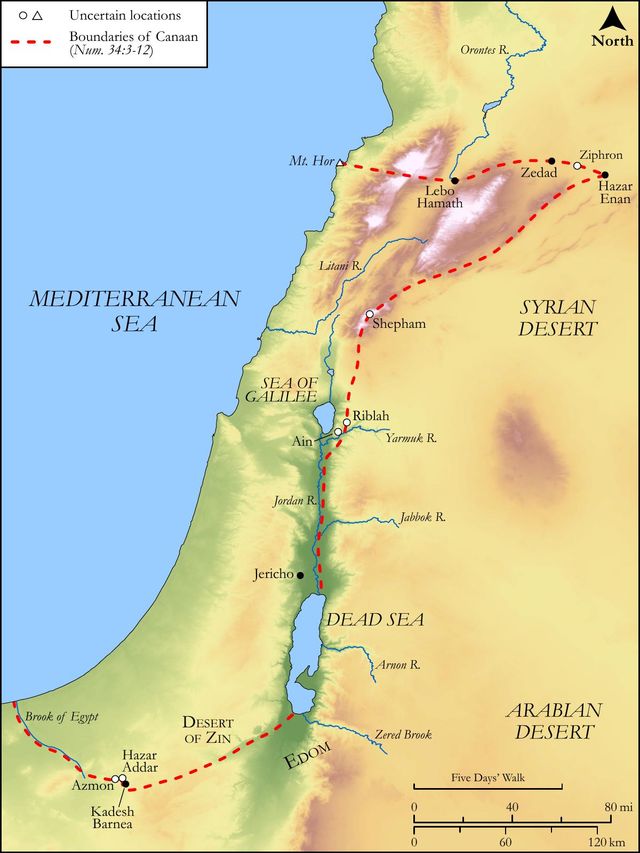
Numbers 34:14 is strategically placed within a chapter primarily devoted to outlining the precise geographical boundaries of the land of Canaan that was to be distributed among the remaining nine and a half Israelite tribes. Prior to this chapter, Numbers 33 provides a comprehensive summary of Israel's wilderness wanderings, bringing the narrative to the threshold of the Promised Land. Chapter 34 then pivots to the practicalities of settling this land. Verse 14 functions as a parenthetical note, a concise backward reference to the events detailed in Numbers 32, where the tribes of Reuben, Gad, and half of Manasseh requested and were granted their inheritance east of the Jordan River. This reminder clarifies the scope of the subsequent land division instructions, ensuring the reader understands precisely which tribes are still awaiting their portion within Canaan proper. It acts as a vital bridge, connecting the prior narrative of the Transjordan settlement with the forthcoming meticulous allocation of land in the west.
Historical & Cultural Context
The historical setting of Numbers 34 is the culmination of Israel's forty years of wilderness wandering, immediately preceding their entry into the Promised Land. The land east of the Jordan (Transjordan) had been recently conquered from Sihon, king of the Amorites, and Og, king of Bashan, as vividly recounted in Numbers 21. The tribes of Reuben and Gad, possessing vast herds of livestock, recognized the rich pasturelands of Gilead and Bashan as ideal for their economic needs and formally requested this territory as their inheritance. Moses granted their petition under the strict condition that their fighting men would cross the Jordan with the other tribes and actively participate in the conquest of Canaan before returning to their Transjordan homes, an agreement meticulously recorded in Numbers 32. This unique arrangement underscores several key cultural values of ancient Israel: the paramount importance of tribal solidarity, the sanctity of covenant faithfulness, and the understanding of land not merely as property but as a divinely allotted inheritance, absolutely crucial for tribal identity, economic stability, and the practice of their covenant relationship with Yahweh.
Key Themes
ShowHideThough brief, Numbers 34:14 contributes significantly to several overarching themes woven throughout the book of Numbers and the Pentateuch. It powerfully underscores the theme of Divine Provision and Fulfillment of Promise, as God systematically orchestrates the distribution of the promised land to Abraham's descendants, tribe by tribe, meticulously fulfilling the ancient covenant made with Abraham in passages like Genesis 12:7. The explicit mention of specific tribes also reinforces the profound theme of Tribal Identity and Inheritance, highlighting the meticulous care with which God ordered the nation's social, geographical, and familial structures. Furthermore, the implicit reference to the agreement detailed in Numbers 32 brings to the forefront the theme of Covenant Loyalty and Corporate Responsibility, demonstrating that while God remains utterly faithful to His promises, His people are simultaneously called to fulfill their obligations to Him and to one another in the collective pursuit of the divine plan for the nation.
Exposition and Analysis
ShowHideKey Word Analysis
ShowHideThis primitive word signifies a literal and immediate father, but also extends to figurative and remote applications such as a chief or forefather. In the phrase "according to the house of their fathers," it underscores the patriarchal structure of Israelite society and the foundational role of ancestral lineage in determining tribal identity and, crucially, the allocation of land. The inheritance was not merely for individuals but for the continuity of the family line and the collective identity of the tribe.
Derived from a root meaning "to build," this term primarily denotes a physical dwelling but extends broadly to encompass a family, household, or even a dynasty. In the context of "house of their fathers," it emphasizes the familial unit as the basis for tribal organization and the recipient of the inheritance. It speaks to the communal aspect of the land grant, where the land was given not to isolated individuals but to established family units that formed the larger tribal structure.
This primitive root means "to take," "to seize," or "to receive." In Numbers 34:14, its usage indicates that these tribes have already actively taken possession of their allotted portion. It implies a completed action of appropriation, distinguishing their status from the tribes who are yet to enter and conquer their designated territories west of the Jordan. The verb highlights the active role of the tribes in securing what was granted to them, even as the ultimate source of the inheritance was divine.
Verse Breakdown
ShowHide"For the tribe of the children of Reuben according to the house of their fathers"
This initial clause precisely identifies the first of the two full tribes that have already secured their inheritance. The phrase "according to the house of their fathers" profoundly emphasizes the patriarchal and familial foundation of tribal identity and the meticulous method of land allocation. The inheritance was not merely for individuals but for the entire lineage, ensuring the continuity of the tribal identity and its place within the larger Israelite nation.
"and the tribe of the children of Gad according to the house of their fathers, have received [their inheritance];"
This clause parallels the first, naming the second full tribe, Gad, and reiterating the same patriarchal basis for their land possession. The verb "have received" (implied for both Reuben and Gad) signifies their completed acquisition and settlement of the Transjordan territory. The KJV's bracketed "their inheritance" accurately infers the implied object, which is explicitly stated in the subsequent clause, reinforcing the notion of a divinely allotted portion.
"and half the tribe of Manasseh have received their inheritance:"
This final clause specifies the third group that has already settled east of the Jordan. The "half the tribe of Manasseh" refers to the distinct portion of Manasseh that chose to settle in Bashan and Gilead, separate from the other half that would receive land west of the Jordan. The repetition of "have received their inheritance" serves as a strong, concluding affirmation that these three groups are already settled and established, thereby setting them apart from the tribes for whom the remaining, detailed instructions of Numbers 34 apply.
Literary Devices
ShowHideNumbers 34:14 primarily employs Recapitulation and functions as a Parenthetical Statement. It serves as a concise summary, reiterating information previously detailed in Numbers 32, thereby reminding the reader of the unique, pre-settled status of these tribes. The verse functions as a Parenthetical Statement within the broader narrative of land division, interrupting the flow of instructions for the western territories to clarify that a significant portion of Israel has already been accounted for. This structural choice ensures clarity and prevents confusion regarding the precise scope of the subsequent detailed boundary descriptions. Furthermore, the Repetition of the concept "have received their inheritance" (or its equivalent) for each group listed emphatically underscores the completed action and the distinct, settled status of these specific tribes.
Theological and Thematic Connections
ShowHideNumbers 34:14, though seemingly an administrative detail, powerfully reinforces the overarching theme of God's unwavering faithfulness in fulfilling His covenant promises. The "inheritance" (Hebrew: nachalah) of land was the tangible manifestation of God's commitment to Abraham, Isaac, and Jacob, providing a secure and permanent dwelling place for His people. This verse highlights the orderly and meticulous nature of divine provision, demonstrating that God's plan unfolds systematically, ensuring each part of His people receives its allotted portion according to His design. It also subtly underscores the principle of corporate responsibility, as these tribes had to fulfill their part of the agreement—assisting their brethren in the conquest of Canaan—to fully secure their inheritance, reflecting the reciprocal nature of the covenant relationship and the interconnectedness of the entire community.
Reflection and Application
ShowHideNumbers 34:14, while deeply rooted in ancient Israel's land distribution, offers profound and enduring lessons for contemporary believers. It serves as a powerful reminder of God's meticulous care and unwavering faithfulness in fulfilling His promises, not just in a broad, general sense, but specifically for each individual and community within His divine plan. Just as He ensured every tribe received its designated portion, God has a unique plan and provision for our lives, an "inheritance" that is both spiritual and practical. This verse also implicitly calls us to embrace communal responsibility. The tribes of Reuben, Gad, and half-Manasseh, having secured their own blessing and immediate needs, were still obligated by covenant to assist their brethren in conquering the land west of the Jordan. This principle of mutual support, unwavering commitment to a shared vision, and faithfulness to agreements remains vitally important for the church today. We are called to use our blessings, gifts, and resources not solely for our own benefit, but to actively contribute to the flourishing of the wider body of Christ and the advancement of God's kingdom, even when our immediate needs are met. Our individual "inheritances" and blessings are often intricately intertwined with the corporate well-being and mission of God's people.
Questions for Reflection
ShowHideFAQ
ShowHideWhy were Reuben, Gad, and half of Manasseh given land east of the Jordan, and what was the significance of this?
ShowHideThese tribes were granted land east of the Jordan River (Transjordan) primarily because they possessed a great number of livestock and found the fertile plains of Gilead and Bashan exceptionally suitable for grazing. Their detailed request and Moses's response are recorded in Numbers 32. The significance of this arrangement was multifaceted: it demonstrated God's flexible and gracious provision within His overarching plan for the land; it highlighted the importance of tribal identity and economic needs; and, crucially, it underscored the principle of corporate responsibility. Moses granted their request on the strict condition that their fighting men would cross the Jordan with the other tribes and actively assist in the conquest of the land of Canaan before returning to their eastern inheritance. This agreement ensured tribal unity and mutual support in the fulfillment of God's command to possess the entire Promised Land.
Does this verse imply that the Transjordan tribes were somehow less favored or outside the "Promised Land"?
ShowHideNot necessarily. While the primary "Promised Land" often refers to Canaan proper (west of the Jordan), the Transjordan region was also territory conquered by divine assistance from Sihon and Og, as seen in Numbers 21. The text consistently refers to their eastern settlements as their "inheritance," indicating it was a legitimate, divinely sanctioned portion. However, their geographical location did create some distinctions—both geographical and, at times, cultural—from the tribes west of the Jordan, which occasionally led to challenges in maintaining full unity, as hinted at in passages like Joshua 22. Nevertheless, from the perspective of Numbers 34:14, their inheritance was fully recognized and established by divine decree.
What is the difference between "inheritance" and "possession" in this context?
ShowHideIn the biblical context, "inheritance" (Hebrew: nachalah) refers to the divinely allotted portion of land, a heritage given by God. It signifies the inherent right or claim to the land based on God's covenant promise and tribal allocation. "Possession" (often implied by verbs like laqach "to take" or yarash "to inherit/possess") refers to the actual physical occupation, settlement, and control of that land. Numbers 34:14 states that these tribes "have received" (meaning they have taken possession of) their inheritance, indicating that they have not only been allotted it but have actively moved in, settled, and begun to benefit from it. This distinguishes them from the tribes who are yet to receive and possess their portions west of the Jordan, highlighting that the inheritance is the divine gift, while possession is the human act of occupying and benefiting from that gift.
Christ-Centered Fulfillment
ShowHideNumbers 34:14, with its focus on a divinely appointed "inheritance" and the orderly provision of land for Israel, finds its ultimate and profound fulfillment in Christ. The earthly inheritance of Canaan, though profoundly significant for the nation of Israel, was ultimately a shadow and type of a greater, spiritual reality. Believers in Christ receive an "inheritance" that is "imperishable, undefiled, and unfading, kept in heaven" for them (1 Peter 1:4). Just as the tribes of Israel received their portion by divine decree and promise, so too are believers "chosen in Him before the foundation of the world" to receive a glorious spiritual inheritance in Christ (Ephesians 1:4). This inheritance is not a piece of land but participation in the very life and eternal kingdom of God, secured definitively through the ultimate sacrifice of the Lamb of God, who takes away the sin of the world. The communal responsibility seen in the Transjordan tribes' commitment to help their brethren conquer the land foreshadows the profound unity of the body of Christ, where believers, having received their spiritual blessings and gifts, are called to live in mutual service and love, actively building up the church in love (Ephesians 4:16). Ultimately, Christ Himself is the true "rest" and "land" for His people, providing eternal security, abundant life, and a spiritual dwelling place that far surpasses any earthly territory (Hebrews 4:9-10).