


Numbers 34:15
Bible text: King James Version (1769 Blayney text) · Public domain
Bible text: Berean Standard Bible · Public domain
Bible text: American Standard Version (1901) · Public domain
Bible text: World English Bible, Messianic edition · Public domain
Bible text: Geneva Bible (1599) · Public domain
Bible text: Young's Literal Translation · Public domain
- שְׁנֵיshe·Nei[the] twoH8147Adj-cdcAdjective Numerical Dual common gender Construct
- הַמַּטּוֹתha·ma·Totthe tribesH4294Art ¦ N-fpNoun Plural Feminine Absoluteהַtheמַּטּוֹתtribes
- וַחֲצִיva·cha·Tziand [the] half ofH2677Conj-w ¦ N-mscNoun Singular Masculine Constructוַandחֲצִי[the] half of
- הַמַּטֶּהha·ma·Tehthe tribeH4294Art ¦ N-msNoun Singular Masculine Absoluteהַtheמַּטֶּהtribe
- לָקְחוּla·ke·Chuthey have takenH3947V-Qal-Perf-3cpVerb Qal Perfect 3rd Plural common gender
- נַחֲלָתָםna·cha·la·Tamtheir inheritanceH5159N-fsc ¦ 3mpNoun Singular Feminine Constructנַחֲלָתָinheritanceםtheir
- מֵעֵבֶרme·'E·verfrom [the] other sideH5676Prep-m ¦ N-mscNoun Singular Masculine Constructמֵfromעֵבֶר[the] other side
- לְיַרְדֵּןle·yar·Denof [the] JordanH3383Prep-l ¦ N-properNoun Proper Locationלְofיַרְדֵּן[the] Jordan
- יְרֵחוֹye·re·Choof JerichoH3405N-properNoun Proper Location
- קֵדְמָהKe·de·maheast -wardH6924N-ms ¦ SfxNoun Singular Masculine Absoluteקֵדְמָeastה-ward
- מִזְרָחָהmiz·Ra·chaheast -wardH4217N-ms ¦ SfxNoun Singular Masculine Absoluteמִזְרָחָeastה-ward
English is a literal word-by-word gloss of the Hebrew, not the KJV's wording. Why?
This is the original text the KJV's translators worked from — each Hebrew word with its own literal English meaning in this verse, prepared by scholars at Tyndale House, Cambridge. The KJV translates whole sentences, not word by word, so its wording differs: one Hebrew word can become several English words, and the KJV may choose “the LORD” where the gloss reads “Yahweh”. Both are faithful — they answer different questions. For the KJV's own rendering, switch to the KJV text.
Details
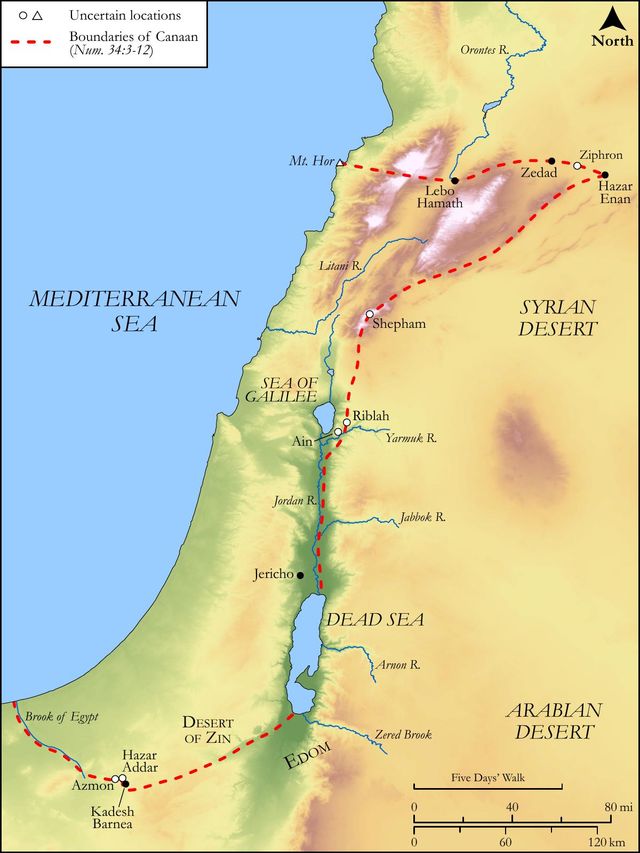
See on the biblical-era map
Study this verse
Continue studying Numbers 34:15 across the web’s major study libraries — every link below opens this exact verse, chapter, or book on the destination site.
Read & Compare
 BibleGatewayThis verse in more than 200 translations and 70 languages.
 Bible.comThe YouVersion reader — hundreds of translations, reading plans, and highlights.
 ESV.orgCrossway's official English Standard Version reader.
 NET BibleThe NET translation with 60,000+ translators' notes on every rendering decision.
 STEP BibleTyndale House's free study tool — original text, vocabulary, and scholarly resources.
 BibliaLogos Bible Software's free web reader.
 USCCBThe New American Bible (Revised Edition) with the U.S. bishops' study notes.
Commentaries
 BibleHub CommentariesDozens of classic commentaries on this verse, gathered on one page.
 StudyLightMore than 100 commentary sets — the largest collection on the web.
 BibleRefPlain-English commentary on what this verse means, verse by verse.
 Enduring WordDavid Guzik's free commentary on this chapter, widely used by Bible teachers.
 Bible Study ToolsVerse commentary alongside Greek and Hebrew study aids.
Original Language & Research
- BibleHub InterlinearThe verse word by word — original language, transliteration, and English.
- BibleHub LexiconEvery word's original-language definition and Strong's entry.
 Blue Letter BibleDeep-study tools — Strong's numbers, concordance, and word studies.
 SefariaThe Hebrew text with Rashi and centuries of Jewish commentary.
Sermons, Hymns & Audio


TrulyRandomVerse is not affiliated with these sites and doesn’t control their content. They’re linked because they’re genuinely useful.
Summary
Numbers 34:15 serves as a definitive concluding statement within the detailed instructions for Israel's land distribution, confirming the prior allocation of territory to the tribes of Reuben, Gad, and the half-tribe of Manasseh. This verse precisely situates their inheritance on the eastern side of the Jordan River, near Jericho, and specifies its eastward orientation. It underscores the meticulous fulfillment of God's covenantal promise of land, acknowledging the unique arrangement for these tribes as an integral part of the broader divine plan for Israel's settlement.
Context
ShowHideLiterary Context
Numbers chapter 34 meticulously details the divinely ordained boundaries for the land of Canaan, which was to be distributed among the nine and a half tribes settling west of the Jordan River. This chapter follows the census in Numbers 26 that determined the population for land division and precedes the instructions for the cities of refuge and Levitical towns in Numbers 35. Verse 15 functions as a crucial parenthetical reminder or concluding note, explicitly stating that the two and a half tribes (Reuben, Gad, and half of Manasseh) had already received their inheritance. Their request and Moses' conditional approval for settling in the fertile Transjordan region are thoroughly documented in Numbers 32, making Numbers 34:15 a vital cross-reference that ties together the narrative of land acquisition, highlighting the distinct yet integrated nature of their inheritance within God's overall plan for Israel.
Historical & Cultural Context
The period described in Numbers marks Israel's transition from four decades of nomadic existence in the wilderness to a settled life in the Promised Land. Land ownership was not merely an economic or political matter but a profound theological concept, representing the tangible fulfillment of God's covenant promises to Abraham, Isaac, and Jacob (e.g., Genesis 12:7). The request of the tribes of Reuben and Gad, along with half of Manasseh, to settle east of the Jordan was driven by the region's suitability for their large livestock, as detailed in Numbers 32:1-5. Culturally, land inheritance was paramount, establishing tribal identity, family lineage, and economic stability, ensuring the continuity of the Israelite social structure. The phrase "toward the sunrising" was a common and universally understood geographical marker in Hebrew speech, precisely indicating the eastern direction and emphasizing the specific location of their granted territory relative to the Jordan River and the central land of Canaan.
Key Themes
ShowHideThis verse contributes to several overarching themes within Numbers and the Pentateuch. Firstly, it underscores Divine Faithfulness and Covenant Fulfillment, demonstrating God's unwavering commitment to providing the promised land for His people, even accommodating specific tribal requests within His larger design, as foreshadowed in Genesis 15:18. Secondly, it highlights the theme of Tribal Identity and Inheritance, emphasizing the meticulous distribution of land as foundational to the social and political structure of Israel. Each tribe received a distinct, divinely appointed territory, reinforcing their unique identity while contributing to the unity of the nation. Lastly, it subtly introduces the theme of Choice and Consequence, as the decision of these tribes to settle outside the primary land of Canaan would later lead to unique challenges, including a degree of geographical and, at times, spiritual separation from the rest of Israel, as evidenced by events like the altar dispute in Joshua 22.
Exposition and Analysis
ShowHideKey Word Analysis
ShowHide(nachălâh), this term signifies more than mere property ownership. It denotes a divinely allotted possession, a permanent and inalienable share of the land promised by God. For Israel, their "inheritance" was a tangible manifestation of God's covenant faithfulness and their identity as His chosen people. It was a gift from God, not something earned, and was meant to be passed down through generations, ensuring the continuity of the tribal and family structure within the Promised Land.
(Yardên), meaning "a descender," this refers to the principal river of Palestine. In this context, it serves as the crucial geographical dividing line. The reference to "this side Jordan" (H5676, ʻêber) specifically indicates the eastern bank, distinguishing the territory of these tribes from the main land of Canaan to the west. The Jordan River was not just a physical barrier but also held symbolic significance, marking the boundary of the primary covenantal land.
This phrase combines two terms to provide a precise geographical orientation. Qedem (H6924) refers to the front or the east, often used adverbially for "eastward." Mizrâch (H4217), from the root "to rise," specifically denotes the sunrise, hence "the east." Together, they form a clear and unambiguous directional marker for "east," specifically the direction from which the sun rises. In the context of the Jordan River, it firmly places the territory of these tribes on the Transjordanian plateau, distinct from the land west of the Jordan that constituted the heart of Canaan. This detail emphasizes the exactness of the land distribution as ordained by God.
Verse Breakdown
ShowHide"The two tribes and the half tribe"
This refers specifically to the tribes of Reuben and Gad, and the half-tribe of Manasseh. These were the tribes whose leaders had approached Moses with the request to settle in the fertile pasturelands east of the Jordan, which they had already conquered (as detailed in Numbers 32). The precise enumeration highlights the meticulous nature of the land allocation.
"have received their inheritance"
This phrase indicates a completed action, emphasizing that the land allocation for these specific tribes was already a settled matter. It underscores the divine provision and the fulfillment of God's promise to provide land for His people, even before the full conquest of Canaan. The use of "inheritance" highlights the theological significance of this land as a permanent, divinely-granted possession, a gift from God to His covenant people.
"on this side Jordan near Jericho eastward, toward the sunrising"
This provides the precise geographical location of their received territory. "On this side Jordan" refers to the eastern bank, indicating the land beyond the river from the perspective of the main Promised Land. "Near Jericho" specifies the proximity to a key city on the western bank, serving as a prominent landmark for orientation. "Eastward, toward the sunrising" further clarifies the direction, firmly situating their land in the Transjordan region, facing the rising sun relative to the main land of Canaan. This detail reinforces the meticulous nature of God's plan for His people's settlement, leaving no ambiguity about the boundaries.
Literary Devices
ShowHideThe verse employs Geographical Precision to clearly delineate the boundaries and location of the tribes' inheritance, using specific markers like "Jordan," "Jericho," and "eastward." This precision underscores the tangible and concrete nature of God's promises and their fulfillment. The phrase "toward the sunrising" is a common biblical Idiom for "east," which adds a poetic yet practical descriptive element to the geographical details, universally understood in Hebrew speech. The Repetition of the concept of "inheritance" throughout Numbers and other books of the Pentateuch emphasizes its profound theological significance as a divine gift and a permanent possession, reinforcing God's faithfulness to His covenant and the security of His provision.
Theological and Thematic Connections
ShowHideNumbers 34:15 stands as a powerful testament to God's meticulous faithfulness in fulfilling His covenant promises to Israel, particularly the promise of land. It demonstrates that God's plan is comprehensive, accounting for the unique circumstances and requests of His people while maintaining His overarching design for their inheritance. This verse shows that God's provision is not generic but specific, detailed, and perfectly aligned with His sovereign will. It reminds us that God is a God of order, who carefully allocates and establishes boundaries, both physical and spiritual, for His people. The granting of this inheritance, even before the full conquest of Canaan, highlights the certainty of God's word and the reliability of His divine decrees, assuring Israel of their future in the land.
Reflection and Application
ShowHideNumbers 34:15, while seemingly a dry geographical detail, offers profound insights for contemporary believers. It reminds us that God is a God of faithful provision and meticulous planning, who works out His purposes even through human requests and choices. Just as He provided a physical inheritance for the tribes of Israel, He has also prepared a spiritual and eternal inheritance for us through Christ. This verse encourages us to trust in God's detailed plans for our lives, even when our paths or callings might seem to diverge from what is conventional or expected. It subtly highlights the importance of discerning our unique "territory" or calling within the broader body of Christ, recognizing that different roles and locations can still contribute to the overall unity and purpose of God's people. Our ultimate security and belonging are found not in a physical location but in our relationship with the One who grants all inheritance, our heavenly Father.
Questions for Reflection
ShowHideFAQ
ShowHideWhy did these tribes settle east of the Jordan, and was it part of God's original plan?
ShowHideThe tribes of Reuben, Gad, and half of Manasseh requested to settle east of the Jordan because the land was well-suited for their large herds of livestock, as they saw its fertile pasturelands (see Numbers 32:1-5). While God's initial promise to Abraham focused on the land west of the Jordan, Moses, under divine guidance, granted their request on the condition that they would first join the other tribes in conquering the land of Canaan. Thus, it became part of God's unfolding plan, demonstrating His flexibility and willingness to work within human choices, provided they align with His greater purposes of faithfulness and covenant fulfillment.
What were the long-term implications of their choice to settle east of the Jordan?
ShowHideThe decision of these tribes to settle east of the Jordan had significant long-term implications. Geographically, they were separated from the main body of Israel by the Jordan River, which served as a natural barrier. This often led to a degree of isolation and, at times, spiritual drift, as they were more exposed to foreign influences from the east. Historically, they were among the first to be attacked and carried into exile by Assyrian forces (e.g., 1 Chronicles 5:26). Spiritually, their distinct location sometimes led to misunderstandings with the western tribes, as seen in the incident of the altar in Joshua 22, where their actions were initially perceived as apostasy. Despite these challenges, they remained part of Israel, and their story serves as a reminder of the complexities of living out one's faith in distinct circumstances and the importance of maintaining unity in the body of God's people.
Christ-Centered Fulfillment
ShowHideWhile Numbers 34:15 details a physical land inheritance, its deeper theological resonance finds its ultimate fulfillment in Christ. The land of Canaan, though a tangible promise, was always a shadow of a greater, spiritual rest and inheritance that God intended for His people. Just as the tribes received their allotted portion, believers in Christ receive an imperishable inheritance, "reserved in heaven for you" (1 Peter 1:4). Jesus is the true "Promised Land," in whom all of God's promises find their "Yes" and "Amen" (2 Corinthians 1:20). He is our ultimate rest, our true dwelling place, and the source of all spiritual blessings, granting us an inheritance "in the light" (Colossians 1:12). Through faith in Him, we are not merely given a plot of land, but are made heirs with Christ, receiving the Holy Spirit as a down payment of our glorious future in God's eternal kingdom (Ephesians 1:11-14). The meticulous division of land in Numbers foreshadows the precise and perfect provision of salvation and eternal life offered through the finished work of the Lamb of God, who leads us to our true, heavenly inheritance (Hebrews 9:15).