


Ezekiel 47:22
Bible text: King James Version (1769 Blayney text) · Public domain
Bible text: King James Version with Strong's numbers · Public domain
Bible text: Berean Standard Bible · Public domain
Bible text: American Standard Version (1901) · Public domain
Bible text: World English Bible, Messianic edition · Public domain
Bible text: Geneva Bible (1599) · Public domain
Bible text: Young's Literal Translation · Public domain
- וְהָיָהve·ha·Yahand it will beH1961Conj-w ¦ V-Qal-ConsecPerf-3msVerb Qal Consecutive Perfect 3rd Singular Masculineוְandהָיָהit will be
- תַּפִּלוּta·Pi·luyou will make fallH5307V-Hiphil-Imperf-2mpVerb Hiphil Imperfect 2nd Plural Masculine
- אוֹתָהּ'o·Tah<obj.> itH853DirObjM ¦ 3fsParticle Object Indicatorאוֹתָ<obj.>הּit
- בְּנַחֲלָהbe·na·cha·Lah<in> an inheritanceH5159Prep-b ¦ N-fsNoun Singular Feminine Absoluteבְּ<in>נַחֲלָהan inheritance
- לָכֶםla·Khemfor yourselvesPrep-l ¦ 2mpSuffix Personal 2nd Plural Masculineלָforכֶםyourselves
- וּלְהַגֵּרִיםu·le·ha·ge·Rimand for the sojournersH1616Conj-w ¦ Prep-l ¦ Art ¦ N-mpNoun Plural Masculine Absoluteוּandלְforהַtheגֵּרִיםsojourners
- הַגָּרִיםha·ga·Rimwho sojournH1481Art ¦ V-Qal-Prtcpl-mpVerb Qal Participle Plural Masculine Absoluteהַwhoגָּרִיםsojourn
- בְּתוֹכְכֶםbe·tokh·Khemin midst of youH8432Prep-b ¦ N-msc ¦ 2mpNoun Singular Masculine Constructבְּinתוֹכְmidst ofכֶםyou
- אֲשֶׁר'a·SherwhoH834RelParticle Relative
- הוֹלִדוּho·Li·duthey have fatheredH3205V-Hiphil-Perf-3cpVerb Hiphil Perfect 3rd Plural common gender
- בָנִיםva·NimchildrenH1121N-mpNoun Plural Masculine Absolute
- בְּתוֹכְכֶםbe·tokh·Khemin midst of youH8432Prep-b ¦ N-msc ¦ 2mpNoun Singular Masculine Constructבְּinתוֹכְmidst ofכֶםyou
- וְהָיוּve·ha·Yuand they will beH1961Conj-w ¦ V-Qal-ConsecPerf-3cpVerb Qal Consecutive Perfect 3rd Plural common genderוְandהָיוּthey will be
- לָכֶםla·Khemto youPrep-l ¦ 2mpSuffix Personal 2nd Plural Masculineלָtoכֶםyou
- כְּאֶזְרָחke·'ez·Rachlike [the] native-bornH249Prep-k ¦ N-msNoun Singular Masculine Absoluteכְּlikeאֶזְרָח[the] native-born
- בִּבְנֵיbiv·Neiamong [the] people ofH1121Prep-b ¦ N-mpcNoun Plural Masculine Constructבִּamongבְנֵי[the] people of
- יִשְׂרָאֵלYis·ra·'ElIsraelH3478N-properNoun Proper Location
- אִתְּכֶם'i·te·Khemwith youH854Prep ¦ 2mpPrepositionאִתְּwithכֶםyou
- יִפְּלוּyi·pe·Luthey will fallH5307V-Qal-Imperf-3mpVerb Qal Imperfect 3rd Plural Masculine
- בְנַחֲלָהve·na·cha·Lah<in> an inheritanceH5159Prep-b ¦ N-fsNoun Singular Feminine Absoluteבְ<in>נַחֲלָהan inheritance
- בְּתוֹךְbe·Tokhin amongH8432Prep-b ¦ N-mscNoun Singular Masculine Constructבְּinתוֹךְamong
- שִׁבְטֵיshiv·Tei[the] tribes ofH7626N-mpcNoun Plural Masculine Construct
- יִשְׂרָאֵלYis·ra·'ElIsraelH3478N-properNoun Proper Location
English is a literal word-by-word gloss of the Hebrew, not the KJV's wording. Why?
This is the original text the KJV's translators worked from — each Hebrew word with its own literal English meaning in this verse, prepared by scholars at Tyndale House, Cambridge. The KJV translates whole sentences, not word by word, so its wording differs: one Hebrew word can become several English words, and the KJV may choose “the LORD” where the gloss reads “Yahweh”. Both are faithful — they answer different questions. For the KJV's own rendering, switch to the KJV text.
Details
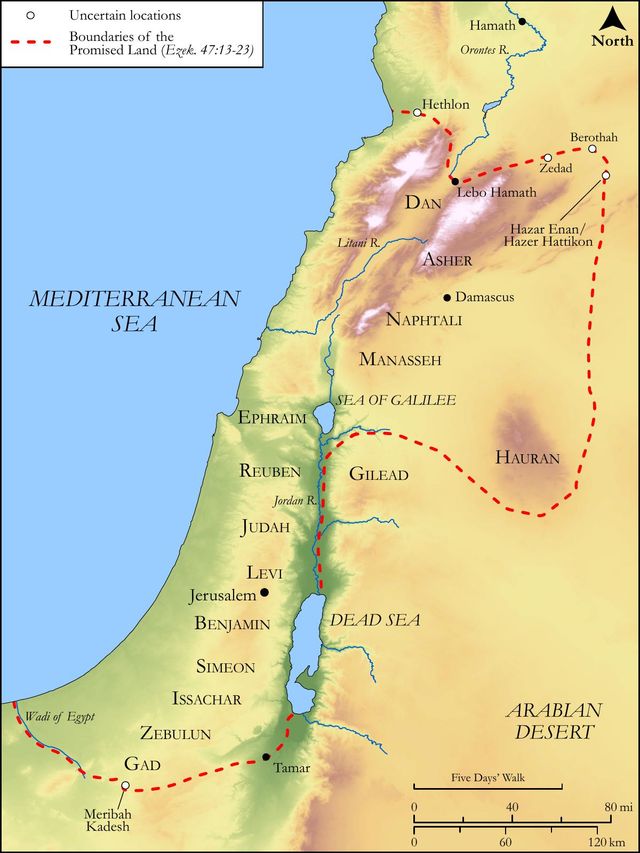
See on the biblical-era map
Study this verse
Public-domain commentary
Matthew Henry
From his Commentary on the Whole Bible. Henry comments on passages, not single verses — this entry covers Ezekiel 47:13–23.
We are now to pass from the affairs of the sanctuary to those of the state, from the city to the country. 1. The Land of Canaan is here secured to them for an inheritance (Eze 47:14): I lifted up my hand to give it unto your fathers, that is, promised it upon oath to them and their posterity. Though the possession had been a great while discontinued, yet God had not forgotten his oath which he swore to their fathers. Though God's providences may for a time seem to contradict his promises, yet the promise will certainly take place at last, for God will be ever mindful of his covenant. I lifted up my hand to give it, and therefore it shall without fail fall to you for an inheritance. Thus the heavenly Canaan is sure to all the seed, because it is what God, who cannot lie, has promised. 2. It is here circumscribed, and the bounds and limits of it are fixed, which they must not pass over to encroach upon their neighbours and which their neighbours shall not break through to encroach upon them. We had such a draught of the borders of Canaan when Joshua was to put the people in possession of it, Num 34:1, etc. That begins with the salt sea in the south, goes round and ends there. This begins with Hamath about Damascus in the north, and so goes round and ends there, Eze 47:20. Note, It is God that appoints the bounds of our habitation; and his Israel shall always have cause to say that the lines have fallen to them in pleasant places. The lake of Sodom is here called the east sea, for it, being healed by the waters of the sanctuary, it is no more to be called a salt sea, as it was in Numbers. 3. It is here ordered to be divided among the tribes of Israel, reckoning Joseph for two tribes, to make up the number of twelve, when Levi was taken out to attend the sanctuary, and had his lot adjoining to that (Eze 47:13, Eze 47:21): You shall inherit it, one as well as another, Eze 47:14. The tribes shall have an equal share, one as much as another. As the tribes returned out of Babylon, this seems unequal, because some tribes were much more numerous than the other, and indeed the most were of Judah and Benjamin and very few of the other ten tribes; but as the twelve tribes stand, in type and vision, for the gospel-church, the Israel of God, it was very equal, because we find in another vision an equal number of each of the twelve tribes sealed for the living God, just 12,000 of each, Rev 7:5, etc. And to those sealed ones these allotments did belong. It intimates likewise that all the subjects of Christ's kingdom have obtained like precious faith. Male and female, Jew and Gentile, bond and free, are all alike welcome to Christ and made partakers of him. 4. The strangers who sojourn among them, who shall beget children and be built up into families, and so help to people their country, shall have inheritance among the tribes, as if they had been native Israelites (Eze 47:22, Eze 47:23), which was by no means allowed in Joshua's division of the land. This is an act for a general naturalization, which would teach the Jews who was their neighbour, not those only of their own nation and religion, but those, whoever they were, that they had an opportunity of showing kindness to, because from them they would be willing to receive kindness. It would likewise invite strangers to come and settle among them, and put themselves under the wings of the divine Majesty. But it certainly looks at gospel-times, when the partition-wall between Jew and Gentile was taken down, and both one in Christ, in whom there is no difference, Rom 10:12. This land was a type of the heavenly Canaan, that better country (Heb 11:16), in which believing Gentiles shall have a blessed lot, as well as believing Jews, Isa 56:3.
Historical interpretation
Historical reception
1 surviving comment on this verse from the historical church.
(Verse 21 onwards) And you shall divide this land among yourselves into the tribes of Israel, and you shall allocate it as an inheritance to yourselves and to the foreigners who have joined you and have children born among you. They shall be considered as natives among the children of Israel and shall share in the possession with you among the tribes of Israel. In whatever tribe a foreigner resides, you shall give them an inheritance there, says the Lord God. By this chapter, we learn (and it is a refutation of the Jewish objections) that there is no distinction between the people of Israel and the Gentiles. For if the foreigners and strangers come with those who are from the people of Israel, that is to say, with the indigenous people, the land is divided; there is no doubt that it is the same inheritance of the people of the Gentiles and the people of the Jews: however, if they have converted to the worship of the God of Israel, which is properly called Christian, having the Jews as possessors of the letter of the Law, and us of the spirit: they hold on to the membranes, and we to him who is written in the membranes. And with Moses the land is divided by lot; but here, as we have said, it is delegated by the judgment of the Lord: and there is one possession for the stranger and the Israelite, and an inheritance is given in each tribe, at the command of the Lord God.
Continue studying Ezekiel 47:22 across the web’s major study libraries — every link below opens this exact verse, chapter, or book on the destination site.
Read & Compare
 BibleGatewayThis verse in more than 200 translations and 70 languages.
 Bible.comThe YouVersion reader — hundreds of translations, reading plans, and highlights.
 ESV.orgCrossway's official English Standard Version reader.
 NET BibleThe NET translation with 60,000+ translators' notes on every rendering decision.
 STEP BibleTyndale House's free study tool — original text, vocabulary, and scholarly resources.
 BibliaLogos Bible Software's free web reader.
 USCCBThe New American Bible (Revised Edition) with the U.S. bishops' study notes.
Commentaries
 BibleHub CommentariesDozens of classic commentaries on this verse, gathered on one page.
 StudyLightMore than 100 commentary sets — the largest collection on the web.
 BibleRefPlain-English commentary on what this verse means, verse by verse.
 Enduring WordDavid Guzik's free commentary on this chapter, widely used by Bible teachers.
 Bible Study ToolsVerse commentary alongside Greek and Hebrew study aids.
Original Language & Research
- BibleHub InterlinearThe verse word by word — original language, transliteration, and English.
- BibleHub LexiconEvery word's original-language definition and Strong's entry.
 Blue Letter BibleDeep-study tools — Strong's numbers, concordance, and word studies.
 SefariaThe Hebrew text with Rashi and centuries of Jewish commentary.
Sermons, Hymns & Audio


TrulyRandomVerse is not affiliated with these sites and doesn’t control their content. They’re linked because they’re genuinely useful.
Summary
Ezekiel 47:22 unveils a transformative vision for the restored community of Israel, decreeing that the land, allocated by divine lot, will be inherited not only by native-born Israelites but also by the "strangers that sojourn among you." These foreigners, who have settled and raised families within the community, are to be granted full and equal inheritance rights, treated "as born in the country." This stipulation looks ahead to the gathering of the nations into God's people, which Paul declares fulfilled in Christ, in whom the Gentiles are fellow heirs and of the same body.
Context
ShowHideLiterary Context
This verse is deeply embedded within Ezekiel's climactic vision of restoration, spanning chapters 40-48. Following the detailed architectural blueprints for the new temple (chapters 40-43) and the regulations for its worship and priesthood (chapters 44-46), chapter 47 shifts focus to the miraculous, life-giving river flowing from the temple, symbolizing spiritual healing and abundance for the land. After describing the river's transformative power, the chapter transitions to the re-division of the land among the twelve tribes, outlining the precise boundaries. Verse 22 then introduces a groundbreaking divine directive concerning the distribution of this land, immediately after the general principles of tribal inheritance. Its placement underscores its theological weight, presenting a radical departure from previous norms and emphasizing an unprecedented level of inclusion within the divinely re-established Israel.
Historical & Cultural Context
Ezekiel prophesied during the Babylonian exile, a period of profound national trauma where the people had lost their land, temple, and sense of identity. In pre-exilic Israel, land inheritance was meticulously tied to tribal lineage, forming the bedrock of Israelite identity and economic stability, as outlined in texts like Numbers 26:52-56. While Mosaic Law commanded compassionate and just treatment for resident aliens (Hebrew: gerim), often reminding Israelites of their own past as sojourners in Egypt (e.g., Deuteronomy 10:19), these gerim were generally excluded from land ownership, which remained the exclusive domain of the Israelite tribes. Ezekiel's vision, therefore, represents a monumental theological and social shift, projecting a future where the restored community would transcend the ethnocentric tendencies of the past, embodying a level of equality and integration previously unimaginable.
Key Themes
ShowHideThe central theme in Ezekiel 47:22 is Radical Inclusion and Equality. This verse dismantles the traditional ethnic and nationalistic barriers to land inheritance, elevating the status of resident aliens to that of native-born Israelites, granting them full and equal rights within the divinely apportioned land. This signifies that true belonging in God's restored community transcends mere physical lineage, emphasizing a covenantal or spiritual identity that embraces all who commit to His ways. Another crucial theme is Divine Restoration and Sovereign Provision, as the land's division "by lot" underscores God's direct and impartial hand in re-establishing His people and ensuring their sustenance and security in the promised land. This act of restoration is not merely physical but deeply theological, reflecting God's intention to create a truly just and expansive community. Furthermore, the verse subtly introduces New Covenant Principles, foreshadowing a future reality where distinctions based on ethnicity or nationality are transcended, a concept fully realized in the New Testament's vision of the Church, where all believers are united in Christ, as seen in passages like Ephesians 2:19.
Exposition and Analysis
ShowHideKey Word Analysis
ShowHideMeaning "properly, a guest; by implication, a foreigner; alien, sojourner." This term refers to non-Israelites who had settled within Israelite territory, distinct from temporary visitors. The inclusion of the gêr in land inheritance is a profound theological shift, indicating a breaking down of traditional ethnic boundaries in the eschatological community.
A primitive root meaning "to turn aside from the road (for a lodging or any other purpose), i.e. sojourn (as a guest); also to shrink, fear (as in a strange place); also to gather for hostility (as afraid)." In this context, it emphasizes the transient or non-native status of these individuals who have taken up residence among the Israelites, highlighting their previous outsider status now being transformed into full insider rights.
Meaning "a spontaneous growth, i.e. native (tree or persons); bay tree, (home-) born (in the land), of the (one's own) country (nation)." This word directly contrasts with "strangers" and "sojourn," emphasizing the radical equality granted. To be "as born in the country" means they are granted the same rights and privileges as those whose families have been in the land for generations, effectively erasing any distinction in terms of inheritance.
Verse Breakdown
ShowHide"And it shall come to pass, that ye shall divide it by lot for an inheritance unto you"
This opening clause establishes the divine mandate for the land's distribution and confirms that the native Israelites will receive their allotted portions. The method of "dividing by lot" underscores God's sovereign hand in the process, ensuring impartial and divinely ordained allocation.
"and to the strangers that sojourn among you, which shall beget children among you"
This is the revolutionary stipulation. It explicitly includes resident aliens who have integrated into the community and established families, marking a profound expansion of God's people beyond ethnic lines. The condition of "begetting children" implies a settled, long-term commitment and rootedness within the community, signifying their full assimilation.
"and they shall be unto you as born in the country among the children of Israel"
This clause elevates the status of these formerly overlooked strangers to full equality with native-born Israelites. It signifies not merely tolerance or protection, but complete assimilation and equal standing in the eyes of God and the community, dismantling previous legal and social distinctions regarding land rights and identity.
"they shall have inheritance with you among the tribes of Israel"
This final phrase powerfully reiterates and reinforces the core message: these individuals, once outsiders, will receive a full, equal, and permanent share of the land alongside the traditional tribes of Israel. This cements their place as legitimate heirs within the restored nation, highlighting the unprecedented universal reach of God's future kingdom.
Literary Devices
ShowHideEzekiel 47:22 employs several significant literary devices to convey its profound message. Symbolism is central, with the "land" representing not just physical territory but the covenant relationship, God's secure provision, and the very identity of His people. The "division by lot" symbolizes divine sovereignty, impartiality, and the unerring justice of God in allocating the inheritance. The inclusion of "strangers" serves as a powerful Foreshadowing of the New Covenant's expansive and inclusive nature, where ethnic distinctions are transcended in God's universal kingdom. The phrase "as born in the country" functions as a striking Simile, equating the legal and social status of the gerim with that of native Israelites, highlighting a radical shift from previous legal codes and cultural norms. This visionary statement also functions as Idealism, presenting a perfected future state of Israel that embodies divine justice and universal welcome, standing in stark contrast to the historical realities of exclusivism and xenophobia often present among the nations.
Theological and Thematic Connections
ShowHideEzekiel 47:22 stands as a theological landmark, profoundly revealing God's expansive and inclusive nature within His eschatological plan. It demonstrates that God's ultimate vision for His people transcends narrow ethnic or nationalistic boundaries, embracing all who genuinely belong to Him through faith and commitment. This radical inclusion of "strangers" into the inheritance of the land prefigures the universal scope of salvation and the breaking down of dividing walls between peoples, a theme profoundly developed in the New Testament. It underscores that true membership in God's people is not solely determined by physical lineage but by participation in the covenant community, reflecting a divine heart for all nations and a future where distinctions are erased in Christ.
Reflection and Application
ShowHideEzekiel 47:22 offers a profound challenge and encouragement for believers today, particularly regarding the nature and practice of the Church. It calls us to embody the universal reach of God's future kingdom in our present communities. Just as the "strangers" were granted full inheritance and status, so too are all who come to Christ, regardless of their background, race, social standing, or past, made full co-heirs with Him. This truth should compel us to remove any barriers within our churches, ensuring that our fellowship reflects the boundless grace and welcome of God. It reminds us that God's family is defined by faith and adoption, not by human distinctions. Our communities should be places where the lowly find belonging, where differences are celebrated within the unity of the Spirit, and where every member is valued and given a share in the spiritual inheritance of Christ. This verse fosters a deep sense of hope for a future where perfect justice prevails and every heir of Christ receives his share.
Questions for Reflection
ShowHideFAQ
ShowHideWhat is the significance of "dividing by lot" in this context?
ShowHideDividing the land "by lot" (Hebrew: nâphal, H5307, meaning to fall, cast lots) signifies that the distribution is not based on human preference, power, or negotiation, but on divine providence and sovereignty. In ancient Israel, casting lots was a common method to ascertain God's will or to make impartial decisions (e.g., Joshua 18:10). Here, it underscores that the inclusion of the strangers and the specific allocation of land are God's design, ensuring fairness and preventing disputes, and highlighting the divine origin of this radical new order.
How does Ezekiel 47:22 compare to earlier Old Testament laws regarding strangers?
ShowHideEarlier Old Testament laws, particularly in the Pentateuch, mandated kindness, justice, and protection for the "stranger" or ger (e.g., Leviticus 19:33-34, Deuteronomy 24:17). They were to be included in certain religious festivals and social provisions. However, these laws did not typically grant them the right to tribal land inheritance, which was reserved for the descendants of Jacob. Ezekiel 47:22 represents a significant theological progression, elevating the ger's status from protected resident to full co-heir in the land, "as born in the country," thereby dismantling the last major legal distinction between native-born Israelites and integrated foreigners concerning the most fundamental aspect of Israelite identity and sustenance—the land.
Is this prophecy literal or symbolic, and how does it apply to believers today?
ShowHideWhile the vision of the temple and land division in Ezekiel 40-48 has elements that are difficult to interpret purely literally (e.g., the miraculous river, the precise dimensions), its primary application is often understood symbolically and spiritually. The inclusion of strangers in the land inheritance is a powerful symbol of God's expansive grace and the breaking down of barriers in the eschatological kingdom. For believers today, this prophecy finds its ultimate fulfillment in the New Covenant, where the Church is the new Israel of God, and all believers, whether Jew or Gentile, are united in Christ and share in a spiritual inheritance (e.g., Romans 10:12). It calls the Church to be an open to all community, reflecting God's heart for all peoples.
Christ-Centered Fulfillment
ShowHideEzekiel 47:22 finds its profound Christ-centered fulfillment in the New Covenant, where the ultimate inheritance is not a physical plot of land but eternal life and co-heirship with Christ in God's spiritual kingdom. The radical inclusion of "strangers" in Ezekiel's vision powerfully foreshadows the breaking down of the dividing wall between Jew and Gentile through the atoning work of Jesus Christ. As Ephesians 2:14 declares, Christ "is our peace, who has made us both one and has broken down in his flesh the dividing wall of hostility." Through faith in Him, those who were once "strangers and aliens" are now "fellow citizens with the saints and members of the household of God" (Ephesians 2:19). This means that all believers, regardless of their ethnic or national origin, are equally adopted as sons and daughters of God, receiving the full inheritance of the Spirit and the promise of eternal life (Romans 8:17). The vision of a unified, inclusive people sharing a common inheritance in Ezekiel 47:22 is thus realized in the Church, the body of Christ, where "there is neither Jew nor Greek, there is neither bond nor free, there is neither male nor female: for ye are all one in Christ Jesus" (Galatians 3:28).