


Ezekiel 48:1
Bible text: King James Version (1769 Blayney text) · Public domain
Bible text: King James Version with Strong's numbers · Public domain
Bible text: Berean Standard Bible · Public domain
Bible text: American Standard Version (1901) · Public domain
Bible text: World English Bible, Messianic edition · Public domain
Bible text: Geneva Bible (1599) · Public domain
Bible text: Young's Literal Translation · Public domain
- וְאֵלֶּהve·'E·lehand theseH428Conj-w ¦ PrtParticle Demonstrativeוְandאֵלֶּהthese
- שְׁמוֹתshe·Mot[are] [the] names ofH8034N-fpcNoun Plural Feminine Construct
- הַשְּׁבָטִיםha·she·va·Timthe tribesH7626Art ¦ N-mpNoun Plural Masculine Absoluteהַtheשְּׁבָטִיםtribes
- מִקְצֵהmik·Tzehfrom [the] end ofH7097Prep-m ¦ N-mscNoun Singular Masculine Constructמִfromקְצֵה[the] end of
- צָפוֹנָהtza·Fo·nahnorth -wardH6828N-fs ¦ SfxNoun Singular Feminine Absoluteצָפוֹנָnorthה-ward
- אֶל'eltoH413PrepPreposition
- יַדyad[the] hand ofH3027N-cscNoun Singular common gender Construct
- דֶּרֶךְde·rekh[the] road ofH1870N-cscNoun Singular common gender Construct
- חֶתְלֹןchet·LonHethlonH2855N-properNoun Proper Location
- לְבוֹאle·Vo'LeboH935V-Qal-InfVerb Qal Infinitive Construct
- חֲמָתcha·MatHamathH2574N-properNoun Proper Location
- חֲצַרcha·TzarHazarH2704N-properNoun Proper Location
- עֵינָן'ei·NanEnanH2704N-properNoun Proper Location
- גְּבוּלge·Vul[the] border ofH1366N-mscNoun Singular Masculine Construct
- דַּמֶּשֶׂקda·Me·sekDamascusH1834N-properNoun Proper Location
- צָפוֹנָהtza·Fo·nahnorth -wardH6828N-fs ¦ SfxNoun Singular Feminine Absoluteצָפוֹנָnorthה-ward
- אֶל'eltoH413PrepPreposition
- יַדyad[the] hand ofH3027N-cscNoun Singular common gender Construct
- חֲמָתcha·MatHamathH2574N-properNoun Proper Location
- וְהָיוּve·ha·yuand they will belongH1961Conj-w ¦ V-Qal-ConsecPerf-3cpVerb Qal Consecutive Perfect 3rd Plural common genderוְandהָיוּthey will belong
- לוֹloto himPrep-l ¦ 3msSuffix Personal 3rd Singular Masculineלtoוֹhim
- פְאַתfe·'at[the] side ofH6285N-fscNoun Singular Feminine Construct
- קָדִיםka·Dim[the] eastH6921N-msNoun Singular Masculine Absolute
- הַיָּםhai·Yamthe seaH3220Art ¦ N-msNoun Singular Masculine Absoluteהַtheיָּםsea
- דָּןdanDanH1835N-properNoun Proper Location
- אֶחָד'e·Chadone [portion]H259Adj-fsAdjective Numerical Singular Feminine Absolute
English is a literal word-by-word gloss of the Hebrew, not the KJV's wording. Why?
This is the original text the KJV's translators worked from — each Hebrew word with its own literal English meaning in this verse, prepared by scholars at Tyndale House, Cambridge. The KJV translates whole sentences, not word by word, so its wording differs: one Hebrew word can become several English words, and the KJV may choose “the LORD” where the gloss reads “Yahweh”. Both are faithful — they answer different questions. For the KJV's own rendering, switch to the KJV text.
Details
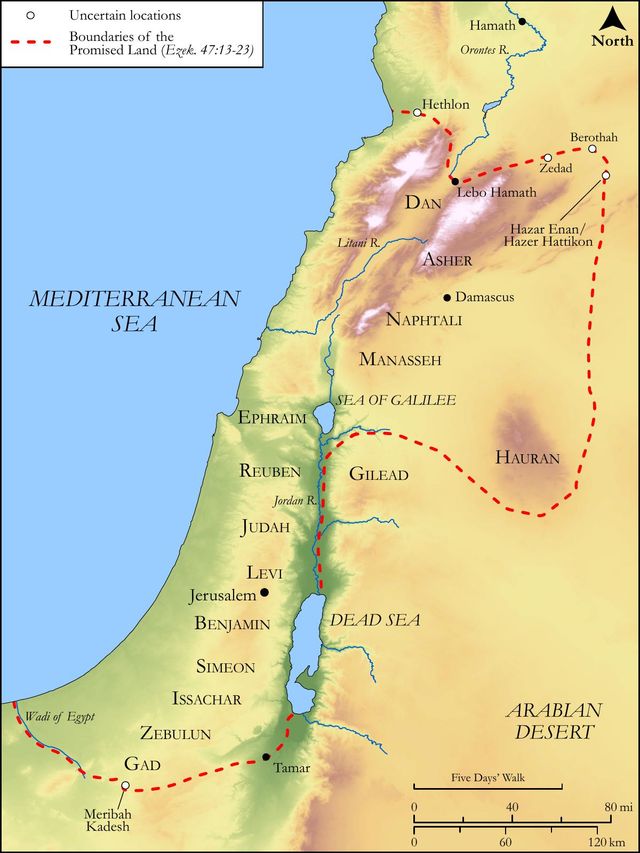
See on the biblical-era map
Study this verse
Historical interpretation
Historical reception
1 surviving comment on this verse from the historical church.
(Chapter 48, verses 1 onwards) And these are the names of the tribes: starting from the northern borders, near the path of Ethalon that goes to Emath, Atrium, Enon, the boundary of Damascus to the north of Emath, and it will have the eastern boundary, the sea. Dan is one tribe. And from the boundary of Dan to the eastern boundary, Asher is one tribe. And beyond the boundary of Asher to the eastern boundary, Nephthali is one tribe. And beyond the boundary of Nephthali to the eastern boundary, Manasseh is one tribe. And over the territory of Manasseh from the eastern border to the sea, Ephraim one. And over the territory of Ephraim from the eastern border to the sea, Reuben one. And over the territory of Reuben from the eastern border to the sea, Judah one. The description of the possession of the Holy Land is given, both according to the present prophecy of Ezekiel and according to the book of Numbers: now the possession of each tribe is described from the eastern border to the western border, that is, the sea. And first, the borders are taken from the north along the route of Ethalon to those going towards Emath, the courtyard or Aser-Enon bordering Damascus to the north near Emath, of which we have already spoken. And so it begins, the first portion goes to the tribe of Dan, the second to Aser, the third to Nephthali, the fourth to Manasseh, the fifth to Ephraim, the sixth to Ruben, the seventh to Judah, which is on the left side, completing the number seven. Then the firstfruits of the priests and the Levites, and the sanctuary of the Lord in the midst, and the holy of holies. The city itself is described on each side in a square, having four thousand and five hundred rods. The suburban areas of the priests and the Levites are also described in order, along with the possession of the prince. And again, on the right side, five tribes succeed from the region similarly to the East, all the way to the region of the West, of which the first is Benjamin; the second is Simeon, having its own possession specifically, and not mixed with Judah as before; the third is Issachar; the fourth is Zebulun; the fifth is Gad; and there are three gates of the city on each side; and the name of this city is contained on the golden plate on the forehead of the high priest. We will discuss all of these in their proper places. And it should be noted that the names of forty-eight cities which are given in the book of Numbers to the Levites for dwelling with their suburbs are omitted here, as well as the cities of refuge: of which three are on the other side of the Jordan, namely Bosor, and Ramoth, and Gaulon, which are given to two and a half tribes; and three are within the Jordan, namely Kadesh, and Sichem, and Kiriatharba. For there was no need in this mystical description and the dwelling of the saints and the perfect conversation to describe the supports of the fugitives, which Israel still needed while in the land and hastening to come to this city through many labors and dangers, and speaking in each of the saints: I am a stranger and a sojourner like all my fathers (Ps. XXXVIII, 13). And in a foreign land: I lived with the inhabitants of Cedar, my soul has traveled far.
Continue studying Ezekiel 48:1 across the web’s major study libraries — every link below opens this exact verse, chapter, or book on the destination site.
Read & Compare
 BibleGatewayThis verse in more than 200 translations and 70 languages.
 Bible.comThe YouVersion reader — hundreds of translations, reading plans, and highlights.
 ESV.orgCrossway's official English Standard Version reader.
 NET BibleThe NET translation with 60,000+ translators' notes on every rendering decision.
 STEP BibleTyndale House's free study tool — original text, vocabulary, and scholarly resources.
 BibliaLogos Bible Software's free web reader.
 USCCBThe New American Bible (Revised Edition) with the U.S. bishops' study notes.
Commentaries
 BibleHub CommentariesDozens of classic commentaries on this verse, gathered on one page.
 StudyLightMore than 100 commentary sets — the largest collection on the web.
 BibleRefPlain-English commentary on what this verse means, verse by verse.
 Enduring WordDavid Guzik's free commentary on this chapter, widely used by Bible teachers.
 Bible Study ToolsVerse commentary alongside Greek and Hebrew study aids.
Original Language & Research
- BibleHub InterlinearThe verse word by word — original language, transliteration, and English.
- BibleHub LexiconEvery word's original-language definition and Strong's entry.
 Blue Letter BibleDeep-study tools — Strong's numbers, concordance, and word studies.
 SefariaThe Hebrew text with Rashi and centuries of Jewish commentary.
Sermons, Hymns & Audio


TrulyRandomVerse is not affiliated with these sites and doesn’t control their content. They’re linked because they’re genuinely useful.
Summary
Ezekiel 48:1 introduces the visionary allocation of land to the twelve tribes of Israel in the restored eschatological kingdom, marking the culmination of Ezekiel's prophecy. This verse meticulously defines the northernmost boundary of the re-divided territory, extending from Hethlon to Hamath and Damascus, and specifically names Dan as the first tribe to receive its inheritance. It sets the stage for a divinely ordered and comprehensive restoration, underscoring God's precision, faithfulness, and the secure establishment of His people within their perfectly ordained land.
Context
ShowHideLiterary Context
Ezekiel 48:1 initiates the climactic final section of Ezekiel's prophecy (chapters 40-48), which is devoted to the detailed vision of the new temple, its sacred ordinances, and the re-division of the land. This verse follows the elaborate descriptions of the temple's architecture and functions in Ezekiel 40-46 and the life-giving river flowing from the temple in Ezekiel 47. Chapter 48, therefore, transitions from the sacred space of worship to the sacred geography of the restored community, providing the precise framework for the physical manifestation of God's presence among His people. It serves as a grand finale, bringing the entire vision to a concrete, albeit symbolic, conclusion regarding the comprehensive nature of God's future restoration plan for Israel.
Historical & Cultural Context
Ezekiel delivered his prophecies during the Babylonian exile (c. 593-571 BC), a period marked by profound national devastation and despair for the Israelites. The destruction of Jerusalem and its temple, coupled with the loss of their ancestral land, severely challenged their understanding of God's covenant promises. In this context, Ezekiel's vision of a new temple and a meticulously re-divided land was not a literal blueprint for the immediate post-exilic return, but a powerful message of hope, divine faithfulness, and future restoration far grander than anything previously experienced. The meticulous detail in land division would have deeply resonated with a people whose tribal inheritances had been fragmented and lost, recalling the original land distribution under Joshua (e.g., Joshua 13-19). The mention of specific northern geographical markers like Hethlon, Hamath, Hazarenan, and Damascus points to a divinely secured and expansive territory, potentially extending beyond historical Israelite borders, signifying a secure and prosperous future under God's sovereign rule.
Key Themes
ShowHideThis verse contributes significantly to several overarching themes within Ezekiel and the broader prophetic literature. It highlights Divine Order and Sovereignty, demonstrating God's meticulous planning and absolute control over the future, ensuring every detail of the restored kingdom is precisely laid out. The re-establishment of tribal inheritances underscores the theme of Restoration and Covenant Faithfulness, affirming God's unwavering commitment to His promises to Abraham, Isaac, and Jacob concerning the land and their descendants (e.g., Genesis 15:18). Furthermore, the inclusion and prominent mention of Dan, a tribe often associated with idolatry and geographical displacement (e.g., Judges 18), emphasizes Total Universal reach and Reconciliation within the restored community, signaling a complete and unblemished renewal for all twelve tribes. The specific, expansive geographical borders also symbolize a future of Security and Abundance, where God's people will dwell safely and prosperously under His direct governance.
Exposition and Analysis
ShowHideKey Word Analysis
ShowHideDerived from a primitive word suggesting definite and conspicuous position, this term signifies more than a mere appellation. It encompasses honor, authority, and character. In Ezekiel 48:1, "names of the tribes" emphasizes the distinct identity, inherent significance, and divinely recognized status of each tribal entity within the collective, highlighting God's personal attention and validation for every part of His restored people.
Properly meaning "a cord" (as twisted), this term extends to signify a boundary or, by implication, the territory enclosed by such a boundary. Its use here for "the border of Damascus northward" highlights the precise and defined limits of the land allocation. It underscores the divine establishment of secure and unchangeable boundaries for the tribes, ensuring their specific inheritance and protection within the restored kingdom, free from encroachment.
Meaning "judge," Dan is one of the sons of Jacob and the tribe descended from him. Its mention here as the first tribe to receive a portion is highly significant. Historically, Dan was known for its geographical displacement and spiritual straying (e.g., Judges 18 details their idolatry). Its prominent placement at the northernmost border in this visionary allocation signifies a complete and inclusive restoration, demonstrating that even those who were historically problematic or overlooked are fully integrated into God's perfected future, reflecting His comprehensive grace.
Verse Breakdown
ShowHide"Now these are the names of the tribes."
This opening clause immediately sets the stage for a detailed enumeration, signaling a systematic and divinely ordered distribution of the land. It emphasizes the individual identity and inherent significance of each of the twelve tribes within the larger restored nation, indicating that each will receive its distinct portion.
"From the north end to the coast of the way of Hethlon, as one goeth to Hamath, Hazarenan, the border of Damascus northward, to the coast of Hamath;"
This lengthy clause meticulously defines the northern boundary of the entire restored territory. Hethlon, Hamath, Hazarenan, and Damascus were well-known geographical markers to the north of historical Israel. The repetition of "coast of Hamath" and "northward" reinforces the precision and expansive extent of this divinely established border, indicating a vast and secure domain for the reunited tribes, potentially extending beyond traditional Israelite borders into what was historically Syrian territory.
"for these are his sides east and west; a portion for Dan."
This final segment clarifies that the described northern line forms the east-west extent of the territory, defining the width of the tribal allotments. The specific mention of "a portion for Dan" immediately after defining the northernmost boundary is highly significant. It indicates that Dan, traditionally the northernmost tribe in the historical land, is allocated the first and northernmost strip of land in this ideal, restored geography, emphasizing its full and prominent inclusion in God's comprehensive plan of restoration, despite its past.
Literary Devices
ShowHideEzekiel 48:1 employs several literary devices to convey its profound message of divine order and restoration. Enumeration is immediately evident with the phrase "Now these are the names of the tribes," signaling a precise and systematic listing that follows, emphasizing God's meticulous attention to detail. This meticulous detailing of specific geographical points (Hethlon, Hamath, Hazarenan, Damascus) and the immediate naming of a tribal allocation (Dan) creates a powerful sense of Precision and Order, underscoring God's absolute control and careful planning for the future. The extensive and specific geographical references also function as a form of Symbolic Geography, where the described borders, potentially larger and more secure than historical Israel, symbolize an expansive, divinely protected, and perfectly ordered realm for the restored nation. Furthermore, the specific mention of Dan, a tribe with a complex history of apostasy and migration, at the very beginning of the land distribution, serves as a powerful symbol of Universal reach and Redemption, highlighting God's comprehensive grace in restoring all His people, even those who had strayed, into a state of perfect fellowship and inheritance.
Theological and Thematic Connections
ShowHideEzekiel 48:1, by meticulously outlining the future land division, powerfully underscores God's unwavering faithfulness to His covenant promises concerning the land and His people. It reveals a God of order and precision, whose plans for restoration are not vague but intricately detailed, ensuring that every aspect of His people's inheritance is secured. This vision provides profound hope, demonstrating that even after severe judgment and dispersion, God's ultimate purpose is to bring His people into a state of complete and secure dwelling in His presence, fulfilling ancient promises in a glorious, renewed reality. It speaks to the divine commitment to a future where every part of His chosen people finds its rightful place and inheritance, free from past failures and external threats, living in perfect alignment with His divine blueprint.
Reflection and Application
ShowHideEzekiel 48:1 offers a profound source of spiritual encouragement and practical application for believers today. In a world often characterized by chaos, uncertainty, and a sense of displacement, this verse reminds us of God's meticulous order and unwavering faithfulness. Just as God had a precise plan for the restoration and re-inheritance of each tribe, He has a detailed and perfect plan for our lives and for the ultimate fulfillment of His kingdom purposes. This vision encourages us to trust in God's sovereignty, even when our circumstances seem fragmented or our future unclear. It assures us that God sees and values every individual within His spiritual household, and that in Christ, we have a secure and eternal inheritance that cannot be lost or diminished. It prompts us to consider how we, as part of God's people, can live in a way that reflects His order and anticipates the full realization of His kingdom, finding our true place and purpose in Him, knowing that His plans are always for our good and His glory.
Questions for Reflection
ShowHideFAQ
ShowHideWhy is the tribe of Dan mentioned first in this land division, given its historical challenges?
ShowHideThe prominent mention of Dan as the first tribe to receive a portion in Ezekiel 48:1 is highly significant and symbolic. Historically, the tribe of Dan faced numerous challenges, including difficulty securing their initial inheritance (Judges 1:34), a major migration to the far north (Judges 18), and a notorious association with idolatry (setting up a graven image and establishing a false priesthood). Its placement at the very beginning of the land distribution in Ezekiel's ideal vision signifies a complete and comprehensive restoration of all twelve tribes, emphasizing God's grace and the perfect, unblemished nature of the future kingdom. It suggests that in God's ultimate plan, there is no exclusion based on past failures; all who are part of His covenant people will be fully included and receive their inheritance. This highlights the theme of divine reconciliation and the perfection of God's future work.
Does this land division in Ezekiel 48 refer to a literal future re-division of the land of Israel?
ShowHideThe interpretation of Ezekiel's temple and land vision (chapters 40-48) varies among scholars. Some interpret it as a literal blueprint for a future, millennial kingdom where the land will be physically re-divided among the tribes of a restored Israel. They point to the precise measurements and geographical details as evidence for a literal fulfillment. Others view the vision primarily as symbolic, representing the spiritual realities of God's presence, order, and blessing in the eschatological age, whether in the church or the new heavens and new earth. They argue that the sheer perfection and scale of the vision, including the river from the temple and the allocation of land to tribes that no longer exist in a distinct form, suggest a spiritual or idealized fulfillment rather than a strictly literal one. Most agree that it speaks to God's faithfulness to His promises and the ultimate establishment of His kingdom, characterized by divine order, secure inheritance, and God's dwelling among His people. The detailed nature of Ezekiel 48 certainly emphasizes the reality and tangibility of God's future work, whether literally or symbolically.
Christ-Centered Fulfillment
ShowHideEzekiel 48:1, with its meticulous description of land division and tribal inheritance, finds its ultimate and most profound fulfillment in Jesus Christ and His new covenant work. While the Old Testament vision speaks of a physical land and tribal boundaries, Christ establishes a spiritual kingdom where the true inheritance is not geographical but spiritual and eternal. The secure and perfectly ordered land for the tribes foreshadows the secure and eternal dwelling place prepared for believers in Christ, who are now the true spiritual Israel, a "chosen race, a royal priesthood, a holy nation, a people for God's own possession" (1 Peter 2:9). The inclusion of Dan, a tribe with a history of apostasy, beautifully prefigures Christ's redemptive work, where all who come to Him, regardless of their past sins or failures, are fully reconciled and given an inheritance "among those who are sanctified by faith in Me" (Acts 26:18). Through Christ, the boundaries of God's people are expanded beyond ethnic Israel to encompass all who believe, forming one body in Him (Ephesians 2:14-16). The "portion for Dan" becomes a "portion for all" who are in Christ, securing for them an eternal inheritance that is "imperishable, undefiled, and unfading, kept in heaven" (1 Peter 1:4). Thus, the precise order and secure inheritance envisioned in Ezekiel find their perfect, spiritual reality in the person and work of Jesus, the true King and architect of the eternal kingdom.