


Genesis 30:3
- וַתֹּאמֶרva·To·merand she saidH559Conj-w ¦ V-Qal-ConsecImperf-3fsVerb Qal Consecutive Imperfect 3rd Singular Feminineוַandתֹּאמֶרshe said
- הִנֵּהhi·Nehhere!H2009PrtParticle Interjection
- אֲמָתִי'a·ma·Timy maidservantH519N-fsc ¦ 1csNoun Singular Feminine Constructאֲמָתִmaidservantיmy
- בִלְהָהvil·HahBilhahH1090N-proper-fNoun Proper Feminine
- בֹּאbo'goH935V-Qal-Imp-2msVerb Qal Imperative 2nd Singular Masculine
- אֵלֶיהָ'e·Lei·hainto herH413Prep ¦ 3fsPreposition Definiteאֵלֶיintoהָher
- וְתֵלֵדve·te·Ledso she may bear childrenH3205Conj-w ¦ V-Qal-ConjImperf-3fsVerb Qal Conjunction+Imperfect 3rd Singular Feminineוְsoתֵלֵדshe may bear children
- עַל'alonH5921PrepPreposition
- בִּרְכַּיbir·Kaimy kneesH1290N-fdc ¦ 1csNoun Dual Feminine Constructבִּרְכַּkneesיmy
- וְאִבָּנֶהve·'i·ba·Nehso I may be built upH1129Conj-w ¦ V-Niphal-ConjImperf-1csVerb Niphal Conjunction+Imperfect 1st Singular common genderוְsoאִבָּנֶהI may be built up
- גַםgamalsoH1571AdvAdverb
- אָנֹכִי'a·no·KhiIH595Pro-1csPronoun Personal 1st Singular common gender
- מִמֶּנָּהmi·Me·nahfrom herH4480Prep ¦ 3fsPreposition Definiteמִמֶּfromנָּהher
English is a literal word-by-word gloss of the Hebrew, not the KJV's wording. Why?
This is the original text the KJV's translators worked from — each Hebrew word with its own literal English meaning in this verse, prepared by scholars at Tyndale House, Cambridge. The KJV translates whole sentences, not word by word, so its wording differs: one Hebrew word can become several English words, and the KJV may choose “the LORD” where the gloss reads “Yahweh”. Both are faithful — they answer different questions. For the KJV's own rendering, switch to the KJV text.
Details
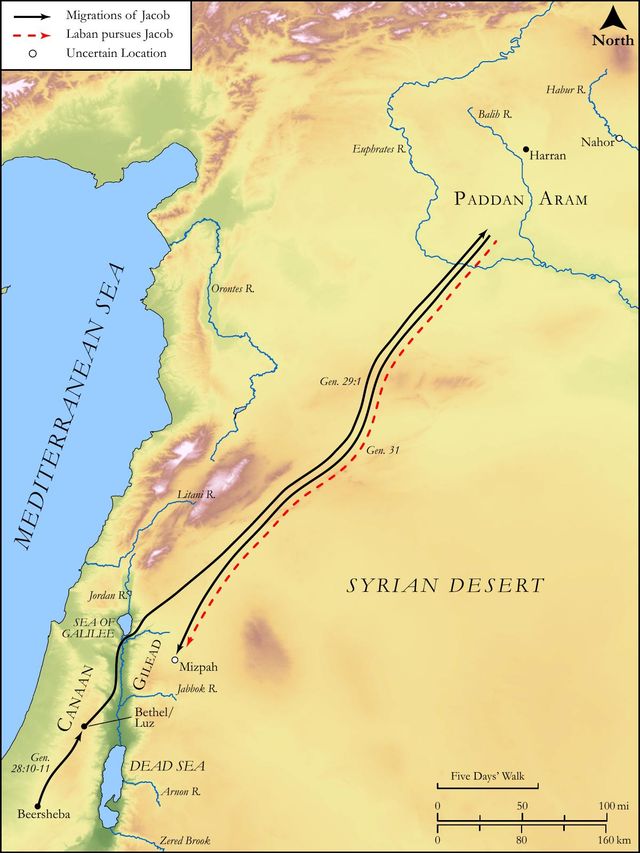
See on the biblical-era map


Study this verse
Public-domain commentary
Matthew Henry
From his Commentary on the Whole Bible. Henry comments on passages, not single verses — this entry covers Genesis 30:1–13. His four-level outline is real structure in the source text, so it is rendered as structure.
We have here the bad consequences of that strange marriage which Jacob made with the two sisters. Here is,
I.An unhappy disagreement between him and Rachel (Gen 30:1, Gen 30:2), occasioned, not so much by her own barrenness as by her sister's fruitfulness. Rebekah, the only wife of Isaac, was long childless, and yet we find no uneasiness between her and Isaac; but here, because Leah bears children, Rachel cannot live peaceably with Jacob.
1.Rachel frets. She envied her sister, Gen 30:1. Envy is grieving at the good of another, than which no sin is more offensive to God, nor more injurious to our neighbour and ourselves. She considered not that it was God that made the difference, and that though, in this single instance her sister was preferred before her, yet in other things she had the advantage. Let us carefully watch against all the risings and workings of this passion in our minds. Let not our eye be evil towards any of our fellow-servants because our master's is good. But this was not all; she said to Jacob, Give me children, or else I die. Note, We are very apt to err in our desires of temporal mercies, as Rachel here.
(1.)One child would not content her; but, because Leah has more than one, she must have more too: Give me children.
(2.)Her heart is inordinately set upon it, and, if she have not what she would have, she will throw away her life, and all the comforts of it. "Give them to me, or else I die," that is, "I shall fret myself to death; the want of this satisfaction will shorten my days." Some think she threatens Jacob to lay violent hands upon herself, if she could not obtain this mercy.
(3.)She did not apply to God by prayer, but to Jacob only, forgetting that children are a heritage of the Lord, Psa 127:3. We wrong both God and ourselves when our eye is more to men, the instruments of our crosses and comforts, than to God the author. Observe a difference between Rachel's asking for this mercy and Hannah's, Sa1 1:10, etc. Rachel envied; Hannah wept. Rachel must have children, and she died of the second; Hannah prayed for one child, and she had four more. Rachel is importunate and peremptory; Hannah is submissive and devout. If thou wilt give me a child, I will give him to the Lord. Let Hannah be imitated, and not Rachel; and let our desires be always under the direction and control of reason and religion.
2.Jacob chides, and most justly. He loved Rachel, and therefore reproved her for what she said amiss, Gen 30:2. Note, Faithful reproofs and products and instances of true affection, Psa 141:5; Pro 27:5, Pro 27:6. Job reproved his wife when she spoke the language of the foolish women, Job 2:10. See Co1 7:16. He was angry, not at the person, but at the sin; he expressed himself so as to show this displeasure. Note, sometimes it is requisite that a reproof should be given warm, like a medical potion; not too hot, lest it scald the patient; yet not cold, lest it prove ineffectual. It was a very grave and pious reply which Jacob gave to Rachel's peevish demand: Am I in God's stead? The Chaldee paraphrases it well, Dost thou ask sons of me? Oughtest thou not to ask them from before the Lord? The Arabic reads it, "Am I above God? can I give thee that which God denies thee?" This was said like a plain man. Observe,
(1.)He acknowledges the hand of God in the affliction which he was a sharer with her in: He hath withheld the fruit of the womb. Note, Whatever we want, it is God that withholds it, a sovereign Lord, most wise, holy, and just, that may do what he will with his own, and is debtor to no man, that never did, nor ever can do, any wrong to any of his creatures. The keys of the clouds, of the heart, of the grave, and of the womb, are four keys which God had in his hand, and which (the rabbin say) he entrusts neither with angels nor seraphim. See Rev 3:7. Job 11:10; Job 12:14.
(2.)He acknowledges his own inability to alter what God had appointed: "Am I in God's stead? What! dost thou make a god of me?" Deos qui rogat ille facit - He to whom we offer supplications is to us a god. Note,
[1.]There is no creature that is, or can be, to us, in God's stead. God may be to us instead of any creature, as the sun instead of the moon and stars; but the moon and all the stars will not be to us instead of the sun. No creature's wisdom, power, and love, will be to us instead of God's.
[2.]It is therefore our sin and folly to place any creature in God's stead, and to place that confidence in any creature which is to be placed in God only.
II.An unhappy agreement between him and the two handmaids.
1.At the persuasion of Rachel, he took Bilhah her handmaid to wife, that, according to the usage of those times, his children by her might be adopted and owned as her mistress's children, Gen 30:3, etc. She would rather have children by reputation than none at all, children that she might fancy to be her own, and call her own, though they were not so. One would think her own sister's children were nearer akin to her than her maid's, and she might with more satisfaction have made them her own if she had so pleased; but (so natural is it for us all to be fond of power) children that she had a right to rule were more desirable to her than children that she had more reason to love; and, as an early instance of her dominion over the children born in her apartment, she takes a pleasure in giving them names that carry in them nothing but marks of emulation with her sister, as if she had overcome her, (1.) At law. She calls the first son of her handmaid Dan (judgement), saying, "God hath judged me" (Gen 30:6), that is, "given sentence in my favour." (2.) In battle. she calls the next Naphtali (wrestlings), saying, I have wrestled with my sister, and have prevailed (Gen 30:8); as if all Jacob's sons must be born men of contention. See what roots of bitterness envy and strife are, and what mischief they make among relations.
2.At the persuasion of Leah, he took Zilpah her handmaid to wife also, Gen 30:9. Rachel had done that absurd and preposterous thing of giving her maid to her husband, in emulation with Leah; and now Leah (because she missed one year in bearing children) does the same, to be even with her, or rather to keep before her. See the power of jealousy and rivalship, and admire the wisdom of the divine appointment, which unites one man and one woman only; for God hath called us to peace and purity, Co1 7:15. Two sons Zilpah bore to Jacob, whom Leah looked upon herself as entitled to, in token of which she called one Gad (Gen 30:11), promising herself a little troop of children; and children are the militia of a family, they fill the quiver, Psa 127:4, Psa 127:5. The other she called Asher (happy), thinking herself happy in him, and promising herself that her neighbours would think so too: The daughters will call me blessed, Gen 30:13. Note, It is an instance of the vanity of the world, and the foolishness bound up in our hearts, that most people value themselves and govern themselves more by reputation than either by reason or religion; they think themselves blessed if the daughters do but call them so. There was much amiss in the contest and competition between these two sisters, yet God brought good out of this evil; for, the time being now at hand when the seed of Abraham must begin to increase and multiply, thus Jacob's family was replenished with twelve sons, heads of the thousands of Israel, from whom the celebrated twelve tribes descended and were named.
Continue studying Genesis 30:3 across the web’s major study libraries — every link below opens this exact verse, chapter, or book on the destination site.
Read & Compare
 BibleGatewayThis verse in more than 200 translations and 70 languages.
 Bible.comThe YouVersion reader — hundreds of translations, reading plans, and highlights.
 ESV.orgCrossway's official English Standard Version reader.
 NET BibleThe NET translation with 60,000+ translators' notes on every rendering decision.
 STEP BibleTyndale House's free study tool — original text, vocabulary, and scholarly resources.
 BibliaLogos Bible Software's free web reader.
 USCCBThe New American Bible (Revised Edition) with the U.S. bishops' study notes.
Commentaries
 BibleHub CommentariesDozens of classic commentaries on this verse, gathered on one page.
 StudyLightMore than 100 commentary sets — the largest collection on the web.
 BibleRefPlain-English commentary on what this verse means, verse by verse.
 Enduring WordDavid Guzik's free commentary on this chapter, widely used by Bible teachers.
 Bible Study ToolsVerse commentary alongside Greek and Hebrew study aids.
Original Language & Research
- BibleHub InterlinearThe verse word by word — original language, transliteration, and English.
- BibleHub LexiconEvery word's original-language definition and Strong's entry.
 Blue Letter BibleDeep-study tools — Strong's numbers, concordance, and word studies.
 SefariaThe Hebrew text with Rashi and centuries of Jewish commentary.
Sermons, Hymns & Audio


TrulyRandomVerse is not affiliated with these sites and doesn’t control their content. They’re linked because they’re genuinely useful.
Summary
Genesis 30:3 records Rachel's desperate and culturally informed decision to offer her maidservant, Bilhah, to Jacob as a surrogate. This act, driven by Rachel's barrenness and the intense societal pressure to bear children, reflects the complex and often painful family dynamics within Jacob's household, highlighting the human tendency to employ personal strategies in the face of unfulfilled desires and the perceived delay of divine promises.
Context
ShowHideLiterary Context
This verse is deeply embedded within the intricate narrative of Jacob's family, specifically the intense rivalry between his two wives, Leah and Rachel, and their shared desire to bear children for him. Immediately preceding this, Rachel expresses profound distress over her barrenness, even declaring to Jacob, "Give me children, or I'll die!" (see Genesis 30:1). Her action in this verse mirrors Sarah's earlier decision to give Hagar to Abraham (found in Genesis 16:1-3), establishing a recurring pattern within the patriarchal narratives where barren wives resort to surrogacy through their maidservants to secure offspring and maintain their social standing. The subsequent verses detail Bilhah's pregnancies and the birth of Dan and Naphtali, further escalating the competition as Leah responds by also giving her maidservant, Zilpah, to Jacob.
Historical & Cultural Context
In the ancient Near East, a woman's honor, social status, and the continuation of the family lineage were intrinsically linked to her ability to bear children, particularly sons. Barrenness was considered a profound misfortune, often interpreted as divine disfavor, and brought immense shame. The practice of a barren wife providing her maidservant (often a slave acquired as part of her dowry) to her husband as a surrogate was a recognized legal and social custom. This arrangement, documented in ancient law codes like the Code of Hammurabi, allowed the barren wife to claim the children born to the maidservant as her own, ensuring the family's perpetuation and the wife's continued place within the household. The phrase "bear upon my knees" was a symbolic act of adoption, legitimizing the children as belonging to the principal wife.
Key Themes
ShowHideGenesis 30:3 significantly contributes to several overarching themes within the book of Genesis and the broader biblical narrative. It underscores the theme of barrenness and divine intervention, a recurring motif for matriarchs like Sarah, Rebekah, and Rachel, emphasizing that true fruitfulness ultimately comes from God's sovereign hand, not human ingenuity. The intense sibling rivalry and family dysfunction between Rachel and Leah are vividly portrayed here, highlighting the complex and often painful consequences of polygamy and human attempts to manipulate divine promises. Furthermore, the verse subtly points to the theme of God's faithfulness despite human imperfection, as His covenant promise to Abraham of numerous descendants (see Genesis 12:2) continues to unfold even through these flawed and desperate human actions, laying the foundation for the twelve tribes of Israel.
Exposition and Analysis
ShowHideRachel's instruction to Jacob, "Behold my maid Bilhah, go in unto her; and she shall bear upon my knees, that I may also have children by her," reveals a profound blend of cultural custom, personal anguish, and a desire to secure her place within the family and the covenant lineage.
Key Word Analysis
ShowHideThis term refers to a "maidservant or female slave." Rachel's use of "my maid Bilhah" indicates that Bilhah was her personal property, likely part of her dowry, making her available for this culturally sanctioned arrangement. The practice of a wife giving her maidservant to her husband for procreation was a legal custom in the ancient Near East, allowing the children born to be considered the principal wife's offspring.
Translated as "go in," this primitive root signifies "to go or come" in a wide variety of applications, but in this context, it is a common biblical euphemism for sexual intercourse. Rachel's direct command for Jacob to "go in unto her" explicitly instructs him to have relations with Bilhah for the purpose of conception.
Meaning "to bear young" or "to beget," this root describes the act of giving birth. The phrase "she shall bear upon my knees" uses this verb, emphasizing that Bilhah will physically give birth, but the subsequent idiom clarifies that the child will be legally and symbolically attributed to Rachel.
This word, meaning "a knee," is crucial to understanding the idiom "upon my knees." The phrase "she shall bear upon my knees" (Hebrew: 'al birkay) signifies a symbolic and legal act of adoption. In ancient cultures, it was a practice for a child to be placed on the knees of the adopting parent, particularly the father, to signify legitimacy and inclusion into the family line. In this case, it indicates that the child born to Bilhah would be legally considered Rachel's child, ensuring her maternal claim and the child's right to inheritance.
This primitive root means "to build," but it also carries the figurative sense of "to obtain children" or "to build a family." Rachel's statement "that I may also have children by her" uses this word, expressing her desire to "build" her family through Bilhah, to gain offspring and thus overcome her barrenness and secure her legacy within Jacob's household.
Verse Breakdown
ShowHide"And she said, Behold my maid Bilhah, go in unto her"
This clause reveals Rachel's direct command and desperate initiative. Unable to conceive herself, she takes a culturally accepted, though ethically complex, step to secure offspring. Her declaration of Bilhah as "my maid" emphasizes her legal right to offer Bilhah for this purpose, a common practice for barren wives in the ancient Near East. The instruction for Jacob to "go in unto her" is a clear euphemism for sexual relations, indicating her intent for Bilhah to conceive.
"and she shall bear upon my knees"
This is a critical idiomatic phrase. While Bilhah would physically give birth, the act of "bearing upon my knees" was a symbolic and legal ritual of adoption. It signified that the child born to the maidservant would be formally recognized and legally considered the child of the barren wife (Rachel). This practice ensured Rachel's maternal claim and the child's legitimacy and right to inheritance within Jacob's household, as if she had given birth herself.
"that I may also have children by her"
This final clause explicitly states Rachel's motivation: to "have children" or "be built up" through Bilhah. The Hebrew word for "have children" (H1129, bânâh) literally means "to build," underscoring Rachel's desire to "build" her family and lineage, to gain offspring and thus overcome her barrenness and secure her legacy within Jacob's household. This highlights the immense pressure and personal anguish associated with barrenness in that cultural context.
Literary Devices
ShowHideThe verse employs several significant literary devices. Irony is present in Rachel's attempt to "build" her family through human means, as the ultimate fulfillment of God's promise of numerous descendants for Jacob would come through divine intervention, not merely human strategy. The phrase "bear upon my knees" is a powerful idiom, a culturally specific expression that conveys a legal and symbolic meaning beyond its literal words, signifying adoption and legitimacy. This idiom also functions as foreshadowing, hinting at the complex and often contentious family dynamics that will unfold as more children are born through various mothers, ultimately leading to the formation of the twelve tribes. Furthermore, Rachel's desperation, conveyed through her actions, serves as a characterization of her deep longing for motherhood and the societal pressures she faced, painting a vivid picture of her emotional state.
Theological and Thematic Connections
ShowHideRachel's desperate act in Genesis 30:3, while rooted in ancient custom and personal anguish, reveals profound theological truths about human nature and divine sovereignty. It illustrates the human tendency to take matters into our own hands when God's promises seem delayed or when our deepest desires remain unfulfilled, echoing the earlier actions of Sarah. Yet, even amidst these flawed human strategies and the ensuing family strife, God's overarching plan for the formation of the nation of Israel through Jacob's descendants continues to unfold, demonstrating His faithfulness and ability to work through imperfect circumstances. This passage reminds us that God's purposes are not thwarted by human sin or ingenuity, but rather His sovereign will ultimately prevails.
Reflection and Application
ShowHideThis passage offers profound insights into the human condition and the nature of faith. Rachel's desperate yearning for children, to the point of resorting to a surrogate, speaks to the deep-seated human desire for legacy, belonging, and fulfillment. It highlights the immense pressure, both internal and external, that individuals can feel when their hopes are unmet, and the temptation to seize control rather than patiently trust in divine timing. While the specific ancient customs are not directly applicable today, the underlying themes resonate powerfully: the pain of unfulfilled desires, the complexities of family relationships, and the challenge of waiting on God. For us, this narrative serves as a poignant reminder to cultivate patience and faith in God's perfect timing and provision, even when our circumstances seem to contradict our deepest hopes. It encourages us to surrender our desires to His sovereign will, trusting that His plans for us are good, and that true fruitfulness, whether physical or spiritual, ultimately comes from His hand.
Questions for Reflection
ShowHideFAQ
ShowHideWhy did Rachel give her handmaid Bilhah to Jacob?
ShowHideRachel was deeply distressed by her barrenness, as the ability to bear children, especially sons, was crucial for a woman's honor, social standing, and the continuation of the family line in ancient Israel. Giving a handmaid to her husband to bear children on her behalf was a recognized ancient Near Eastern custom, intended to provide the barren wife with legal children and maintain her status within the household. This practice had a precedent with Genesis 16:2.
What does "bear upon my knees" signify in this context?
ShowHideThe phrase "bear upon my knees" (Hebrew: 'al birkay) was a legal and symbolic idiom in the ancient world. It meant that the child born to the handmaid would be formally recognized and legally adopted as the child of the barren wife. This ritual, sometimes involving the child being placed on the knees of the adopting parent, established Rachel's maternal claim and ensured the child's legitimacy and right to inheritance within the family, as if she had given birth herself.
Does this passage endorse the practice of surrogacy or polygamy?
ShowHideThe Bible records the cultural practices of its time, including polygamy and surrogate motherhood through handmaids, but it does not necessarily endorse them as God's ideal. These narratives often highlight the complex human consequences, rivalries, and pain that arose from such arrangements, demonstrating the challenges within these family structures. God's original design for marriage, as established in Genesis 2:24, is monogamous. The subsequent strife and heartache in Jacob's family serve as a testament to the difficulties inherent in deviating from God's original design.
Christ-Centered Fulfillment
ShowHideRachel's desperate pursuit of physical fruitfulness, even through a surrogate, profoundly foreshadows humanity's spiritual barrenness and its ultimate fulfillment in Christ. Just as Rachel yearned for a physical "seed" to secure her legacy and place, humanity is inherently spiritually barren, unable to produce true righteousness or eternal life on its own. The lineage that Rachel so desperately sought to "build" (H1129, bânâh) ultimately points to the true "seed" of Abraham, Jesus Christ, through whom all the families of the earth are blessed (see Galatians 3:16). He is the one who takes away the sin of the world (as proclaimed in John 1:29), providing the spiritual adoption that transforms barren lives into those that bear the true "fruit of the Spirit" (described in Galatians 5:22-23). God's sovereign plan, which unfolded through the imperfect and often desperate actions of individuals like Rachel, ultimately led to the perfect provision of a Savior who brings spiritual life and an eternal inheritance to all who believe, far surpassing any earthly lineage or human scheme (as seen in Ephesians 1:5).