


Ezekiel 48:2
Bible text: King James Version (1769 Blayney text) · Public domain
Bible text: Berean Standard Bible · Public domain
Bible text: American Standard Version (1901) · Public domain
Bible text: World English Bible, Messianic edition · Public domain
Bible text: Geneva Bible (1599) · Public domain
Bible text: Young's Literal Translation · Public domain
- וְעַלve·'Aland atH5921Conj-w ¦ PrepPrepositionוְandעַלat
- גְּבוּלge·Vul[the] border ofH1366N-mscNoun Singular Masculine Construct
- דָּןDanDanH1835N-properNoun Proper Location
- מִפְּאַתmi·pe·'Atfrom [the] side ofH6285Prep-m ¦ N-fscNoun Singular Feminine Constructמִfromפְּאַת[the] side of
- קָדִיםka·Dim[the] eastH6921N-msNoun Singular Masculine Absolute
- עַד'adtoH5704PrepPreposition
- פְּאַתpe·'at[the] side ofH6285N-fscNoun Singular Feminine Construct
- יָמָּהYa·mahwest -wardH3220N-ms ¦ SfxNoun Singular Masculine Absoluteיָמָּwestה-ward
- אָשֵׁר'a·SherAsherH836N-proper-mNoun Proper Masculine
- אֶחָד'e·Chadone [portion]H259Adj-fsAdjective Numerical Singular Feminine Absolute
English is a literal word-by-word gloss of the Hebrew, not the KJV's wording. Why?
This is the original text the KJV's translators worked from — each Hebrew word with its own literal English meaning in this verse, prepared by scholars at Tyndale House, Cambridge. The KJV translates whole sentences, not word by word, so its wording differs: one Hebrew word can become several English words, and the KJV may choose “the LORD” where the gloss reads “Yahweh”. Both are faithful — they answer different questions. For the KJV's own rendering, switch to the KJV text.
Details
See on the biblical-era map
Study this verse
Historical interpretation
Historical reception
1 surviving comment on this verse from the historical church.
(Chapter 48, verses 1 onwards) And these are the names of the tribes: starting from the northern borders, near the path of Ethalon that goes to Emath, Atrium, Enon, the boundary of Damascus to the north of Emath, and it will have the eastern boundary, the sea. Dan is one tribe. And from the boundary of Dan to the eastern boundary, Asher is one tribe. And beyond the boundary of Asher to the eastern boundary, Nephthali is one tribe. And beyond the boundary of Nephthali to the eastern boundary, Manasseh is one tribe. And over the territory of Manasseh from the eastern border to the sea, Ephraim one. And over the territory of Ephraim from the eastern border to the sea, Reuben one. And over the territory of Reuben from the eastern border to the sea, Judah one. The description of the possession of the Holy Land is given, both according to the present prophecy of Ezekiel and according to the book of Numbers: now the possession of each tribe is described from the eastern border to the western border, that is, the sea. And first, the borders are taken from the north along the route of Ethalon to those going towards Emath, the courtyard or Aser-Enon bordering Damascus to the north near Emath, of which we have already spoken. And so it begins, the first portion goes to the tribe of Dan, the second to Aser, the third to Nephthali, the fourth to Manasseh, the fifth to Ephraim, the sixth to Ruben, the seventh to Judah, which is on the left side, completing the number seven. Then the firstfruits of the priests and the Levites, and the sanctuary of the Lord in the midst, and the holy of holies. The city itself is described on each side in a square, having four thousand and five hundred rods. The suburban areas of the priests and the Levites are also described in order, along with the possession of the prince. And again, on the right side, five tribes succeed from the region similarly to the East, all the way to the region of the West, of which the first is Benjamin; the second is Simeon, having its own possession specifically, and not mixed with Judah as before; the third is Issachar; the fourth is Zebulun; the fifth is Gad; and there are three gates of the city on each side; and the name of this city is contained on the golden plate on the forehead of the high priest. We will discuss all of these in their proper places. And it should be noted that the names of forty-eight cities which are given in the book of Numbers to the Levites for dwelling with their suburbs are omitted here, as well as the cities of refuge: of which three are on the other side of the Jordan, namely Bosor, and Ramoth, and Gaulon, which are given to two and a half tribes; and three are within the Jordan, namely Kadesh, and Sichem, and Kiriatharba. For there was no need in this mystical description and the dwelling of the saints and the perfect conversation to describe the supports of the fugitives, which Israel still needed while in the land and hastening to come to this city through many labors and dangers, and speaking in each of the saints: I am a stranger and a sojourner like all my fathers (Ps. XXXVIII, 13). And in a foreign land: I lived with the inhabitants of Cedar, my soul has traveled far.
Continue studying Ezekiel 48:2 across the web’s major study libraries — every link below opens this exact verse, chapter, or book on the destination site.
Read & Compare
 BibleGatewayThis verse in more than 200 translations and 70 languages.
 Bible.comThe YouVersion reader — hundreds of translations, reading plans, and highlights.
 ESV.orgCrossway's official English Standard Version reader.
 NET BibleThe NET translation with 60,000+ translators' notes on every rendering decision.
 STEP BibleTyndale House's free study tool — original text, vocabulary, and scholarly resources.
 BibliaLogos Bible Software's free web reader.
 USCCBThe New American Bible (Revised Edition) with the U.S. bishops' study notes.
Commentaries
 BibleHub CommentariesDozens of classic commentaries on this verse, gathered on one page.
 StudyLightMore than 100 commentary sets — the largest collection on the web.
 BibleRefPlain-English commentary on what this verse means, verse by verse.
 Enduring WordDavid Guzik's free commentary on this chapter, widely used by Bible teachers.
 Bible Study ToolsVerse commentary alongside Greek and Hebrew study aids.
Original Language & Research
- BibleHub InterlinearThe verse word by word — original language, transliteration, and English.
- BibleHub LexiconEvery word's original-language definition and Strong's entry.
 Blue Letter BibleDeep-study tools — Strong's numbers, concordance, and word studies.
 SefariaThe Hebrew text with Rashi and centuries of Jewish commentary.
Sermons, Hymns & Audio


TrulyRandomVerse is not affiliated with these sites and doesn’t control their content. They’re linked because they’re genuinely useful.
Summary
Ezekiel 48:2 precisely details the allocation of land for the tribe of Asher within the prophet Ezekiel's grand vision of a restored Israel. This verse, part of the climactic final chapters of Ezekiel's prophecy, describes an idealized, perfectly ordered, and meticulously divided territory for each of the twelve tribes, emphasizing God's sovereign plan for a future, complete restoration and the secure inheritance of His people.
Context
ShowHideLiterary Context
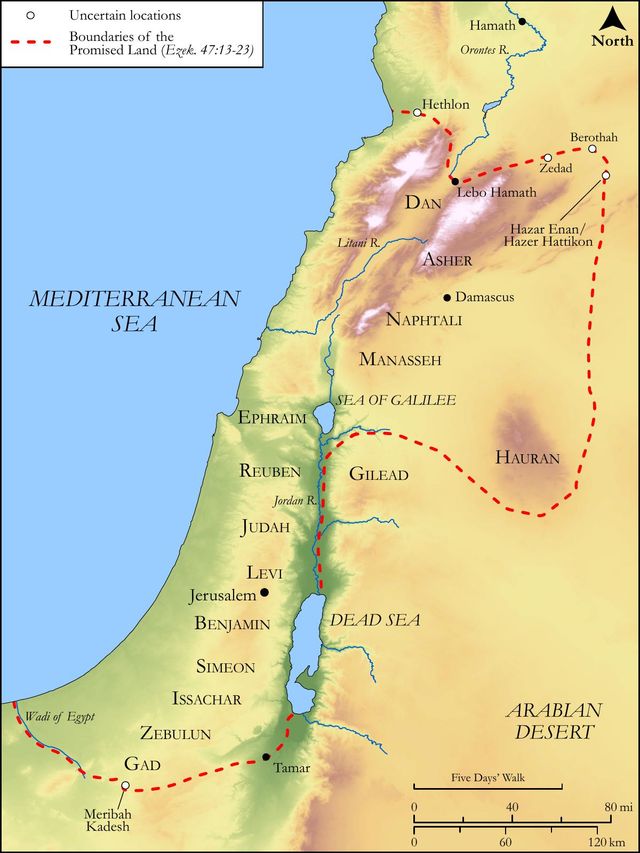
Ezekiel 48:2 is situated within the climactic final section of the book of Ezekiel (chapters 40-48), which presents a detailed, visionary blueprint for a new temple, a renewed priesthood, and the re-allotment of the land to the twelve tribes of Israel. This vision is distinct from the historical land divisions recorded in the book of Joshua and represents an eschatological, idealized order, often interpreted as pertaining to a future, possibly millennial, era of God's kingdom. The meticulous geographical descriptions, including the "east side unto the west side" orientation for each tribal strip, underscore the divine precision and symmetry of this future arrangement, contrasting sharply with the chaotic circumstances of Israel's exile, which forms the backdrop of much of Ezekiel's earlier prophecies. Each tribe receives a distinct, perfectly rectangular portion, symbolizing a complete and equitable restoration under God's perfect governance.
Historical & Cultural Context
Ezekiel prophesied during the Babylonian exile (c. 593-571 BC), a period of profound national trauma and displacement for the Jewish people. The loss of their land, temple, and sovereignty was devastating. In this context, Ezekiel's visions of restoration offered immense hope, promising a future return, re-establishment, and divine order that transcended their current suffering. Land was central to Israelite identity, covenant, and security; it was God's promised inheritance. The detailed land division in Ezekiel 48 speaks directly to the deep longing for a secure homeland and the fulfillment of God's covenant promises to Abraham, Isaac, and Jacob. The concept of a divinely ordered society, with each family and tribe having its secure place, was a foundational aspect of Israelite cultural and theological understanding, providing a stark contrast to the dispossessed reality of the exiles.
Key Themes
ShowHideThis verse, as part of the broader vision in Ezekiel 48, contributes significantly to several overarching themes. Firstly, it highlights Divine Order and Meticulous Provision. The precise geographical description of Asher's portion, "by the border of Dan, from the east side unto the west side," emphasizes God's perfect and detailed plan for His people, ensuring that every tribe receives a specific, secure, and clearly defined inheritance. This meticulousness underscores God's sovereign control and His commitment to establishing perfect justice and harmony. Secondly, the inclusion of all twelve tribes, each with its designated portion, signifies a Complete Restoration and Wholeness for the nation of Israel. This vision assures that no tribe is forgotten or left out of God's future blessings, symbolizing a reunification and spiritual renewal akin to the vision of the dry bones in Ezekiel 37:21-23. Finally, the theme of Inheritance and Blessing is prominent. Asher, whose name means "happy" or "blessed," was historically known for its fertile land, as prophesied in Jacob's blessing upon Asher in Genesis 49:20. Its placement in this future allocation continues the theme of divine blessing and provision, ensuring prosperity and security within its allotted territory, a testament to God's enduring faithfulness to His covenant promises.
Exposition and Analysis
ShowHideKey Word Analysis
ShowHideThis term, derived from a root meaning "to twist" or "a cord," signifies a boundary or limit. In Ezekiel 48:2, it denotes the precise demarcation of Asher's territory, specifically adjacent to Dan's portion. The use of "border" throughout Ezekiel 48 emphasizes the divinely ordained and unalterable nature of these new tribal allotments, ensuring clear and undisputed possession for each tribe. It speaks to God's meticulousness in establishing order and security.
While translated "a" or "a portion for" in KJV, the underlying Hebrew word means "one" or "united." This numerical emphasis highlights that each tribe receives a single, distinct, and undivided strip of land. It underscores the systematic, equitable, and complete nature of the land distribution, where each tribe is given its unique, whole inheritance, signifying unity and completeness within the restored nation.
Meaning "happy" or "blessed," Asher was one of Jacob's sons and the progenitor of one of the twelve tribes. Historically, Asher's territory was in the fertile coastal plain of northern Israel. In this visionary context, the inclusion of Asher, along with all the other tribes, signifies the comprehensive nature of God's future restoration. The placement of Asher's portion, "from the east side unto the west side," indicates a full, broad strip of land, suggesting ample provision and blessing for the tribe whose name signifies happiness.
Verse Breakdown
ShowHide"And by the border of Dan"
This phrase immediately establishes the geographical relationship of Asher's future inheritance to that of Dan. In this visionary arrangement, the tribes are laid out in parallel strips from north to south. Dan's portion is described in Ezekiel 48:1, making Asher's territory directly adjacent to its southern boundary. This precise placement highlights the systematic and orderly nature of God's new creation, where every tribe has a designated and secure place within the divine blueprint.
"from the east side unto the west side"
This clause specifies the breadth and orientation of Asher's allocated land. It indicates that the territory stretches across the entire width of the land, from the eastern boundary (likely the Jordan River or the desert beyond) to the western boundary (the Mediterranean Sea). This "sea-to-sea" expanse signifies a complete and ample portion, free from internal divisions or limitations. It reinforces the idea of a perfectly designed and fully provided inheritance, ensuring each tribe has full access to the land's resources and strategic advantages.
"a [portion for] Asher"
This final phrase identifies the recipient of this specifically defined strip of land. The KJV's "[portion for]" clarifies the Hebrew "one for Asher," emphasizing that this distinct, undivided strip is specifically designated for the tribe of Asher. It underscores the individual attention and provision God extends to each component of His restored people, ensuring that Asher, whose name implies blessing, receives its full and secure share in the future kingdom.
Literary Devices
ShowHideThe primary literary device at play in Ezekiel 48:2, and indeed throughout chapters 40-48, is Symbolism. The meticulous and highly ordered description of the land division is not merely a geographical blueprint but a profound symbolic representation of God's ultimate sovereignty, justice, and faithfulness. The perfectly rectangular, east-to-west strips for each tribe symbolize divine order, completeness, and equitable provision, contrasting with the historical, often fragmented, and contested tribal lands. The Precision and Detail in the geographical specifications (e.g., "border of Dan," "east side unto the west side") serve to emphasize the divine meticulousness and the certainty of God's future plans. This level of detail lends an air of reality and inevitability to the vision, assuring the exiles that God's restoration would be thorough and perfectly executed. Furthermore, the entire section functions as an Idealization, presenting a perfected state of Israel under God's direct rule, free from the imperfections and injustices of the past.
Theological and Thematic Connections
ShowHideEzekiel 48:2, within its broader context, speaks powerfully to God's unwavering faithfulness and His commitment to His covenant promises. The precise and orderly land division symbolizes the ultimate restoration of God's people, not merely to a physical territory, but to a state of perfect peace, security, and divine blessing under His direct reign. It assures that God's purposes, even when seemingly thwarted by human sin and exile, will ultimately be fulfilled with meticulous detail and divine perfection. This vision points to an eschatological hope where God's people will dwell securely in His presence, each receiving their designated inheritance, reflecting a complete and harmonious relationship with their Creator. It is a testament to God's sovereign power to bring order out of chaos and to establish His kingdom in perfect righteousness.
Reflection and Application
ShowHideEzekiel 48:2, while describing a specific future for ancient Israel, offers profound spiritual insights for believers today. It reminds us that God is a God of order, precision, and meticulous provision. In a world often marked by chaos, injustice, and uncertainty, this verse assures us of God's ultimate sovereignty and His ability to bring perfect order out of any disarray. Just as He had a specific place and portion for Asher, He has a divine plan and purpose for each of our lives, ensuring our security and provision in His kingdom. This vision encourages us to trust in God's faithfulness, even when our circumstances seem bleak, knowing that He is working all things according to His perfect will. It inspires us to live with a future-oriented hope, looking forward to the ultimate fulfillment of God's promises, where every believer will find their secure and blessed inheritance in Christ. Our present struggles are temporary, but God's meticulous care for His people is eternal, guaranteeing a future where perfect order and divine blessing prevail.
Questions for Reflection
ShowHideFAQ
ShowHideIs this land division in Ezekiel 48:2 literal or symbolic?
ShowHideThe interpretation of the land division in Ezekiel 48, including the portion for Asher, varies among scholars. Some interpret it as a literal blueprint for a future, physical re-allotment of land to the tribes of Israel during a millennial kingdom on earth. They point to the extreme precision and detail as evidence of its literal intent. Others view it primarily as symbolic, representing God's perfect order, justice, and complete restoration of His people in an ideal, eschatological sense, possibly fulfilled spiritually in the church or in the new heavens and new earth. A mediating view suggests it is literally intended but also carries profound spiritual symbolism, emphasizing God's faithfulness to His promises and the ultimate establishment of His righteous kingdom. Regardless of the literal-symbolic debate, the passage unequivocally communicates God's commitment to a future of order, security, and blessing for His people, as seen in the provision for Asher's portion.
Christ-Centered Fulfillment
ShowHideWhile Ezekiel 48:2 describes a physical land inheritance for Asher, its ultimate fulfillment and spiritual significance are found in Jesus Christ. The meticulous division of land, ensuring each tribe a secure and perfect "portion," foreshadows the spiritual inheritance and secure dwelling that believers receive in Christ. Jesus is the true "land" or "inheritance" for His people, providing a spiritual rest and security far surpassing any earthly territory, as explored in Hebrews 4:9-11. Through His atoning sacrifice, Christ has secured for us an eternal inheritance that is "imperishable, undefiled, and unfading, kept in heaven for you" (1 Peter 1:4). The perfect order and divine provision seen in Ezekiel's vision find their ultimate reality in the new covenant, where believers, regardless of their earthly tribe or nation, are united in Christ as members of God's spiritual Israel (Galatians 3:28-29). In Christ, we are given a secure place in God's eternal kingdom, a spiritual "portion" that is perfectly ordered and eternally blessed, culminating in the vision of the New Jerusalem where God dwells among His people in perfect harmony (Revelation 21:3). Thus, the promise of a secure "portion for Asher" ultimately points to the comprehensive and eternal security and blessing that all believers receive as their inheritance in Christ Jesus.