


Joshua 19:24
Bible text: King James Version (1769 Blayney text) · Public domain
Bible text: Berean Standard Bible · Public domain
Bible text: American Standard Version (1901) · Public domain
Bible text: World English Bible, Messianic edition · Public domain
Bible text: Geneva Bible (1599) · Public domain
Bible text: Young's Literal Translation · Public domain
- וַיֵּצֵאvai·ye·Tze'and it came outH3318Conj-w ¦ V-Qal-ConsecImperf-3msVerb Qal Consecutive Imperfect 3rd Singular Masculineוַandיֵּצֵאit came out
- הַגּוֹרָלha·go·Ralthe lotH1486Art ¦ N-msNoun Singular Masculine Absoluteהַtheגּוֹרָלlot
- הַחֲמִישִׁיha·cha·mi·Shi<the> fifthH2549Art ¦ Adj-msAdjective Numerical Position Singular Masculine Absoluteהַ<the>חֲמִישִׁיfifth
- לְמַטֵּהle·ma·Tehfor [the] tribe ofH4294Prep-l ¦ N-mscNoun Singular Masculine Constructלְforמַטֵּה[the] tribe of
- בְנֵיve·nei[the] descendants ofH1121N-mpcNoun Plural Masculine Construct
- אָשֵׁר'a·SherAsherH836N-proper-mNoun Proper Masculine
- לְמִשְׁפְּחוֹתָםle·mish·pe·cho·Tamto their clansH4940Prep-l ¦ N-fpc ¦ 3mpNoun Plural Feminine Constructלְtoמִשְׁפְּחוֹתָclansםtheir
English is a literal word-by-word gloss of the Hebrew, not the KJV's wording. Why?
This is the original text the KJV's translators worked from — each Hebrew word with its own literal English meaning in this verse, prepared by scholars at Tyndale House, Cambridge. The KJV translates whole sentences, not word by word, so its wording differs: one Hebrew word can become several English words, and the KJV may choose “the LORD” where the gloss reads “Yahweh”. Both are faithful — they answer different questions. For the KJV's own rendering, switch to the KJV text.
Details
See on the biblical-era maps
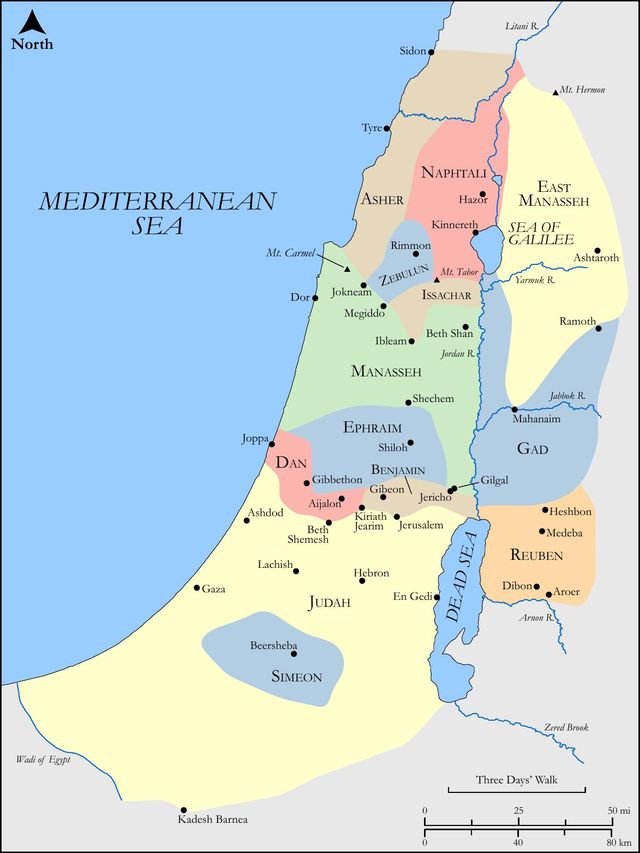
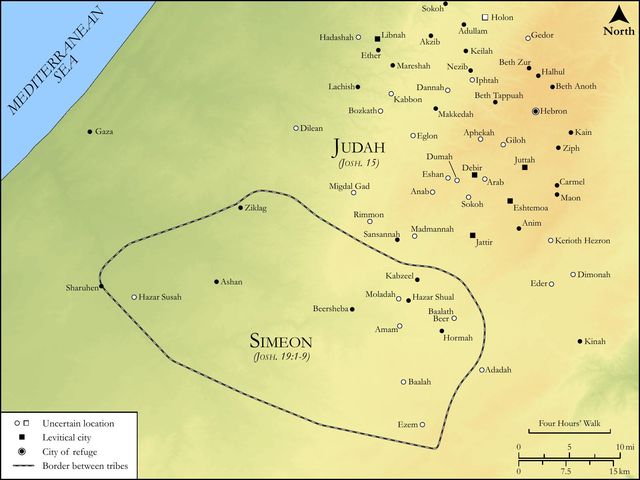
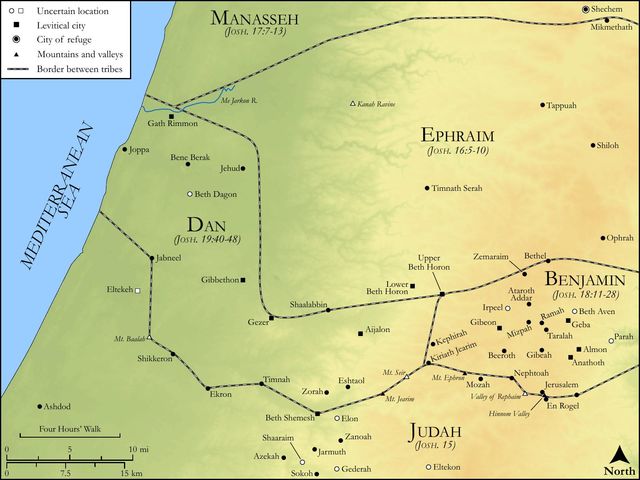
Study this verse
Public-domain commentary
Matthew Henry
From his Commentary on the Whole Bible. Henry comments on passages, not single verses — this entry covers Joshua 19:24–31.
The lot of Asher lay upon the coast of the great sea. We read not of any famous person of this tribe but Anna the prophetess, who was a constant resident in the temple at the time of our Saviour's birth, Luk 2:36. Nor were there many famous places in this tribe. Aphek (mentioned Jos 19:30) was the place near which Benhadad was beaten by Ahad, Kg1 20:30. But close adjoining to this tribe were the celebrated sea-port towns of Tyre and Sidon, which we read so much of. Tyre is called here that strong city (Jos 19:29), but Bishop Patrick thinks it was not the same Tyre that we read of afterwards, for that was built on an island; this old strong city was on the continent. And it is conjectured by some that into these two strong-holds, Sidon and Tzor, or Tyre, many of the people of Canaan fled and took shelter when Joshua invaded them.
Continue studying Joshua 19:24 across the web’s major study libraries — every link below opens this exact verse, chapter, or book on the destination site.
Read & Compare
 BibleGatewayThis verse in more than 200 translations and 70 languages.
 Bible.comThe YouVersion reader — hundreds of translations, reading plans, and highlights.
 ESV.orgCrossway's official English Standard Version reader.
 NET BibleThe NET translation with 60,000+ translators' notes on every rendering decision.
 STEP BibleTyndale House's free study tool — original text, vocabulary, and scholarly resources.
 BibliaLogos Bible Software's free web reader.
 USCCBThe New American Bible (Revised Edition) with the U.S. bishops' study notes.
Commentaries
 BibleHub CommentariesDozens of classic commentaries on this verse, gathered on one page.
 StudyLightMore than 100 commentary sets — the largest collection on the web.
 BibleRefPlain-English commentary on what this verse means, verse by verse.
 Enduring WordDavid Guzik's free commentary on this chapter, widely used by Bible teachers.
 Bible Study ToolsVerse commentary alongside Greek and Hebrew study aids.
Original Language & Research
- BibleHub InterlinearThe verse word by word — original language, transliteration, and English.
- BibleHub LexiconEvery word's original-language definition and Strong's entry.
 Blue Letter BibleDeep-study tools — Strong's numbers, concordance, and word studies.
 SefariaThe Hebrew text with Rashi and centuries of Jewish commentary.
Sermons, Hymns & Audio


TrulyRandomVerse is not affiliated with these sites and doesn’t control their content. They’re linked because they’re genuinely useful.
Summary
Joshua 19:24 marks a significant moment in the systematic allocation of the Promised Land, detailing the precise distribution of territory to the tribe of Asher. This verse, part of a meticulous record of tribal inheritances, underscores God's unwavering faithfulness in fulfilling His ancient covenant promises to Israel, demonstrating His sovereign hand in establishing His people in the land He had sworn to their ancestors. It highlights the divine order and meticulous care with which God oversees the destiny of His chosen nation.
Context
ShowHideLiterary Context
Joshua 19:24 is situated within the latter half of the Book of Joshua (chapters 13-21), which meticulously records the division of the land of Canaan among the twelve tribes of Israel. Following the conquest narratives (chapters 1-12), these chapters detail the fulfillment of God's promise to give Israel a land of their own. Specifically, chapters 13-19 describe the individual tribal allotments, with Joshua 19 focusing on the territories assigned to Simeon, Zebulun, Issachar, Asher, Naphtali, and Dan. The repeated phrase "the lot came out for..." emphasizes the divinely ordained nature of this distribution, ensuring that each tribe received its designated portion, thereby establishing their identity and future within the land. The preceding verses (Joshua 19:20-23) describe the inheritance of the tribe of Issachar, making Asher's allocation the next in the divinely guided sequence.
Historical & Cultural Context
The division of the land by "lot" was a culturally significant practice in ancient Israel, not viewed as a random gamble but as a means of discerning divine will. This method, carried out under the leadership of Joshua, Eleazar the priest, and the heads of the tribal families at Shiloh (Joshua 14:1), underscored the belief that God was actively orchestrating the settlement of His people. Shiloh served as a central religious site, housing the tabernacle, which further sanctified the land distribution process. The meticulous recording of boundaries and cities for each tribe reflects the importance of land ownership as the basis for tribal identity, economic stability, and national security in Israel. The process ensured an equitable and divinely sanctioned inheritance for each family within their respective tribes, preventing disputes and solidifying their claim to the land promised by God to Abraham (Genesis 12:7).
Key Themes
ShowHideJoshua 19:24, along with the broader narrative of land distribution, powerfully illustrates several key themes. First, Divine Providence is paramount, as the casting of lots was understood to be a direct revelation of God's sovereign will, ensuring fairness and demonstrating His active involvement in Israel's affairs (Proverbs 16:33). Second, the verse underscores the Fulfillment of Promise, as the physical inheritance of the land represents the tangible culmination of centuries of divine promises made to the patriarchs (e.g., Genesis 15:18-21). Third, the concept of Tribal Inheritance and Identity is central; each tribe, including Asher, received a distinct and defined territory "according to their families," which established their unique place within the nation of Israel and reinforced their lineage and heritage. This systematic division laid the foundation for Israel's future as a settled nation, organized according to God's precise design.
Exposition and Analysis
ShowHideKey Word Analysis
ShowHideThis ordinal number, derived from the Hebrew word for "five," indicates the sequential order of the lot's outcome. Its presence emphasizes the systematic and deliberate nature of the land distribution process, highlighting that Asher's inheritance was not a random occurrence but a specific step in God's ordered plan for the tribes of Israel.
The Hebrew word גּוֹרָל (gôwrâl) refers to a small object, typically a pebble or stone, used for making decisions or allocating portions. In biblical contexts, particularly concerning land distribution, the casting of lots was not viewed as a game of chance but as a divinely appointed method for revealing God's will. The underlying belief was that "the decision is from the Lord" (Proverbs 16:33). This practice underscores the Israelite conviction that God was intimately involved in the details of their national life, ensuring impartiality and divine sanction for the land assignments.
This primitive root, יָצָא (yâtsâʼ), signifies "to go out" or "to come forth," encompassing a wide variety of applications. In the context of the lot, it describes the physical act of the lot being drawn or revealed from the container, signifying the manifestation of the divine decision. This active verb reinforces the idea that the outcome was not passive but a dynamic revelation of God's preordained will, bringing forth the specific inheritance for Asher.
The Hebrew word מִשְׁפָּחָה (mishpâchâh) refers to a clan, family, or a subdivision of a tribe. Its inclusion here, "according to their families," highlights the meticulous and granular nature of the land distribution. It wasn't just a broad allocation to the tribe, but a precise division that considered the needs and sizes of the constituent families within Asher. This detail emphasizes God's comprehensive care and the orderly structure He established for His people, ensuring every household had a secure inheritance and a defined place within the larger tribal identity.
Verse Breakdown
ShowHide"¶ And the fifth lot came out"
This phrase signifies the continuation of the land distribution process, indicating that Asher's inheritance was determined by the same divine method as the preceding tribes. The "fifth lot" places Asher in the sequence of allocations, emphasizing the systematic and orderly nature of God's provision for His people. The outcome of the lot was understood as a direct revelation of God's sovereign will, not mere chance.
"for the tribe of the children of Asher"
This specifies the recipient of the fifth lot. Asher, one of the twelve tribes descended from Jacob's son Asher, is now formally assigned its territorial inheritance. This particularization highlights the distinct identity and destiny of each tribe within the larger nation of Israel, as God fulfills His promises to each lineage.
"according to their families"
This concluding phrase underscores the meticulousness of the land division. The inheritance was not merely for the tribe as a whole but was further subdivided and allocated to the individual families within the tribe of Asher. This ensured that every household had a stake in the Promised Land, reinforcing the familial and communal structure of Israelite society and securing the inheritance for future generations.
Literary Devices
ShowHideThe verse employs several literary devices that contribute to its meaning and impact. The most prominent is Repetition, as the phrase "the lot came out for the tribe... according to their families" is a recurring formula throughout Joshua 19 (e.g., Joshua 19:1, Joshua 19:10, Joshua 19:17). This repetition emphasizes the systematic, orderly, and divinely sanctioned nature of the land distribution, reinforcing the idea that each tribe's inheritance was a deliberate act of God. The text also functions as a Cataloging or Census-style record, meticulously listing each tribe and its allocation, which lends an air of historical accuracy and divine authority to the narrative. Furthermore, there is an implied Divine Agency through the use of the "lot," which is presented not as a random event but as a means through which God's will is revealed and implemented, showcasing His sovereign control over the destiny of His people.
Theological and Thematic Connections
ShowHideJoshua 19:24, while seemingly a dry geographical detail, is profoundly theological. It stands as a powerful testament to God's faithfulness and meticulous order in fulfilling His ancient covenant promises. The division of the land by lot, specifically for each tribe and "according to their families," underscores the belief that God is not a God of chaos but of precision, ensuring that every detail of His plan for Israel's inheritance was divinely ordained. This act solidifies Israel's identity as a settled nation, demonstrating God's unwavering commitment to His people across generations, from the patriarchal promises to their tangible fulfillment in Canaan. It teaches us that God's promises are not vague aspirations but concrete realities, brought to pass with divine precision and care.
Reflection and Application
ShowHideJoshua 19:24 invites us to reflect on the nature of God's faithfulness and His meticulous care for His people. Just as the tribe of Asher received its specific, divinely appointed inheritance, so too does God have a precise plan and provision for each of our lives. This passage reminds us that our inheritance, whether spiritual or temporal, is not a matter of chance but of divine design. It encourages us to trust in God's sovereignty, knowing that He oversees every detail of our lives, just as He meticulously divided the land for Israel. We can find assurance in the fact that the same God who faithfully fulfilled His promises to Asher will also be faithful to His promises to us, providing for our needs and guiding us into the inheritance He has prepared. This should inspire a deep sense of security and gratitude, fostering a life of confident dependence on His perfect plan.
Questions for Reflection
ShowHideFAQ
ShowHideWhy was the land divided by lot instead of by human decision?
ShowHideThe division of the land by lot was a crucial practice in ancient Israel, rooted in the belief that it was a means of discerning God's will, not a random game of chance. The Israelites understood that "The lot is cast into the lap, but its every decision is from the Lord" (Proverbs 16:33). This method ensured impartiality and prevented disputes among the tribes, as the outcome was seen as divinely ordained. It underscored God's sovereignty over the land and His direct involvement in establishing His people in their inheritance, fulfilling His ancient promises to Abraham (e.g., Genesis 15:18). This process, carried out under the spiritual leadership of Eleazar the priest and Joshua, at the tabernacle in Shiloh, further sanctified the distribution as a sacred act of divine provision.
Christ-Centered Fulfillment
ShowHideThe physical land inheritance of Asher and the other tribes in Joshua finds its ultimate and spiritual fulfillment in Jesus Christ. The Promised Land, a tangible inheritance for a physical people, foreshadows the spiritual inheritance that believers receive in Christ, who is the true and ultimate "Promised Land." Just as God meticulously divided the land by lot for each family, so too has He, in Christ, meticulously prepared an eternal inheritance for every believer, not by human effort or chance, but by divine grace. This spiritual inheritance is not a geographical territory but a relationship with God, access to His presence, and participation in His eternal kingdom. Paul speaks of believers being "chosen in him before the foundation of the world" (Ephesians 1:4), and having "obtained an inheritance" in Christ (Ephesians 1:11). The meticulous division of land in Joshua points to the precise and perfect plan of God to bring all things to their culmination in Christ, in whom "all the promises of God find their Yes" (2 Corinthians 1:20). Our true "rest" and "inheritance" are found not in a physical land, but in the spiritual reality of being "seated with him in the heavenly places in Christ Jesus" (Ephesians 2:6), a far greater and eternal possession than any earthly territory.