


Joshua 19:47
Bible text: King James Version (1769 Blayney text) · Public domain
Bible text: King James Version with Strong's numbers · Public domain
Bible text: Berean Standard Bible · Public domain
Bible text: American Standard Version (1901) · Public domain
Bible text: World English Bible, Messianic edition · Public domain
Bible text: Geneva Bible (1599) · Public domain
Bible text: Young's Literal Translation · Public domain
- וַיֵּצֵאvai·ye·Tze'and it went outH3318Conj-w ¦ V-Qal-ConsecImperf-3msVerb Qal Consecutive Imperfect 3rd Singular Masculineוַandיֵּצֵאit went out
- גְבוּלge·Vul[the] territory ofH1366N-mscNoun Singular Masculine Construct
- בְּנֵיbe·nei[the] descendants ofH1121N-mpcNoun Plural Masculine Construct
- דָןdanDanH1835N-properNoun Proper Location
- מֵהֶםme·Hemfrom <the> themPrep-m ¦ 3mpSuffix Personal 3rd Plural Masculineמֵfrom <the>הֶםthem
- וַיַּעֲלוּvai·ya·'a·Luand they went upH5927Conj-w ¦ V-Qal-ConsecImperf-3mpVerb Qal Consecutive Imperfect 3rd Plural Masculineוַandיַּעֲלוּthey went up
- בְנֵיve·nei[the] descendants ofH1121N-mpcNoun Plural Masculine Construct
- דָןdanDanH1835N-properNoun Proper Location
- וַיִּלָּחֲמוּvai·yi·la·cha·Muand they waged warH3898Conj-w ¦ V-Niphal-ConsecImperf-3mpVerb Niphal Consecutive Imperfect 3rd Plural Masculineוַandיִּלָּחֲמוּthey waged war
- עִם'imwithH5973PrepPreposition
- לֶשֶׁםLe·shemLeshemH3959N-properNoun Proper Location
- וַיִּלְכְּדוּvai·yil·ke·Duand they capturedH3920Conj-w ¦ V-Qal-ConsecImperf-3mpVerb Qal Consecutive Imperfect 3rd Plural Masculineוַandיִּלְכְּדוּthey captured
- אוֹתָהּ'o·Tah<obj.> itH853DirObjM ¦ 3fsParticle Object Indicatorאוֹתָ<obj.>הּit
- וַיַּכּוּvai·ya·Kuand they struckH5221Conj-w ¦ V-Hiphil-ConsecImperf-3mpVerb Hiphil Consecutive Imperfect 3rd Plural Masculineוַandיַּכּוּthey struck
- אוֹתָהּ'o·Tah<obj.> itH853DirObjM ¦ 3fsParticle Object Indicatorאוֹתָ<obj.>הּit
- לְפִיle·fito [the] mouth ofH6310Prep-l ¦ N-mscNoun Singular Masculine Constructלְtoפִי[the] mouth of
- חֶרֶבChe·rev[the] swordH2719N-fsNoun Singular Feminine Absolute
- וַיִּרְשׁוּvai·yir·Shuand they took possession ofH3423Conj-w ¦ V-Qal-ConsecImperf-3mpVerb Qal Consecutive Imperfect 3rd Plural Masculineוַandיִּרְשׁוּthey took possession of
- אוֹתָהּ'o·Tah<obj.> itH853DirObjM ¦ 3fsParticle Object Indicatorאוֹתָ<obj.>הּit
- וַיֵּשְׁבוּvai·Ye·she·vuand they dweltH3427Conj-w ¦ V-Qal-ConsecImperf-3mpVerb Qal Consecutive Imperfect 3rd Plural Masculineוַandיֵּשְׁבוּthey dwelt
- בָהּVahin <the> itPrep-b ¦ 3fsSuffix Personal 3rd Singular Feminineבָin <the>הּit
- וַיִּקְרְאוּvai·yik·re·'Uand they calledH7121Conj-w ¦ V-Qal-ConsecImperf-3mpVerb Qal Consecutive Imperfect 3rd Plural Masculineוַandיִּקְרְאוּthey called
- לְלֶשֶׁםle·Le·shem<to> LeshemH3959Prep-l ¦ N-properNoun Proper Locationלְ<to>לֶשֶׁםLeshem
- דָּןDanDanH1835N-properNoun Proper Location
- כְּשֵׁםke·Shemaccording to [the] name ofH8034Prep-k ¦ N-mscNoun Singular Masculine Constructכְּaccording toשֵׁם[the] name of
- דָּןdanDanH1835N-properNoun Proper Location
- אֲבִיהֶם'a·vi·Hemtheir ancestorH1N-msc ¦ 3mpNoun Singular Masculine Constructאֲבִיancestorהֶםtheir
English is a literal word-by-word gloss of the Hebrew, not the KJV's wording. Why?
This is the original text the KJV's translators worked from — each Hebrew word with its own literal English meaning in this verse, prepared by scholars at Tyndale House, Cambridge. The KJV translates whole sentences, not word by word, so its wording differs: one Hebrew word can become several English words, and the KJV may choose “the LORD” where the gloss reads “Yahweh”. Both are faithful — they answer different questions. For the KJV's own rendering, switch to the KJV text.
Details
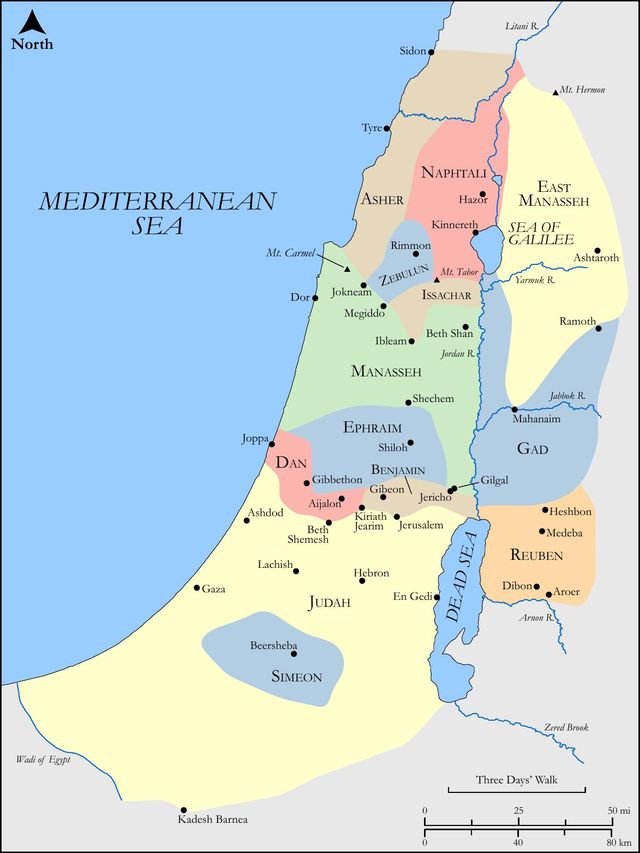
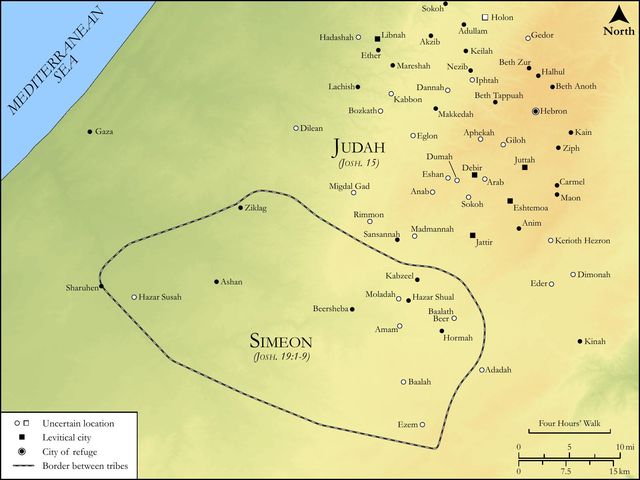
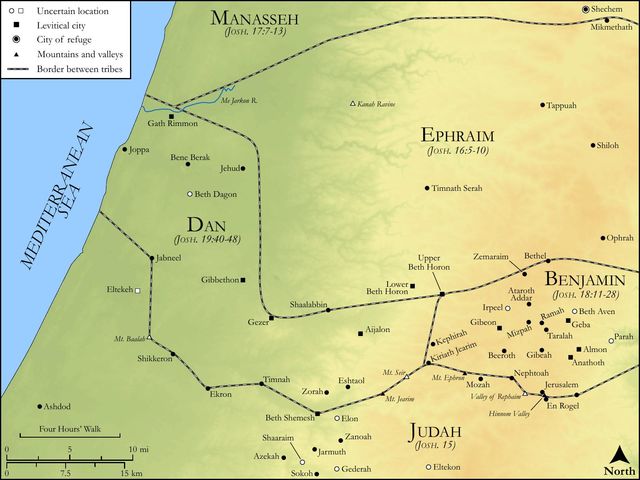
See on the biblical-era maps
Study this verse
Public-domain commentary
Matthew Henry
From his Commentary on the Whole Bible. Henry comments on passages, not single verses — this entry covers Joshua 19:40–48.
Dan, though commander of one of the four squadrons of the camp of Israel, in the wilderness, that which brought up the rear, yet was last provided for in Canaan, and his lot fell in the southern part of Canaan, between Judah on the east and the land of the Philistines on the west, Ephraim on the north and Simeon on the south. Providence ordered this numerous and powerful tribe into a post of danger, as best able to deal with those vexatious neighbours the Philistines, and so it was found in Samson. Here is an account, 1. Of what fell to this tribe by lot, Zorah, and Eshtaol, and the camp of Dan thereabouts, of which we read in the story of Samson. And near there was the valley of Eshcol, whence the spies brought the famous bunch of grapes. Japho, or Joppa was in this lot. 2. Of what they got by their own industry and valour, which is mentioned here (Jos 19:47), but related at large, Jdg 18:7, etc.
Continue studying Joshua 19:47 across the web’s major study libraries — every link below opens this exact verse, chapter, or book on the destination site.
Read & Compare
 BibleGatewayThis verse in more than 200 translations and 70 languages.
 Bible.comThe YouVersion reader — hundreds of translations, reading plans, and highlights.
 ESV.orgCrossway's official English Standard Version reader.
 NET BibleThe NET translation with 60,000+ translators' notes on every rendering decision.
 STEP BibleTyndale House's free study tool — original text, vocabulary, and scholarly resources.
 BibliaLogos Bible Software's free web reader.
 USCCBThe New American Bible (Revised Edition) with the U.S. bishops' study notes.
Commentaries
 BibleHub CommentariesDozens of classic commentaries on this verse, gathered on one page.
 StudyLightMore than 100 commentary sets — the largest collection on the web.
 BibleRefPlain-English commentary on what this verse means, verse by verse.
 Enduring WordDavid Guzik's free commentary on this chapter, widely used by Bible teachers.
 Bible Study ToolsVerse commentary alongside Greek and Hebrew study aids.
Original Language & Research
- BibleHub InterlinearThe verse word by word — original language, transliteration, and English.
- BibleHub LexiconEvery word's original-language definition and Strong's entry.
 Blue Letter BibleDeep-study tools — Strong's numbers, concordance, and word studies.
 SefariaThe Hebrew text with Rashi and centuries of Jewish commentary.
Sermons, Hymns & Audio


TrulyRandomVerse is not affiliated with these sites and doesn’t control their content. They’re linked because they’re genuinely useful.
Summary
Joshua 19:47 meticulously records a pivotal and problematic episode in the history of the tribe of Dan, detailing their dissatisfaction with their initially allotted inheritance in the Promised Land, which they perceived as insufficient. This perceived inadequacy prompted a unilateral and violent northward migration to conquer the prosperous city of Leshem (also known as Laish). The verse succinctly describes their decisive military action, the complete subjugation of the city's inhabitants, their subsequent occupation and settlement, and the renaming of the city to Dan, thereby establishing a new, albeit self-acquired, tribal center far from their original boundaries.
Context
ShowHideLiterary Context
Joshua 19 concludes the meticulous division of the land of Canaan among the tribes of Israel, a process central to the fulfillment of God's covenant promises to Abraham and his descendants. Following the detailed allotments for Judah, Ephraim, and Manasseh, this chapter enumerates the portions for the remaining seven tribes, including Dan. Within this otherwise formulaic description of boundaries and cities, Joshua 19:47 stands out as a unique narrative interjection. It immediately highlights a significant challenge faced by the tribe of Dan regarding their inheritance and their subsequent, self-initiated solution. This concise account serves as a crucial narrative bridge, providing the foundational context for the more expansive and ethically complex recounting of the Danite migration and their spiritual apostasy found in Judges 18. Its inclusion in Joshua underscores the immediate and practical difficulties the tribes encountered in fully possessing their God-given inheritance, even as the land was being distributed.
Historical & Cultural Context
The period immediately following the initial conquests under Joshua, leading into the era of the Judges, was characterized by Israel's ongoing struggle to fully dispossess the indigenous Canaanite populations and secure their allotted territories. Dan's original inheritance was strategically located in the fertile but fiercely contested Shephelah, a low-lying plain bordering the powerful Philistines and situated between the territories of Judah and Ephraim. This region was densely populated by formidable Canaanite groups, particularly the Amorites, who, as Judges 1:34 explicitly states, "pressed the children of Dan into the mountain: for they would not suffer them to come down to the valley." This intense pressure, coupled with the Danites' apparent inability or unwillingness to fully conquer their assigned territory, led to their perception of insufficiency. The act of conquest itself, while violent, was a common practice among the nations for establishing dominion and securing resources. However, Israel's conquests were uniquely framed within a divine mandate to dispossess the Canaanites, a mandate the Danites failed to fully execute in their initial territory.
Key Themes
ShowHideThis singular verse encapsulates several profound and enduring themes that resonate throughout Israel's early history. First, it powerfully illustrates the tension between divine promise and human struggle. Despite God's unwavering faithfulness in providing the land, the Danites perceived their portion as inadequate, whether due to its actual size, the strength of its inhabitants, or their own lack of faith and resolve to fully conquer it. This highlights the ongoing challenge for God's people to fully appropriate His provision. Second, the verse showcases proactive, yet ultimately problematic, expansion. Faced with constraints, the Danites took decisive initiative to secure new territory. However, as the detailed account in Judges 18 reveals, this self-reliant solution was deeply marred by significant moral and spiritual compromise, including the theft of cultic objects and the establishment of idolatry. This foreshadows the broader pattern of disobedience and moral decline that characterizes the period of the Judges. Finally, the renaming of Leshem to Dan underscores the theme of establishing identity and territorial claim. By renaming the city after their tribal patriarch, the Danites solidified their presence and asserted their dominion in this new northern location, creating a lasting monument to their tribal name and effectively redefining their tribal identity.
Exposition and Analysis
ShowHideKey Word Analysis
ShowHideThis term (H1366, גְּבוּל) refers to a "border," "boundary," or, by extension, the "territory" enclosed within those boundaries. In this context, it specifically denotes the geographical allotment or assigned land of the tribe of Dan. The KJV's use of "coast" here reflects an archaic meaning of "frontier" or "district," not necessarily a shoreline, although Dan's original territory did extend towards the Mediterranean. The phrase "went out... for them" refers to the extent or allocation of this territory, implying its perceived limits.
The Hebrew verb (H3318, יָצָא) means "to go out" or "to come forth." In the phrase "went out [too little] for them," the verb describes the extent or allocation of the territory. The KJV's interpretive addition "[too little]" accurately captures the implied meaning of inadequacy or insufficiency. The Danites found their divinely appointed portion insufficient to sustain their growing population or to provide the security they desired, leading them to seek expansion beyond their original, God-given borders.
This city (H3959, לֶשֶׁם) is identified in other biblical texts, most notably Judges 18, as Laish. It was a prosperous, peaceful, and isolated Canaanite city located in the far northern reaches of Canaan, near the source of the Jordan River. Its strategic location made it an attractive target for the Danites seeking new territory. Its renaming to Dan by the conquering tribe marked a significant shift in the geopolitical landscape of the region, establishing a new northernmost boundary for Israelite settlement and becoming a lasting symbol of the tribe's self-reliant expansion.
Verse Breakdown
ShowHide"And the coast of the children of Dan went out [too little] for them"
This opening clause establishes the core problem that precipitates the Danites' actions. The phrase "went out [too little]" indicates that their allotted territory was deemed inadequate. This inadequacy was likely a combination of factors: the actual size of the land, its fertility, and, most significantly, the strong presence of unconquered indigenous inhabitants who effectively prevented the Danites from fully possessing their inheritance, as implied by Judges 1:34.
"therefore the children of Dan went up to fight against Leshem"
This clause describes the Danites' decisive and self-initiated response to their territorial challenge. Rather than seeking divine aid to conquer their original inheritance or petitioning for a reallocation, they embarked on an offensive expedition to the far north. The phrase "went up" signifies a geographical ascent, as Leshem/Laish was situated in a higher elevation in the northern reaches of the land, near Mount Hermon.
"and took it, and smote it with the edge of the sword, and possessed it, and dwelt therein"
This sequence of strong verbs vividly portrays the violent and complete conquest of Leshem. "Took it" signifies capture; "smote it with the edge of the sword" indicates a decisive and destructive military victory, often implying the extermination of its inhabitants (a practice common in ancient warfare and sometimes commanded by God for the Canaanites, though the specific context here is a self-initiated conquest). "Possessed it, and dwelt therein" confirms their successful occupation and permanent settlement in the newly acquired territory.
"and called Leshem, Dan, after the name of Dan their father"
The final clause details the renaming of the conquered city. This act, like Nobah's naming of Kenath after himself, was a common practice employed to assert ownership, commemorate a victory, or establish a new identity for a place. By renaming Leshem to Dan, the tribe firmly established their presence and identity in this new northern location, honoring their tribal patriarch and marking a permanent change in the city's identity, effectively making it the new tribal center.
Literary Devices
ShowHideJoshua 19:47 employs several significant literary devices. Narrative Compression is strikingly evident, as this single verse summarizes a momentous historical event that is subsequently elaborated upon in much greater detail and with significant moral commentary in Judges 18. The author of Joshua provides a concise, outcome-focused overview, deliberately omitting the spiritual compromises and idolatry that accompanied the Danites' migration, which are central to the Judges account. The verse also utilizes Eponymous Naming, a pervasive biblical device where a place is named or renamed after a person or group. The renaming of Leshem to Dan serves not only to solidify the tribal claim but also to establish a lasting memorial to the tribe in their new, self-acquired home. Furthermore, the stark contrast between the initial "too little" inheritance and the violent, self-reliant acquisition of a new territory creates a subtle yet powerful Juxtaposition, highlighting the tribe's perceived need versus their aggressive, problematic solution, which, within the broader biblical narrative, often points to human self-reliance rather than faithful dependence on divine provision.
Theological and Thematic Connections
ShowHideJoshua 19:47, while presented as a straightforward historical record, carries profound theological implications. It starkly highlights the persistent tension between God's perfect provision and human perceived inadequacy or, more critically, the failure to faithfully appropriate that provision. God had meticulously allotted a specific inheritance to Dan, yet the tribe found it "too little," likely due to their lack of faith, courage, or resolve to fully dispossess the formidable inhabitants of their original territory (Judges 1:34). This perceived insufficiency led them to seek their own solution through violent conquest, a move that, while providing physical security, ultimately initiated a trajectory of spiritual decline, as detailed in the Book of Judges, where they adopted idolatry and established a rival cultic center (Judges 18:30-31). The verse implicitly raises critical questions about human initiative versus divine leading, and the profound consequences of seeking security and provision outside of God's prescribed means and trusting in one's own strength. It underscores the ongoing struggle of Israel to live faithfully within the covenant, even after receiving their promised land.
Reflection and Application
ShowHideThe narrative of the Danites in Joshua 19:47 offers a poignant and timeless reflection on human discontent and the often misguided pursuit of security. It serves as a powerful reminder that even when God has faithfully provided, our perception of "enough" can be distorted by fear, ambition, or, most significantly, a lack of faith to fully claim and contend for what is rightfully ours in Christ. The Danites, finding their inheritance "too little," took matters into their own hands, initiating a costly and ultimately spiritually compromising migration. While believers today are not called to physical conquest, the underlying principle remains profoundly relevant: How do we respond when our circumstances feel insufficient, or when challenges in our "allotted" spiritual or material inheritance seem overwhelming? Do we trust in God's sovereign provision and empowering presence to overcome obstacles within our current sphere, or do we seek alternative, self-reliant solutions that may lead us away from God's perfect will and best blessings? This passage challenges us to deeply examine our contentment, our courage in the face of spiritual warfare, and our unwavering reliance on God's strength to possess the blessings and overcome the challenges He has placed before us. It is a compelling call to faithful perseverance and unwavering trust, even when the path appears difficult or the opposition formidable.
Questions for Reflection
ShowHideFAQ
ShowHideWhy was Dan's original inheritance considered "too little" for them?
ShowHideThe text states their "coast... went out [too little] for them," implying a perceived inadequacy. This was likely due to a complex interplay of factors. Their original territory in the Shephelah was indeed fertile, but it bordered the powerful Philistines and was densely populated by other formidable indigenous groups, notably the Amorites. Judges 1:34 explicitly states that the Amorites "pressed the children of Dan into the mountain: for they would not suffer them to come down to the valley." This suggests that the Danites, whether due to a lack of military strength, insufficient faith, or an unwillingness to fully engage in the arduous task of dispossessing these inhabitants, failed to claim their divinely allotted land. Consequently, they perceived their portion as insufficient for their needs and security, leading to their decision to seek new territory.
Did God approve of the Danites' migration and conquest of Leshem?
ShowHideThe book of Joshua simply records the event as a historical fact without explicit divine approval or disapproval in this verse. However, the fuller account in Judges 18 reveals significant spiritual compromises and moral failings associated with this migration. The Danites stole Micah's idol and his Levite priest, establishing idolatry in their new northern settlement (Judges 18:30-31). Furthermore, the city of Leshem/Laish was described as "quiet and secure" and "without any to vex them" (Judges 18:7), indicating that the Danites attacked a peaceful and unsuspecting people. While God permits human actions, He does not necessarily endorse those undertaken outside of His will, in defiance of His commands, or when they involve idolatry and unprovoked violence. The subsequent spiritual decline of the Danites strongly indicates that this was not a divinely sanctioned or blessed move in the same way as the initial, God-commanded conquest of Canaan.
What happened to Dan's original territory after they migrated north?
ShowHideWhile the main body of the tribe of Dan migrated north to Leshem/Dan, it is plausible that some Danites remained in their original southern territory, or at least maintained a presence there for a time. However, the tribe as a whole became primarily associated with their new northern settlement. The original territory, being strategically vulnerable and contested, eventually became absorbed into the control of other tribes or was increasingly dominated by the Philistines. The migration effectively marked a significant and permanent shift in the tribal map of Israel, with Dan becoming the northernmost tribe, giving rise to the well-known phrase "from Dan to Beersheba" to denote the full geographical extent of Israelite territory (Judges 20:1).
Christ-Centered Fulfillment
ShowHideThe narrative of the Danites' restless search for a sufficient inheritance, culminating in their self-initiated conquest and relocation, finds a profound and sobering Christ-centered fulfillment. Israel's broader struggle to fully possess their promised land, and Dan's particular failure to find rest and security within their God-given portion, powerfully foreshadows humanity's deeper, innate spiritual quest for true rest and an enduring inheritance. Just as Dan sought a physical dwelling place, humanity universally yearns for a secure home and a lasting portion. However, this verse, especially when read in light of the detailed account in Judges 18, tragically reveals the futility and spiritual compromise inherent in seeking this inheritance through human strength, self-serving means, and a departure from divine leading.
In Christ, we discover the ultimate and truly sufficient inheritance, a portion that never proves "too little." He is the one who perfectly fulfills all of God's covenant promises, providing not merely a piece of land, but eternal life, spiritual rest, and an unshakable kingdom (Hebrews 4:9-10). Unlike the Danites who failed to dispossess their enemies and instead compromised their faith, Jesus, the true and greater Joshua, has definitively conquered sin, death, and the devil, securing for us an "inheritance that is imperishable, undefiled, and unfading, kept in heaven for you" (1 Peter 1:4). The Danites' renaming of Leshem to Dan, establishing their new identity and claim, beautifully points to our new identity in Christ, where we are no longer defined by our earthly struggles, perceived insufficient portions, or self-made solutions, but by our adoption as beloved children of God (Galatians 4:4-7). Our true "coast" or inheritance is not found in a geographical location secured by the sword, but in the spiritual realities of God's eternal kingdom, fully realized and eternally secure in the person and redemptive work of Jesus Christ, who is our peace, our portion, and our ultimate dwelling place (Ephesians 2:14).