


Joshua 19:46
Bible text: King James Version (1769 Blayney text) · Public domain
Bible text: Berean Standard Bible · Public domain
Bible text: American Standard Version (1901) · Public domain
Bible text: World English Bible, Messianic edition · Public domain
Bible text: Geneva Bible (1599) · Public domain
Bible text: Young's Literal Translation · Public domain
- וּמֵיu·Meiand [the] waters ofH4313Conj-w ¦ N-mpcNoun Plural Masculine Constructוּandמֵי[the] waters of
- הַיַּרְקוֹןhai·yar·Kon<the> JarkonH4313Art ¦ N-properNoun Proper Locationהַ<the>יַּרְקוֹןJarkon
- וְהָרַקּוֹןve·ha·ra·Konand <the> RakkonH7542Conj-w ¦ Art ¦ N-properNoun Proper Locationוְandהָ<the>רַקּוֹןRakkon
- עִם'imwithH5973PrepPreposition
- הַגְּבוּלha·ge·Vulthe territoryH1366Art ¦ N-msNoun Singular Masculine Absoluteהַtheגְּבוּלterritory
- מוּלmulopposite toH4136N-mscNoun Singular Masculine Construct
- יָפוֹya·FoJoppaH3305N-properNoun Proper Location
English is a literal word-by-word gloss of the Hebrew, not the KJV's wording. Why?
This is the original text the KJV's translators worked from — each Hebrew word with its own literal English meaning in this verse, prepared by scholars at Tyndale House, Cambridge. The KJV translates whole sentences, not word by word, so its wording differs: one Hebrew word can become several English words, and the KJV may choose “the LORD” where the gloss reads “Yahweh”. Both are faithful — they answer different questions. For the KJV's own rendering, switch to the KJV text.
Details
See on the biblical-era maps
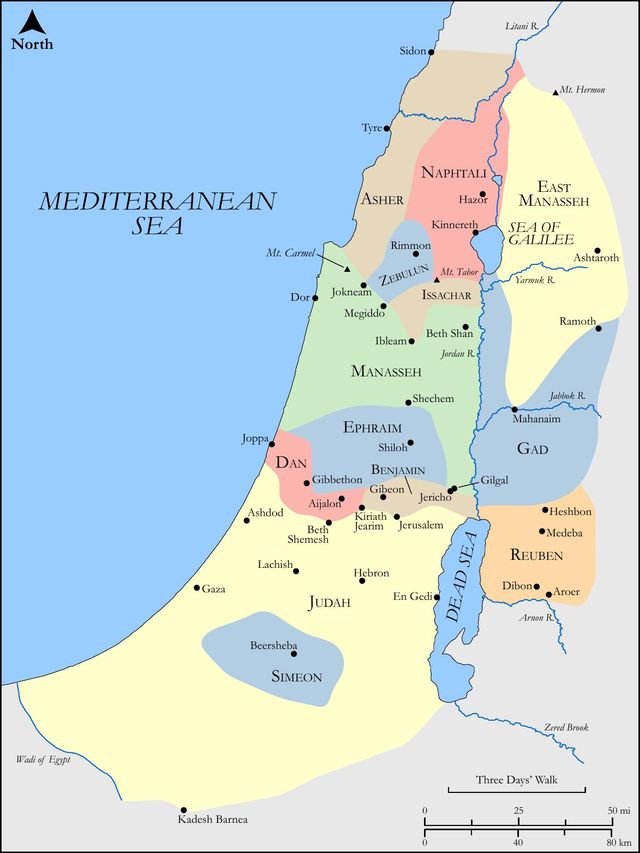
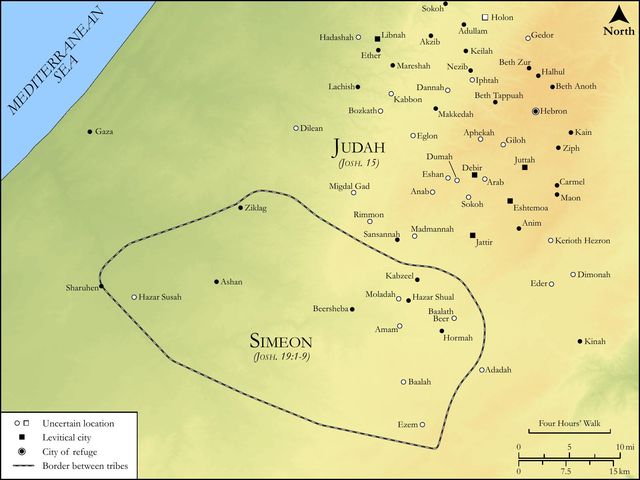
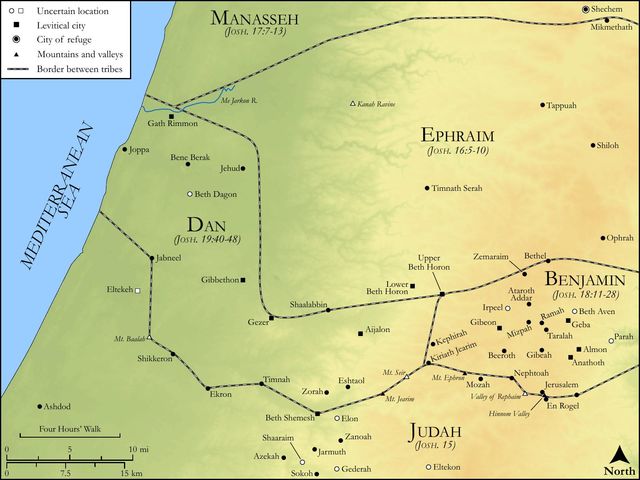
Study this verse
Public-domain commentary
Matthew Henry
From his Commentary on the Whole Bible. Henry comments on passages, not single verses — this entry covers Joshua 19:40–48.
Dan, though commander of one of the four squadrons of the camp of Israel, in the wilderness, that which brought up the rear, yet was last provided for in Canaan, and his lot fell in the southern part of Canaan, between Judah on the east and the land of the Philistines on the west, Ephraim on the north and Simeon on the south. Providence ordered this numerous and powerful tribe into a post of danger, as best able to deal with those vexatious neighbours the Philistines, and so it was found in Samson. Here is an account, 1. Of what fell to this tribe by lot, Zorah, and Eshtaol, and the camp of Dan thereabouts, of which we read in the story of Samson. And near there was the valley of Eshcol, whence the spies brought the famous bunch of grapes. Japho, or Joppa was in this lot. 2. Of what they got by their own industry and valour, which is mentioned here (Jos 19:47), but related at large, Jdg 18:7, etc.
Continue studying Joshua 19:46 across the web’s major study libraries — every link below opens this exact verse, chapter, or book on the destination site.
Read & Compare
 BibleGatewayThis verse in more than 200 translations and 70 languages.
 Bible.comThe YouVersion reader — hundreds of translations, reading plans, and highlights.
 ESV.orgCrossway's official English Standard Version reader.
 NET BibleThe NET translation with 60,000+ translators' notes on every rendering decision.
 STEP BibleTyndale House's free study tool — original text, vocabulary, and scholarly resources.
 BibliaLogos Bible Software's free web reader.
 USCCBThe New American Bible (Revised Edition) with the U.S. bishops' study notes.
Commentaries
 BibleHub CommentariesDozens of classic commentaries on this verse, gathered on one page.
 StudyLightMore than 100 commentary sets — the largest collection on the web.
 BibleRefPlain-English commentary on what this verse means, verse by verse.
 Enduring WordDavid Guzik's free commentary on this chapter, widely used by Bible teachers.
 Bible Study ToolsVerse commentary alongside Greek and Hebrew study aids.
Original Language & Research
- BibleHub InterlinearThe verse word by word — original language, transliteration, and English.
- BibleHub LexiconEvery word's original-language definition and Strong's entry.
 Blue Letter BibleDeep-study tools — Strong's numbers, concordance, and word studies.
 SefariaThe Hebrew text with Rashi and centuries of Jewish commentary.
Sermons, Hymns & Audio


TrulyRandomVerse is not affiliated with these sites and doesn’t control their content. They’re linked because they’re genuinely useful.
Summary
Joshua 19:46 is a concise yet profoundly significant verse embedded within the meticulous tribal land allocations, specifically delineating a crucial segment of the western border for the tribe of Dan. It precisely names Mejarkon and Rakkon as key geographical markers, indicating their immediate proximity to the prominent coastal city of Japho. This detailed demarcation underscores God's unwavering faithfulness in fulfilling His ancient promises regarding the Promised Land and highlights the strategic, maritime access initially granted to Dan, even as it foreshadows the challenges they would face in fully possessing their inheritance.
Context
ShowHideLiterary Context
This verse is intricately woven into the broader narrative of the division of the Promised Land among the twelve tribes of Israel, a process meticulously documented in Joshua 13-19. More precisely, it forms an integral part of the detailed description of the inheritance allotted to the tribe of Dan, found in Joshua 19:40-48. Following the triumphant conquest of Canaan, Joshua, acting under direct divine instruction, painstakingly oversaw the casting of lots to assign territories. The precise listing of towns and geographical features, even seemingly minor ones like Mejarkon and Rakkon alongside the major port of Japho, serves to emphasize the thoroughness, divine authority, and undeniable fulfillment of God's covenant promises. This administrative detail underscores the theological truth that God's word is not vague but is brought to fruition with absolute precision.
Historical & Cultural Context
The period described in the Book of Joshua encompasses the immediate aftermath of the Israelites' exodus from Egypt and their forty-year wilderness wandering, culminating in the conquest and settlement of Canaan, roughly spanning c. 1400-1200 BCE. Land ownership was of paramount importance in Israel, serving as the bedrock of identity, economic security, and a tangible manifestation of divine favor. The inclusion of Japho (modern Jaffa/Tel Aviv) is particularly significant as it was a strategic ancient port city on the Mediterranean coast, offering vital trade routes and maritime access. For the tribe of Dan, receiving territory near such a crucial port presented immense economic and strategic potential. However, the historical reality, as later recounted in Judges 1:34 and the extensive narrative of Judges 18, reveals that the Danites struggled to dispossess the indigenous Amorites and Philistines from their allocated coastal plain, ultimately leading to their northward migration to Laish/Dan. This struggle highlights the ongoing challenge of fully possessing God's promises amidst human failure and hostile opposition.
Key Themes
ShowHideThe meticulous geographical descriptions, including those found in Joshua 19:46, powerfully illustrate the overarching theme of Divine Fulfillment of Promise. God's ancient covenant with Abraham, which promised his descendants the land of Canaan (Genesis 12:7; Genesis 15:18), is meticulously brought to fruition through these land allocations. The Meticulous Order and Detail evident in these boundary lists reflects God's precise and orderly nature, demonstrating that His plans are not vague generalities but are executed with absolute thoroughness and divine authority. Furthermore, the Geographical Significance of Japho is a crucial theme. As a major maritime gateway, its inclusion in Dan's territory underscores the strategic importance of the coastal region, a place that would later feature prominently in biblical history, such as Jonah's departure and Peter's transformative vision and ministry in the New Testament.
Exposition and Analysis
ShowHideKey Word Analysis
ShowHideVerse Breakdown
ShowHide"And Mejarkon"
This phrase introduces the first specific geographical marker of Dan's western border. The mention of "Mejarkon" (the waters of the Yarkon River) establishes a natural and identifiable northern boundary point for this segment of Dan's inheritance, indicating that their territory extended up to or included this significant river.
"and Rakkon"
Following Mejarkon, the inclusion of "Rakkon" denotes another specific point on the border, likely a town or settlement. This adds further precision to the description, indicating the border's path from the river to this particular settlement, thereby more fully defining the tribal land's extent.
"with the border before Japho"
This concluding phrase clarifies the overall orientation and extent of this section of the border. The phrase "before Japho" signifies that the boundary runs in front of, or in the immediate vicinity of, the prominent city of Japho. This places Dan's territory directly adjacent to this crucial coastal city, confirming their allocation of land that reached the Mediterranean Sea and encompassed a highly strategic area with access to trade and international connections.
Literary Devices
ShowHideThe concise nature of Joshua 19:46 primarily employs Topographical Description, a pervasive literary feature throughout the Book of Joshua as it meticulously details the division of the land. The verse functions as a small part of an extensive Catalogue of place names, systematically listing the boundaries and cities allotted to each tribe. This cataloging serves to emphasize the thoroughness, precision, and divine order of the land distribution, underscoring the fulfillment of prophecy. While not a direct example of Merism, the combination of a natural feature (Mejarkon, a river), a specific settlement (Rakkon), and a major city (Japho) effectively delineates a comprehensive segment of the border, providing a complete picture of that particular stretch of territory. The language is characterized by a Telegraphic Style, prioritizing factual geographical information over elaborate narrative, which is characteristic of administrative or legal documents of the time, thereby reinforcing the authoritative and binding nature of the land allocation.
Theological and Thematic Connections
ShowHideJoshua 19:46, though seemingly a mere geographical listing, profoundly underscores God's meticulous faithfulness in fulfilling His ancient promises. The precision with which these boundaries are described, down to specific rivers and towns, demonstrates that God's covenant with Abraham regarding the land of Canaan was not a vague generality but a detailed, divinely orchestrated reality. It reveals a God who is intimately involved in the specifics of His people's lives and destiny, ensuring that every detail of His word comes to pass. This attention to detail in the physical inheritance foreshadows the intricate precision with which God orchestrates His spiritual promises for His people, assuring believers of the certainty of His redemptive plan.
Reflection and Application
ShowHideThis brief verse, a fragment of an ancient land deed, offers profound lessons for contemporary believers. It serves as a powerful reminder of God's unwavering faithfulness and His meticulous attention to detail in fulfilling His promises. Just as He precisely delineated the physical inheritance for the tribes of Israel, so too does He meticulously work out the details of our lives and His grand redemptive plan for humanity. We are called to trust in this God who is faithful in the grand sweep of history and in the seemingly small, intricate aspects of our personal journeys. Furthermore, understanding the challenges faced by the Danites in fully possessing their inheritance, despite its divine allocation, prompts us to reflect on our own spiritual inheritance in Christ. Are we actively "possessing" the blessings, gifts, responsibilities, and spiritual realities that are truly ours in Him, or are we allowing spiritual "Amorites"—be they sin, doubt, fear, or worldly distractions—to hinder us from fully inhabiting God's provision? The strategic importance of Japho, a gateway to the nations, also invites us to consider how God places us in strategically important positions—whether geographical, relational, or vocational—for the furtherance of His kingdom, even if those positions come with inherent challenges and require spiritual fortitude.
Questions for Reflection
ShowHideFAQ
ShowHideWhat is the significance of the specific locations mentioned in Joshua 19:46?
ShowHideThe significance of the locations mentioned in Joshua 19:46 lies in their role as precise geographical markers defining a key portion of the western border of the tribe of Dan's inheritance. "Mejarkon" refers to the "waters of the Yarkon," a significant perennial river, and "Rakkon" is a town, both situated in the central coastal plain of Israel. "Japho" (modern Jaffa/Joppa) was a crucial ancient port city on the Mediterranean Sea, offering vital maritime access. The mention of these specific, identifiable locations underscores the meticulous nature of the land division, demonstrating God's faithfulness in fulfilling His promise to give Israel a defined and tangible territory. It also highlights the strategic access to the sea that was initially granted to the tribe of Dan, though they later struggled to fully occupy this region, as detailed in Judges 1:34 and Judges 18.
Why are such seemingly minor geographical details included in the biblical narrative?
ShowHideThe inclusion of seemingly minor geographical details like those in Joshua 19:46 serves several crucial theological and historical purposes. First, it powerfully authenticates the historical claims of the text, providing verifiable (or at least historically plausible) markers that ground the narrative in real geography, demonstrating its rootedness in actual events. Second, and most importantly, it emphasizes the divine precision and meticulousness with which God fulfilled His covenant promises to Abraham regarding the land (Genesis 15:18). Every inch of the promised land was accounted for, reflecting God's faithfulness to His word. Third, these details highlight the legal and administrative thoroughness of the land distribution, which was a foundational act for the nascent Israelite nation's identity and governance. Finally, for the original audience, these specific names would have been highly relevant, helping them understand the exact extent and boundaries of their tribal heritage, reinforcing their identity and place within God's sovereign plan.
How does the mention of Japho in Dan's territory connect to other biblical events?
ShowHideJapho (Joppa) is a highly significant ancient port city that appears in several key biblical narratives beyond its mention in Joshua 19:46. In the Old Testament, it is most famously known as the port from which the prophet Jonah attempted to flee from God's command to go to Nineveh. This event underscores Japho's role as a gateway to the wider world. In the New Testament, Japho is the city where the apostle Peter stayed with Simon the tanner and, most notably, where he received the pivotal vision of the sheet with unclean animals. This vision prepared him to preach the Gospel to Gentiles, specifically Cornelius in Caesarea (Acts 10:9-23). These later events underscore Japho's enduring strategic importance as a hub connecting the land of Israel to the wider world, a significance implicitly recognized by its inclusion in Dan's initial tribal allocation, foreshadowing its future role in God's redemptive plan for all nations.
Christ-Centered Fulfillment
ShowHideWhile Joshua 19:46 describes a physical border in the Promised Land, its deeper theological resonance points powerfully to Christ. The meticulous detail with which God allocated land to His people foreshadows the precise and comprehensive fulfillment of His ultimate redemptive plan in Jesus. Just as the land was a tangible, promised inheritance, Christ Himself is the believer's true, eternal, and infinitely superior inheritance, far surpassing any earthly possession or geographical boundary (Ephesians 1:11). The "borders" of this spiritual inheritance are not defined by ancient rivers or towns, but by the boundless grace, truth, and love found exclusively in Him, extending to all who believe, regardless of their earthly tribe, nation, or social status (Galatians 3:28). Furthermore, the mention of Japho, a strategic port city connecting Israel to the wider world, subtly prefigures Christ's universal mission. He is the ultimate "gateway" and the sole means through whom all nations can access God's salvation and eternal life (John 14:6), breaking down the dividing wall of hostility between Jew and Gentile and uniting all believers into one new humanity in Himself (Ephesians 2:14). Thus, this seemingly obscure verse ultimately points to the comprehensive, inclusive, and perfectly executed nature of God's kingdom, fully realized in the person and redemptive work of Jesus Christ, our perfect and eternal inheritance.