


Joshua 19:45
Bible text: King James Version (1769 Blayney text) · Public domain
Bible text: King James Version with Strong's numbers · Public domain
Bible text: Berean Standard Bible · Public domain
Bible text: American Standard Version (1901) · Public domain
Bible text: World English Bible, Messianic edition · Public domain
Bible text: Geneva Bible (1599) · Public domain
Bible text: Young's Literal Translation · Public domain
- וִיהֻדvi·Hudand JehudH3055Conj-w ¦ N-properNoun Proper LocationוִandיהֻדJehud
- וּבְנֵיu·ve·neiand BeneH1139Conj-w ¦ N-properNoun Proper LocationוּandבְנֵיBene
- בְרַקve·RakBerakH1139N-properNoun Proper Location
- וְגַתve·gatand GathH1667Conj-w ¦ N-properNoun Proper LocationוְandגַתGath
- רִמּוֹןri·MonRimmonH1667N-properNoun Proper Location
English is a literal word-by-word gloss of the Hebrew, not the KJV's wording. Why?
This is the original text the KJV's translators worked from — each Hebrew word with its own literal English meaning in this verse, prepared by scholars at Tyndale House, Cambridge. The KJV translates whole sentences, not word by word, so its wording differs: one Hebrew word can become several English words, and the KJV may choose “the LORD” where the gloss reads “Yahweh”. Both are faithful — they answer different questions. For the KJV's own rendering, switch to the KJV text.
Details
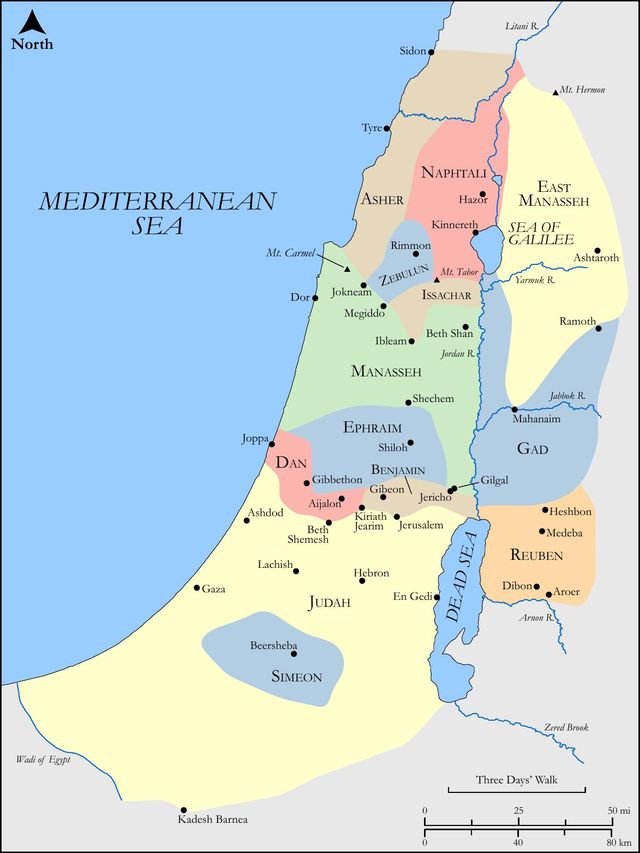
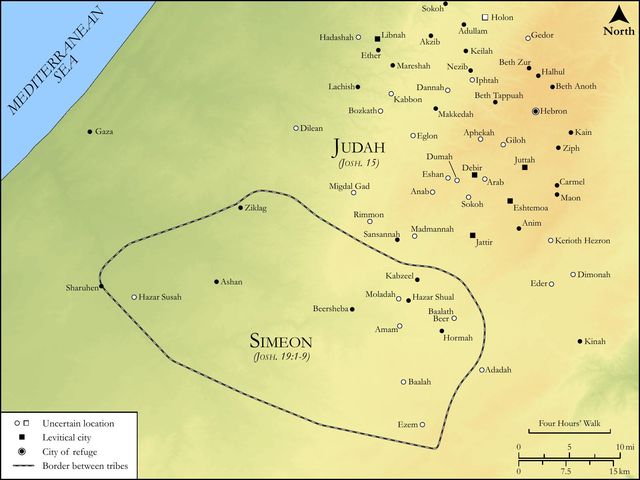
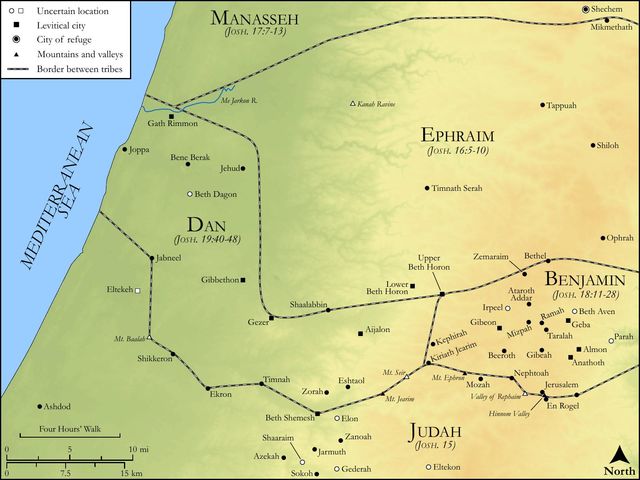
See on the biblical-era maps
Study this verse
Public-domain commentary
Matthew Henry
From his Commentary on the Whole Bible. Henry comments on passages, not single verses — this entry covers Joshua 19:40–48.
Dan, though commander of one of the four squadrons of the camp of Israel, in the wilderness, that which brought up the rear, yet was last provided for in Canaan, and his lot fell in the southern part of Canaan, between Judah on the east and the land of the Philistines on the west, Ephraim on the north and Simeon on the south. Providence ordered this numerous and powerful tribe into a post of danger, as best able to deal with those vexatious neighbours the Philistines, and so it was found in Samson. Here is an account, 1. Of what fell to this tribe by lot, Zorah, and Eshtaol, and the camp of Dan thereabouts, of which we read in the story of Samson. And near there was the valley of Eshcol, whence the spies brought the famous bunch of grapes. Japho, or Joppa was in this lot. 2. Of what they got by their own industry and valour, which is mentioned here (Jos 19:47), but related at large, Jdg 18:7, etc.
Continue studying Joshua 19:45 across the web’s major study libraries — every link below opens this exact verse, chapter, or book on the destination site.
Read & Compare
 BibleGatewayThis verse in more than 200 translations and 70 languages.
 Bible.comThe YouVersion reader — hundreds of translations, reading plans, and highlights.
 ESV.orgCrossway's official English Standard Version reader.
 NET BibleThe NET translation with 60,000+ translators' notes on every rendering decision.
 STEP BibleTyndale House's free study tool — original text, vocabulary, and scholarly resources.
 BibliaLogos Bible Software's free web reader.
 USCCBThe New American Bible (Revised Edition) with the U.S. bishops' study notes.
Commentaries
 BibleHub CommentariesDozens of classic commentaries on this verse, gathered on one page.
 StudyLightMore than 100 commentary sets — the largest collection on the web.
 BibleRefPlain-English commentary on what this verse means, verse by verse.
 Enduring WordDavid Guzik's free commentary on this chapter, widely used by Bible teachers.
 Bible Study ToolsVerse commentary alongside Greek and Hebrew study aids.
Original Language & Research
- BibleHub InterlinearThe verse word by word — original language, transliteration, and English.
- BibleHub LexiconEvery word's original-language definition and Strong's entry.
 Blue Letter BibleDeep-study tools — Strong's numbers, concordance, and word studies.
 SefariaThe Hebrew text with Rashi and centuries of Jewish commentary.
Sermons, Hymns & Audio


TrulyRandomVerse is not affiliated with these sites and doesn’t control their content. They’re linked because they’re genuinely useful.
Summary
Joshua 19:45 meticulously enumerates three specific towns—Jehud, Beneberak, and Gathrimmon—as integral parts of the land inheritance divinely allotted to the tribe of Dan within the Promised Land. This seemingly straightforward listing serves as a powerful testament to God's unwavering faithfulness, His meticulous precision in fulfilling ancient covenant promises to Israel, and the tangible reality of their inheritance, underscoring the comprehensive nature of His divine provision for His people.
Context
ShowHideLiterary Context
Joshua 19:45 is situated within the extensive and highly detailed section of Joshua 13-19, which systematically records the distribution of the land of Canaan among the twelve tribes of Israel. Following the initial military campaigns and conquests led by Joshua, this phase of the narrative transitions to the orderly and divinely sanctioned division of the promised inheritance by lot. Chapter 19 specifically delineates the territories and cities assigned to the remaining tribes, including Simeon, Zebulun, Issachar, Asher, Naphtali, and Dan. The allotment for the tribe of Dan, though geographically compact and strategically located along the coastal plain, receives the same meticulous attention to detail as the larger tribal portions, emphasizing the comprehensive and equitable nature of God's provision. These intricate lists, far from being mere geographical data, functioned as vital legal and historical records, solidifying Israel's claim to the land and unequivocally confirming the veracity of God's covenant word.
Historical & Cultural Context
The division of the land marked a pivotal transition for Israel, transforming them from a nomadic, wilderness-dwelling people into a settled, agricultural nation. In Israel, land ownership was profoundly central to identity, security, and the reception of covenant blessings. The precise demarcation of boundaries and the enumeration of cities were therefore crucial for establishing distinct tribal identities, preventing future disputes over territory, and ensuring that each family received its generational inheritance as promised by God. The method of casting lots for land distribution, as explicitly detailed in Numbers 26:55, was understood not as a random act but as a divine mechanism, ensuring God's direct and sovereign involvement in the allocation process. Geographically, the Danite territory, encompassing the towns mentioned in this verse, was situated in the fertile Shephelah and coastal plain, a region that would become a significant trade route and, consequently, a frequently contested area due to its strategic and economic importance.
Key Themes
ShowHideThe meticulous detailing of tribal allotments throughout the book of Joshua, including the specific towns listed in Joshua 19, powerfully reinforces several overarching theological themes. Firstly, it profoundly highlights Divine Faithfulness, demonstrating God's absolute commitment to fulfilling His ancient promises to Abraham regarding the land, a covenant first articulated with remarkable clarity in Genesis 15:18. Secondly, the comprehensive and precise nature of the land division underscores God's Order and Precision, revealing His character as a God who meticulously plans, provides for, and governs His people, down to the smallest geographical detail. This theme is explicitly affirmed later in Joshua 21:45. Thirdly, these detailed lists served to establish Territorial Identity and Inheritance, providing each tribe with a clear and undeniable sense of their distinct boundaries and their place within the unified nation of Israel, which was crucial for their self-governance, their understanding of covenant responsibilities, and their collective identity as God's chosen people.
Exposition and Analysis
ShowHideKey Word Analysis
ShowHideAs a place name, Jehud is identified as a specific location within the territory allotted to the tribe of Dan. The Strong's data indicates it is a briefer form of a related Hebrew word, signifying a distinct town in Palestine. Its inclusion in this list underscores the precise and verifiable nature of the land distribution, marking a tangible point within the divinely appointed inheritance.
This compound name, derived from the plural construction of "son" and "lightning," literally translates to "sons of lightning." As a place name, it designates a specific town in Palestine within Dan's inheritance. The evocative imagery of "lightning" might suggest a place known for its swiftness, perhaps in movement or action, or simply a descriptive characteristic of the locale, firmly rooting the Danite inheritance in concrete, named locations.
This name is a compound of "Gath" (wine-press) and "Rimmon" (pomegranate), thus translating to "wine-press of (the) pomegranate." This name clearly indicates the agricultural significance of the town, suggesting it was a fertile area known for its vineyards and pomegranate groves. Such details, though seemingly minor, paint a vivid picture of the land's bounty and the practical realities of Israelite life within their new, divinely provided inheritance.
Verse Breakdown
ShowHide"And Jehud"
This phrase introduces the first of three specific towns enumerated as part of the inheritance for the tribe of Dan. Its inclusion emphasizes the meticulous detail and precision with which the land was divided, signifying a precise and identifiable point within the tribal boundary.
"and Beneberak"
The second town listed, further detailing the extent and specific locations within Dan's inheritance. The conjunction "and" links these places as part of a continuous, divinely sanctioned allocation, reinforcing the comprehensive nature of the land distribution.
"and Gathrimmon"
The final town in this specific enumeration, completing the trio of named places. Its presence reinforces the exact and exhaustive nature of God's provision for His people, ensuring every portion of the promised land was accounted for and documented, solidifying their claim and identity.
Literary Devices
ShowHideThe predominant literary device employed in Joshua 19:45, and indeed throughout the land distribution chapters of Joshua, is Cataloging or Listing. This involves the systematic enumeration of names, places, and geographical boundaries. This detailed listing serves to underscore the Precision and Verifiability of God's covenant promises. It demonstrates that God's word is not a vague or abstract declaration but a tangible, itemized fulfillment. The sheer volume of names and locations creates a sense of Completeness and Thoroughness, emphasizing that no detail was overlooked in the divine administration of the inheritance. While these sections may not present a dynamic narrative, the meticulous nature of the list itself acts as a powerful literary statement, reinforcing the Divine Order and the Fulfillment of Covenant. The repetition of such comprehensive lists across multiple chapters also functions as a form of Emphasis, continually reminding the reader of God's unwavering faithfulness and the secure reality of Israel's inheritance.
Theological and Thematic Connections
ShowHideJoshua 19:45, though a simple list of towns, profoundly underscores the theological truth of God's covenant faithfulness and His meticulous care for His people. The precise naming of these locations within Dan's inheritance is a tangible demonstration that God keeps His word, fulfilling promises made centuries earlier to Abraham and his descendants. It speaks to a God who is not vague but specific, not forgetful but attentive to every detail of His divine plan. This precision in land distribution served not only as a historical record but also as a foundational act establishing Israel's national identity and their secure place as God's chosen people in the land He had sworn to give them. It is a powerful reminder that God's promises are concrete and reliable, providing a secure foundation for His people's existence and future.
Reflection and Application
ShowHideThe detailed enumeration of towns like Jehud, Beneberak, and Gathrimmon in Joshua 19:45 might initially seem like a dry, antiquated record. However, it serves as a profound and encouraging reminder of God's meticulous care and unwavering faithfulness in our own lives. Just as He precisely allotted every parcel of land to Israel, down to individual towns and their specific characteristics, He is intimately involved in the intricate details of our lives, orchestrating circumstances and providing for our needs with intentionality and divine precision. This verse invites us to cultivate a deeper trust in a God who sees, knows, and provides for every specific aspect of our journey, even the seemingly mundane or insignificant. It encourages us to recognize that our spiritual inheritance in Christ is equally real, meticulously prepared, and infinitely more glorious and enduring than any earthly possession. We are called to live in the fullness of this spiritual inheritance, not just acknowledging it intellectually, but actively possessing, stewarding, and enjoying the abundant blessings and profound responsibilities that come with being children of God and co-heirs with Christ.
Questions for Reflection
ShowHideFAQ
ShowHideWhy are these specific towns mentioned in such detail in the book of Joshua?
ShowHideThe detailed mention of towns like Jehud, Beneberak, and Gathrimmon serves several crucial and interconnected purposes within the narrative of Joshua. Firstly, it provides a precise, legal, and historical record of the land distribution, ensuring that each tribe's inheritance was clearly defined, documented, and beyond dispute. This meticulousness powerfully underscores God's unwavering faithfulness in fulfilling His ancient covenant promises to Abraham, that his descendants would indeed inherit the land (see Genesis 15:18). Secondly, it highlights God's divine order and precision; He is not a God of chaos or ambiguity but of meticulous planning and provision, down to the smallest geographical detail. These lists were vital for establishing the Israelites' national identity, defining tribal boundaries, and preventing future disputes over territory. Finally, from a profound theological perspective, it demonstrates that God's promises are tangible and concrete, not vague or abstract, solidifying the reality of their inheritance and providing a secure foundation for their new life as a settled nation.
Christ-Centered Fulfillment
ShowHideWhile Joshua 19:45 meticulously details the physical inheritance of the tribe of Dan, its deeper theological significance finds profound Christ-centered fulfillment in the New Testament. The precise division of the earthly land foreshadows the spiritual inheritance believers receive in Christ, which is infinitely more glorious, enduring, and comprehensive than any earthly territory. Just as the land was a gift from God, secured by conquest under Joshua's leadership, our spiritual inheritance—which encompasses salvation, reconciliation with God, eternal life, and every spiritual blessing—is a gift secured by Christ's decisive victory on the cross. He is our true "Promised Land," our ultimate rest and dwelling place, as we are spiritually united "in Christ" (Ephesians 1:3). The precise boundaries for Dan point to the secure and perfect provision found in Jesus, who is the ultimate "Yes" and "Amen" to all God's promises (2 Corinthians 1:20). Our inheritance is not merely a place but a Person, Jesus Christ, in whom we have "obtained an inheritance" (Ephesians 1:11) and are declared "co-heirs with Christ" (Romans 8:17). The earthly land was a type and shadow of the heavenly reality, where Christ reigns and prepares an eternal dwelling place for us (John 14:2-3).