


2 Chronicles 2:16
- וַאֲנַחְנוּVa·'a·nach·nuand weH587Conj-w ¦ Pro-1cpPronoun Personal 1st Plural common genderוַandאֲנַחְנוּwe
- נִכְרֹתnikh·Rotwe will cutH3772V-Qal-Imperf-1cpVerb Qal Imperfect 1st Plural common gender
- עֵצִים'e·Tzimwood<s>H6086N-mpNoun Plural Masculine Absolute
- מִןminfromH4480PrepPreposition
- הַלְּבָנוֹןha·le·va·nOn<the> LebanonH3844Art ¦ N-properNoun Proper Locationהַ<the>לְּבָנוֹןLebanon
- כְּכָלke·kholaccording to allH3605Prep-k ¦ N-mscNoun Singular Masculine Constructכְּaccording toכָלall
- צָרְכֶּךָtza·re·Ke·khayour needH6878N-msc ¦ 2msNoun Singular Masculine Constructצָרְכֶּneedךָyour
- וּנְבִיאֵםu·ne·vi·'Emand we will bring themH935Conj-w ¦ V-Hiphil-ConjImperf-1cp ¦ 3mpVerb Hiphil Conjunction+Imperfect 1st Plural common genderוּandנְבִיאֵwe will bringםthem
- לְךָle·Khato youPrep-l ¦ 2msSuffix Personal 2nd Singular Masculineלְtoךָyou
- רַפְסֹדוֹתraf·so·DotraftsH7513N-fpNoun Plural Feminine Absolute
- עַל'alonH5921PrepPreposition
- יָםyam[the] seaH3220N-msNoun Singular Masculine Absolute
- יָפוֹya·FoJoppaH3305N-properNoun Proper Location
- וְאַתָּהve·'a·Tahand youH859Conj-w ¦ Pro-2msPronoun Personal 2nd Singular Masculineוְandאַתָּהyou
- תַּעֲלֶהta·'a·Lehyou will take upH5927V-Hiphil-Imperf-2msVerb Hiphil Imperfect 2nd Singular Masculine
- אֹתָם'o·Tam<obj.> themH853DirObjM ¦ 3mpParticle Object Indicatorאֹתָ<obj.>םthem
- יְרוּשָׁלִָםye·ru·sha·LimJerusalemH3389N-properNoun Proper Location
English is a literal word-by-word gloss of the Hebrew, not the KJV's wording. Why?
This is the original text the KJV's translators worked from — each Hebrew word with its own literal English meaning in this verse, prepared by scholars at Tyndale House, Cambridge. The KJV translates whole sentences, not word by word, so its wording differs: one Hebrew word can become several English words, and the KJV may choose “the LORD” where the gloss reads “Yahweh”. Both are faithful — they answer different questions. For the KJV's own rendering, switch to the KJV text.
Details
See on the biblical-era map
Study this verse
Public-domain commentary
Matthew Henry
From his Commentary on the Whole Bible. Henry comments on passages, not single verses — this entry covers 2 Chronicles 2:11–18.
Here we have, I. The return which Huram made to Solomon's embassy, in which he shows a great respect for Solomon and a readiness to serve him. Meaner people may learn of these great ones to be neighbourly and complaisant. 1. He congratulates Israel on having such a king as Solomon was (Ch2 2:11): Because the Lord loved his people, he has made thee king. Note, A wise and good government is a great blessing to a people, and may well be accounted a singular token of God's favour. He does not say, Because he loved thee (though that was true, Sa2 12:24) he made thee king, but because he loved his people. Princes must look upon themselves as preferred for the public good, not for their own personal satisfaction, and should rule so as to prove that they were given in love and not in anger. 2. He blesses God for raising up such a successor to David, Ch2 2:12. It should seem that Huram was not only very well affected to the Jewish nation, and well pleased with their prosperity, but that he was proselyted to the Jewish religion, and worshipped Jehovah, the God of Israel (who was now known by that name to the neighbouring nations), as the God that made heaven and earth, and as the fountain of power as well as being; for he sets up kings. Now that the people of Israel kept close to the law and worship of God, and so preserved their honour, the neighbouring nations were as willing to be instructed by them in the true religion as Israel had been, in the days of their apostasy, to be infected with the idolatries and superstitions of their neighbours. This made them high, that they lent to many nations and did not borrow, lent truth to them, and did not borrow error from them; as when they did the contrary it was their shame. 3. He sent him a very ingenious curious workman, that would not fail to answer his expectations in every thing, one that had both Jewish and Gentile blood meeting in him; for his mother was an Israelite (Huram though she was of the tribe of Dan, and therefore says so here, Ch2 2:14, but it seems she was of the tribe of Naphtali, Kg1 7:14), but his father was a Tyrian - a good omen of uniting Jew and Gentile in the gospel temple, as it was afterwards when the building of the second temple was greatly furthered by Darius (Ezra 6), who is supposed to have been the son of Esther - an Israelite by the mother's side. 4. He engaged for the timber, as much as he would have occasion for, and undertook to deliver it at Joppa, and withal signified his dependence upon Solomon for the maintenance of the workmen as he had promised, v. 15, 16. This agreement we had, Kg1 5:8, Kg1 5:9.
II.The orders which Solomon gave about the workmen.
He would not employ the free-born Israelites in the drudgery work of the temple itself, not so much as to be overseers of it. In this he employed the strangers who were proselyted to the Jewish religion, who had not lands of inheritance in Canaan as the Israelites had, and therefore applied to trades, and got their living by their ingenuity and industry. There were, at this time, vast numbers of them in the land (Ch2 2:17), who, if they were of any of the devoted nations, perhaps fell within the case, and therefore fell under the law, of the Gibeonites, to be hewers of wood for the congregation: if not, yet being in many respects well provided for by the law of Moses, and put upon an equal footing with the native Israelites, they were bound in gratitude to do what they could for the service of the temple. Yet, no doubt, they were well paid in money or money's worth: the law was, Thou shalt not oppress a stranger. The distribution of them we have here (Ch2 2:2, and again Ch2 2:18), in all 150,000. Canaan was a fruitful land, that found meat for so many mouths more than the numerous natives; and the temple was a vast building, that found work for so many bands. Mr. Fuller suggests that the expedient peculiar to this structure, of framing all beforehand, must needs increase the work. I think it rather left so much the more room for this vast multitude of hands to be employed in it; for in the forest of Lebanon they might all be at work together, without crowding one another, which they could not have been upon Mount Sion. And, if there had not been such vast numbers employed, so large and curious a fabric, which was begun and ended in seven years, might, for aught I know, have been as long in building as St. Paul's.
Continue studying 2 Chronicles 2:16 across the web’s major study libraries — every link below opens this exact verse, chapter, or book on the destination site.
Read & Compare
 BibleGatewayThis verse in more than 200 translations and 70 languages.
 Bible.comThe YouVersion reader — hundreds of translations, reading plans, and highlights.
 ESV.orgCrossway's official English Standard Version reader.
 NET BibleThe NET translation with 60,000+ translators' notes on every rendering decision.
 STEP BibleTyndale House's free study tool — original text, vocabulary, and scholarly resources.
 BibliaLogos Bible Software's free web reader.
 USCCBThe New American Bible (Revised Edition) with the U.S. bishops' study notes.
Commentaries
 BibleHub CommentariesDozens of classic commentaries on this verse, gathered on one page.
 StudyLightMore than 100 commentary sets — the largest collection on the web.
 BibleRefPlain-English commentary on what this verse means, verse by verse.
 Enduring WordDavid Guzik's free commentary on this chapter, widely used by Bible teachers.
 Bible Study ToolsVerse commentary alongside Greek and Hebrew study aids.
Original Language & Research
- BibleHub InterlinearThe verse word by word — original language, transliteration, and English.
- BibleHub LexiconEvery word's original-language definition and Strong's entry.
 Blue Letter BibleDeep-study tools — Strong's numbers, concordance, and word studies.
 SefariaThe Hebrew text with Rashi and centuries of Jewish commentary.
Sermons, Hymns & Audio


TrulyRandomVerse is not affiliated with these sites and doesn’t control their content. They’re linked because they’re genuinely useful.
Summary
This verse from 2 Chronicles meticulously details King Hiram of Tyre's practical and comprehensive commitment to King Solomon, outlining the precise logistical plan for supplying the vast quantities of timber from Lebanon required for the construction of the First Temple in Jerusalem. It underscores the meticulous planning, advanced engineering, and international cooperation essential for such a monumental sacred undertaking, showcasing the ancient world's sophisticated trade and resource management capabilities.
Context
ShowHideLiterary Context
This verse serves as the practical culmination of King Hiram's affirmative response to King Solomon's ambitious request for materials and skilled labor for the Temple's construction. Solomon's initial appeal, detailed in 2 Chronicles 2:3-10, sought specific resources, notably timber from Lebanon and expert craftsmen. Hiram, a long-standing ally of David and now Solomon, expresses his profound joy and praises the Lord God of Israel for Solomon's wisdom in 2 Chronicles 2:11-15. Verse 16 specifically transitions from this general agreement and theological affirmation to the concrete, actionable plan for timber delivery, forming the logistical core of Hiram's commitment. This account closely parallels the narrative found in 1 Kings 5:8-9, highlighting the unified historical record of this significant inter-kingdom collaboration in a divinely ordained project.
Historical & Cultural Context
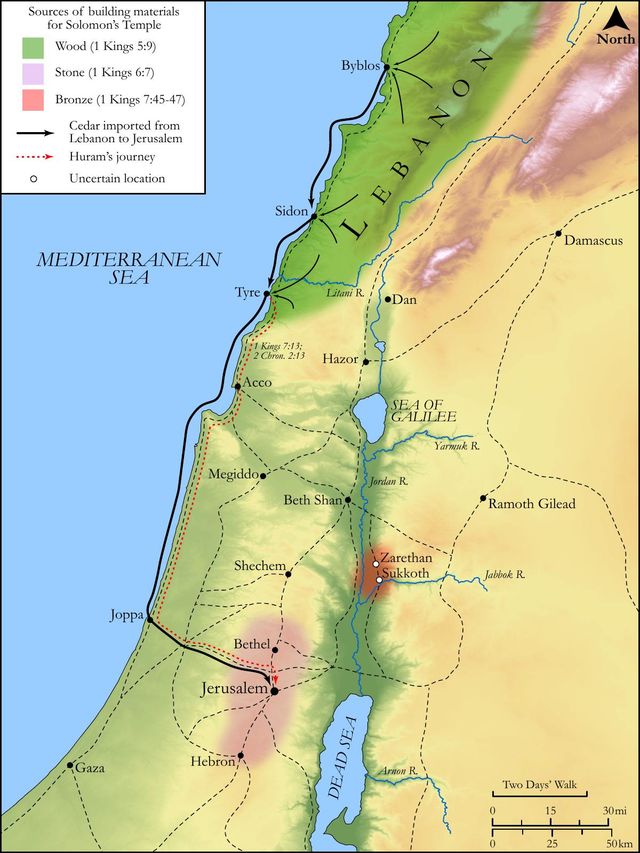
The ancient Near East placed immense value on natural resources, and the majestic cedar and fir trees of Lebanon were particularly coveted. Renowned for their durability, aromatic qualities, and resistance to decay, these "cedars of Lebanon" were a premium building material, extensively used for palaces, temples, and ships across the region. The method of "floats by sea" (Hebrew: רַפְסֹדוֹת יָם, raphṣōḏōṯ yām) refers to bundles or rafts of logs tied together and towed by ships along the Mediterranean coastline. This was an efficient and common practice for transporting large quantities of timber over water, leveraging Tyre's renowned maritime expertise. Joppa (modern-day Jaffa), located on the Mediterranean coast, served as the primary port for Jerusalem, being the closest and most practical harbor. From Joppa, the timber would then be laboriously transported overland, uphill, to the capital city, Jerusalem, a significant logistical challenge given the volume and weight of the materials. The strategic alliance between Israel and Tyre was one of mutually beneficial trade, with Tyre providing materials and expertise in exchange for agricultural products from Israel, as detailed in 1 Kings 5:11.
Key Themes
ShowHideThis verse powerfully contributes to several overarching themes within 2 Chronicles and the broader biblical narrative. It illustrates Divine Provision and International Collaboration, showing how God orchestrates resources and partnerships, even from outside Israel, to accomplish His sacred purposes. The detailed logistical plan highlights the theme of Diligence and Meticulous Planning in God's service, emphasizing that significant spiritual endeavors require careful thought, hard work, and strategic foresight, not merely spiritual zeal. Furthermore, the immense scale of the operation—cutting, floating, and transporting vast quantities of timber over significant distances—underscores the Grandeur and Importance of the Temple Project, signifying the dedication and reverence given to constructing a dwelling place for the Lord's name. This international cooperation also speaks to the broader theme of God's Universal Sovereignty, demonstrating His ability to use all nations and their unique resources for His glory and the advancement of His kingdom.
Exposition and Analysis
ShowHideKey Word Analysis
ShowHideMeaning "(the) white mountain (from its snow)." This refers to the mountain range to the north of Israel, famed throughout the ancient Near East for its vast forests of cedar and fir trees. These trees, particularly the "cedars of Lebanon," were highly prized for their strength, resistance to insects and rot, fragrant aroma, and impressive size, making them ideal for monumental construction projects like the Temple. Their acquisition signified both wealth and access to premium, durable materials.
Meaning "a raft (as flat on the water)." This term specifically refers to rafts or bundles of logs that were tied together and towed by ships. This method was the most practical and efficient way to transport large quantities of timber by sea in the ancient world, allowing for bulk movement of materials that would be impossible to carry on individual vessels. It speaks to the advanced maritime and engineering knowledge of the Tyrians, who were renowned seafarers and traders.
Meaning "beautiful." This was a significant ancient port city on the Mediterranean coast, located approximately 35 miles northwest of Jerusalem. Joppa served as the primary maritime gateway for goods entering and leaving Judah, making it the logical disembarkation point for the timber. The subsequent overland journey from Joppa to Jerusalem was arduous, involving a significant uphill climb, further emphasizing the scale of the logistical challenge and the immense effort required for the Temple's construction.
Verse Breakdown
ShowHide"And we will cut wood out of Lebanon, as much as thou shalt need"
This clause signifies Hiram's full and generous commitment to Solomon's request, promising an unlimited supply of timber from the famed Lebanese forests. It highlights the vast scale of the Temple project and Hiram's willingness to meet Solomon's demands, demonstrating the strength of their alliance and the abundant natural resources at Tyre's disposal. The phrase "as much as thou shalt need" underscores the comprehensive nature of the agreement, ensuring no shortage for the sacred construction, indicating a partnership of trust and mutual benefit.
"and we will bring it to thee in floats by sea to Joppa"
This specifies the primary method of transport for the timber. The use of "floats by sea" indicates an efficient, large-scale maritime operation, leveraging Tyre's renowned naval expertise in moving heavy cargo. Delivering the timber to Joppa, the closest practical port to Jerusalem, was a strategic logistical decision that minimized the overland journey, despite its inherent difficulties. This part of the verse details the international leg of the supply chain, showcasing the Tyrian contribution.
"and thou shalt carry it up to Jerusalem."
This final clause delineates Israel's specific responsibility in the logistical chain. Once the timber arrived at Joppa, it became Solomon's charge to arrange for its overland transport from the coast up to the elevated city of Jerusalem. This uphill haul would have been a massive undertaking, requiring substantial manpower, beasts of burden, and well-maintained roads, underscoring the immense effort and resources Israel devoted to the Temple's construction and their active participation in the divine project.
Literary Devices
ShowHideThe verse employs Practicality and Detailing to convey the meticulous planning involved in the Temple's construction. It moves beyond a mere statement of agreement to outline the precise, step-by-step logistical process: cutting, floating, and overland transport. This detailed approach emphasizes the Monumental Scale of the undertaking, allowing the reader to grasp the sheer effort and resources required for such a sacred project. The mention of specific geographical locations like Lebanon, Joppa, and Jerusalem grounds the narrative in historical reality, lending Credibility to the account and highlighting the ancient world's interconnected trade routes and sophisticated infrastructure. The clear division of labor between Hiram's people ("we will cut," "we will bring") and Solomon's people ("thou shalt carry") illustrates Collaboration and a clear delineation of responsibilities, essential for the successful execution of such a grand and divinely inspired project.
Theological and Thematic Connections
ShowHideThis verse, though seemingly a mere logistical detail, carries profound theological weight, illustrating God's sovereign provision and the principle that He often works through unexpected channels and international partnerships to fulfill His purposes. The building of the Temple, a physical manifestation of God's presence among His people, was not solely an Israelite endeavor but a collaborative effort orchestrated by divine wisdom. This highlights that God's work often requires human diligence, meticulous planning, and the leveraging of diverse gifts and resources—both internal and external—for the greater glory of His kingdom. The detailed plan for transporting the timber underscores the principle that even the most sacred tasks demand practical wisdom and hard work, reflecting a commitment to excellence in all endeavors dedicated to the Lord.
Reflection and Application
ShowHideThe detailed logistics of 2 Chronicles 2:16 serve as a powerful reminder that God's grand plans often unfold through careful human planning, diligent effort, and strategic collaboration. Just as the construction of the physical Temple required immense resources, skilled labor, and precise execution from diverse sources, so too does the building of God's spiritual kingdom today. We are called to be good stewards of the resources, talents, and relationships God provides, recognizing that He often works through partnerships and unexpected avenues. This verse encourages us to approach our callings—whether in ministry, work, or personal life—with both unwavering faith in God's provision and a commitment to excellence, meticulous planning, and hard work. It challenges us to look beyond our immediate capabilities and embrace collaboration, understanding that the body of Christ thrives when its diverse members work together for a common, divinely inspired purpose, reflecting God's own order and wisdom.
Questions for Reflection
ShowHideFAQ
ShowHideWhy was Lebanon's timber so prized for the Temple?
ShowHideLebanon was renowned for its vast forests of cedar and fir trees, particularly the "cedars of Lebanon," which were highly prized throughout the ancient Near East. These trees were coveted for several key reasons: their exceptional durability and strength, making them ideal for large and enduring construction projects; their natural resistance to decay and insect infestation, ensuring the longevity of structures; their aromatic properties, which provided a pleasant and lasting fragrance; and their impressive size, allowing for long, straight beams suitable for grand architectural designs. The acquisition of such premium timber was a mark of wealth and prestige, and its extensive use in the Temple underscored the sacredness, grandeur, and enduring significance of the edifice as a dwelling place for God's name.
What was the significance of Joppa in this logistical plan?
ShowHideJoppa (modern-day Jaffa) was the most important and practical port city on the Mediterranean coast for accessing Jerusalem. While the timber was cut in Lebanon, it was transported by sea in "floats" (rafts of logs) down the coastline to Joppa. From this port, the timber then had to be hauled overland, uphill, approximately 35 miles to Jerusalem. Joppa's strategic location as the closest major harbor to the capital made it the indispensable gateway for all heavy and bulky materials arriving by sea for the Temple's construction. It served as the crucial link between efficient maritime transport and the challenging overland delivery to the elevated city of Jerusalem, highlighting its critical role in ancient Israeli trade and infrastructure.
Christ-Centered Fulfillment
ShowHideThe detailed account of building the First Temple, particularly the international collaboration and meticulous logistics described in 2 Chronicles 2:16, ultimately points beyond a physical structure to the ultimate Temple: Jesus Christ. While Solomon's Temple was a magnificent dwelling place for God's name, a place of sacrifice and worship, it was only a shadow of the true and living Temple. Jesus boldly declared, "Destroy this temple, and in three days I will raise it up," explicitly referring to "the temple of his body" (John 2:19-21). Just as the finest materials and skilled labor were gathered from diverse sources for the earthly Temple, so too was the perfect sacrifice of the Lamb of God, who takes away the sin of the world, required to build the spiritual Temple of God, the Church. We, as believers, are now "living stones" being built into a "spiritual house" with Christ as the "chief cornerstone" (1 Peter 2:5 and Ephesians 2:19-22). The provision of timber from Lebanon foreshadows the lavish spiritual resources and diverse gifts provided by Christ through the Holy Spirit for the building up of His body, the Church (Ephesians 4:11-13). The painstaking transport of timber to Jerusalem reflects the journey of faith and the diligent work of discipleship required to build up the Church, which is the dwelling place of God's Spirit in the world today (1 Corinthians 3:16). Thus, this ancient logistical detail ultimately highlights God's ultimate redemptive plan to dwell among His people through Christ, the perfect and eternal Temple.