


2 Chronicles 2:15
- וְעַתָּהVe·'a·tahand thereforeH6258Conj-w ¦ AdvAdverbוְandעַתָּהtherefore
- הַחִטִּיםha·chi·Timthe wheat<s>H2406Art ¦ N-mpNoun Plural Masculine Absoluteהַtheחִטִּיםwheat<s>
- וְהַשְּׂעֹרִיםve·ha·se·'o·Rimand the barley<s>H8184Conj-w ¦ Art ¦ N-mpNoun Plural Masculine Absoluteוְandהַtheשְּׂעֹרִיםbarley<s>
- הַשֶּׁמֶןha·She·menthe oilH8081Art ¦ N-msNoun Singular Masculine Absoluteהַtheשֶּׁמֶןoil
- וְהַיַּיִןve·hai·Ya·yinand the wineH3196Conj-w ¦ Art ¦ N-msNoun Singular Masculine Absoluteוְandהַtheיַּיִןwine
- אֲשֶׁר'a·SherwhichH834RelParticle Relative
- אָמַר'a·Marhe has saidH559V-Qal-Perf-3msVerb Qal Perfect 3rd Singular Masculine
- אֲדֹנִי'a·do·Nimy lordH113N-msc ¦ 1csNoun Singular Masculine Constructאֲדֹנִlordיmy
- יִשְׁלַחyish·Lachlet him sendH7971V-Qal-Imperf-3msVerb Qal Imperfect 3rd Singular Masculine
- לַעֲבָדָיוla·'a·va·Davto his servantsH5650Prep-l ¦ N-mpc ¦ 3msNoun Plural Masculine Constructלַtoעֲבָדָיservantsוhis
English is a literal word-by-word gloss of the Hebrew, not the KJV's wording. Why?
This is the original text the KJV's translators worked from — each Hebrew word with its own literal English meaning in this verse, prepared by scholars at Tyndale House, Cambridge. The KJV translates whole sentences, not word by word, so its wording differs: one Hebrew word can become several English words, and the KJV may choose “the LORD” where the gloss reads “Yahweh”. Both are faithful — they answer different questions. For the KJV's own rendering, switch to the KJV text.
Details
See on the biblical-era map
Study this verse
Public-domain commentary
Matthew Henry
From his Commentary on the Whole Bible. Henry comments on passages, not single verses — this entry covers 2 Chronicles 2:11–18.
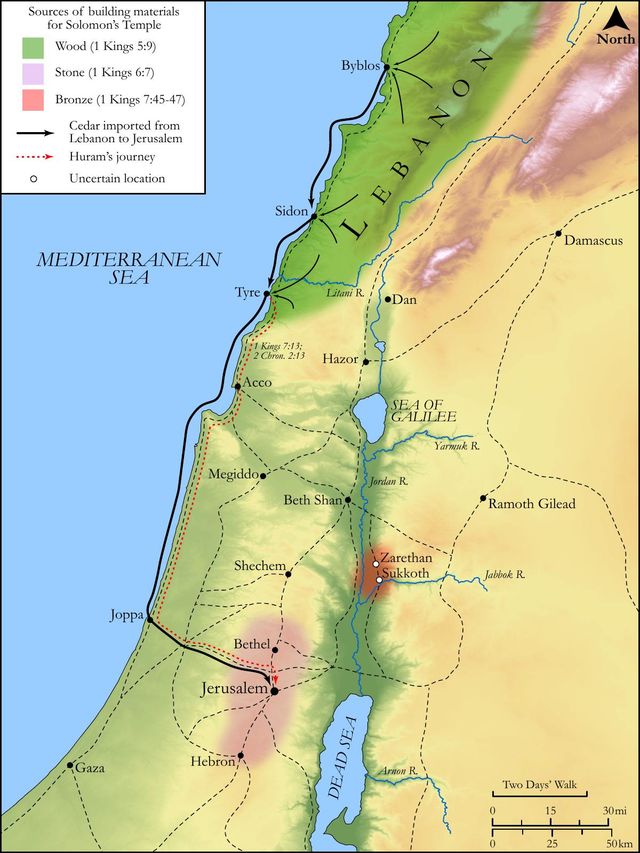
Here we have, I. The return which Huram made to Solomon's embassy, in which he shows a great respect for Solomon and a readiness to serve him. Meaner people may learn of these great ones to be neighbourly and complaisant. 1. He congratulates Israel on having such a king as Solomon was (Ch2 2:11): Because the Lord loved his people, he has made thee king. Note, A wise and good government is a great blessing to a people, and may well be accounted a singular token of God's favour. He does not say, Because he loved thee (though that was true, Sa2 12:24) he made thee king, but because he loved his people. Princes must look upon themselves as preferred for the public good, not for their own personal satisfaction, and should rule so as to prove that they were given in love and not in anger. 2. He blesses God for raising up such a successor to David, Ch2 2:12. It should seem that Huram was not only very well affected to the Jewish nation, and well pleased with their prosperity, but that he was proselyted to the Jewish religion, and worshipped Jehovah, the God of Israel (who was now known by that name to the neighbouring nations), as the God that made heaven and earth, and as the fountain of power as well as being; for he sets up kings. Now that the people of Israel kept close to the law and worship of God, and so preserved their honour, the neighbouring nations were as willing to be instructed by them in the true religion as Israel had been, in the days of their apostasy, to be infected with the idolatries and superstitions of their neighbours. This made them high, that they lent to many nations and did not borrow, lent truth to them, and did not borrow error from them; as when they did the contrary it was their shame. 3. He sent him a very ingenious curious workman, that would not fail to answer his expectations in every thing, one that had both Jewish and Gentile blood meeting in him; for his mother was an Israelite (Huram though she was of the tribe of Dan, and therefore says so here, Ch2 2:14, but it seems she was of the tribe of Naphtali, Kg1 7:14), but his father was a Tyrian - a good omen of uniting Jew and Gentile in the gospel temple, as it was afterwards when the building of the second temple was greatly furthered by Darius (Ezra 6), who is supposed to have been the son of Esther - an Israelite by the mother's side. 4. He engaged for the timber, as much as he would have occasion for, and undertook to deliver it at Joppa, and withal signified his dependence upon Solomon for the maintenance of the workmen as he had promised, v. 15, 16. This agreement we had, Kg1 5:8, Kg1 5:9.
II.The orders which Solomon gave about the workmen.
He would not employ the free-born Israelites in the drudgery work of the temple itself, not so much as to be overseers of it. In this he employed the strangers who were proselyted to the Jewish religion, who had not lands of inheritance in Canaan as the Israelites had, and therefore applied to trades, and got their living by their ingenuity and industry. There were, at this time, vast numbers of them in the land (Ch2 2:17), who, if they were of any of the devoted nations, perhaps fell within the case, and therefore fell under the law, of the Gibeonites, to be hewers of wood for the congregation: if not, yet being in many respects well provided for by the law of Moses, and put upon an equal footing with the native Israelites, they were bound in gratitude to do what they could for the service of the temple. Yet, no doubt, they were well paid in money or money's worth: the law was, Thou shalt not oppress a stranger. The distribution of them we have here (Ch2 2:2, and again Ch2 2:18), in all 150,000. Canaan was a fruitful land, that found meat for so many mouths more than the numerous natives; and the temple was a vast building, that found work for so many bands. Mr. Fuller suggests that the expedient peculiar to this structure, of framing all beforehand, must needs increase the work. I think it rather left so much the more room for this vast multitude of hands to be employed in it; for in the forest of Lebanon they might all be at work together, without crowding one another, which they could not have been upon Mount Sion. And, if there had not been such vast numbers employed, so large and curious a fabric, which was begun and ended in seven years, might, for aught I know, have been as long in building as St. Paul's.
Continue studying 2 Chronicles 2:15 across the web’s major study libraries — every link below opens this exact verse, chapter, or book on the destination site.
Read & Compare
 BibleGatewayThis verse in more than 200 translations and 70 languages.
 Bible.comThe YouVersion reader — hundreds of translations, reading plans, and highlights.
 ESV.orgCrossway's official English Standard Version reader.
 NET BibleThe NET translation with 60,000+ translators' notes on every rendering decision.
 STEP BibleTyndale House's free study tool — original text, vocabulary, and scholarly resources.
 BibliaLogos Bible Software's free web reader.
 USCCBThe New American Bible (Revised Edition) with the U.S. bishops' study notes.
Commentaries
 BibleHub CommentariesDozens of classic commentaries on this verse, gathered on one page.
 StudyLightMore than 100 commentary sets — the largest collection on the web.
 BibleRefPlain-English commentary on what this verse means, verse by verse.
 Enduring WordDavid Guzik's free commentary on this chapter, widely used by Bible teachers.
 Bible Study ToolsVerse commentary alongside Greek and Hebrew study aids.
Original Language & Research
- BibleHub InterlinearThe verse word by word — original language, transliteration, and English.
- BibleHub LexiconEvery word's original-language definition and Strong's entry.
 Blue Letter BibleDeep-study tools — Strong's numbers, concordance, and word studies.
 SefariaThe Hebrew text with Rashi and centuries of Jewish commentary.
Sermons, Hymns & Audio


TrulyRandomVerse is not affiliated with these sites and doesn’t control their content. They’re linked because they’re genuinely useful.
Summary
This verse captures King Solomon's direct request to King Hiram of Tyre for the delivery of specific provisions—wheat, barley, oil, and wine—which were previously agreed upon as payment for Hiram's assistance in providing timber and skilled craftsmen for the construction of the Temple in Jerusalem. It highlights the meticulous logistical planning and the importance of fulfilling contractual obligations in this monumental, internationally collaborative endeavor, underscoring the practical details necessary for a project of immense spiritual significance.
Context
ShowHideLiterary Context
This verse is situated within Solomon's elaborate preparations for building the Temple, immediately following his initial communication with King Hiram of Tyre and Hiram's affirmative response. In 2 Chronicles 2:3, Solomon outlines his request for timber and skilled laborers, emphasizing the divine mandate for the Temple's construction. 2 Chronicles 2:10 details Solomon's promise of provisions—twenty thousand measures of beaten wheat, twenty thousand measures of barley, twenty thousand baths of wine, and twenty thousand baths of oil—as compensation for Hiram's servants. Verse 15, therefore, serves as the practical follow-up, a concise directive for Hiram to dispatch these promised goods. It reinforces the reciprocal nature of the agreement, moving from the initial negotiation to the actual execution of the terms, setting the stage for the massive undertaking described in subsequent chapters. A parallel, though slightly varied, account of this agreement and provision can be found in 1 Kings 5:11.
Historical & Cultural Context
The interaction between Solomon and Hiram reflects typical ancient Near Eastern diplomacy and trade relations between powerful monarchs. Alliances were often solidified through reciprocal agreements, gifts, and the exchange of goods and services. Tyre, a prominent Phoenician city-state, was renowned for its maritime prowess, its access to cedar and cypress timber from Lebanon, and its skilled artisans, particularly in stonemasonry, metalwork, and carpentry. Israel, under Solomon, possessed agricultural abundance. This exchange was mutually beneficial: Israel gained access to resources and expertise it lacked, while Tyre secured essential foodstuffs. The list of provisions—wheat, barley, oil, and wine—represents the staple diet of the region, crucial for sustaining a large workforce involved in arduous labor. Such detailed agreements underscore the high value placed on integrity and the fulfillment of covenants in a culture where a king's word was binding and failure to uphold it could lead to severe political and economic repercussions.
Key Themes
ShowHideThe verse significantly contributes to several overarching themes within 2 Chronicles and the broader biblical narrative. Firstly, it highlights the theme of diligent preparation and meticulous planning for God's work, demonstrating that even the most sacred endeavors require careful logistical arrangements and human cooperation. Secondly, it underscores the importance of international cooperation and alliances, showing how God can use relationships between different nations to accomplish His purposes, even when those nations do not share the same religious beliefs. Thirdly, the emphasis on provisions speaks to the theme of provision and sustenance for labor, reflecting a biblical principle of caring for those who work, ensuring their well-being and ability to perform their tasks effectively, a concept echoed in passages like Deuteronomy 24:14-15. Finally, and perhaps most profoundly, it reinforces the theme of covenant faithfulness and integrity, as both kings are expected to honor their word and fulfill the terms of their agreement, mirroring God's own perfect faithfulness in His covenants with humanity.
Exposition and Analysis
ShowHideKey Word Analysis
ShowHideThese four items represent the foundational agricultural staples of the ancient Near East, forming the core of the daily diet. "Wheat" (H2406) and "barley" (H8184) were the primary grains for bread, while "oil" (H8081, olive oil) was used for cooking, fuel, and anointing, and "wine" (H3196) was a common beverage. Their inclusion signifies a comprehensive provision for sustenance, emphasizing the practical and essential nature of the payment. This list is not merely symbolic but reflects the actual, tangible needs of a large workforce engaged in strenuous physical labor.
The KJV phrase "my lord hath spoken of" translates the Hebrew verb (H559, ʼâmar), which means "to say (used with great latitude)." In this context, it refers to a prior verbal agreement or promise. The use of this word underscores the binding nature of the oral contract between Solomon and Hiram. It implies a clear, articulated understanding and commitment, reinforcing the theme of integrity and the fulfillment of one's word in diplomatic and commercial dealings. It's not a new request but a reminder of an established, acknowledged obligation.
This word (H7971, shâlach) is a primitive root meaning "to send away, for, or out (in a great variety of applications)." Here, it is a direct command from Solomon to Hiram to dispatch the promised provisions. It signifies the active fulfillment of the agreement, moving from negotiation to concrete action. The verb implies a purposeful and deliberate act of delivery, highlighting the logistical execution of the grand Temple project.
Verse Breakdown
ShowHide"Now therefore"
This transitional phrase connects the current request directly to the preceding agreement. It signals that what follows is a logical consequence or implementation of what has already been discussed and settled between Solomon and Hiram, specifically the terms outlined in 2 Chronicles 2:10. It creates a sense of continuity and obligation.
"the wheat, and the barley, the oil, and the wine"
This precise enumeration of provisions reiterates the specific items and quantities that Solomon had promised to Hiram. It highlights the meticulous nature of the planning for the Temple project, where even the sustenance of laborers was carefully calculated and agreed upon, demonstrating the practical foresight required for such a massive undertaking.
"which my lord hath spoken of"
This clause serves as a direct reference to Hiram's previous commitment. It acts as a reminder, emphasizing that the request is not arbitrary but is based on a mutually acknowledged and binding agreement. This reinforces the theme of covenant faithfulness and the expectation that promises made between leaders would be honored. The use of "my lord" (H113, ʼâdôwn) acknowledges Hiram's status and authority.
"let him send unto his servants"
This is the direct command or request from Solomon to Hiram. The phrase "his servants" (H5650, ʻebed) most likely refers to Solomon's own laborers who would be working on the Temple project, or perhaps the Tyrian workers who would be felling the trees in Lebanon. The provisions were intended to sustain the workforce involved in the Temple construction, underscoring the practical logistics of such a large-scale international collaboration.
Literary Devices
ShowHideThe verse employs several subtle literary devices. Enumeration is evident in the precise listing of "wheat, barley, oil, and wine," which serves to specify the exact nature of the provisions, emphasizing the detailed and contractual nature of the agreement. This list also functions as a form of synecdoche, where these staple items represent the broader category of all necessary sustenance and payment for the laborers. The phrase "which my lord hath spoken of" acts as an allusion to the prior verbal agreement detailed earlier in the chapter, creating a sense of continuity and reinforcing the theme of covenant fulfillment. Furthermore, the entire interaction between Solomon and Hiram, culminating in this verse, exemplifies reciprocity in international relations, a balanced exchange of goods and services for mutual benefit.
Theological and Thematic Connections
ShowHideThis seemingly simple verse, focused on mundane provisions, carries profound theological weight. It underscores the biblical principle that even the most sacred and divinely ordained projects, like the building of God's Temple, require diligent human effort, meticulous planning, and faithful adherence to commitments. God, in His sovereignty, works through human means, and this often involves practical arrangements, fair dealings, and the honoring of agreements. The provision of sustenance for laborers reflects a divine concern for justice and the well-being of those who toil, a theme consistently woven through Scripture. Solomon's expectation that Hiram would fulfill his word mirrors God's own perfect faithfulness to His covenants, serving as a human reflection, however imperfect, of divine integrity. The collaboration between Israel and Tyre also hints at God's broader redemptive plan, which ultimately encompasses all nations.
Reflection and Application
ShowHide2 Chronicles 2:15, though a detail in a grand narrative, offers timeless principles for personal and communal life. Firstly, it profoundly emphasizes the importance of integrity and honoring commitments. Just as Solomon expected Hiram to fulfill his promise, we are called to be people of our word, whether in personal relationships, professional dealings, or our commitments to God. Our faithfulness in small, practical matters reflects our character and builds trust. Secondly, the verse subtly highlights the biblical value of caring for those who labor. Providing fair compensation and adequate support for workers is not merely good business practice but a reflection of valuing human dignity and contribution, a principle that extends to how we support those who serve in any capacity, including ministry. Finally, it reminds us that even the most practical and seemingly mundane aspects of our work can be part of a larger, divinely purposed endeavor. Our diligence in managing resources, fulfilling obligations, and attending to details can contribute significantly to God's kingdom work, demonstrating that all of life, when lived faithfully, can be an act of worship.
Questions for Reflection
ShowHideFAQ
ShowHideWhy were these specific provisions (wheat, barley, oil, and wine) chosen as payment?
ShowHideThese items were the primary agricultural staples and most valuable commodities in ancient Israel. Wheat and barley were essential grains for bread, forming the backbone of the diet. Oil (primarily olive oil) was crucial for cooking, lighting, and anointing, while wine was a common beverage. By offering these provisions, Solomon was providing comprehensive sustenance for a large workforce, ensuring their basic needs were met. This exchange was economically sound, as Israel had an abundance of these agricultural products, while Tyre, a maritime nation, relied on imports for such goods. It was a practical and mutually beneficial arrangement for both kingdoms.
Who are "his servants" that Solomon refers to in this verse?
ShowHideThe phrase "his servants" most likely refers to Solomon's own laborers—the Israelite workers who would be involved in the immense task of constructing the Temple, possibly alongside Hiram's skilled craftsmen. In 2 Chronicles 2:10, Solomon promised these provisions "unto thy servants, the hewers that cut timber," referring to Hiram's men. However, the subsequent verse 2 Chronicles 2:16 has Hiram promising to send the timber to Solomon's "servants." Given the context of Solomon's overall management of the project, it's highly probable that these provisions were intended to sustain the entire workforce, both Israelite and Tyrian, engaged in the Temple construction, or specifically the Israelite laborers who would be receiving the timber from Hiram.
What does this verse tell us about the nature of ancient Near Eastern diplomacy and trade?
ShowHideThis verse exemplifies the highly structured and reciprocal nature of diplomacy and trade in the ancient Near East. Agreements between kings were often formalized through verbal promises, which were considered binding covenants. The exchange of goods and services was common, often based on each kingdom's unique resources and expertise. Tyre provided specialized timber and skilled labor, while Israel provided agricultural abundance. This arrangement highlights the importance of mutual benefit, trust, and the fulfillment of agreed-upon terms to maintain stable political and economic relationships between powerful states. It shows that even monumental projects like the Temple required intricate international cooperation and meticulous logistical planning.
Christ-Centered Fulfillment
ShowHideThe meticulous provisions for the earthly Temple, as seen in 2 Chronicles 2:15, beautifully foreshadow the ultimate provision found in Christ, the true Temple of God. Solomon's careful planning and the sustenance offered to laborers point to God's divine foresight and His abundant provision for His people in the new covenant. Just as wheat, barley, oil, and wine sustained the physical laborers, Christ is the spiritual sustenance for all who believe—He is the Bread of Life, the living water, and the true vine from whom we draw all spiritual nourishment. The integrity of the agreement between Solomon and Hiram, where promises were kept, prefigures the perfect faithfulness of God, who always fulfills His covenant promises through Christ. The earthly Temple, built with human hands and resources, was a temporary dwelling for God's presence, but Christ's body is the eternal Temple, through whom believers are built into a spiritual house. Furthermore, the international cooperation between Israel and Tyre, bringing together diverse peoples for a common purpose, subtly anticipates the breaking down of the dividing wall between Jew and Gentile in Christ, who makes one new humanity from all nations, uniting them in His body, the Church.