


2 Chronicles 2:14
- בֶּןbena son ofH1121N-mscNoun Singular Masculine Construct
- אִשָּׁה'i·Shaha womanH802N-fsNoun Singular Feminine Absolute
- מִןminone ofH4480PrepPreposition
- בְּנוֹתbe·Not[the] daughters ofH1323N-fpcNoun Plural Feminine Construct
- דָּןDanDanH1835N-properNoun Proper Location
- וְאָבִיוve·'a·Vivand his fatherH1Conj-w ¦ N-msc ¦ 3msNoun Singular Masculine Constructוְandאָבִיfatherוhis
- אִישׁ'ish[was] a manH376N-msNoun Singular Masculine Absolute
- צֹרִיtzo·RiTyrianH6876N-msNoun Gentilic Singular Masculine Absolute
- יוֹדֵעַyo·De·a'[who] knowsH3045V-Qal-Prtcpl-msVerb Qal Participle Singular Masculine Absolute
- לַעֲשׂוֹתla·'a·Sotto workH6213Prep-l ¦ V-Qal-InfVerb Qal Infinitive Constructלַtoעֲשׂוֹתwork
- בַּזָּהָבba·za·hovin <the> goldH2091Prep-b ¦ N-msNoun Singular Masculine Absoluteבַּin <the>זָּהָבgold
- וּבַכֶּסֶףU·va·ke·sefand in <the> silverH3701Conj-w ¦ Prep-b ¦ N-msNoun Singular Masculine Absoluteוּandבַin <the>כֶּסֶףsilver
- בַּנְּחֹשֶׁתba·ne·Cho·shetin <the> bronzeH5178Prep-b ¦ N-fsNoun Singular Feminine Absoluteבַּin <the>נְּחֹשֶׁתbronze
- בַּבַּרְזֶלba·bar·Zelin <the> ironH1270Prep-b ¦ N-msNoun Singular Masculine Absoluteבַּin <the>בַּרְזֶלiron
- בָּאֲבָנִיםba·'a·va·Nimin <the> stone<s>H68Prep-b ¦ N-fpNoun Plural Feminine Absoluteבָּin <the>אֲבָנִיםstone<s>
- וּבָעֵצִיםu·va·'e·Tzimand in <the> wood<s>H6086Conj-w ¦ Prep-b ¦ N-mpNoun Plural Masculine Absoluteוּandבָin <the>עֵצִיםwood<s>
- בָּאַרְגָּמָןba·'ar·ga·Manin <the> purpleH713Prep-b ¦ N-msNoun Singular Masculine Absoluteבָּin <the>אַרְגָּמָןpurple
- בַּתְּכֵלֶתba·te·Khe·letin <the> violetH8504Prep-b ¦ N-fsNoun Singular Feminine Absoluteבַּin <the>תְּכֵלֶתviolet
- וּבַבּוּץu·va·Butzand in <the> fine linenH948Conj-w ¦ Prep-b ¦ N-msNoun Singular Masculine Absoluteוּandבַin <the>בּוּץfine linen
- וּבַכַּרְמִילu·va·kar·Miland in <the> crimsonH3758Conj-w ¦ Prep-b ¦ N-msNoun Singular Masculine Absoluteוּandבַin <the>כַּרְמִילcrimson
- וּלְפַתֵּחַu·le·fa·Te·achand to engraveH6605Conj-w ¦ Prep-l ¦ V-Piel-InfVerb Piel Infinitive Constructוּandלְtoפַתֵּחַengrave
- כָּלkoleveryH3605N-mscNoun Singular Masculine Construct
- פִּתּוּחַpi·Tu·achengravingH6603N-msNoun Singular Masculine Absolute
- וְלַחְשֹׁבve·lach·Shoand to designH2803Conj-w ¦ Prep-l ¦ V-Qal-InfVerb Qal Infinitive Constructוְandלַtoחְשֹׁבdesign
- כָּלkolanyH3605N-mscNoun Singular Masculine Construct
- מַחֲשָׁבֶתma·cha·Sha·vetdesignH4284N-fsNoun Singular Feminine Absolute
- אֲשֶׁר'a·SherwhichH834RelParticle Relative
- יִנָּתֶןyi·na·tenit will be givenH5414V-Niphal-Imperf-3msVerb Niphal Imperfect 3rd Singular Masculine
- לוֹloto himPrep-l ¦ 3msSuffix Personal 3rd Singular Masculineלtoוֹhim
- עִם'imwithH5973PrepPreposition
- חֲכָמֶיךָcha·kha·Mei·khayour skilled [people]H2450Adj-mpc ¦ 2msAdjective Plural Masculine Constructחֲכָמֶיskilled [people]ךָyour
- וְחַכְמֵיve·chakh·Meiand [the] skillful [people] ofH2450Conj-w ¦ Adj-mpcAdjective Plural Masculine Constructוְandחַכְמֵי[the] skillful [people] of
- אֲדֹנִי'a·do·Nimy lordH113N-msc ¦ 1csNoun Singular Masculine Constructאֲדֹנִlordיmy
- דָּוִידda·VidDavidH1732N-proper-mNoun Proper Masculine
- אָבִיךָ'a·Vi·khayour fatherH1N-msc ¦ 2msNoun Singular Masculine Constructאָבִיfatherךָyour
English is a literal word-by-word gloss of the Hebrew, not the KJV's wording. Why?
This is the original text the KJV's translators worked from — each Hebrew word with its own literal English meaning in this verse, prepared by scholars at Tyndale House, Cambridge. The KJV translates whole sentences, not word by word, so its wording differs: one Hebrew word can become several English words, and the KJV may choose “the LORD” where the gloss reads “Yahweh”. Both are faithful — they answer different questions. For the KJV's own rendering, switch to the KJV text.
Details
See on the biblical-era map
Study this verse
Public-domain commentary
Matthew Henry
From his Commentary on the Whole Bible. Henry comments on passages, not single verses — this entry covers 2 Chronicles 2:11–18.
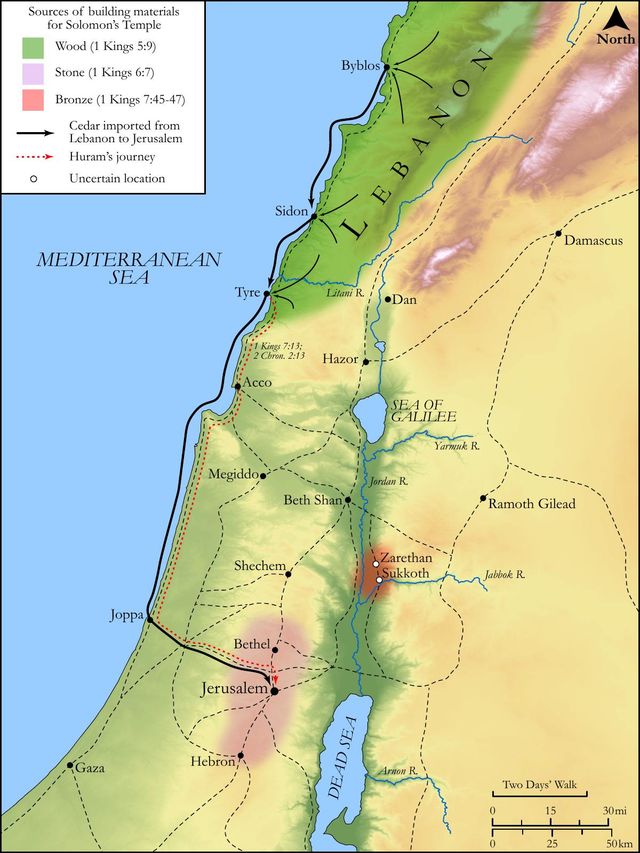
Here we have, I. The return which Huram made to Solomon's embassy, in which he shows a great respect for Solomon and a readiness to serve him. Meaner people may learn of these great ones to be neighbourly and complaisant. 1. He congratulates Israel on having such a king as Solomon was (Ch2 2:11): Because the Lord loved his people, he has made thee king. Note, A wise and good government is a great blessing to a people, and may well be accounted a singular token of God's favour. He does not say, Because he loved thee (though that was true, Sa2 12:24) he made thee king, but because he loved his people. Princes must look upon themselves as preferred for the public good, not for their own personal satisfaction, and should rule so as to prove that they were given in love and not in anger. 2. He blesses God for raising up such a successor to David, Ch2 2:12. It should seem that Huram was not only very well affected to the Jewish nation, and well pleased with their prosperity, but that he was proselyted to the Jewish religion, and worshipped Jehovah, the God of Israel (who was now known by that name to the neighbouring nations), as the God that made heaven and earth, and as the fountain of power as well as being; for he sets up kings. Now that the people of Israel kept close to the law and worship of God, and so preserved their honour, the neighbouring nations were as willing to be instructed by them in the true religion as Israel had been, in the days of their apostasy, to be infected with the idolatries and superstitions of their neighbours. This made them high, that they lent to many nations and did not borrow, lent truth to them, and did not borrow error from them; as when they did the contrary it was their shame. 3. He sent him a very ingenious curious workman, that would not fail to answer his expectations in every thing, one that had both Jewish and Gentile blood meeting in him; for his mother was an Israelite (Huram though she was of the tribe of Dan, and therefore says so here, Ch2 2:14, but it seems she was of the tribe of Naphtali, Kg1 7:14), but his father was a Tyrian - a good omen of uniting Jew and Gentile in the gospel temple, as it was afterwards when the building of the second temple was greatly furthered by Darius (Ezra 6), who is supposed to have been the son of Esther - an Israelite by the mother's side. 4. He engaged for the timber, as much as he would have occasion for, and undertook to deliver it at Joppa, and withal signified his dependence upon Solomon for the maintenance of the workmen as he had promised, v. 15, 16. This agreement we had, Kg1 5:8, Kg1 5:9.
II.The orders which Solomon gave about the workmen.
He would not employ the free-born Israelites in the drudgery work of the temple itself, not so much as to be overseers of it. In this he employed the strangers who were proselyted to the Jewish religion, who had not lands of inheritance in Canaan as the Israelites had, and therefore applied to trades, and got their living by their ingenuity and industry. There were, at this time, vast numbers of them in the land (Ch2 2:17), who, if they were of any of the devoted nations, perhaps fell within the case, and therefore fell under the law, of the Gibeonites, to be hewers of wood for the congregation: if not, yet being in many respects well provided for by the law of Moses, and put upon an equal footing with the native Israelites, they were bound in gratitude to do what they could for the service of the temple. Yet, no doubt, they were well paid in money or money's worth: the law was, Thou shalt not oppress a stranger. The distribution of them we have here (Ch2 2:2, and again Ch2 2:18), in all 150,000. Canaan was a fruitful land, that found meat for so many mouths more than the numerous natives; and the temple was a vast building, that found work for so many bands. Mr. Fuller suggests that the expedient peculiar to this structure, of framing all beforehand, must needs increase the work. I think it rather left so much the more room for this vast multitude of hands to be employed in it; for in the forest of Lebanon they might all be at work together, without crowding one another, which they could not have been upon Mount Sion. And, if there had not been such vast numbers employed, so large and curious a fabric, which was begun and ended in seven years, might, for aught I know, have been as long in building as St. Paul's.
Continue studying 2 Chronicles 2:14 across the web’s major study libraries — every link below opens this exact verse, chapter, or book on the destination site.
Read & Compare
 BibleGatewayThis verse in more than 200 translations and 70 languages.
 Bible.comThe YouVersion reader — hundreds of translations, reading plans, and highlights.
 ESV.orgCrossway's official English Standard Version reader.
 NET BibleThe NET translation with 60,000+ translators' notes on every rendering decision.
 STEP BibleTyndale House's free study tool — original text, vocabulary, and scholarly resources.
 BibliaLogos Bible Software's free web reader.
 USCCBThe New American Bible (Revised Edition) with the U.S. bishops' study notes.
Commentaries
 BibleHub CommentariesDozens of classic commentaries on this verse, gathered on one page.
 StudyLightMore than 100 commentary sets — the largest collection on the web.
 BibleRefPlain-English commentary on what this verse means, verse by verse.
 Enduring WordDavid Guzik's free commentary on this chapter, widely used by Bible teachers.
 Bible Study ToolsVerse commentary alongside Greek and Hebrew study aids.
Original Language & Research
- BibleHub InterlinearThe verse word by word — original language, transliteration, and English.
- BibleHub LexiconEvery word's original-language definition and Strong's entry.
 Blue Letter BibleDeep-study tools — Strong's numbers, concordance, and word studies.
 SefariaThe Hebrew text with Rashi and centuries of Jewish commentary.
Sermons, Hymns & Audio


TrulyRandomVerse is not affiliated with these sites and doesn’t control their content. They’re linked because they’re genuinely useful.
Summary
2 Chronicles 2:14 introduces Huram-abi, a preeminent master craftsman dispatched by King Huram of Tyre to assist King Solomon in the monumental undertaking of constructing the Temple in Jerusalem. This verse meticulously details his unparalleled expertise across an astonishing array of materials, including various metals, stones, timber, and luxurious textiles, alongside his exceptional proficiency in intricate engraving and innovative design. His unique background, stemming from an Israelite mother of the tribe of Dan and a Tyrian father, underscores a remarkable synthesis of Israelite heritage and Phoenician artistic mastery, positioning him as precisely the artisan Solomon sought for the divinely ordained project.
Context
ShowHideLiterary Context
This verse is strategically placed within King Solomon's elaborate preparations for the construction of the Lord's Temple, as meticulously detailed in 2 Chronicles chapter 2. Following his profound decision to build a magnificent house for the Lord's name (2 Chronicles 2:1), Solomon initiates a formal and extensive request to King Huram of Tyre, a long-standing and trusted ally of Israel. This request, articulated in 2 Chronicles 2:7, specifically calls for a craftsman of extraordinary skill, proficient in working with precious materials and capable of intricate engraving. Huram-abi, presented in this verse, is King Huram's direct and comprehensive fulfillment of Solomon's precise specifications, thereby underscoring the divine orchestration and the essential international collaboration required for such a sacred and monumental undertaking.
Historical & Cultural Context
The relationship between the burgeoning Israelite kingdom and the powerful Phoenician city-state of Tyre was historically robust, characterized by significant trade and strategic alliances, particularly flourishing during the reigns of David and Solomon. Tyre was renowned throughout the ancient Near East for its unparalleled advancements in craftsmanship, especially in metallurgy, the production of highly prized textiles (notably the vibrant Tyrian purple dye), and sophisticated timber work. Phoenician artisans were highly sought after for their exceptional technical proficiency, artistic innovation, and ability to execute large-scale projects. Huram-abi's distinctive mixed heritage—his mother from the Israelite tribe of Dan (a tribe known for its early artistic and architectural contributions, though later associated with idolatry) and his father a Tyrian—symbolizes a profound fusion of Israelite spiritual purpose and the pinnacle of Phoenician artistic and engineering skill. This unique blend was absolutely crucial for the Temple, which was designed to embody both divine sanctity and the zenith of human excellence, necessitating the utilization of the finest available materials and expertise from both cultural traditions.
Key Themes
ShowHideThe introduction of Huram-abi in 2 Chronicles 2:14 contributes significantly to several overarching themes within the book of 2 Chronicles. Firstly, it powerfully underscores the theme of Divine Provision and International Collaboration. God, through Solomon's divinely granted wisdom and strategic foresight, orchestrates the acquisition of all necessary resources and personnel, even drawing upon expertise from outside Israel's borders, to accomplish His grand purposes. The long-standing alliance with Tyre, initially forged by King David (2 Samuel 5:11), is now providentially leveraged for the ultimate divine architectural project. Secondly, the exhaustive enumeration of Huram-abi's diverse skills highlights the profound theme of Excellence in Craftsmanship for God's Glory. The Temple was not conceived merely as a functional structure but as a magnificent and awe-inspiring dwelling place for God's manifest presence, demanding the absolute highest quality of artistry and materials, thereby reflecting God's own supreme majesty and His worthiness of humanity's finest efforts. Finally, the verse profoundly emphasizes The Value of Specialized Skills and Wisdom. Huram-abi's unique and incredibly diverse talents were indispensable, serving as a powerful demonstration that God sovereignly equips individuals with specific, often extraordinary, gifts—much like Bezalel and Oholiab were divinely empowered for the Tabernacle's construction (Exodus 31:3-5)—to contribute to His grand and unfolding designs.
Exposition and Analysis
ShowHideKey Word Analysis
ShowHideThis primitive root means "to know," but in a broad sense that includes ascertaining by seeing, discerning, understanding, and by extension, being cunning or skillful. In the context of craftsmanship, it denotes a master artisan who possesses not merely technical ability but also profound insight, discernment, and creative intelligence. It implies a deep, experiential knowledge of materials and processes, allowing for the execution of complex designs and the transformation of raw elements into works of beauty and function. This "knowing" often carries a connotation of divinely imparted wisdom, elevating the craft beyond mere human ingenuity.
This primitive root means "to open wide," but also specifically "to loosen, begin, plough, carve." In this context, it refers to the act of cutting, carving, or engraving, particularly in hard materials like stone or metal. It signifies precision, artistic detail, and the ability to create intricate designs and patterns through subtractive processes. For the Temple, "graving" would have involved the creation of decorative elements, inscriptions, and symbolic carvings that adorned the structure and its furnishings, adding significantly to its aesthetic and theological significance.
This noun refers to a "contrivance," which can be a texture, machine, or abstractly, an intention or plan. Here, it denotes an ingenious invention, a cunning plan, or an intricate design. It speaks to Huram-abi's capacity for innovation, problem-solving, and conceptualization. He could not only execute existing designs but also "find out" or invent new, complex patterns and mechanisms, demonstrating his role as a designer and innovator, capable of bringing elaborate visions and solutions to life.
Verse Breakdown
ShowHide"The son of a woman of the daughters of Dan, and his father [was] a man of Tyre"
This opening clause meticulously establishes Huram-abi's distinctive, mixed ethnic and cultural heritage. His mother's lineage from the Israelite tribe of Dan firmly connects him to the covenant people of God, while his Tyrian father anchors him in the renowned Phoenician tradition of unparalleled craftsmanship and maritime prowess. This dual background is not merely incidental; it makes him exceptionally and uniquely suited for the task, effectively bridging two distinct worlds of identity, skill, and cultural influence, thereby symbolizing the collaborative and international nature of the Temple construction project.
"skilful to work in gold, and in silver, in brass, in iron, in stone, and in timber, in purple, in blue, and in fine linen, and in crimson"
This remarkably extensive and detailed enumeration serves to powerfully highlight the extraordinary breadth and profound depth of Huram-abi's expertise. He is presented not merely as proficient in a single craft but as a true master across an incredibly diverse and demanding range of materials—from the hardest metals and resilient stones to pliable timber and the most luxurious and delicate textiles. This comprehensive list unequivocally demonstrates his holistic understanding of various artistic and construction disciplines, which was absolutely essential for meeting the multifaceted and intricate requirements of the Temple's design and ornamentation.
"also to grave any manner of graving, and to find out every device which shall be put to him"
Beyond his mastery of working with raw materials, Huram-abi is endowed with the highly specialized artistic skill of engraving and the innovative, intellectual capacity to "find out every device." This signifies his ability to not only meticulously execute pre-existing designs but also to conceptualize, invent, and create new, intricate patterns, mechanisms, and solutions. He is portrayed as both a skilled artisan and an ingenious designer and inventor, capable of solving complex artistic and engineering challenges and bringing the most elaborate and visionary concepts to tangible reality.
"with thy cunning men, and with the cunning men of my lord David thy father"
This concluding phrase emphatically underscores the collaborative and integrated aspect of the entire Temple project. Huram-abi is not intended to operate in isolation but rather to seamlessly integrate his exceptional skills and innovative approaches with the existing "cunning men" (a term for skilled artisans or wise individuals) already present within Solomon's kingdom. This includes those highly experienced craftsmen who had previously served King David. This collaborative model ensures a harmonious blend of external, specialized expertise with established local talent, fostering a shared, unified endeavor in the sacred and monumental task of building God's holy house.
Literary Devices
ShowHideThe verse primarily employs Enumeration, systematically listing an exhaustive range of materials (gold, silver, brass, iron, stone, timber, purple, blue, fine linen, crimson) and diverse skills (working, graving, finding out devices). This meticulous and comprehensive list serves to powerfully convey the extraordinary and unparalleled nature of Huram-abi's craftsmanship, leaving no doubt as to his exceptional qualifications. The sheer volume and variety of his proficiencies create a sense of Hyperbole, emphasizing that he is not merely skilled, but supremely, uniquely, and almost unbelievably skilled across an incredibly vast spectrum of crafts. This Emphasis on his diverse talents underscores the immense value placed on excellence and the meticulous, divinely-inspired requirements for the Temple's construction, reflecting the absolute standard of perfection worthy of God's dwelling place. Furthermore, the Juxtaposition of his Israelite mother and Tyrian father highlights the unique blend of heritage and skill, symbolizing the coming together of different strengths and cultures for a unified, divine purpose that transcends national boundaries.
Theological and Thematic Connections
ShowHideHuram-abi's pivotal role in the Temple's construction beautifully illustrates God's meticulous providential care and His sovereign use of diverse gifts, even drawing from unexpected sources and nations, to accomplish His divine purposes. Just as God divinely endowed Bezalel and Oholiab with extraordinary wisdom and skill for the intricate work of the Tabernacle (Exodus 31:3-5), He provides Huram-abi, a master artisan of unparalleled ability, for the construction of the permanent Temple. This demonstrates a profound theological truth: all genuine skill, creativity, and talent, whether manifested in sacred or seemingly secular contexts, ultimately originate from God and can be consecrated and utilized for His glory. It also powerfully highlights the principle of collaboration in God's work, where different talents, diverse backgrounds, and even distinct nations are called to come together in unity for a common, holy goal, thereby underscoring that God's kingdom and redemptive plan transcend narrow national or cultural boundaries.
Reflection and Application
ShowHideThe detailed account of Huram-abi's extraordinary skills in 2 Chronicles 2:14 serves as a profound reminder that every skill, talent, and ability we possess, regardless of how seemingly mundane, specialized, or even "secular" it may appear, can and should be consecrated and utilized for God's glory. Just as Huram-abi brought his diverse and exceptional craftsmanship to meticulously build the physical Temple, we are similarly called to offer our "best work" in all spheres of life—whether in our professional careers, our family roles, our community engagement, or our church ministries—as a genuine act of worship to the Creator who gifted us. This verse profoundly challenges us to pursue excellence with diligence and integrity, not primarily for personal recognition or worldly acclaim, but as a direct reflection of the character of God, who is Himself excellent, perfect, and supremely worthy of our highest efforts. Furthermore, it powerfully encourages us to value, affirm, and actively collaborate with others who possess different gifts and come from diverse backgrounds, recognizing that the collective strength and synergistic impact of varied talents working in unity more effectively build up the body of Christ and advance His kingdom than isolated individual efforts alone.
Questions for Reflection
ShowHideFAQ
ShowHideWho was Huram-abi, and why was he so important for the Temple's construction?
ShowHideHuram-abi (also known as Hiram in 1 Kings 7:13) was an exceptionally gifted master craftsman from Tyre, specifically chosen and sent by King Huram of Tyre to assist King Solomon in the monumental and sacred task of building the Lord's Temple in Jerusalem. He was absolutely crucial because he possessed an extraordinarily diverse and comprehensive skill set, as meticulously detailed in 2 Chronicles 2:14. He was proficient in working with virtually all major materials—including gold, silver, brass, iron, stone, timber, and various precious textiles—and was also highly skilled in intricate engraving and innovative design. This unparalleled expertise was indispensable for creating the magnificent, intricate, and divinely-specified furnishings, decorations, and architectural elements required for God's dwelling place, which demanded the highest quality of artistry, technical precision, and creative problem-solving.
What is the significance of Huram-abi's mixed heritage (Israelite mother, Tyrian father)?
ShowHideHuram-abi's mixed heritage is profoundly significant and symbolic. His mother was from the Israelite tribe of Dan, thereby connecting him to the covenant people of God and their spiritual heritage, while his father was a Tyrian, linking him directly to the renowned Phoenician tradition of superior craftsmanship, artistic innovation, and advanced engineering. This unique blend symbolized the fusion of Israelite divine purpose and spiritual intentionality with the very best available human skill and artistic tradition from the Gentile world. It powerfully underscored the international collaboration involved in building the Temple, demonstrating that God can sovereignly use individuals from diverse backgrounds, cultures, and nations to accomplish His sacred and universal plans. Furthermore, it highlighted that the Temple, while built by Israel, was ultimately intended as a place where all nations could come to acknowledge God's glory, thereby foreshadowing the universal and inclusive reach of God's redemptive plan for humanity.
Christ-Centered Fulfillment
ShowHideHuram-abi, the master craftsman, skilled in every material and device necessary for the construction of the physical Temple, serves as a powerful and insightful type pointing to Jesus Christ, the ultimate Master Builder and Architect of God's eternal spiritual Temple. Just as Huram-abi brought unparalleled skill, wisdom, and innovation to construct a dwelling place for God's presence in the Old Covenant, so too does Christ, in His divine wisdom and omnipotent power, build the Church, which is the true spiritual house where God's Spirit eternally dwells (Ephesians 2:20-22). While Huram-abi labored with earthly materials—metals, stones, and timber—Christ works with living stones, which are believers, shaping them into a holy priesthood and a spiritual house fit for God's habitation (1 Peter 2:5). He is not merely a craftsman, but the very foundation and indispensable cornerstone (Ephesians 2:20), the one who perfectly understands, initiates, and executes the Father's eternal design for redemption. Unlike the earthly Temple, which was eventually destroyed, the spiritual Temple built by Christ is eternal, indestructible, and ever-expanding, standing as an enduring testament to His supreme skill, perfect faithfulness, and ultimate authority as the Son over God's own house (Hebrews 3:3-6).