


2 Chronicles 2:12
- וַיֹּאמֶרvai·yo·Merand he saidH559Conj-w ¦ V-Qal-ConsecImperf-3msVerb Qal Consecutive Imperfect 3rd Singular Masculineוַandיֹּאמֶרhe said
- חוּרָםchu·RamHuramH2361N-proper-mNoun Proper Masculine
- בָּרוּךְba·Rukh[be] blessedH1288V-Qal-PassPrtcpl-msVerb Qal Participle Passive Singular Masculine Absolute
- יְהוָהYah·wehYahwehH3068N-properNoun Proper Title
- אֱלֹהֵי'e·lo·Hei[the] God ofH430N-mpcNoun Plural Masculine Construct
- יִשְׂרָאֵלYis·ra·'ElIsraelH3478N-properNoun Proper Location
- אֲשֶׁר'a·SherwhoH834RelParticle Relative
- עָשָׂה'a·Sahhe has madeH6213V-Qal-Perf-3msVerb Qal Perfect 3rd Singular Masculine
- אֶת'et<obj.>H853DirObjMParticle Object Indicator
- הַשָּׁמַיִםha·sha·Ma·yimthe heavensH8064Art ¦ N-mpNoun Plural Masculine Absoluteהַtheשָּׁמַיִםheavens
- וְאֶתve·'Etand <obj.>H853Conj-w ¦ DirObjMParticle Object Indicatorוְandאֶת<obj.>
- הָאָרֶץha·'A·retzthe earthH776Art ¦ N-fsNoun Singular Feminine Absoluteהָtheאָרֶץearth
- אֲשֶׁר'a·SherwhoH834RelParticle Relative
- נָתַןna·Tanhe has givenH5414V-Qal-Perf-3msVerb Qal Perfect 3rd Singular Masculine
- לְדָוִידle·da·Vidto DavidH1732Prep-l ¦ N-proper-mNoun Proper MasculineלְtoדָוִידDavid
- הַמֶּלֶךְha·Me·lekhthe kingH4428Art ¦ N-msNoun Singular Masculine Absoluteהַtheמֶּלֶךְking
- בֵּןbena sonH1121N-msNoun Singular Masculine Absolute
- חָכָםcha·KhamwiseH2450Adj-msAdjective Singular Masculine Absolute
- יוֹדֵעַyo·De·a'[who] knowsH3045V-Qal-Prtcpl-msVerb Qal Participle Singular Masculine Absolute
- שֵׂכֶלSe·khelinsightH7922N-msNoun Singular Masculine Absolute
- וּבִינָהu·vi·Nahand understandingH998Conj-w ¦ N-fsNoun Singular Feminine Absoluteוּandבִינָהunderstanding
- אֲשֶׁר'a·SherwhoH834RelParticle Relative
- יִבְנֶהyiv·nehhe will buildH1129V-Qal-Imperf-3msVerb Qal Imperfect 3rd Singular Masculine
- בַּיִתba·yita houseH1004N-msNoun Singular Masculine Absolute
- לַיהוָהla·Yah·wehfor YahwehH3068Prep-l ¦ N-properNoun Proper TitleלַforיהוָהYahweh
- וּבַיִתu·Va·yitand a houseH1004Conj-w ¦ N-msNoun Singular Masculine Absoluteוּandבַיִתa house
- לְמַלְכוּתוֹle·mal·khu·Tofor his royaltyH4438Prep-l ¦ N-fsc ¦ 3msNoun Singular Feminine Constructלְforמַלְכוּתroyaltyוֹhis
English is a literal word-by-word gloss of the Hebrew, not the KJV's wording. Why?
This is the original text the KJV's translators worked from — each Hebrew word with its own literal English meaning in this verse, prepared by scholars at Tyndale House, Cambridge. The KJV translates whole sentences, not word by word, so its wording differs: one Hebrew word can become several English words, and the KJV may choose “the LORD” where the gloss reads “Yahweh”. Both are faithful — they answer different questions. For the KJV's own rendering, switch to the KJV text.
Details
See on the biblical-era map
Study this verse
Public-domain commentary
Matthew Henry
From his Commentary on the Whole Bible. Henry comments on passages, not single verses — this entry covers 2 Chronicles 2:11–18.
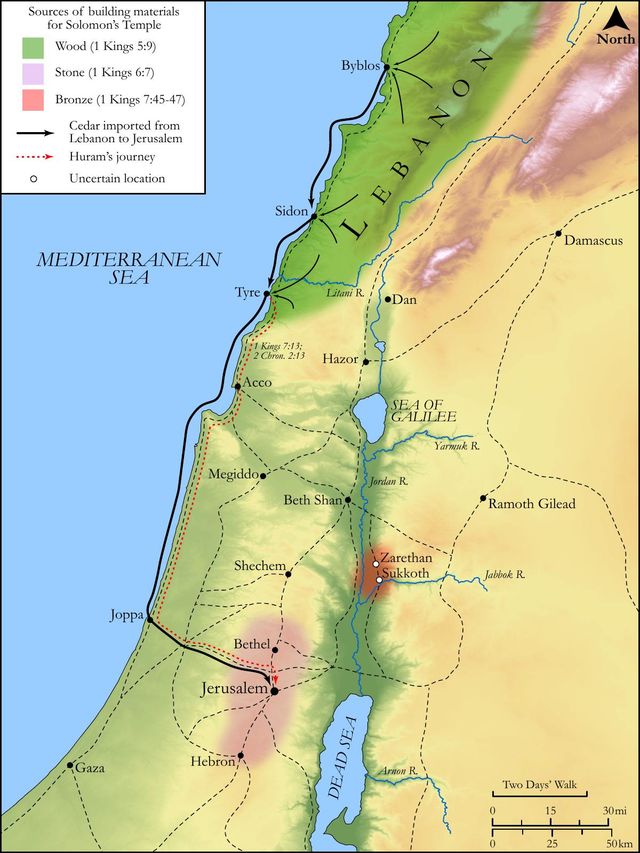
Here we have, I. The return which Huram made to Solomon's embassy, in which he shows a great respect for Solomon and a readiness to serve him. Meaner people may learn of these great ones to be neighbourly and complaisant. 1. He congratulates Israel on having such a king as Solomon was (Ch2 2:11): Because the Lord loved his people, he has made thee king. Note, A wise and good government is a great blessing to a people, and may well be accounted a singular token of God's favour. He does not say, Because he loved thee (though that was true, Sa2 12:24) he made thee king, but because he loved his people. Princes must look upon themselves as preferred for the public good, not for their own personal satisfaction, and should rule so as to prove that they were given in love and not in anger. 2. He blesses God for raising up such a successor to David, Ch2 2:12. It should seem that Huram was not only very well affected to the Jewish nation, and well pleased with their prosperity, but that he was proselyted to the Jewish religion, and worshipped Jehovah, the God of Israel (who was now known by that name to the neighbouring nations), as the God that made heaven and earth, and as the fountain of power as well as being; for he sets up kings. Now that the people of Israel kept close to the law and worship of God, and so preserved their honour, the neighbouring nations were as willing to be instructed by them in the true religion as Israel had been, in the days of their apostasy, to be infected with the idolatries and superstitions of their neighbours. This made them high, that they lent to many nations and did not borrow, lent truth to them, and did not borrow error from them; as when they did the contrary it was their shame. 3. He sent him a very ingenious curious workman, that would not fail to answer his expectations in every thing, one that had both Jewish and Gentile blood meeting in him; for his mother was an Israelite (Huram though she was of the tribe of Dan, and therefore says so here, Ch2 2:14, but it seems she was of the tribe of Naphtali, Kg1 7:14), but his father was a Tyrian - a good omen of uniting Jew and Gentile in the gospel temple, as it was afterwards when the building of the second temple was greatly furthered by Darius (Ezra 6), who is supposed to have been the son of Esther - an Israelite by the mother's side. 4. He engaged for the timber, as much as he would have occasion for, and undertook to deliver it at Joppa, and withal signified his dependence upon Solomon for the maintenance of the workmen as he had promised, v. 15, 16. This agreement we had, Kg1 5:8, Kg1 5:9.
II.The orders which Solomon gave about the workmen.
He would not employ the free-born Israelites in the drudgery work of the temple itself, not so much as to be overseers of it. In this he employed the strangers who were proselyted to the Jewish religion, who had not lands of inheritance in Canaan as the Israelites had, and therefore applied to trades, and got their living by their ingenuity and industry. There were, at this time, vast numbers of them in the land (Ch2 2:17), who, if they were of any of the devoted nations, perhaps fell within the case, and therefore fell under the law, of the Gibeonites, to be hewers of wood for the congregation: if not, yet being in many respects well provided for by the law of Moses, and put upon an equal footing with the native Israelites, they were bound in gratitude to do what they could for the service of the temple. Yet, no doubt, they were well paid in money or money's worth: the law was, Thou shalt not oppress a stranger. The distribution of them we have here (Ch2 2:2, and again Ch2 2:18), in all 150,000. Canaan was a fruitful land, that found meat for so many mouths more than the numerous natives; and the temple was a vast building, that found work for so many bands. Mr. Fuller suggests that the expedient peculiar to this structure, of framing all beforehand, must needs increase the work. I think it rather left so much the more room for this vast multitude of hands to be employed in it; for in the forest of Lebanon they might all be at work together, without crowding one another, which they could not have been upon Mount Sion. And, if there had not been such vast numbers employed, so large and curious a fabric, which was begun and ended in seven years, might, for aught I know, have been as long in building as St. Paul's.
Continue studying 2 Chronicles 2:12 across the web’s major study libraries — every link below opens this exact verse, chapter, or book on the destination site.
Read & Compare
 BibleGatewayThis verse in more than 200 translations and 70 languages.
 Bible.comThe YouVersion reader — hundreds of translations, reading plans, and highlights.
 ESV.orgCrossway's official English Standard Version reader.
 NET BibleThe NET translation with 60,000+ translators' notes on every rendering decision.
 STEP BibleTyndale House's free study tool — original text, vocabulary, and scholarly resources.
 BibliaLogos Bible Software's free web reader.
 USCCBThe New American Bible (Revised Edition) with the U.S. bishops' study notes.
Commentaries
 BibleHub CommentariesDozens of classic commentaries on this verse, gathered on one page.
 StudyLightMore than 100 commentary sets — the largest collection on the web.
 BibleRefPlain-English commentary on what this verse means, verse by verse.
 Enduring WordDavid Guzik's free commentary on this chapter, widely used by Bible teachers.
 Bible Study ToolsVerse commentary alongside Greek and Hebrew study aids.
Original Language & Research
- BibleHub InterlinearThe verse word by word — original language, transliteration, and English.
- BibleHub LexiconEvery word's original-language definition and Strong's entry.
 Blue Letter BibleDeep-study tools — Strong's numbers, concordance, and word studies.
 SefariaThe Hebrew text with Rashi and centuries of Jewish commentary.
Sermons, Hymns & Audio


TrulyRandomVerse is not affiliated with these sites and doesn’t control their content. They’re linked because they’re genuinely useful.
Summary
2 Chronicles 2:12 records a profound declaration from King Huram of Tyre, a Gentile ruler, who blesses "the LORD God of Israel, that made heaven and earth." This verse is Huram's articulate response to King Solomon's request for skilled labor and materials for the Temple's construction. It powerfully showcases Huram's recognition of God's universal sovereignty as Creator, His specific providence in gifting Solomon with exceptional wisdom, and His divine purpose for Solomon to build both the sacred Temple for the Lord and to establish his own royal house. The passage thus underscores the international acknowledgment of Israel's God and the divine enablement behind Solomon's monumental undertakings.
Context
ShowHideLiterary Context
This verse is situated within the initial chapters of 2 Chronicles, which meticulously detail the early years of Solomon's reign, with a particular emphasis on the preparations for and the subsequent construction of the magnificent Temple in Jerusalem. Specifically, 2 Chronicles 2:12 is a pivotal part of the diplomatic exchange between King Solomon and King Huram of Tyre, as recorded in 2 Chronicles 2:1-16. Solomon initiates this correspondence by sending a detailed request to Huram for expert craftsmen and precious timber, highlighting the unparalleled grandeur required for a house dedicated to the name of the Lord. Huram's reply, commencing in 2 Chronicles 2:11, is notably deferential and surprisingly rich in theological insight. Verse 12 functions as the theological cornerstone of Huram's agreement, establishing a tone of divine endorsement for the entire Temple project. The subsequent verses then elaborate on Huram's commitment to supply the requested resources and specialized expertise, thereby facilitating a critical step in the Temple's realization.
Historical & Cultural Context
The relationship between the Israelite kingdom and the Phoenician city-state of Tyre was historically robust, flourishing particularly during the reigns of King David and his son, Solomon. Tyre, a prominent maritime power, was celebrated throughout the ancient Near East for its extensive trade networks, its highly skilled artisans—especially in metallurgy, carpentry, and masonry—and its strategic access to the vast cedar forests of Lebanon. This alliance was mutually advantageous: Israel provided essential agricultural provisions, while Tyre offered sophisticated craftsmanship and invaluable building materials. For a Gentile monarch like Huram to not only bless the God of Israel but also to explicitly acknowledge His creative power and providential hand in bestowing wisdom upon Solomon was an exceptionally significant act. This recognition could stem from genuine respect for Israel's God, a shrewd diplomatic maneuver, or perhaps a syncretistic understanding common in the ancient Near East, where rulers often acknowledged the deities of other prosperous and powerful nations. Regardless of the precise motivation, Huram's declaration undeniably highlights the increasing reputation of YHWH among surrounding nations, a reputation significantly bolstered by the legendary wisdom of Solomon, which was widely recognized (compare 1 Kings 4:34).
Key Themes
ShowHideSeveral profound themes converge and are powerfully articulated in 2 Chronicles 2:12. Firstly, the verse emphatically asserts Divine Sovereignty and Creation, as Huram explicitly blesses "the LORD God of Israel, that made heaven and earth." This universal acknowledgment, emanating from a non-Israelite king, resonates deeply with the foundational truth of God as the ultimate Creator, a truth proclaimed from the very beginning in Genesis 1:1 and echoed throughout the Psalms, such as Psalm 121:2. Secondly, the verse highlights God's Gift of Wisdom, recognizing that Solomon's "prudence and understanding" are not innate human attributes but divinely bestowed endowments. This aligns perfectly with Solomon's own earnest prayer for wisdom, as recorded in 1 Kings 3:9 and 2 Chronicles 1:10, demonstrating God's faithfulness in granting requests that align with His divine will. Thirdly, it points to the Fulfillment of God's Covenant Promise to David, specifically that his son would be the one to build the Temple (2 Samuel 7:13). Huram acknowledges Solomon's divinely ordained dual purpose: "to build an house for the LORD" (referring to the sacred Temple) and "an house for his kingdom" (referring to Solomon's own royal palace and the enduring stability of his reign), both of which are enabled by divine wisdom and purpose.
Exposition and Analysis
ShowHideKey Word Analysis
ShowHideThis primitive root signifies to kneel, and by extension, to bless. When applied to God, as Huram does here, it is an act of adoration, praise, and acknowledgment of His inherent goodness, power, and supreme worthiness. It is a doxology, a formal expression of profound reverence, indicating Huram's recognition of YHWH's preeminence as the Creator of "heaven and earth." This is more than mere diplomatic courtesy; it is a theological statement from a non-Israelite king.
This adjective describes one who is intelligent, skillful, or artful. It denotes not just intellectual capacity but also practical discernment and the ability to make sound judgments. When applied to Solomon, it highlights his divinely endowed sagacity, which was renowned throughout the ancient world and essential for the immense tasks of governance and temple construction.
Derived from a root meaning "to build," this noun refers to a dwelling or building, but its application is remarkably broad. It can signify a physical structure (like the Temple or a palace), a household, a family, or even a dynasty. In this verse, it is used twice: first for the "house for the LORD" (the Temple, God's dwelling place among His people), and second for "an house for his kingdom" (Solomon's royal palace and, by extension, the stability and continuity of his royal lineage and reign).
Verse Breakdown
ShowHide"Huram said moreover, Blessed [be] the LORD God of Israel,"
This opening phrase is profoundly significant, coming from a Gentile king. Huram's spontaneous declaration of blessing upon YHWH, the specific God of Israel, indicates a remarkable recognition of His power and sovereignty, undoubtedly influenced by the widespread fame of David and now Solomon. It establishes a tone of reverence and acknowledges a divine hand in the affairs of Israel.
"that made heaven and earth,"
This clause expands upon the nature of the God Huram is blessing. By identifying YHWH as the Creator of the entire cosmos, Huram attributes universal sovereignty to Him. This is a fundamental tenet of Israelite theology, and its affirmation by a non-Israelite monarch underscores the pervasive influence of Israel's God beyond its national borders. It serves to legitimize the monumental project of building a Temple to such a powerful and all-encompassing Deity.
"who hath given to David the king a wise son, endued with prudence and understanding,"
Here, Huram directly attributes Solomon's renowned wisdom, described as being "endued with prudence and understanding," to divine bestowal. He recognizes that Solomon's exceptional qualities are not merely inherent human traits but a direct gift from the God of Israel. This acknowledges God's active involvement in the lineage of David and His faithfulness to His covenant promises, particularly regarding a wise successor who would undertake the building of the Temple.
"that might build an house for the LORD, and an house for his kingdom."
This final clause articulates the dual, divinely ordained purpose for which Solomon was gifted with such profound wisdom. The primary purpose is to construct "an house for the LORD," referring to the magnificent Temple in Jerusalem, the central place of worship. The secondary purpose, "and an house for his kingdom," refers to Solomon's own royal palace and, more broadly, the stability, prosperity, and dynastic continuity of his rule. Huram acknowledges that both the sacred and the royal aspects of Solomon's reign are divinely purposed and enabled.
Literary Devices
ShowHideThe verse employs several significant literary devices that enrich its meaning and impact. A prominent feature is Doxology, immediately evident in Huram's opening declaration, "Blessed be the LORD God of Israel." This serves as a formal, reverent expression of praise and acknowledgment of God's supreme worth, setting a tone of divine affirmation for the entire Temple construction enterprise. Divine Attribution is central to the verse's message, as Huram explicitly credits Solomon's wisdom and his assigned tasks directly to God, rather than to human skill or ingenuity. This emphasizes God's active providence and sovereign control over human affairs, extending even to the actions and perceptions of foreign kings. Furthermore, Merism is present in the phrase "heaven and earth," a rhetorical device that uses two contrasting parts to represent a complete totality, thereby signifying the entirety of creation and underscoring God's universal dominion. A clear instance of Parallelism is also observed in the dual purpose "an house for the LORD, and an house for his kingdom," which highlights the intertwined nature of sacred and royal responsibilities within God's overarching plan for Israel.
Theological and Thematic Connections
ShowHideThis verse is exceptionally rich with theological implications, particularly concerning God's universal sovereignty, His unwavering covenant faithfulness, and the profound nature of divine wisdom. Huram's declaration, originating from outside the covenant community of Israel, stands as a powerful testament to the God of Israel's widespread reputation and immense power. It vividly demonstrates that God's work and influence are not confined solely to Israel but are recognized and even praised by those beyond its borders, foreshadowing a time when all nations would come to acknowledge Him. The divine gifting of wisdom to Solomon for specific, monumental tasks—building the Temple and establishing his kingdom—underscores the crucial principle that God equips those He calls for His specific purposes. This wisdom is presented not as a means for personal aggrandizement but as an enablement for the advancement of God's redemptive plan and the establishment of His dwelling place among His people. The verse subtly anticipates a future era when the glory of the Lord would be so manifest that it would draw all nations to worship Him.
Reflection and Application
ShowHideKing Huram's remarkable declaration in 2 Chronicles 2:12 offers profound and enduring lessons for contemporary believers. It serves as a powerful reminder that true wisdom, prudence, and understanding are ultimately divine gifts, not merely the products of human intellect, effort, or accumulated experience. Like Solomon, we are called to humbly recognize that any ability, talent, or success we possess is divinely bestowed and is intended for the greater glory of God and the advancement of His kingdom purposes. This realization should cultivate a deep sense of humility and foster a continuous dependence on God in all our endeavors, whether in our professional vocations, our personal ministries, or our daily interactions. Furthermore, Huram's acknowledgment of God, despite his status as a Gentile king, challenges us to live lives that so clearly manifest God's presence, blessing, and transforming power that even those outside the community of faith are compelled to recognize and perhaps even praise the God whom we serve. Our actions, our character, the integrity of our lives, and the fruit we bear should collectively serve as a compelling witness to the reality and goodness of God, prompting others to inquire about the source of our wisdom, peace, and strength.
Questions for Reflection
ShowHideFAQ
ShowHideWhy would a pagan king like Huram bless the God of Israel?
ShowHideHuram's blessing of the LORD God of Israel is highly significant for several interconnected reasons. Historically, Tyre and Israel maintained a robust diplomatic and economic alliance, particularly during the reigns of King David and his son, Solomon. This enduring relationship naturally fostered a degree of mutual respect and familiarity. Culturally, it was not uncommon in the ancient Near East for rulers to acknowledge the deities of other powerful and prosperous nations, especially if those nations appeared to be enjoying divine favor and success. Solomon's renowned wisdom, coupled with the burgeoning prosperity of his kingdom, would have been widely attributed to the active involvement of his God, YHWH. Diplomatically, Huram's declaration was a courteous and respectful way to respond to a powerful and esteemed ally, reinforcing their alliance. Theologically, it highlights God's universal sovereignty and His ability to make His name known and His power recognized even among those who do not explicitly worship Him, subtly preparing the way for future Gentile inclusion in His broader redemptive plan (compare Isaiah 49:6).
What is the significance of Solomon building "an house for the LORD, and an house for his kingdom"?
ShowHideThis phrase encapsulates the dual, divinely ordained purpose of Solomon's reign and the wisdom gifted to him. The "house for the LORD" refers to the magnificent Temple in Jerusalem, which was designed to be the central place of worship and the symbolic dwelling place of God among His people. Its construction was the direct fulfillment of God's covenant promise to David that his son would build a house for God's name (2 Samuel 7:13). The "house for his kingdom" refers to Solomon's own grand royal palace and, more broadly, signifies the establishment, stability, and enduring prosperity of his dynastic rule. This dual emphasis demonstrates that God's blessing and divinely imparted wisdom extended not only to sacred, spiritual endeavors but also to the wise governance and material well-being of the kingdom, illustrating that God cares for both the spiritual and temporal flourishing of His people.
Christ-Centered Fulfillment
ShowHide2 Chronicles 2:12, while celebrating the divinely bestowed wisdom of Solomon and the monumental task of building the first Temple, profoundly foreshadows the ultimate wise King and the true, spiritual Temple: Jesus Christ. Solomon, uniquely endowed with divine prudence and understanding to construct a physical house for the Lord and to establish his earthly kingdom, serves as a significant type of Christ. Jesus is not merely wise but is the very "wisdom of God" personified (1 Corinthians 1:24), declaring Himself to be "something greater than Solomon" (Matthew 12:42). Just as Solomon built a house for the Lord, Jesus proclaims, "I will build my church" (Matthew 16:18), establishing a spiritual house composed of "living stones" (1 Peter 2:5)—His body, the Church, which is the true temple where God dwells by His Spirit. The "house for his kingdom" that Solomon built finds its ultimate and eternal fulfillment in Christ's everlasting, unshakeable kingdom (Luke 1:33), a kingdom "not of this world" (John 18:36) that transcends all earthly reigns. Huram's acknowledgment of the Creator God who graciously gives wisdom for building points to the Father's ultimate redemptive plan to build His eternal dwelling place through the perfect wisdom, sacrificial work, and reigning authority of His Son, Jesus, who is both the perfect Temple and the eternal King of an everlasting kingdom.