


2 Chronicles 2:17
- וַיִּסְפֹּרvai·yis·Porand he countedH5608Conj-w ¦ V-Qal-ConsecImperf-3msVerb Qal Consecutive Imperfect 3rd Singular Masculineוַandיִּסְפֹּרhe counted
- שְׁלֹמֹהshe·lo·MohSolomonH8010N-proper-mNoun Proper Masculine
- כָּלkolallH3605N-mscNoun Singular Masculine Construct
- הָאֲנָשִׁיםha·'a·na·Shimthe peopleH582Art ¦ N-mpNoun Plural Masculine Absoluteהָtheאֲנָשִׁיםpeople
- הַגֵּירִיםha·gei·Rimthe sojournersH1616Art ¦ N-mpNoun Plural Masculine Absoluteהַtheגֵּירִיםsojourners
- אֲשֶׁר'a·SherwhoH834RelParticle Relative
- בְּאֶרֶץbe·'E·retz[were] in [the] land ofH776Prep-b ¦ N-fscNoun Singular Feminine Constructבְּ[were] inאֶרֶץ[the] land of
- יִשְׂרָאֵלYis·ra·'ElIsraelH3478N-properNoun Proper Location
- אַחֲרֵי'a·cha·ReiafterH310Adj-mpcAdjective Numerical Plural Masculine Construct
- הַסְּפָרha·se·Farthe censusH5610Art ¦ N-msNoun Singular Masculine Absoluteהַtheסְּפָרcensus
- אֲשֶׁר'a·SherwhichH834RelParticle Relative
- סְפָרָםse·fa·Ramhe had counted themH5608V-Qal-Perf-3ms ¦ 3mpVerb Qal Perfect 3rd Singular Masculineסְפָרָhe had countedםthem
- דָּוִידda·VidDavidH1732N-proper-mNoun Proper Masculine
- אָבִיו'a·Vivhis fatherH1N-msc ¦ 3msNoun Singular Masculine Constructאָבִיfatherוhis
- וַיִּמָּצְאוּvai·yi·ma·tze·'Uand they were foundH4672Conj-w ¦ V-Niphal-ConsecImperf-3mpVerb Niphal Consecutive Imperfect 3rd Plural Masculineוַandיִּמָּצְאוּthey were found
- מֵאָהme·'Ahone hundredH3967N-fsNoun Singular Feminine Absolute
- וַחֲמִשִּׁיםva·cha·mi·Shimand fiftyH2572Conj-w ¦ N-mpNoun Plural Masculine Absoluteוַandחֲמִשִּׁיםfifty
- אֶלֶף'E·lefthousandH505N-csNoun Singular common gender Absolute
- וּשְׁלֹשֶׁתu·she·Lo·shetand threeH7969Conj-w ¦ N-cscNoun Singular common gender Constructוּandשְׁלֹשֶׁתthree
- אֲלָפִים'a·la·Fimthousand<s>H505N-cpNoun Plural common gender Absolute
- וְשֵׁשׁve·Sheshand sixH8337Conj-w ¦ N-csNoun Singular common gender Absoluteוְandשֵׁשׁsix
- מֵאוֹתme·'othundred<s>H3967N-fpNoun Plural Feminine Absolute
English is a literal word-by-word gloss of the Hebrew, not the KJV's wording. Why?
This is the original text the KJV's translators worked from — each Hebrew word with its own literal English meaning in this verse, prepared by scholars at Tyndale House, Cambridge. The KJV translates whole sentences, not word by word, so its wording differs: one Hebrew word can become several English words, and the KJV may choose “the LORD” where the gloss reads “Yahweh”. Both are faithful — they answer different questions. For the KJV's own rendering, switch to the KJV text.
Details
See on the biblical-era map
Study this verse
Public-domain commentary
Matthew Henry
From his Commentary on the Whole Bible. Henry comments on passages, not single verses — this entry covers 2 Chronicles 2:11–18.
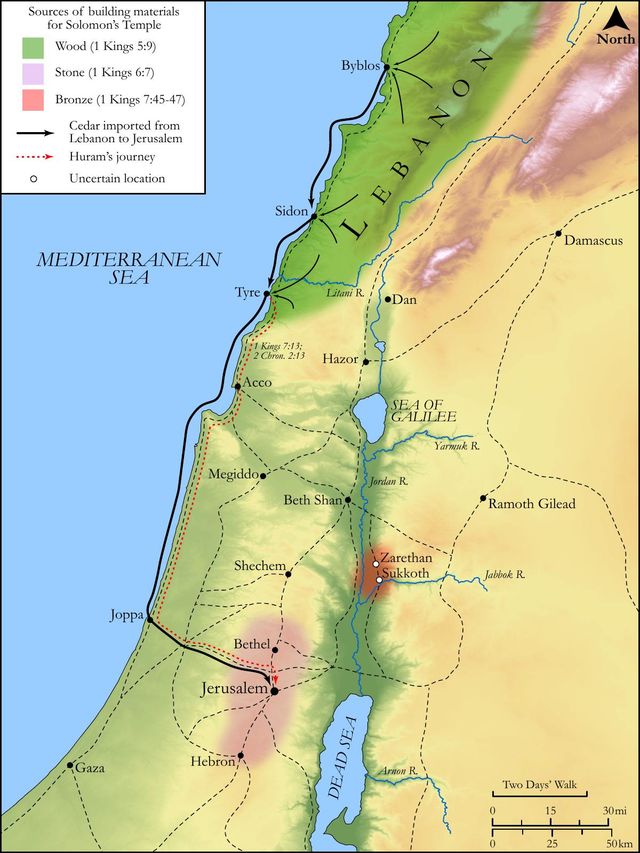
Here we have, I. The return which Huram made to Solomon's embassy, in which he shows a great respect for Solomon and a readiness to serve him. Meaner people may learn of these great ones to be neighbourly and complaisant. 1. He congratulates Israel on having such a king as Solomon was (Ch2 2:11): Because the Lord loved his people, he has made thee king. Note, A wise and good government is a great blessing to a people, and may well be accounted a singular token of God's favour. He does not say, Because he loved thee (though that was true, Sa2 12:24) he made thee king, but because he loved his people. Princes must look upon themselves as preferred for the public good, not for their own personal satisfaction, and should rule so as to prove that they were given in love and not in anger. 2. He blesses God for raising up such a successor to David, Ch2 2:12. It should seem that Huram was not only very well affected to the Jewish nation, and well pleased with their prosperity, but that he was proselyted to the Jewish religion, and worshipped Jehovah, the God of Israel (who was now known by that name to the neighbouring nations), as the God that made heaven and earth, and as the fountain of power as well as being; for he sets up kings. Now that the people of Israel kept close to the law and worship of God, and so preserved their honour, the neighbouring nations were as willing to be instructed by them in the true religion as Israel had been, in the days of their apostasy, to be infected with the idolatries and superstitions of their neighbours. This made them high, that they lent to many nations and did not borrow, lent truth to them, and did not borrow error from them; as when they did the contrary it was their shame. 3. He sent him a very ingenious curious workman, that would not fail to answer his expectations in every thing, one that had both Jewish and Gentile blood meeting in him; for his mother was an Israelite (Huram though she was of the tribe of Dan, and therefore says so here, Ch2 2:14, but it seems she was of the tribe of Naphtali, Kg1 7:14), but his father was a Tyrian - a good omen of uniting Jew and Gentile in the gospel temple, as it was afterwards when the building of the second temple was greatly furthered by Darius (Ezra 6), who is supposed to have been the son of Esther - an Israelite by the mother's side. 4. He engaged for the timber, as much as he would have occasion for, and undertook to deliver it at Joppa, and withal signified his dependence upon Solomon for the maintenance of the workmen as he had promised, v. 15, 16. This agreement we had, Kg1 5:8, Kg1 5:9.
II.The orders which Solomon gave about the workmen.
He would not employ the free-born Israelites in the drudgery work of the temple itself, not so much as to be overseers of it. In this he employed the strangers who were proselyted to the Jewish religion, who had not lands of inheritance in Canaan as the Israelites had, and therefore applied to trades, and got their living by their ingenuity and industry. There were, at this time, vast numbers of them in the land (Ch2 2:17), who, if they were of any of the devoted nations, perhaps fell within the case, and therefore fell under the law, of the Gibeonites, to be hewers of wood for the congregation: if not, yet being in many respects well provided for by the law of Moses, and put upon an equal footing with the native Israelites, they were bound in gratitude to do what they could for the service of the temple. Yet, no doubt, they were well paid in money or money's worth: the law was, Thou shalt not oppress a stranger. The distribution of them we have here (Ch2 2:2, and again Ch2 2:18), in all 150,000. Canaan was a fruitful land, that found meat for so many mouths more than the numerous natives; and the temple was a vast building, that found work for so many bands. Mr. Fuller suggests that the expedient peculiar to this structure, of framing all beforehand, must needs increase the work. I think it rather left so much the more room for this vast multitude of hands to be employed in it; for in the forest of Lebanon they might all be at work together, without crowding one another, which they could not have been upon Mount Sion. And, if there had not been such vast numbers employed, so large and curious a fabric, which was begun and ended in seven years, might, for aught I know, have been as long in building as St. Paul's.
Historical interpretation
Historical reception
1 surviving comment on this verse from the historical church.
Now the overseers who were in charge of each operation are the writers of sacred Scripture by whose teaching authority we are instructed in all things as to how best to teach the ignorant and correct the contemptuous, to bear each other’s burdens so that we may fulfill the law of Christ. But the more each one labors in giving his neighbors support in their needs or in correcting their mistakes, the more surely may he expect in the life to come the rewards whether of peace of soul after death or of blessed immortality of body. Consequently, the aforesaid overseers are rightly recorded as numbering 70, and 80,000: 70, because of the sabbath rest of souls for the seventh day is consecrated to the sabbath, that is, rest; 80, because of the hope of resurrection on the eighth day, that is, after the sabbath, has already taken place in the Lord, and, it is hoped, will take place in us also on the eighth day and in the eighth age to come. The overseers, on the other hand, were 3,300, doubtless because of faith in the holy Trinity that the holy Scriptures proclaim to us. But the fact that in the book of Paralipomenon the number 3, is written instead of 3, has to do with the very same perfection of people of sublime virtue. For because the Lord completed the adornment of the world in the number six, the perfect works of good people are rightly apt to be symbolized by the same number, and because holy Scripture teaches that we must have the works of piety as well as true faith, the overseers of the temple works are rightly said to be 3,600. Nor should we pass over the fact that these 70, and 80, hod carriers and stonemasons with their overseers were not from Israel but from among the proselytes, that is, strangers who sojourned among them. For it is written in the book of Paralipomenon, “And Solomon took a census of all the proselytes resident in the land of Israel, on the model of the census that David his father had taken; and it was found that they numbered 153,600. And he put 70, of them carrying burdens on their shoulders,” and so forth.
Continue studying 2 Chronicles 2:17 across the web’s major study libraries — every link below opens this exact verse, chapter, or book on the destination site.
Read & Compare
 BibleGatewayThis verse in more than 200 translations and 70 languages.
 Bible.comThe YouVersion reader — hundreds of translations, reading plans, and highlights.
 ESV.orgCrossway's official English Standard Version reader.
 NET BibleThe NET translation with 60,000+ translators' notes on every rendering decision.
 STEP BibleTyndale House's free study tool — original text, vocabulary, and scholarly resources.
 BibliaLogos Bible Software's free web reader.
 USCCBThe New American Bible (Revised Edition) with the U.S. bishops' study notes.
Commentaries
 BibleHub CommentariesDozens of classic commentaries on this verse, gathered on one page.
 StudyLightMore than 100 commentary sets — the largest collection on the web.
 BibleRefPlain-English commentary on what this verse means, verse by verse.
 Enduring WordDavid Guzik's free commentary on this chapter, widely used by Bible teachers.
 Bible Study ToolsVerse commentary alongside Greek and Hebrew study aids.
Original Language & Research
- BibleHub InterlinearThe verse word by word — original language, transliteration, and English.
- BibleHub LexiconEvery word's original-language definition and Strong's entry.
 Blue Letter BibleDeep-study tools — Strong's numbers, concordance, and word studies.
 SefariaThe Hebrew text with Rashi and centuries of Jewish commentary.
Sermons, Hymns & Audio


TrulyRandomVerse is not affiliated with these sites and doesn’t control their content. They’re linked because they’re genuinely useful.
Summary
2 Chronicles 2:17 meticulously details King Solomon's comprehensive census of all non-Israelite residents within the land of Israel, a vital administrative undertaking in preparation for the monumental task of constructing the Temple in Jerusalem. This numbering, which identified 153,600 "strangers," directly continued the preparatory work initiated by his father, King David, underscoring the diligent organization and vast human resources required for such a divinely commissioned endeavor.
Context
ShowHideLiterary Context
This verse is strategically positioned within 2 Chronicles 2, a chapter that meticulously outlines Solomon's initial preparations for building the Temple. It immediately follows Solomon's correspondence with Hiram, King of Tyre, regarding the provision of timber and skilled craftsmen for the project, as detailed in 2 Chronicles 2:16. The census of "strangers" (resident aliens) described in 2 Chronicles 2:17 serves as a crucial administrative precursor to the allocation of labor for the Temple's construction, which is explicitly detailed in the subsequent verse, 2 Chronicles 2:18, where these numbered individuals are assigned roles as foremen, carriers, and stonecutters. This precise sequence highlights Solomon's systematic approach to resource management, ensuring all available manpower, both Israelite and foreign, was accounted for and effectively deployed for the sacred endeavor. A parallel account of this census and the subsequent assignment of duties can be found in 1 Kings 5:15-16, demonstrating the consistency of this historical record across the biblical narratives.
Historical & Cultural Context
The term "strangers" (Hebrew: gerim) refers to resident aliens or sojourners, non-Israelites who lived within the borders of Israel. Unlike foreign enemies or transient visitors, these individuals often resided in Israel by choice, perhaps for economic opportunities, trade, or refuge, and were generally afforded certain legal protections under Israelite law, though they did not possess full citizenship rights. The practice of conducting censuses was common in the ancient Near East for purposes of taxation, military conscription, or, as in this case, labor mobilization for large-scale building projects. The sheer number—153,600—reflects the substantial non-Israelite population within the kingdom, likely accumulated through generations of settlement, trade, and perhaps even remnants of conquered peoples. Their numbering was a levy of labor: Solomon "set threescore and ten thousand of them to be bearers of burdens" (2 Chronicles 2:18), as he levied "a tribute of bondservice" on the peoples left in the land (1 Kings 9:21).
Key Themes
ShowHideThe numbering of these "strangers" in 2 Chronicles 2:17 contributes to several overarching themes within 2 Chronicles and the broader biblical narrative. Firstly, it underscores Diligent Preparation, emphasizing that even divinely commissioned tasks like building the Temple of the Lord require meticulous planning, organization, and resource management. Solomon's systematic census exemplifies this principle, showing a king who understands that divine blessing does not negate human responsibility. Secondly, it highlights the Continuity of Vision and Leadership, as Solomon explicitly follows "the numbering wherewith David his father had numbered them." This demonstrates Solomon's commitment to honoring and completing the preparatory work (1 Chronicles 22:2) and the grand vision (1 Chronicles 22:7) inherited from his father, ensuring a seamless transition of purpose across generations. Thirdly, the utilization of "strangers" for the Temple project illustrates the Utilization of All Resources, including those from outside the covenant community, for God's purposes. This foreshadows a broader universal reach in God's redemptive plan, where even those considered "outsiders" can contribute to God's work. Finally, the immense number of individuals involved in this census vividly conveys the Scale and Significance of the Temple Project, underscoring its central importance as the dwelling place of God's presence and the focal point of Israelite worship.
Exposition and Analysis
ShowHideKey Word Analysis
ShowHideThis term refers to a guest; by implication, a foreigner; alien, sojourner. In this context, it specifically denotes non-Israelite residents who had settled within the land. Unlike transient visitors, gerim were permanent or semi-permanent residents who had integrated into the socio-economic fabric of Israel. While not full citizens, they were subject to Israelite law and often enjoyed certain protections and responsibilities, highlighting a degree of integration into the nation, even for sacred tasks like Temple construction.
This primitive root means to score with a mark as a tally or record, i.e., (by implication) to inscribe, and also to enumerate; intensively, to recount. This verb signifies a formal census or enumeration, an act of systematic organization and accounting. The repetition of this verb in the verse, both for Solomon's action and David's prior effort, emphasizes the deliberate, methodical, and precise nature of this administrative task, underscoring the importance of accurate data for large-scale undertakings.
This primitive root means properly, to come forth to, i.e., appear or exist; transitively, to attain, i.e., find or acquire; figuratively, to occur, meet or be present. In this context, it refers to the outcome of the census, indicating that the specified number of strangers "were discovered" or "were ascertained" to be present. This word highlights the successful completion and verification of the census, confirming the precise count of the available workforce.
Verse Breakdown
ShowHide"And Solomon numbered all the strangers that [were] in the land of Israel"
This initial clause establishes Solomon's proactive and comprehensive administrative action. He undertook a meticulous census not merely of his Israelite subjects but specifically of the non-Israelite population, recognizing them as a significant and valuable labor resource within his kingdom. This demonstrates his meticulous planning and foresight in preparing for the massive Temple construction project.
"after the numbering wherewith David his father had numbered them"
This phrase highlights the profound continuity of the royal vision and the administrative groundwork. Solomon's census was not an independent, novel initiative but a continuation or re-verification of a prior census conducted by his father, King David. This underscores the legacy of diligent preparation and strategic foresight passed from father to son, ensuring that the Temple project was built upon established foundations and meticulous prior planning, reflecting a shared commitment to God's grand design.
"and they were found an hundred and fifty thousand and three thousand and six hundred"
This final clause provides the precise numerical outcome of the census: a total of 153,600 non-Israelite residents. This specific and remarkably large figure emphasizes the sheer scale of the available workforce and, by extension, the monumental effort required to build the Temple. It also reflects the demographic reality of a diverse and substantial non-Israelite population within the Israelite kingdom during this prosperous era, highlighting the breadth of Solomon's dominion and the resources at his disposal.
Literary Devices
ShowHideThe verse employs several literary devices to convey its message with precision and emphasis. The most prominent is Repetition of the verb "numbered" (Hebrew: çâphar), appearing twice ("Solomon numbered... after the numbering wherewith David his father had numbered them"). This repetition serves to underscore the meticulousness and continuity of the administrative effort across two reigns, highlighting Solomon's faithfulness to his father's preparatory work. This creates an Emphasis on the methodical and deliberate nature of the census. The precise, large number (153,600) functions as a form of Numerical Specificity, lending credibility and gravity to the account, impressing upon the reader the immense scale of the Temple project and the vast human resources required for its completion. While not hyperbole, the sheer magnitude of the figure evokes a sense of awe regarding the enormity of the task. Furthermore, the inclusion and utilization of "strangers" in such a foundational national project carries a subtle Foreshadowing of God's broader redemptive plan, which would eventually extend beyond the nation of Israel to include all peoples and nations.
Theological and Thematic Connections
ShowHideThe census of "strangers" for Temple construction in 2 Chronicles 2:17 carries significant theological weight, illustrating God's capacity to use all available resources, including those from outside the immediate covenant community, to accomplish His divine purposes. It demonstrates that even for the most sacred undertakings, practical wisdom, diligent planning, and the efficient stewardship of human resources are essential. The continuity from David to Solomon also underscores the importance of building upon the foundations laid by previous generations, honoring their contributions and extending their vision for God's kingdom work. This pragmatic inclusion of non-Israelites in a project central to Israel's identity subtly anticipates the New Testament revelation of God's universal redemptive plan, where all are invited to participate in the building of God's spiritual house.
Reflection and Application
ShowHideSolomon's meticulous census of the "strangers" teaches us invaluable lessons about preparation and stewardship in the context of God's work. Great endeavors for God's glory are rarely achieved through haphazard efforts; they demand careful planning, diligent organization, and a thoughtful assessment of all available resources. Just as Solomon utilized every able body, we are called to be good stewards of the talents, time, and diverse individuals God places in our lives, recognizing that everyone, regardless of background or perceived status, has a unique contribution to make to the kingdom. This verse reminds us that God can use anyone, even strangers levied for labor, to accomplish His purposes. It also reminds us to honor and build upon the spiritual foundations laid by those who came before us, ensuring continuity and progress in the ongoing work of God's church, recognizing that our efforts are part of a larger, ongoing divine narrative.
Questions for Reflection
ShowHideFAQ
ShowHideWho were these "strangers" and why were they numbered?
ShowHideThe "strangers" (Hebrew: gerim) were resident aliens or non-Israelites who had settled within the land of Israel. They were not necessarily slaves captured in war, but often people who had migrated for various reasons, such as trade, economic opportunity, or seeking refuge. Solomon numbered them as part of a comprehensive census to identify and organize the vast workforce required for the immense task of building the Temple. This census allowed him to efficiently allocate labor for specific roles, such as carriers, stonecutters, and foremen, as detailed in 2 Chronicles 2:18. It was a pragmatic administrative step to manage human resources for a national project of unprecedented scale, demonstrating Solomon's organizational prowess.
Did David also number these "strangers," and why is that mentioned?
ShowHideYes, the text explicitly states that Solomon's numbering followed "the numbering wherewith David his father had numbered them." This indicates a continuity of administrative practice and vision between the two kings. David had already begun extensive preparations for the Temple, including gathering materials and likely assessing available labor, as seen in 1 Chronicles 22:2. Mentioning David's prior census emphasizes that Solomon was building upon his father's established groundwork, demonstrating a seamless transition of leadership and a shared, unwavering commitment to the Temple project. It highlights the importance of honoring continuity and the legacy of those who prepared the way for God's work.
What is the significance of the specific number 153,600?
ShowHideThe number 153,600 (broken down as 150,000 plus 3,600) is a very precise and substantial figure. It underscores the sheer magnitude of the non-Israelite population living within the kingdom and, by extension, the monumental scale of the Temple construction project. This large number of available laborers highlights the immense resources Solomon commanded and the extensive effort required to build such a magnificent structure. The breakdown into 150,000 for general labor and 3,600 for oversight (as further clarified in 2 Chronicles 2:18) further emphasizes the meticulous organization and division of labor that characterized Solomon's administration, ensuring every aspect of the project was managed with precision.
Christ-Centered Fulfillment
ShowHideThe inclusion of "strangers" in the building of the physical Temple in Jerusalem, as meticulously recorded in 2 Chronicles 2:17, profoundly foreshadows the New Testament reality of God's inclusive kingdom, where Gentiles (the ultimate "strangers" to the Abrahamic covenant) are brought near through the atoning work of Christ. The Temple, though a magnificent earthly dwelling for God's presence, was ultimately a shadow of the true Temple to come. Jesus Christ Himself declared, "Destroy this temple, and in three days I will raise it up," speaking of the temple of His body (John 2:19). He is the ultimate meeting place between God and humanity, the one through whom all, both Jew and Gentile, gain access to the Father in one Spirit (Ephesians 2:18). Just as the gerim contributed to the physical structure of Solomon's Temple, so too are believers from every nation now living stones, being built into a spiritual house, a holy priesthood, to offer spiritual sacrifices acceptable to God through Jesus Christ (1 Peter 2:5). The vision of Solomon utilizing all available resources, regardless of origin, for God's dwelling place finds its ultimate fulfillment in the Church, the body of Christ, composed of people from "every tribe and language and people and nation" (Revelation 5:9), all united in building God's eternal, spiritual kingdom.