


1 Kings 9:20
Bible text: King James Version (1769 Blayney text) · Public domain
Bible text: Berean Standard Bible · Public domain
Bible text: American Standard Version (1901) · Public domain
Bible text: World English Bible, Messianic edition · Public domain
Bible text: Geneva Bible (1599) · Public domain
Bible text: Young's Literal Translation · Public domain
- כָּלkolallH3605N-mscNoun Singular Masculine Construct
- הָעָםHa·'omthe peopleH5971Art ¦ N-msNoun Singular Masculine Absoluteהָtheעָםpeople
- הַנּוֹתָרha·no·Tarwhich remainedH3498Art ¦ V-Niphal-Prtcpl-msVerb Niphal Participle Singular Masculine Absoluteהַwhichנּוֹתָרremained
- מִןminofH4480PrepPreposition
- הָאֱמֹרִיha·'e·mo·Rithe Amorite[s]H567Art ¦ N-msNoun Gentilic Singular Masculine AbsoluteהָtheאֱמֹרִיAmorite[s]
- הַחִתִּיha·chi·Tithe Hittite[s]H2850Art ¦ N-msNoun Gentilic Singular Masculine AbsoluteהַtheחִתִּיHittite[s]
- הַפְּרִזִּיha·pe·ri·Zithe Perizzite[s]H6522Art ¦ N-msNoun Gentilic Singular Masculine AbsoluteהַtheפְּרִזִּיPerizzite[s]
- הַחִוִּיha·chi·Vithe Hivite[s]H2340Art ¦ N-msNoun Gentilic Singular Masculine AbsoluteהַtheחִוִּיHivite[s]
- וְהַיְבוּסִיve·hay·vu·Siand the Jebusite[s]H2983Conj-w ¦ Art ¦ N-msNoun Gentilic Singular Masculine AbsoluteוְandהַtheיְבוּסִיJebusite[s]
- אֲשֶׁר'a·SherwhoH834RelParticle Relative
- לֹאlo'notH3808NegParticle Negative
- מִבְּנֵיmi·be·Nei[were] of [the] people ofH1121Prep-m ¦ N-mpcNoun Plural Masculine Constructמִ[were] ofבְּנֵי[the] people of
- יִשְׂרָאֵלYis·ra·'ElIsraelH3478N-properNoun Proper Location
- הֵמָּהHe·mahtheyH1992Pro-3mpPronoun Personal 3rd Plural Masculine
English is a literal word-by-word gloss of the Hebrew, not the KJV's wording. Why?
This is the original text the KJV's translators worked from — each Hebrew word with its own literal English meaning in this verse, prepared by scholars at Tyndale House, Cambridge. The KJV translates whole sentences, not word by word, so its wording differs: one Hebrew word can become several English words, and the KJV may choose “the LORD” where the gloss reads “Yahweh”. Both are faithful — they answer different questions. For the KJV's own rendering, switch to the KJV text.
Details
See on the biblical-era maps

Study this verse
Public-domain commentary
Matthew Henry
From his Commentary on the Whole Bible. Henry comments on passages, not single verses — this entry covers 1 Kings 9:15–28. His two-level outline is real structure in the source text, so it is rendered as structure.
We have here a further account of Solomon's greatness.
I.His buildings.
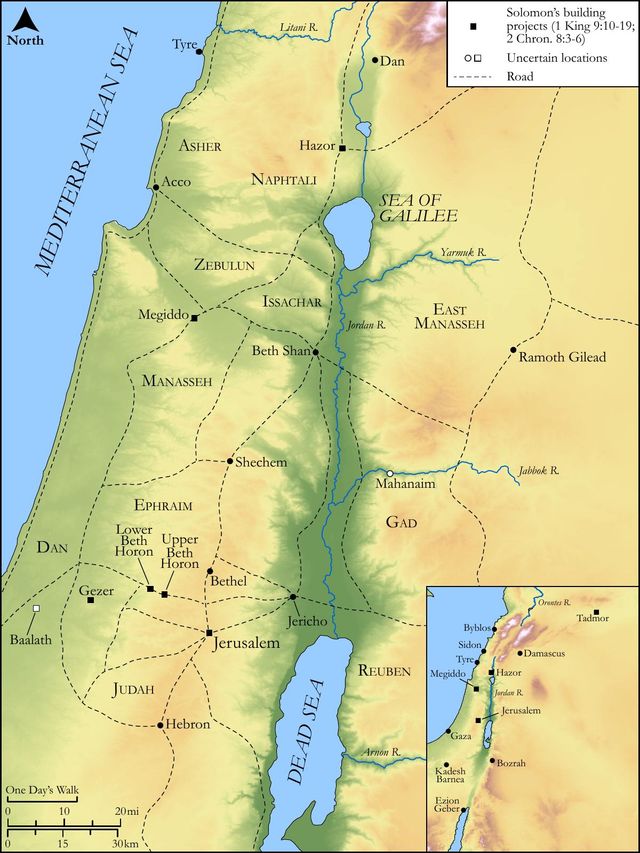
He raised a great levy both of men and money, because he projected a great deal of building, which would both employ many hands and put him to a vast expense, Kg1 9:15. And he was a wise builder, who sat down first, and counted the cost, and would not begin to build till he found himself able to finish. Perhaps there was some complaint of the heaviness of the taxes, which the historian excuses from the greatness of his undertakings. He raised it, not for war (as other princes), which would spend the blood of his subjects, but for building, which would require only their labour and purses. Perhaps David observed Solomon's genius to lie towards building, and foresaw he would have his head and hands full of it, when he penned that song of degrees for Solomon, which begins, Except the Lord build the house, those labour in vain that build it (Psa 127:1), directing him to acknowledge God in all his ways, and, by prayer and faith in his providence, to take him along with him in all his designs of this kind. And Solomon verily began his work at the right end, for he built God's house first, and finished that before he began his own; and then God blessed him, and he prospered in all his other buildings. If we begin with God, he will go on with us. Let the first-fruits be his, and the after-fruits will the more comfortably be ours, Mat 6:33. Solomon built a church first and then he was enabled to build houses, and cities, and walls. Those consult not their own interest that defer to the last what they design for pious uses. The further order in Solomon's buildings is observable. God's house first for religion, then his own for his own convenience, then a house for his wife, to which she removed as soon as it was ready for her (Kg1 9:24), then Millo, the town-house or guild-hall, then the wall of Jerusalem, the royal city, then some cities of note and strength in the country, which were decayed and unfortified, Hazor, Megiddo, etc. As he rebuilt these at his own charge, the inhabitants would be not only his subjects, but his tenants, which would increase the revenues of the crown for the benefit of his successors. Among the rest, he built Gezer, which Pharaoh took out of the hands of the Canaanites, and made a present of to his daughter, Solomon's wife, Kg1 9:16. See how God maketh the earth to help the woman. Solomon was not himself a warlike prince, but the king of Egypt, who was, took cities for him to build. Then he built cities for convenience, for store, for his chariots, and for his horsemen, Kg1 9:19. And, lastly, he built for pleasure in Lebanon, for his hunting perhaps, or other diversions there. Let piety begin, and profit proceed, and leave pleasure to the last.
II.His workmen and servants.
In doing such great works, he must needs employ abundance of workmen. The honour of great men is borrowed from their inferiors, who do that which they have the credit of.
1.Solomon employed those who remained of the conquered and devoted nations in all the slavish work, Kg1 9:20, Kg1 9:21. We may suppose that they renounced their idolatry and submitted to Solomon's government, so that he could not, in honour, utterly destroy them, and they were so poor that he could not levy money on them; therefore he served himself of their labour. Herein he observed God's law (Lev 25:44, Thy bondmen shall be of the heathen), and fulfilled Noah's curse upon Canaan, A servant of servants shall he be unto his brethren, Gen 9:25.
2.He employed Israelites in the more creditable services (Kg1 9:22, Kg1 9:23): Of them he made no bondmen, for they were God's freemen, but he made them soldiers and courtiers, and gave them offices, as he saw them qualified, among his chariots and horsemen, appointing some to support the service of the inferior labourers. Thus he preserved the dignity and liberty of Israel and honoured their relation to God as a kingdom of priests.
III.His piety and devotion (Kg1 9:25):
Three times in a year he offered burnt-offerings extraordinary (namely, at the three yearly feasts, the passover, pentecost, and feast of tabernacles) in honour of the divine institution, besides what he offered at other times, both statedly and upon special occasions. With his sacrifices he burnt incense, not himself (that was king Uzziah's crime), but the priest for him, at his charge, and for his particular use. It is said, He offered on the altar which he himself built. He took care to build it, and then,
1.He himself made use of it. Many will assist the devotions of others that neglect their own. Solomon did not think his building an altar would excuse him from sacrificing, but rather engage him the more to it.
2.He himself had the benefit and comfort of it. Whatever pains we take, for the support of religion, to the glory of God and the edification of others, we ourselves are likely to have the advantage of it.
IV.His merchandise.
He built a fleet of trading ships at Ezion-geber (Kg1 9:26), a port on the coast of the Red Sea, the furthest stage of the Israelites when they wandered in the wilderness, Num 33:35. Probably that wilderness now began to be peopled by the Edomites, which it was not then. To them this port had belonged, but, David having subdued the Edomites, it now pertained to the crown of Judah. The fleet traded to Ophir in the East Indies, supposed to be that which is now called Ceylon. Gold was the commodity traded for, substantial wealth. It should seem, Solomon had before been Hiram's partner, or put a venture into his ships, which made him a rich return of 120 talents (Kg1 9:14), which encouraged him to build a fleet of his own. The success of others in any employment should quicken our industry; for in all labour there is profit. Solomon sent his own servants as factors, and merchants, and super-cargoes, but hired Tyrians for sailors, for they had knowledge of the sea, Kg1 9:27. Thus one nation needs another, Providence so ordering it that there may be mutual commerce and assistance; for not only as Christians, but as men, we are members one of another. The fleet brought home to Solomon 420 talents of gold, Kg1 9:28. Canaan, the holy land, the glory of all lands, had no gold in it, which teaches us that that part of the wealth of this world which is for hoarding and trading is not the best part of it, but that which is more immediately for the present support and comfort of life, our own and others'; such were the productions of Canaan. Solomon got much by his merchandise, but, it should seem, David got much more by his conquests. What were Solomon's 420 talents to David's 100,000 talents of gold? Ch1 22:14; Ch1 29:4. Solomon got much by his merchandise, and yet has directed us to a better trade, within reach of the poorest, having assured us from his own experience of both that the merchandise of wisdom is better than the merchandise of silver and the gain thereof than fine gold, Pro 3:14.
Continue studying 1 Kings 9:20 across the web’s major study libraries — every link below opens this exact verse, chapter, or book on the destination site.
Read & Compare
 BibleGatewayThis verse in more than 200 translations and 70 languages.
 Bible.comThe YouVersion reader — hundreds of translations, reading plans, and highlights.
 ESV.orgCrossway's official English Standard Version reader.
 NET BibleThe NET translation with 60,000+ translators' notes on every rendering decision.
 STEP BibleTyndale House's free study tool — original text, vocabulary, and scholarly resources.
 BibliaLogos Bible Software's free web reader.
 USCCBThe New American Bible (Revised Edition) with the U.S. bishops' study notes.
Commentaries
 BibleHub CommentariesDozens of classic commentaries on this verse, gathered on one page.
 StudyLightMore than 100 commentary sets — the largest collection on the web.
 BibleRefPlain-English commentary on what this verse means, verse by verse.
 Enduring WordDavid Guzik's free commentary on this chapter, widely used by Bible teachers.
 Bible Study ToolsVerse commentary alongside Greek and Hebrew study aids.
Original Language & Research
- BibleHub InterlinearThe verse word by word — original language, transliteration, and English.
- BibleHub LexiconEvery word's original-language definition and Strong's entry.
 Blue Letter BibleDeep-study tools — Strong's numbers, concordance, and word studies.
 SefariaThe Hebrew text with Rashi and centuries of Jewish commentary.
Sermons, Hymns & Audio


TrulyRandomVerse is not affiliated with these sites and doesn’t control their content. They’re linked because they’re genuinely useful.
Summary
1 Kings 9:20 meticulously identifies the non-Israelite populations—specifically the Amorites, Hittites, Perizzites, Hivites, and Jebusites—who continued to reside within the Promised Land during King Solomon's reign. This verse serves as a critical demographic and historical marker, highlighting the enduring presence of these indigenous Canaanite groups who were not fully dispossessed by the children of Israel during the initial conquest, thereby setting the stage for Solomon's subsequent administrative policies regarding their forced labor.
Context
ShowHideLiterary Context
This verse is strategically placed within a significant narrative block in 1 Kings that details the culmination of Solomon's monumental building endeavors, including the magnificent Temple and his opulent royal palace, a colossal undertaking spanning twenty years (see 1 Kings 9:10). Immediately preceding this passage, the narrative recounts God's renewed covenant promises to Solomon, emphasizing the blessings contingent upon obedience and the severe consequences of disobedience (as found in 1 Kings 9:1-9). The explicit mention of these remaining foreign peoples in 1 Kings 9:20 functions as a crucial narrative bridge, directly leading into 1 Kings 9:21, which unveils Solomon's policy of conscripting them into forced labor. This transition effectively underscores Solomon's pragmatic governance and the persistent demographic realities of the land.
Historical & Cultural Context
From a historical standpoint, God had unequivocally commanded the Israelites, through Moses, to utterly dispossess and destroy these Canaanite nations from the land. This divine mandate was primarily driven by the imperative to prevent their idolatry and abominable practices from corrupting Israel's spiritual purity (refer to Deuteronomy 7:1-5 and Deuteronomy 20:16-18). However, the book of Judges repeatedly chronicles Israel's persistent failure to fully obey this divine injunction, resulting in the continued presence of these nations within their borders (e.g., Judges 1:21, Judges 1:27-36). By Solomon's era, generations later, these remnants persisted, albeit in a subdued state, often put to tribute or made to serve Israel. Solomon's policy of forced labor for these subjugated groups aligns with the practice of the nations, where conquered or tributary populations were routinely conscripted for large-scale state projects and infrastructure development, as Israel itself had labored under Pharaoh's taskmasters.
Key Themes
ShowHideThis verse significantly contributes to several overarching themes pervasive throughout 1 Kings and the broader Deuteronomistic History. Firstly, it powerfully underscores the theme of The Unfinished Conquest and Incomplete Obedience, highlighting Israel's persistent failure to fully comply with God's command to clear the land of its indigenous inhabitants. The continued presence of the Amorites, Hittites, Perizzites, Hivites, and Jebusites serves as a tangible and stark reminder of the nation's spiritual shortcomings and compromises, a direct consequence of their disobedience. Secondly, it touches upon the theme of Divine Sovereignty and Human Agency, demonstrating how God, in His permissive will, can allow and even utilize human actions—even those stemming from imperfect obedience—to achieve broader redemptive purposes, such as the construction of the Temple, which was central to Israel's worship and God's presence among His people, and the development of the kingdom's infrastructure. Lastly, the verse subtly introduces the theme of Servitude and Subjugation, foreshadowing the fate of these non-Israelite groups, as the subsequent verse (1 Kings 9:21) reveals Solomon's policy of conscripting them into forced labor, a long-term consequence of Israel's partial obedience and a clear reflection of Solomon's administrative power and the hierarchical structure of his kingdom.
Exposition and Analysis
ShowHideKey Word Analysis
ShowHideThis term (H5971) refers to "a people (as a congregated unit)." In this context, it emphasizes the collective identity of these non-Israelite groups, highlighting that they were organized communities, distinct from the covenant people of Israel. Their status as "people" underscores their continued presence as an identifiable demographic within the land, rather than scattered individuals.
The verb "yâthar" (H3498) signifies "to remain or be left." Its usage here is crucial, indicating that these populations were not completely eradicated or driven out, a direct consequence of Israel's incomplete obedience to God's command. This "remnant" status implies their subjugation and vulnerability to Solomon's authority, contrasting sharply with the Israelites who were explicitly forbidden from being enslaved by their brethren (as per Leviticus 25:39-46).
This phrase combines "bên" (H1121), meaning "son" or "child" (as a builder of the family name), and "Yisrâʼêl" (H3478), meaning "he will rule as God" and referring to Jacob's symbolic name and his posterity. This serves as a definitive distinction between the indigenous populations and the covenant people of God. It clearly marks their foreign, non-covenantal status, which provided the legal and theological basis for Solomon's policy of forced labor for them, as opposed to the Israelites, who were protected by Mosaic Law from such servitude.
Verse Breakdown
ShowHide"[And] all the people [that were] left"
This opening phrase immediately draws attention to the enduring presence of the indigenous populations. The term "left" is profoundly significant, indicating that despite the initial conquest attempts under Joshua and subsequent skirmishes, these groups were neither entirely dispossessed nor eliminated. Their continued existence represents a persistent challenge to the full realization of God's command for the land's purification and a lingering element of the pre-Israelite order within the Promised Land.
"of the Amorites, Hittites, Perizzites, Hivites, and Jebusites"
This precise enumeration identifies the specific ethnic composition of the remaining non-Israelite inhabitants. These five tribes were among the most prominent Canaanite nations in the land prior to the Israelite invasion. Their continued existence in Solomon's time, generations after Joshua's initial campaigns, speaks volumes about the partial nature of the Israelite conquest and their failure to fully adhere to God's explicit command to drive out all the inhabitants. The Jebusites, for instance, famously maintained control of Jerusalem until David's conquest (as recorded in 2 Samuel 5:6-9), yet remnants still resided within the kingdom.
"which [were] not of the children of Israel"
This concluding clause functions as a critical qualifier, explicitly distinguishing these groups from the Israelites, the covenant people of God. This distinction is paramount for understanding Solomon's subsequent administrative actions, as it delineates who was subject to forced labor and who was exempt. It underscores their status as "outsiders" or "foreigners" within the land, thereby providing the justification for their conscription without violating the Mosaic Law's prohibitions against enslaving fellow Israelites (as outlined in Leviticus 25:39).
Literary Devices
ShowHide1 Kings 9:20 skillfully employs several literary devices to convey its historical and theological significance. Enumeration is prominently featured through the explicit listing of the five Canaanite tribes (Amorites, Hittites, Perizzites, Hivites, and Jebusites). This precise cataloging emphasizes the specific, identifiable nature of these lingering populations, reinforcing the historical reality of their continued presence. Contrast is also powerfully evident, particularly in the phrase "which were not of the children of Israel," which sharply distinguishes these indigenous groups from the covenant people. This distinction sets the stage for the differing treatment they would receive under Solomon's administration compared to the Israelites. Furthermore, the verse functions as a form of Foreshadowing, subtly preparing the reader for the subsequent explanation in 1 Kings 9:21 regarding Solomon's policy of conscripting these remnants for forced labor. Lastly, it serves as a factual Historical Marker, grounding the narrative in the ongoing demographic and political realities of the land of Israel during Solomon's reign, reflecting the long-term consequences of Israel's partial obedience.
Theological and Thematic Connections
ShowHideThe continued presence of the Amorites, Hittites, Perizzites, Hivites, and Jebusites in Solomon's time, as explicitly noted in this verse, serves as a poignant theological reminder of Israel's incomplete obedience to God's clear commands regarding the disinheritance of the Canaanite nations. God had unequivocally warned that if Israel failed to drive them out, these nations would become "thorns in your sides and their gods will be a snare to you" (Numbers 33:55). This failure was not merely a military oversight but a profound spiritual compromise, leading to ongoing challenges to Israel's purity and fidelity to the covenant. The reality of these "remnants" in the land underscores a profound spiritual truth: incomplete obedience often leaves lingering elements that can hinder spiritual progress, compromise faithfulness, or become sources of future trouble. While Solomon pragmatically utilized them for his grand building projects, their very presence was a persistent testament to a foundational national sin and a symbol of unfulfilled divine mandate.
Reflection and Application
ShowHide1 Kings 9:20, though a historical detail from ancient Israel, offers a profound and enduring spiritual lesson for believers today. Just as the Canaanite nations were "left" in the Promised Land due to Israel's incomplete obedience, so too can "remnants" of ungodly habits, sinful strongholds, or worldly influences linger in our lives if we fail to fully obey God's call to spiritual transformation. These lingering issues, much like the Canaanites, can become persistent sources of temptation, compromise, or spiritual weakness, hindering our walk with God and our effectiveness in His kingdom. The narrative challenges us to engage in honest self-examination: are there areas where we have only partially surrendered to Christ, allowing "foreign" elements to remain rather than fully dispossessing them through the sanctifying power of the Holy Spirit? True spiritual freedom and profound growth come from a thorough and complete commitment to God's revealed will, ensuring that no "remnants" of the old self remain to compromise our devotion, dilute our testimony, or impede our service to the Lord.
Questions for Reflection
ShowHideFAQ
ShowHideWhy were these specific groups still present in Solomon's time, despite God's command to drive them out?
ShowHideThese groups—the Amorites, Hittites, Perizzites, Hivites, and Jebusites—were remnants of the original Canaanite inhabitants of the land. Their continued presence in Solomon's era, generations after the initial conquest, was a direct consequence of Israel's repeated failure to fully obey God's command to utterly dispossess them, as extensively detailed in books like Deuteronomy 7 and Judges 1. The Israelites often made treaties with them, allowed them to remain for various pragmatic reasons, or simply failed to complete the conquest, leading to their continued existence as a "snare" and a "thorn" to Israel, just as God had warned in Numbers 33:55.
Does Solomon's use of these people for forced labor contradict God's earlier commands?
ShowHideGod's earlier commands were for the complete disinheritance and destruction of the Canaanite nations due to their pervasive idolatry and wickedness, aiming to preserve Israel's spiritual purity. However, Israel's failure to fully execute this command resulted in these populations remaining in the land. Solomon's action of conscripting them into forced labor (1 Kings 9:21) was a practical administrative response to this demographic reality. While it was not God's original intention for these nations to remain, their presence was a direct consequence of Israel's disobedience and incomplete conquest. Solomon, in his wisdom and pragmatism, utilized this subjugated population for his massive building projects, which included the Temple and his palace. This act highlights human agency and the consequences of incomplete obedience within the broader scope of God's permissive will, rather than a direct contradiction of the initial command, which had already been largely unfulfilled by previous generations.
Christ-Centered Fulfillment
ShowHideThe Old Testament narrative of Israel's incomplete conquest, vividly marked by the lingering presence of the Canaanite "remnants" in 1 Kings 9:20, powerfully foreshadows the profound need for a more complete and ultimate spiritual conquest accomplished solely by Jesus Christ. Just as Israel failed to fully drive out the physical enemies from the Promised Land, humanity is utterly incapable of fully dispossessing the spiritual enemies of sin, death, and the devil from our hearts and lives. Jesus, the true and greater Joshua, accomplishes what Israel could not. He is the one who, through His perfect life, atoning death on the cross, and glorious resurrection, decisively conquers the spiritual "Amorites, Hittites, Perizzites, Hivites, and Jebusites" that hold humanity captive. His victory on the cross is not a partial conquest but a complete and decisive triumph over the powers of darkness, disarming them and leading them in triumph (Colossians 2:15). Through faith in Him, believers are empowered to participate in this already completed work, putting off the "old self with its practices" and putting on the "new self, which is being renewed in knowledge after the image of its Creator" (Colossians 3:9-10). This spiritual disinheritance, achieved by Christ's power and applied by the Holy Spirit, ensures that no "remnants" of sin or ungodly influences remain to enslave or compromise the redeemed life, leading to true freedom and spiritual flourishing in the "Promised Land" of God's abundant grace and eternal kingdom.