


1 Kings 9:21
Bible text: King James Version (1769 Blayney text) · Public domain
Bible text: King James Version with Strong's numbers · Public domain
Bible text: Berean Standard Bible · Public domain
Bible text: American Standard Version (1901) · Public domain
Bible text: World English Bible, Messianic edition · Public domain
Bible text: Geneva Bible (1599) · Public domain
Bible text: Young's Literal Translation · Public domain
- בְּנֵיהֶםbe·nei·Hemtheir descendantsH1121N-mpc ¦ 3mpNoun Plural Masculine Constructבְּנֵיdescendantsהֶםtheir
- אֲשֶׁר'a·SherwhoH834RelParticle Relative
- נֹתְרוּno·te·Ruthey were leftH3498V-Niphal-Perf-3cpVerb Niphal Perfect 3rd Plural common gender
- אַחֲרֵיהֶם'a·cha·rei·Hemafter themH310Adj-mpc ¦ 3mpAdjective Numerical Plural Masculine Constructאַחֲרֵיafterהֶםthem
- בָּאָרֶץba·'A·retzin the landH776Prep-b ¦ N-fsNoun Singular Feminine Absoluteבָּin theאָרֶץland
- אֲשֶׁר'a·SherwhomH834RelParticle Relative
- לֹאlo'notH3808NegParticle Negative
- יָכְלוּya·khe·Luthey were ableH3201V-Qal-Perf-3cpVerb Qal Perfect 3rd Plural common gender
- בְּנֵיbe·Nei[the] people ofH1121N-mpcNoun Plural Masculine Construct
- יִשְׂרָאֵלYis·ra·'ElIsraelH3478N-properNoun Proper Location
- לְהַחֲרִימָםle·ha·cha·ri·Mamto totally destroy themH2763Prep-l ¦ V-Hiphil-Inf ¦ 3mpVerb Hiphil Infinitive Constructלְtoהַחֲרִימָtotally destroyםthem
- וַיַּעֲלֵםvai·ya·'a·Lemand he raised themH5927Conj-w ¦ V-Hiphil-ConsecImperf-3ms ¦ 3mpVerb Hiphil Consecutive Imperfect 3rd Singular Masculineוַandיַּעֲלֵhe raisedםthem
- שְׁלֹמֹהshe·lo·MohSolomonH8010N-proper-mNoun Proper Masculine
- לְמַסle·masto forced labor ofH4522Prep-l ¦ N-mscNoun Singular Masculine Constructלְtoמַסforced labor of
- עֹבֵד'o·VedlaboringH5647V-Qal-Prtcpl-msVerb Qal Participle Singular Masculine Absolute
- עַד'aduntilH5704PrepPreposition
- הַיּוֹםhai·Yomthe dayH3117Art ¦ N-msNoun Singular Masculine Absoluteהַtheיּוֹםday
- הַזֶּהha·Zeh<the> thisH2088Art ¦ PrtParticle Demonstrativeהַ<the>זֶּהthis
English is a literal word-by-word gloss of the Hebrew, not the KJV's wording. Why?
This is the original text the KJV's translators worked from — each Hebrew word with its own literal English meaning in this verse, prepared by scholars at Tyndale House, Cambridge. The KJV translates whole sentences, not word by word, so its wording differs: one Hebrew word can become several English words, and the KJV may choose “the LORD” where the gloss reads “Yahweh”. Both are faithful — they answer different questions. For the KJV's own rendering, switch to the KJV text.
Details
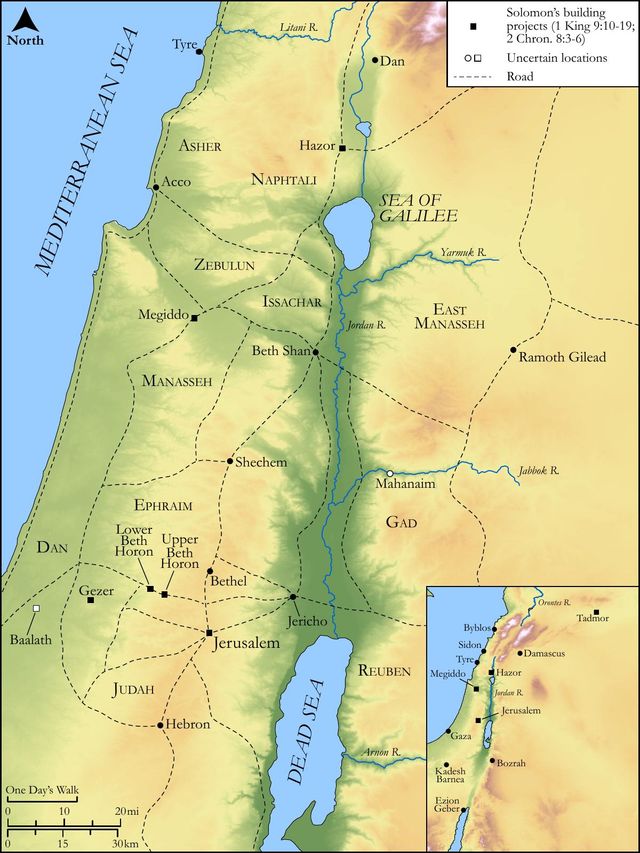
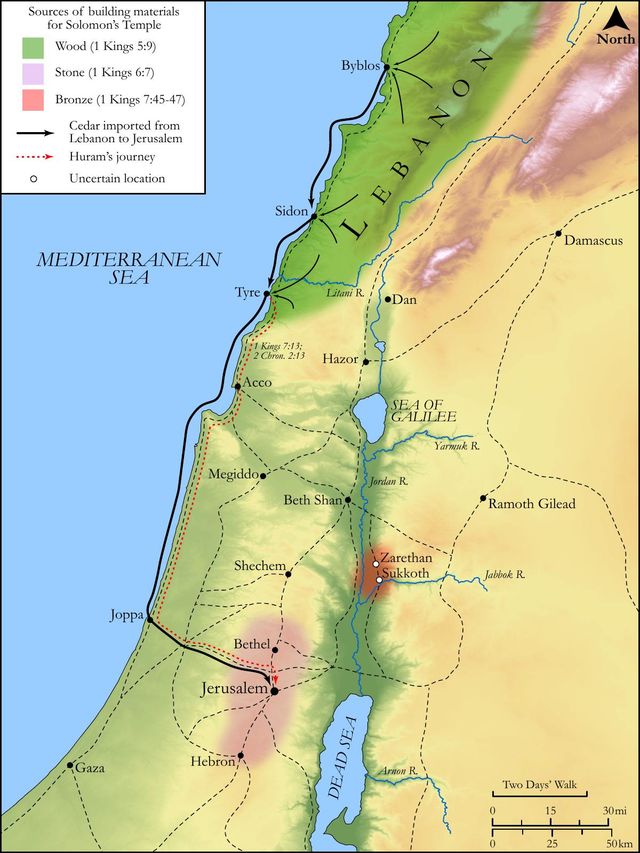
See on the biblical-era maps

Study this verse
Public-domain commentary
Matthew Henry
From his Commentary on the Whole Bible. Henry comments on passages, not single verses — this entry covers 1 Kings 9:15–28. His two-level outline is real structure in the source text, so it is rendered as structure.
We have here a further account of Solomon's greatness.
I.His buildings.
He raised a great levy both of men and money, because he projected a great deal of building, which would both employ many hands and put him to a vast expense, Kg1 9:15. And he was a wise builder, who sat down first, and counted the cost, and would not begin to build till he found himself able to finish. Perhaps there was some complaint of the heaviness of the taxes, which the historian excuses from the greatness of his undertakings. He raised it, not for war (as other princes), which would spend the blood of his subjects, but for building, which would require only their labour and purses. Perhaps David observed Solomon's genius to lie towards building, and foresaw he would have his head and hands full of it, when he penned that song of degrees for Solomon, which begins, Except the Lord build the house, those labour in vain that build it (Psa 127:1), directing him to acknowledge God in all his ways, and, by prayer and faith in his providence, to take him along with him in all his designs of this kind. And Solomon verily began his work at the right end, for he built God's house first, and finished that before he began his own; and then God blessed him, and he prospered in all his other buildings. If we begin with God, he will go on with us. Let the first-fruits be his, and the after-fruits will the more comfortably be ours, Mat 6:33. Solomon built a church first and then he was enabled to build houses, and cities, and walls. Those consult not their own interest that defer to the last what they design for pious uses. The further order in Solomon's buildings is observable. God's house first for religion, then his own for his own convenience, then a house for his wife, to which she removed as soon as it was ready for her (Kg1 9:24), then Millo, the town-house or guild-hall, then the wall of Jerusalem, the royal city, then some cities of note and strength in the country, which were decayed and unfortified, Hazor, Megiddo, etc. As he rebuilt these at his own charge, the inhabitants would be not only his subjects, but his tenants, which would increase the revenues of the crown for the benefit of his successors. Among the rest, he built Gezer, which Pharaoh took out of the hands of the Canaanites, and made a present of to his daughter, Solomon's wife, Kg1 9:16. See how God maketh the earth to help the woman. Solomon was not himself a warlike prince, but the king of Egypt, who was, took cities for him to build. Then he built cities for convenience, for store, for his chariots, and for his horsemen, Kg1 9:19. And, lastly, he built for pleasure in Lebanon, for his hunting perhaps, or other diversions there. Let piety begin, and profit proceed, and leave pleasure to the last.
II.His workmen and servants.
In doing such great works, he must needs employ abundance of workmen. The honour of great men is borrowed from their inferiors, who do that which they have the credit of.
1.Solomon employed those who remained of the conquered and devoted nations in all the slavish work, Kg1 9:20, Kg1 9:21. We may suppose that they renounced their idolatry and submitted to Solomon's government, so that he could not, in honour, utterly destroy them, and they were so poor that he could not levy money on them; therefore he served himself of their labour. Herein he observed God's law (Lev 25:44, Thy bondmen shall be of the heathen), and fulfilled Noah's curse upon Canaan, A servant of servants shall he be unto his brethren, Gen 9:25.
2.He employed Israelites in the more creditable services (Kg1 9:22, Kg1 9:23): Of them he made no bondmen, for they were God's freemen, but he made them soldiers and courtiers, and gave them offices, as he saw them qualified, among his chariots and horsemen, appointing some to support the service of the inferior labourers. Thus he preserved the dignity and liberty of Israel and honoured their relation to God as a kingdom of priests.
III.His piety and devotion (Kg1 9:25):
Three times in a year he offered burnt-offerings extraordinary (namely, at the three yearly feasts, the passover, pentecost, and feast of tabernacles) in honour of the divine institution, besides what he offered at other times, both statedly and upon special occasions. With his sacrifices he burnt incense, not himself (that was king Uzziah's crime), but the priest for him, at his charge, and for his particular use. It is said, He offered on the altar which he himself built. He took care to build it, and then,
1.He himself made use of it. Many will assist the devotions of others that neglect their own. Solomon did not think his building an altar would excuse him from sacrificing, but rather engage him the more to it.
2.He himself had the benefit and comfort of it. Whatever pains we take, for the support of religion, to the glory of God and the edification of others, we ourselves are likely to have the advantage of it.
IV.His merchandise.
He built a fleet of trading ships at Ezion-geber (Kg1 9:26), a port on the coast of the Red Sea, the furthest stage of the Israelites when they wandered in the wilderness, Num 33:35. Probably that wilderness now began to be peopled by the Edomites, which it was not then. To them this port had belonged, but, David having subdued the Edomites, it now pertained to the crown of Judah. The fleet traded to Ophir in the East Indies, supposed to be that which is now called Ceylon. Gold was the commodity traded for, substantial wealth. It should seem, Solomon had before been Hiram's partner, or put a venture into his ships, which made him a rich return of 120 talents (Kg1 9:14), which encouraged him to build a fleet of his own. The success of others in any employment should quicken our industry; for in all labour there is profit. Solomon sent his own servants as factors, and merchants, and super-cargoes, but hired Tyrians for sailors, for they had knowledge of the sea, Kg1 9:27. Thus one nation needs another, Providence so ordering it that there may be mutual commerce and assistance; for not only as Christians, but as men, we are members one of another. The fleet brought home to Solomon 420 talents of gold, Kg1 9:28. Canaan, the holy land, the glory of all lands, had no gold in it, which teaches us that that part of the wealth of this world which is for hoarding and trading is not the best part of it, but that which is more immediately for the present support and comfort of life, our own and others'; such were the productions of Canaan. Solomon got much by his merchandise, but, it should seem, David got much more by his conquests. What were Solomon's 420 talents to David's 100,000 talents of gold? Ch1 22:14; Ch1 29:4. Solomon got much by his merchandise, and yet has directed us to a better trade, within reach of the poorest, having assured us from his own experience of both that the merchandise of wisdom is better than the merchandise of silver and the gain thereof than fine gold, Pro 3:14.
Continue studying 1 Kings 9:21 across the web’s major study libraries — every link below opens this exact verse, chapter, or book on the destination site.
Read & Compare
 BibleGatewayThis verse in more than 200 translations and 70 languages.
 Bible.comThe YouVersion reader — hundreds of translations, reading plans, and highlights.
 ESV.orgCrossway's official English Standard Version reader.
 NET BibleThe NET translation with 60,000+ translators' notes on every rendering decision.
 STEP BibleTyndale House's free study tool — original text, vocabulary, and scholarly resources.
 BibliaLogos Bible Software's free web reader.
 USCCBThe New American Bible (Revised Edition) with the U.S. bishops' study notes.
Commentaries
 BibleHub CommentariesDozens of classic commentaries on this verse, gathered on one page.
 StudyLightMore than 100 commentary sets — the largest collection on the web.
 BibleRefPlain-English commentary on what this verse means, verse by verse.
 Enduring WordDavid Guzik's free commentary on this chapter, widely used by Bible teachers.
 Bible Study ToolsVerse commentary alongside Greek and Hebrew study aids.
Original Language & Research
- BibleHub InterlinearThe verse word by word — original language, transliteration, and English.
- BibleHub LexiconEvery word's original-language definition and Strong's entry.
 Blue Letter BibleDeep-study tools — Strong's numbers, concordance, and word studies.
 SefariaThe Hebrew text with Rashi and centuries of Jewish commentary.
Sermons, Hymns & Audio


TrulyRandomVerse is not affiliated with these sites and doesn’t control their content. They’re linked because they’re genuinely useful.
Summary
1 Kings 9:21 provides a crucial insight into the administrative policies of King Solomon, specifically detailing his practice of conscripting the descendants of the non-Israelite peoples who remained in the land into forced labor. These were the survivors of the Amorites, Hittites, Perizzites, Hivites, and Jebusites whom the Israelites had historically failed to utterly dispossess, contrary to divine command. Solomon leveraged this existing population, levying a "tribute of bondservice" that persisted "unto this day," thereby securing a workforce for his vast building enterprises while distinguishing them from the Israelites who were exempt from such arduous manual labor.
Context
ShowHideLiterary Context
This verse is strategically placed within the narrative of Solomon's reign, immediately following the completion of his ambitious construction projects, including the magnificent Temple in Jerusalem and his opulent royal palace. The preceding verse, 1 Kings 9:20, explicitly identifies the specific non-Israelite groups (Amorites, Hittites, Perizzites, Hivites, and Jebusites) who are the subject of this forced labor. Crucially, 1 Kings 9:22 then clarifies that Solomon did not impose this "bondservice" upon the Israelites themselves, but rather employed them in military and administrative roles. Thus, the passage functions to explain the logistical and demographic source of Solomon's vast labor force, highlighting a clear distinction between the roles of foreign and Israelite populations in the development of his kingdom's infrastructure and military.
Historical & Cultural Context
The practice of levying forced labor, commonly known as corvée, was a widespread and accepted administrative tool among the kings of that day. Powerful rulers like Solomon routinely conscripted portions of their own populace or, more often, subjugated peoples, for large-scale public works such as building projects, military service, or agricultural endeavors. However, for Israel, the continued presence of these non-Israelite peoples carried profound historical and theological significance. God had explicitly commanded Israel to utterly dispossess the inhabitants of Canaan due to their idolatrous practices and inherent wickedness, warning that their presence would become a snare. The phrase "whom the children of Israel also were not able utterly to destroy" in this verse directly references a historical failure of complete obedience dating back to the conquest period, a reality vividly documented in the early chapters of the book of Judges. Solomon's pragmatic solution of bondservice, while economically efficient and culturally normative for the time, implicitly acknowledges and perpetuates this long-standing historical failure.
Key Themes
ShowHideOne central theme illuminated by this verse is Incomplete Obedience and its Enduring Consequences. The explicit statement that Israel "were not able utterly to destroy" these nations underscores a persistent failure to fully obey God's command to dispossess the land, a theme consistently echoed throughout the book of Judges. This partial obedience resulted in the continued presence of foreign elements within the land, which, while providing a convenient labor force for Solomon, also presented an ongoing spiritual threat to Israel's covenant purity and fidelity to Yahweh. Another significant theme is Solomon's Administrative Acumen and Pragmatism. Solomon, renowned for his wisdom and the vastness of his kingdom, shrewdly utilized the existing reality of these remaining populations to serve his ambitious state-building agenda. This "tribute of bondservice" allowed him to exempt the Israelites from such arduous physical labor, thereby demonstrating his administrative prowess and the hierarchical structure of his kingdom, a point further elaborated in 1 Kings 9:22.
Exposition and Analysis
ShowHideKey Word Analysis
ShowHideThis word (H1121) from the root meaning 'to build,' refers to a son, but in the widest sense, encompassing literal and figurative relationships, including descendants, subjects, or a nation. In this context, it specifically denotes the offspring or descendants of the non-Israelite peoples who remained in the land, emphasizing the generational continuity of their presence and their inherited status.
This primitive root (H2763) means "to seclude," specifically by a ban, to devote to religious uses, often implying destruction. In the context of the Canaanite nations, it referred to their complete eradication as a holy war measure, to prevent their idolatry from corrupting Israel (Deuteronomy 7:1-5). The use of this word here highlights Israel's failure to fulfill a divine mandate, resulting in the continued presence of these groups.
This phrase combines two Hebrew words. Mas (H4522) refers to a burden or a tax in the form of forced labor, a levy or conscription for service. 'Ōvēd (H5647) means "to work" or "to serve," implying a bondman or servant. Together, mas 'ōvēd describes a compulsory labor service imposed on subjugated peoples, a common practice among the kings of that day, here applied by Solomon to the remaining non-Israelites.
This phrase (H3117) uses the word for "day" in a temporal sense, often used adverbially to denote continuity or duration. It signifies that the practice of bondservice, or at least the presence of these subjugated peoples under Israelite rule, continued up to the time the book of Kings was written or compiled, emphasizing the long-term historical reality and consequences of Israel's actions.
Verse Breakdown
ShowHide"Their children that were left after them in the land"
This clause identifies the specific demographic group in question: the descendants of the Amorites, Hittites, Perizzites, Hivites, and Jebusites, who were the original inhabitants of Canaan and had survived the Israelite conquest, continuing to reside within the promised land. It underscores their persistent, generational presence.
"whom the children of Israel also were not able utterly to destroy"
This crucial parenthetical statement explains the historical context for the presence of these non-Israelites. It directly attributes their survival to Israel's historical failure to fully obey God's command to completely dispossess the Canaanite inhabitants. This highlights a deep-seated pattern of incomplete obedience with significant theological and practical consequences.
"upon those did Solomon levy a tribute of bondservice"
This describes King Solomon's administrative action. He capitalized on the existing reality of these non-Israelite populations, conscripting them into a system of forced labor to support his extensive building projects. This was a pragmatic solution, allowing him to exempt the Israelites from such arduous physical work, as further clarified in the subsequent verse.
"unto this day"
This concluding phrase functions as a chronological marker, indicating the enduring nature of this policy or its consequences. It implies that the system of bondservice, or at least the subjugated status of these peoples under Israelite rule, persisted up to the time of the book's composition, signifying a long-term historical reality and the lasting impact of past decisions.
Literary Devices
ShowHideThe verse employs several significant literary devices that enrich its meaning. Irony is subtly present, as Israel's failure to "utterly destroy" the Canaanite nations—a direct act of disobedience to God's command—paradoxically provided Solomon with a readily available and extensive labor force for his grand kingdom-building projects. What began as a spiritual compromise inadvertently became a pragmatic solution for the kingdom's economic and architectural expansion. The phrase "unto this day" functions as a powerful Historical Marker or Chronological Indicator, emphasizing the long-lasting impact and continuity of this policy or situation. It bridges the gap between the past (Israel's incomplete conquest) and the present of the narrator, underscoring how historical decisions cast long shadows into the future. Furthermore, the verse subtly employs Foreshadowing, as the continued presence of these nations, even in servitude, would later contribute significantly to Israel's spiritual decline through intermarriage and the adoption of pagan practices, a recurring and tragic theme in the prophetic literature and the subsequent history of the divided kingdom.
Theological and Thematic Connections
ShowHide1 Kings 9:21 powerfully illustrates the enduring tension between divine command and human compromise, a pervasive theme throughout Israel's history. God's explicit directive for Israel to utterly dispossess the Canaanite nations was not merely about territorial conquest but fundamentally about preserving the spiritual purity and distinctiveness of His covenant people, shielding them from the corrupting influence of idolatry and pagan practices. Israel's failure in this regard, whether stemming from a lack of faith, military weariness, or pragmatic expediency, led to the continued presence of these groups within the land. Solomon, in his renowned wisdom and ambitious reign, leveraged this existing reality for the material benefit of his kingdom, establishing a system of forced labor. While administratively efficient, this arrangement was a direct consequence of past disobedience, and it subtly hints at the spiritual vulnerabilities that would plague Israel later, as these foreign elements often became sources of idolatry and syncretism within the kingdom. The verse thus serves as a sober reminder that incomplete obedience, even when seemingly advantageous in the short term, can have profound and lasting theological implications, shaping the destiny and spiritual health of a people across generations.
Reflection and Application
ShowHide1 Kings 9:21 offers a profound lesson on the enduring consequences of incomplete obedience and the subtle allure of pragmatic compromise. Just as Israel's failure to fully dispossess the land led to a persistent foreign presence that Solomon then "managed" through bondservice, so too can our own areas of unaddressed disobedience or half-hearted commitment to God's commands create lingering issues in our lives. These "leftovers" of compromise, while perhaps appearing useful or convenient in the short term, can become insidious sources of spiritual vulnerability, subtly diverting us from God's perfect will and potentially leading to deeper entanglements with sin or worldly values. This verse challenges us to engage in honest self-examination: where might we be settling for less than God's best, allowing "tolerated" sins, unholy influences, or unbiblical practices to remain in our personal lives, families, or communities, rather than pursuing the radical, wholehearted obedience that leads to true freedom, purity, and flourishing? It also subtly invites us to consider the ethics of power and labor, even in ancient contexts, prompting us to reflect on how we treat those under our authority or those who provide essential services, ensuring that our practices are marked by justice, compassion, and the dignity inherent in every human being, created in God's image.
Questions for Reflection
ShowHideFAQ
ShowHideWhy didn't Israel "utterly destroy" these nations as commanded by God?
ShowHideThe biblical narrative, particularly in the book of Judges, repeatedly highlights Israel's failure to fully dispossess the Canaanite nations. This failure stemmed from a variety of reasons, including a lack of complete faith in God's power, military weariness or perceived weakness, and a desire for pragmatic coexistence or economic gain through their labor. Rather than driving them out entirely, Israel often settled among them, made treaties, or put them to forced labor, as seen here with Solomon. This disobedience had severe consequences, as these remaining nations often led Israel into idolatry and moral corruption, as prophesied by the angel of the Lord in Judges 2:1-3.
Was Solomon's use of "bondservice" ethical according to biblical standards?
ShowHideBy the custom of the kings of that day, Solomon's practice was common and generally considered a legitimate exercise of royal power over conquered or resident foreign populations. Within Israelite law, there was a clear distinction between the treatment of foreign bondservants and Israelite bondservants. Israelites could not be enslaved permanently and were to be released after a set period or in the Year of Jubilee (Leviticus 25:39-46). Foreigners, however, could be held as permanent bondservants, often referred to as "sojourners" or "aliens" who were part of the household. While Solomon's actions were technically permissible under the existing legal framework for non-Israelites, the underlying context is Israel's prior failure to fully obey God's command to dispossess these nations. Thus, the "bondservice" itself, while pragmatic and legally sanctioned for foreigners, was a consequence of a prior act of disobedience, highlighting the complex ethical landscape that arises when God's ideal is not fully realized.
Christ-Centered Fulfillment
ShowHide1 Kings 9:21, with its depiction of Israel's incomplete obedience and the resulting "bondservice" of the remaining nations, points powerfully to the redemptive work of Christ. Israel's failure to "utterly destroy" the spiritual enemies within the land foreshadows humanity's inherent inability to overcome the pervasive power of sin and death on its own. We are all, in a profound sense, born into "bondservice" to sin (John 8:34), utterly unable to truly free ourselves from its dominion or perfectly obey God's commands. Jesus, however, comes as the true and perfect Israelite, who accomplishes what Israel could not. He "utterly destroys" the works of the devil (1 John 3:8) and decisively breaks the power of sin and death through His sacrificial death and glorious resurrection. He frees us from the "bondservice" of sin, not by imposing a new form of servitude, but by granting true spiritual liberty and adoption into His family (Romans 6:6-7). In Christ, the ultimate "tribute" is paid, not by the forced labor of others, but by His voluntary offering of Himself, ushering in a new covenant where all are invited into sonship and freedom, no longer bound by the consequences of past disobedience or the chains of spiritual compromise (Galatians 5:1).