


Nehemiah 11:3
Bible text: King James Version (1769 Blayney text) · Public domain
Bible text: King James Version with Strong's numbers · Public domain
Bible text: Berean Standard Bible · Public domain
Bible text: American Standard Version (1901) · Public domain
Bible text: World English Bible, Messianic edition · Public domain
Bible text: Geneva Bible (1599) · Public domain
Bible text: Young's Literal Translation · Public domain
- וְאֵלֶּהve·'E·lehand theseH428Conj-w ¦ PrtParticle Demonstrativeוְandאֵלֶּהthese
- רָאשֵׁיra·Shei[are] [the] leaders ofH7218N-mpcNoun Plural Masculine Construct
- הַמְּדִינָהha·me·di·Nahthe provinceH4082Art ¦ N-fsNoun Singular Feminine Absoluteהַtheמְּדִינָהprovince
- אֲשֶׁר'a·SherwhoH834RelParticle Relative
- יָשְׁבוּya·she·Vuthey dweltH3427V-Qal-Perf-3cpVerb Qal Perfect 3rd Plural common gender
- בִּירוּשָׁלִָםbi·ru·sha·Limin JerusalemH3389Prep-b ¦ N-properNoun Proper LocationבִּinירוּשָׁלִָםJerusalem
- וּבְעָרֵיu·ve·'a·Reiand in [the] cities ofH5892Conj-w ¦ Prep-b ¦ N-mpcNoun Plural Masculine Constructוּandבְinעָרֵי[the] cities of
- יְהוּדָהye·hu·DahJudahH3063N-properNoun Proper Location
- יָשְׁבוּya·she·Vuthey dweltH3427V-Qal-Perf-3cpVerb Qal Perfect 3rd Plural common gender
- אִישׁ'isheach oneH376N-msNoun Singular Masculine Absolute
- בַּאֲחֻזָּתוֹba·'a·chu·za·Toon his own propertyH272Prep-b ¦ N-fsc ¦ 3msNoun Singular Feminine Constructבַּonאֲחֻזָּתown propertyוֹhis
- בְּעָרֵיהֶםbe·'A·rei·Hemin their own citiesH5892Prep-b ¦ N-mpc ¦ 3mpNoun Plural Masculine Constructבְּinעָרֵיown citiesהֶםtheir
- יִשְׂרָאֵלYis·ra·'ElIsraelH3478N-properNoun Proper Location
- הַכֹּהֲנִיםha·ko·ha·Nimthe priestsH3548Art ¦ N-mpNoun Plural Masculine Absoluteהַtheכֹּהֲנִיםpriests
- וְהַלְוִיִּםve·hal·vi·Yimand the LevitesH3881Conj-w ¦ Art ¦ N-mpNoun Gentilic Plural Masculine AbsoluteוְandהַtheלְוִיִּםLevites
- וְהַנְּתִינִיםve·ha·ne·ti·Nimand the temple servantsH5411Conj-w ¦ Art ¦ N-mpNoun Plural Masculine Absoluteוְandהַtheנְּתִינִיםtemple servants
- וּבְנֵיu·ve·Neiand [the] descendants ofH1121Conj-w ¦ N-mpcNoun Plural Masculine Constructוּandבְנֵי[the] descendants of
- עַבְדֵי'av·Dei[the] servants ofH5650N-mpcNoun Plural Masculine Construct
- שְׁלֹמֹהshe·lo·MohSolomonH8010N-proper-mNoun Proper Masculine
English is a literal word-by-word gloss of the Hebrew, not the KJV's wording. Why?
This is the original text the KJV's translators worked from — each Hebrew word with its own literal English meaning in this verse, prepared by scholars at Tyndale House, Cambridge. The KJV translates whole sentences, not word by word, so its wording differs: one Hebrew word can become several English words, and the KJV may choose “the LORD” where the gloss reads “Yahweh”. Both are faithful — they answer different questions. For the KJV's own rendering, switch to the KJV text.
Details
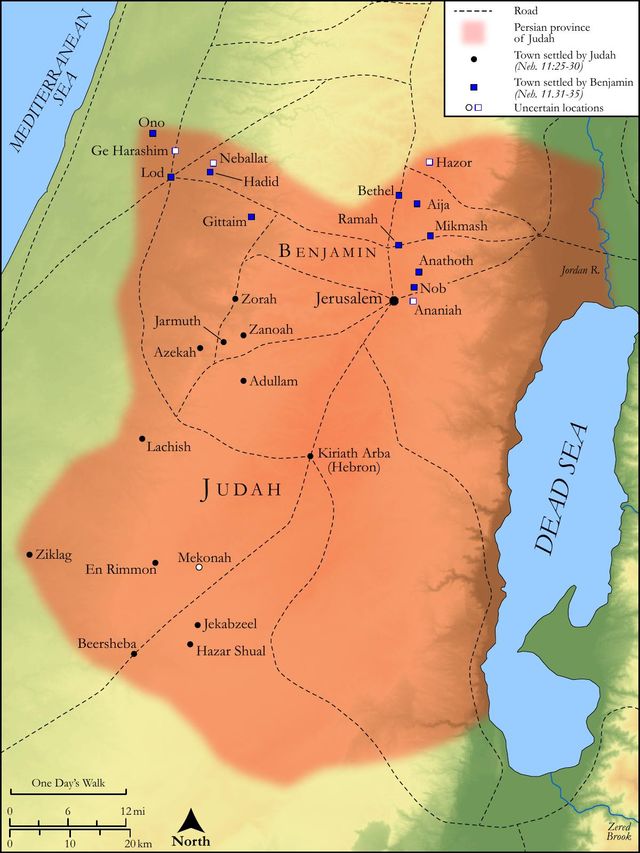
See on the biblical-era map
Study this verse
Public-domain commentary
Matthew Henry
From his Commentary on the Whole Bible. Henry comments on passages, not single verses — this entry covers Nehemiah 11:1–19. His four-level outline is real structure in the source text, so it is rendered as structure.
Jerusalem is called here the holy city (Neh 11:1), because there the temple was, and that was the place God had chosen to put his name there; upon this account, one would think, the holy seed should all have chosen to dwell there and have striven for a habitation there; but, on the contrary, it seems they declined dwelling there, 1. Because a greater strictness of conversation was expected from the inhabitants of Jerusalem than from others, which they were not willing to come up to. Those who care not for being holy themselves are shy of dwelling in a holy city; they would not dwell in the New Jerusalem itself for that reason, but would wish to have a continuing city here upon earth. Or, 2. Because Jerusalem, of all places, was most hated by the heathen their neighbours, and against it their malicious designs were levelled, which made that the post of danger (as the post of honour usually is) and therefore they were not willing to expose themselves there. Fear of persecution and reproach, and of running themselves into trouble, keeps many out of the holy city, and makes them backward to appear for God and religion, not considering that, as Jerusalem is with a special malice threatened and insulted by its enemies, so it is with a special care protected by its God and made a quiet habitation, Isa 33:20; Psa 46:4, Psa 46:5. Or, 3. Because it was more for their worldly advantage to dwell in the country. Jerusalem was no trading city, and therefore there was no money to be got there by merchandise, as there was in the country by corn and cattle. Note, All seek their own, not the things that are Jesus Christ's, Phi 2:21. It is a general and just complaint that most people prefer their own wealth, credit, pleasure, ease, and safety, before the glory of God and the public good. People being thus backward to dwell at Jerusalem, now that it was poor, we are here told,
I.By what means it was replenished.
1.The rulers dwelt there, Neh 11:1. That was the proper place for them to reside in, because there were set the thrones of judgment (Psa 122:5), and thither, in all difficult matters, the people resorted with their last appeals. And if it were an instance of eminent affection to the house of God, zeal for the public good, and of faith, and holy courage, and self-denial, to dwell there at this time, the rulers would be examples of these to their inferiors. Their dwelling there would invite and encourage others to dwell there too. Magnates magnetes - the mighty are magnetic. When great men choose the holy city for their habitation their example brings holiness into reputation, and their zeal will provoke very many.
2.There were some that willingly offered themselves to dwell at Jerusalem, nobly foregoing their own secular interest for the public welfare, Neh 11:2. It is upon record, to their honour, that when others were shy of venturing upon difficulty, loss, and danger, they sought the good of Jerusalem, because of the house of the Lord their God. Those shall prosper that thus love Zion, Psa 122:6, Psa 122:9. It is said, The people blessed them. They praised them; they prayed for them; they praised God for them. Many that do not appear forward themselves for the public good will yet give a good word to those that do. God and man will bless those that are public blessings, which should encourage us to be zealous in doing good.
3.They, finding that yet there was room, concluded upon a review of their whole body to bring one in ten to dwell in Jerusalem; who they should be was determined by lot, the disposal whereof, all knew, was of the Lord. This would prevent strife, and would be a great satisfaction to those on whom the lot fell to dwell at Jerusalem, that they plainly saw God appointing the bounds of their habitation. They observed the proportion of one in ten, as we may suppose, to bring the balance between the city and country to a just and equal poise; so it seems to refer to the ancient rule of giving the tenth to God; and what is given to the holy city he reckons given to himself.
II.By what persons it was replenished.
A general account is here given of the inhabitants of Jerusalem because the governors of Judah looked upon them as their strength in the Lord of hosts their God, and valued them accordingly, Zac 12:5.
1.Many of the children of Judah and Benjamin dwelt there; for, originally, part of the city law in the lot of one of those tribes and part in that of the other; but the greater part was in the lot of Benjamin, and therefore here we find of the children of Judah only 468 families in Jerusalem (Neh 11:6), but of Benjamin 928, Neh 11:7, Neh 11:8. Thus small were its beginnings, but afterwards, before our Saviour's time, it grew much more populous. Those of Judah all descended from Perez, or Pharez, that son of Judah of whom, as concerning the flesh, Christ came. And, though the Benjamites were more in number, yet of the men of Judah it is said (Neh 11:6) that they were valiant men, fit for service, and able to defend the city in case of an attack. Judah has not lost its ancient character of a lion's whelp, bold and daring. Of the Benjamites that dwelt in Jerusalem we are here told who was overseer, and who was second, Neh 11:9. For it is as necessary for a people to have good order kept up among themselves as to be fortified against the attacks of their enemies from abroad, to have good magistrates as to have good soldiers.
2.The priests and Levites did many of them settle at Jerusalem; where else should men that were holy to God dwell, but in the holy city?
(1.)Most of the priests, we may suppose, dwelt there, for their business lay where the temple was. Of those that did the work of the house in their courses here were 822 of one family, 242 of another, and 128 of another, Neh 11:12-14. It was well that those labourers were not few. It is said of some of them that they were mighty men of valour (Neh 11:14); it was necessary that they should be so, for the priesthood was not only a work, which required might, but a warfare, which required valour, especially now. Of one of these priests it is said that he was the son of one of the great men. It was no disparagement to the greatest man they had to have his son in the priesthood; he might magnify his office, for his office did not in the least diminish him.
(2.)Some of the Levites also came and dwelt at Jerusalem, yet but few in comparison, 284 in all (Neh 11:18), with 172 porters (Neh 11:19), for much of their work was to teach the good knowledge of God up and down the country, for which purpose they were to be scattered in Israel. As many as there was occasion for attended at Jerusalem; the rest were doing good elsewhere.
[1.]It is said of one of the Levites that he had the oversight of the outward business of the house of God, Neh 11:16. The priests were chief managers of the business within the temple gates; but this Levite was entrusted with the secular concerns of God's house, that were in ordine ad spiritualia - subservient to its spiritual concerns, the collecting of the contributions, the providing of materials for the temple service, and the like, which it was necessary to oversee, else the inward business would have been starved and have stood still. Those who take care of the ta exō the outward concerns of the church, the serving of its tables, are as necessary in their place as those who take care of its ta esō its inward concerns, who give themselves to the word and prayer.
[2.]It is said of another that he was the principal to begin the thanksgiving in prayer. Probably he had a good ear and a good voice, and was a scientific singer, and therefore was chosen to lead the psalm. He was precentor in the temple. Observe, Thanksgiving is necessary in prayer; they should go together; giving thanks for former mercies is a becoming way of begging further mercies. And care should be taken in public service that every thing be done in the best manner, decently and in good order - in prayer, that one speak and the rest join-in singing, that one begin and the rest follow.
Historical interpretation
Historical reception
1 surviving comment on this verse from the historical church.
Each one dwelt in his own possession, etc. By these words, it is plainly taught that all of Israel, that is, the ten tribes, lived in their cities, in which even the priests and Levites held their portion decreed by law. However, from the tribe of Judah and Benjamin, whoever was chosen by lot dwelled in Jerusalem; along with those from the priestly and Levitical tribes. For the tribe of Benjamin had been dwelling there from ancient times, as that city had fallen to them by lot. The tribe of Judah entered there in the times of David, when he made it the metropolis of the entire Israelite kingdom. The tribe of Levi was added when the ark of the covenant was brought there, and the altar and temple of God were built. For, see the following passages of this book and you will find that inhabitants of Jerusalem are counted only from these three tribes, and their total is carefully tallied; once their catalog is completed, Scripture still goes on to add in which cities the rest of these tribes lived. For it follows:
Continue studying Nehemiah 11:3 across the web’s major study libraries — every link below opens this exact verse, chapter, or book on the destination site.
Read & Compare
 BibleGatewayThis verse in more than 200 translations and 70 languages.
 Bible.comThe YouVersion reader — hundreds of translations, reading plans, and highlights.
 ESV.orgCrossway's official English Standard Version reader.
 NET BibleThe NET translation with 60,000+ translators' notes on every rendering decision.
 STEP BibleTyndale House's free study tool — original text, vocabulary, and scholarly resources.
 BibliaLogos Bible Software's free web reader.
 USCCBThe New American Bible (Revised Edition) with the U.S. bishops' study notes.
Commentaries
 BibleHub CommentariesDozens of classic commentaries on this verse, gathered on one page.
 StudyLightMore than 100 commentary sets — the largest collection on the web.
 BibleRefPlain-English commentary on what this verse means, verse by verse.
 Enduring WordDavid Guzik's free commentary on this chapter, widely used by Bible teachers.
 Bible Study ToolsVerse commentary alongside Greek and Hebrew study aids.
Original Language & Research
- BibleHub InterlinearThe verse word by word — original language, transliteration, and English.
- BibleHub LexiconEvery word's original-language definition and Strong's entry.
 Blue Letter BibleDeep-study tools — Strong's numbers, concordance, and word studies.
 SefariaThe Hebrew text with Rashi and centuries of Jewish commentary.
Sermons, Hymns & Audio


TrulyRandomVerse is not affiliated with these sites and doesn’t control their content. They’re linked because they’re genuinely useful.
Summary
Nehemiah 11:3 marks a pivotal moment in the post-exilic restoration of Judah, detailing the strategic repopulation of Jerusalem and the surrounding towns. This verse outlines the various groups—from leading officials to temple servants—who settled in these vital areas, signifying a comprehensive effort to re-establish the Jewish commonwealth. This organized resettlement was crucial for ensuring the capital's security and vitality, and for solidifying the community's return to their ancestral lands and covenant identity under God's providential care after decades of exile.
Context
ShowHideLiterary Context
Nehemiah 11 immediately follows a period of intense physical and spiritual reconstruction. Chapters 1-6 chronicle the miraculous rebuilding of Jerusalem's walls, completed despite fierce opposition, laying the physical foundation for the restored community. Chapters 7-10 then shift to the spiritual and social re-establishment, including the registration of returnees, Ezra's public reading of the Law, and a solemn covenant renewal ceremony where the people pledged obedience to God. Nehemiah 11, therefore, transitions from securing the city's perimeter and its spiritual commitment to addressing its demographic emptiness. Despite the walls being rebuilt, Jerusalem remained sparsely inhabited, making it vulnerable and impeding its function as the nation's capital. This chapter, and specifically verse 3, details the practical implementation of a plan to populate Jerusalem and distribute the remaining returnees throughout the cities of Judah, thereby laying the essential groundwork for a functioning society and a secure, vibrant capital. The preceding verse, Nehemiah 11:1, indicates that a tenth of the population was chosen by lot to dwell in Jerusalem, highlighting the organized nature of this repopulation effort.
Historical & Cultural Context
The return from Babylonian exile, initiated by King Cyrus's decree in 538 BC, was a multi-stage process. While earlier waves of exiles returned under Zerubbabel to rebuild the Temple (completed by 516 BC) and later under Ezra to reform religious life, Jerusalem itself was far from a flourishing city. It was vulnerable and lacked sufficient inhabitants to defend its newly constructed walls or to sustain its economic and spiritual life. The repopulation described in Nehemiah 11 was a strategic imperative, designed to ensure the capital's security and to provide a robust base for the re-establishment of Temple worship and civil administration. The mention of "possession in their cities" is culturally significant, underscoring the deep importance of tribal land inheritance in ancient Israel. This concept was fundamental to their identity, tied directly to the covenant promises of God regarding the land (as seen in Numbers 26:53 and Joshua 14:1-5). The re-establishment of these land rights affirmed their return to a semblance of the pre-exilic social and economic order.
Key Themes
ShowHideThis verse powerfully contributes to several overarching themes within the book of Nehemiah and the broader post-exilic narrative. Firstly, it highlights Restoration and Divine Providence, demonstrating God's unwavering faithfulness in bringing His people back to their ancestral land and meticulously re-establishing their society after judgment and exile. This fulfills numerous prophecies of return found in books like Jeremiah 29:10-14 and Ezekiel 36:24-38. Secondly, it emphasizes Community and Organization, showcasing the structured and deliberate efforts to rebuild not just physical structures but a cohesive and functional society. The specific mention of priests, Levites, and temple servants resuming their roles (as also detailed in Ezra 2:70) underscores the importance of every group's contribution. Thirdly, the verse underscores The Centrality of Jerusalem, affirming its pivotal role as the spiritual, administrative, and symbolic heart of the restored community, vital for the nation's identity and future. Finally, the re-establishment of individuals in their "possession" points to the theme of Fulfillment of Inheritance, signifying a return to the covenant promises of land and a re-affirmation of their identity as God's chosen people.
Exposition and Analysis
ShowHideKey Word Analysis
ShowHideThis term (H5411) literally means "given ones" or "dedicated ones." These individuals were temple servants, likely descendants of non-Israelites (such as the Gibeonites, as seen in Joshua 9:27) who were assigned to assist the Levites in the more menial tasks associated with temple service, such as carrying water, cutting wood, and other logistical duties. Their inclusion here underscores the diverse composition of the post-exilic community and the vital, though often overlooked, role they played in maintaining the purity and functionality of the re-established worship system.
The word (H272) refers to a permanent holding or inherited property, especially of land. Its use here emphasizes the re-establishment of the ancient Israelite system of land allotments, where families and tribes held specific portions of the land as an inheritance from God. This concept was deeply tied to their covenant identity and the promise of the land, signifying a return to normalcy and the re-affirmation of their rightful claim to the territory after the disruption of exile.
This group is comprised of "children" (H1121, bên), "servants" (H5650, ʻebed), and "Solomon" (H8010, Shᵉlômôh). It refers to the descendants of non-Israelite servants whom King Solomon had appointed for various tasks related to the temple and royal administration (1 Kings 9:20-21). Like the Nethinims, they were distinct from the Levites and priests but served a similar supportive function in the temple economy and administration. Their listing alongside other key groups highlights their recognized and necessary contribution to the communal life and worship of the restored nation.
Verse Breakdown
ShowHide"Now these [are] the chief of the province that dwelt in Jerusalem"
This opening clause immediately sets the focus on the capital city, Jerusalem, identifying its primary inhabitants. "The chief of the province" refers to the leading officials, prominent families, and a significant portion of the general population (specifically, a tenth, as indicated in Nehemiah 11:1) who were chosen by lot or volunteered to reside in Jerusalem. Their presence was absolutely critical for the city's administrative, defensive, and symbolic functions as the spiritual and political heart of the restored Jewish community.
"but in the cities of Judah dwelt every one in his possession in their cities"
This part of the verse describes the settlement pattern outside the capital, indicating that the majority of the returnees dispersed throughout the other towns and villages within the province of Judah. The phrase "dwelt every one in his possession" highlights the crucial re-establishment of inherited land rights. This was a foundational aspect of Israelite identity and a tangible sign of stability and permanence after the profound disruption of the Babylonian exile. This strategic distribution ensured the repopulation and economic viability of the wider region, not just the capital.
"[to wit], Israel, the priests, and the Levites, and the Nethinims, and the children of Solomon's servants"
This final clause provides a comprehensive and inclusive list of the diverse societal and religious groups that comprised the post-exilic community. "Israel" refers to the general populace, the lay people. The "priests" and "Levites" were indispensable for the re-establishment of Temple worship, sacrificial rituals, and religious instruction. The "Nethinims" and "children of Solomon's servants" were auxiliary Temple servants, performing essential support roles. This detailed enumeration underscores the highly organized and multifaceted nature of the community, where each group, regardless of status or origin, played a vital and recognized role in the reconstitution of the nation and its religious life.
Literary Devices
ShowHideNehemiah 11:3 primarily employs Enumeration and Listing to systematically categorize the various groups comprising the post-exilic community and their settlement locations. This detailed register functions as a Census or Register, providing a factual and comprehensive account of the repopulation effort. The precise identification of "the chief of the province," "Israel," "priests," "Levites," "Nethinims," and "children of Solomon's servants" emphasizes the Universal Reach and Diversity of the community, highlighting that people from all walks of life and various historical origins contributed to the restoration. The phrase "every one in his possession" also subtly uses Metonymy, where "possession" stands for the land itself and the concept of inherited tribal territories, underscoring the re-establishment of ancestral rights and the fulfillment of God's promises. Furthermore, the verse uses Juxtaposition by contrasting the "chief of the province" dwelling in Jerusalem with "every one in his possession in their cities," illustrating the dual focus on both the capital and the wider region's repopulation.
Theological and Thematic Connections
ShowHideNehemiah 11:3 is a profound testament to God's unwavering faithfulness and His commitment to His covenant people. After decades of exile, this verse illustrates the tangible fulfillment of prophetic promises concerning Israel's return and re-establishment in their land. It underscores the divine orchestration behind the physical and social rebuilding of Jerusalem and Judah, demonstrating that God's purposes for His people endure even through periods of judgment and desolation. The meticulous organization and diverse participation reflect God's design for a functioning community, where every member, regardless of status or origin, contributes to the collective good and the worship of the Lord. This re-settlement was not merely a logistical exercise but a theological act, signifying the restoration of identity, land, and purpose for a people called to be a light to the nations and to live in covenant relationship with their God.
Reflection and Application
ShowHideNehemiah 11:3 offers a powerful blueprint for community building and the pursuit of a shared vision, especially in spiritual endeavors. Just as the diverse groups in Nehemiah's time—from leaders to temple servants—each played an indispensable role in the repopulation and restoration of Jerusalem, so too does every individual within a community, church, or organization possess unique gifts and a vital part to play. This verse challenges us to recognize the importance of collective effort, where different backgrounds, talents, and abilities converge for the common good and the advancement of God's kingdom. It reminds us that God often uses human organization, commitment, and even sacrifice to bring about His divine purposes, especially after periods of brokenness or desolation. We are called to embrace our specific roles, whether prominent or seemingly humble, with diligence and a spirit of cooperation, trusting that our contributions, when offered in faith and unity, contribute to a larger, divinely ordained tapestry of restoration and flourishing.
Questions for Reflection
ShowHideFAQ
ShowHideWhy was repopulating Jerusalem so important after the walls were rebuilt?
ShowHideWhile the completion of the walls (as described in Nehemiah 6:15) provided physical security, a city without sufficient inhabitants is vulnerable and cannot function effectively. Repopulating Jerusalem was crucial for several reasons:
Who were the "Nethinims" and "children of Solomon's servants," and what was their role?
ShowHideThese two groups were distinct but served similar, vital supporting roles in the Temple and community life of post-exilic Judah.
Christ-Centered Fulfillment
ShowHideNehemiah 11:3, with its focus on the repopulation and re-establishment of Jerusalem and Judah, finds its ultimate Christ-centered fulfillment in the spiritual restoration and new community inaugurated by Jesus Christ. Just as the physical city of Jerusalem was re-inhabited by a diverse people, so too Christ builds His spiritual "Jerusalem," the Church, composed of believers from every tribe, tongue, people, and nation (as prophesied in Isaiah 2:2-4 and powerfully fulfilled in Revelation 7:9-10). The "chief of the province" dwelling in Jerusalem foreshadows Christ as the true head, cornerstone, and ultimate ruler of this new spiritual dwelling place (Ephesians 2:20-22). The various groups—Israel, priests, Levites, Nethinims, and Solomon's servants—all finding their "possession" and role, point to the New Covenant reality where all believers are made "a chosen race, a royal priesthood, a holy nation, a people for his own possession" (1 Peter 2:9). In Christ, the spiritual inheritance is not merely a plot of land but eternal life and a place in God's eternal kingdom, the New Jerusalem, where God dwells with His people forever, and there is no more curse (Revelation 21:1-4 and Revelation 22:3). The meticulous organization and diverse contributions seen in Nehemiah anticipate the divine order and diverse giftedness within the body of Christ, where every member is essential and contributes to the building up of the Church, unified in purpose under Christ, the true Temple and King (1 Corinthians 12:12-27).