


Ezra 2:70
- וַיֵּשְׁבוּvai·ye·she·Vuand they dweltH3427Conj-w ¦ V-Qal-ConsecImperf-3mpVerb Qal Consecutive Imperfect 3rd Plural Masculineוַandיֵּשְׁבוּthey dwelt
- הַכֹּהֲנִיםha·ko·ha·Nimthe priestsH3548Art ¦ N-mpNoun Plural Masculine Absoluteהַtheכֹּהֲנִיםpriests
- וְהַלְוִיִּםVe·hal·vi·yimand the LevitesH3881Conj-w ¦ Art ¦ N-mpNoun Gentilic Plural Masculine AbsoluteוְandהַtheלְוִיִּםLevites
- וּמִןu·minand some ofH4480Conj-w ¦ PrepPrepositionוּandמִןsome of
- הָעָםha·'Amthe peopleH5971Art ¦ N-msNoun Singular Masculine Absoluteהָtheעָםpeople
- וְהַמְשֹׁרְרִיםve·ham·sho·re·Rimand the singersH7891Conj-w ¦ Art ¦ V-Piel-Prtcpl-mpVerb Piel Participle Plural Masculine Absoluteוְandהַtheמְשֹׁרְרִיםsingers
- וְהַשּׁוֹעֲרִיםve·ha·sho·'a·Rimand the gatekeepersH7778Conj-w ¦ Art ¦ N-mpNoun Plural Masculine Absoluteוְandהַtheשּׁוֹעֲרִיםgatekeepers
- וְהַנְּתִינִיםve·ha·ne·ti·Nimand the temple servantsH5411Conj-w ¦ Art ¦ N-mpNoun Plural Masculine Absoluteוְandהַtheנְּתִינִיםtemple servants
- בְּעָרֵיהֶםbe·'a·rei·Hemin their citiesH5892Prep-b ¦ N-mpc ¦ 3mpNoun Plural Masculine Constructבְּinעָרֵיcitiesהֶםtheir
- וְכָלve·kholand allH3605Conj-w ¦ N-mscNoun Singular Masculine Constructוְandכָלall
- יִשְׂרָאֵלYis·ra·'ElIsraelH3478N-properNoun Proper Location
- בְּעָרֵיהֶםbe·'a·rei·Hemin their citiesH5892Prep-b ¦ N-mpc ¦ 3mpNoun Plural Masculine Constructבְּinעָרֵיcitiesהֶםtheir
English is a literal word-by-word gloss of the Hebrew, not the KJV's wording. Why?
This is the original text the KJV's translators worked from — each Hebrew word with its own literal English meaning in this verse, prepared by scholars at Tyndale House, Cambridge. The KJV translates whole sentences, not word by word, so its wording differs: one Hebrew word can become several English words, and the KJV may choose “the LORD” where the gloss reads “Yahweh”. Both are faithful — they answer different questions. For the KJV's own rendering, switch to the KJV text.
Details
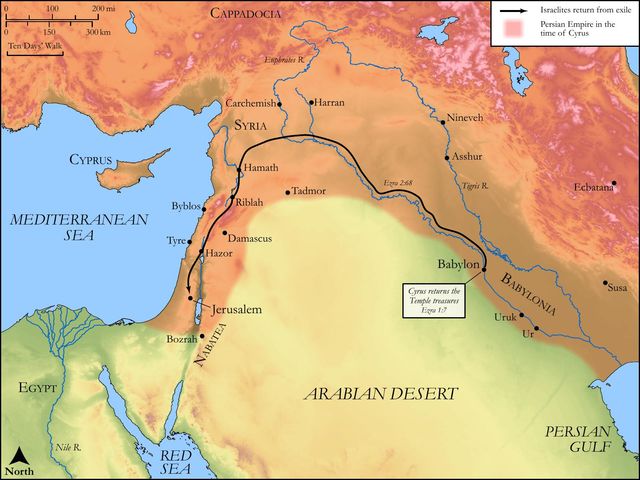
See on the biblical-era map
Study this verse
Public-domain commentary
Matthew Henry
From his Commentary on the Whole Bible. Henry comments on passages, not single verses — this entry covers Ezra 2:64–70. His two-level outline is real structure in the source text, so it is rendered as structure.
Here is, I. The sum total of the company that returned out of Babylon. The particular sums before mentioned amount not quite to 30,000 (29,818), so that there were above 12,000 that come out into any of those accounts, who, it is probable, were of the rest of the tribes of Israel, besides Judah and Benjamin, that could not tell of what particular family or city they were, but that they were Israelites, and of what tribe. Now, 1. This was more than double the number that were carried captive into Babylon by Nebuchadnezzar, so that, as in Egypt, the time of their affliction was the time of their increase. 2. These were but few to begin a nation with, and yet, by virtue of the old promise made to their fathers, they multiplied so as before their last destruction by the Romans, about 500 years after, to be a very numerous people. When God says, "Increase and multiply," a little one shall become a thousand.
II.Their retinue.
They were themselves little better than servants, and therefore no wonder that their servants were comparatively but few (Ezr 2:65) and their beasts of burden about as many, Ezr 2:66, Ezr 2:67. It was not with them now as in days past. But notice is taken of 200 singing-men and women whom they had among them, who, we will suppose, were intended (as those Ch2 35:25) to excite their mourning, for it was foretold that they should, upon this occasion, go weeping (Jer 50:4), with ditties of lamentation.
III.Their oblations. It is said (Ezr 2:68, Ezr 2:69),
1.That they came to the house of the Lord at Jerusalem; and yet that house, that holy and beautiful house, was now in ruins, a heap of rubbish. But, like their father Abraham, when the altar was gone they came with devotion to the place of the altar (Gen 13:4); and it is the character of the genuine sons of Zion that they favour even the dust thereof, Psa 102:14.
2.That they offered freely towards the setting of it up in its place. That, it seems, was the first house they talked of setting up; and though they came off a journey, and were beginning the world (two chargeable things), yet they offered, and offered freely, towards the building of the temple. Let none complain of the necessary expenses of their religion, but believe that when they come to balance the account they will find that it clears the cost. Their offering was nothing in comparison with the offerings of the princes in David's time; then they offered by talents (Ch1 29:7), now by drams, yet these drams, being after their ability, were as acceptable to God as those talents, like the widow's two mites. The 61,000 drams of gold amount, by Cumberland's calculation, to so many pounds of our money and so many groats. Every maneh, or pound of silver, he reckons to be sixty shekels (that is, thirty ounces), which we may reckon 7l. 10s. of our money, so that this 5000 pounds of silver will be above 37,000l. of our money. It seems, God had blessed them with an increase of their wealth, as well as of their numbers, in Babylon; and, as God had prospered them, they gave cheerfully to the service of his house.
3.That they dwelt in their cities, Ezr 2:70. Though their cities were out of repair, yet, because they were their cities, such as God had assigned them, they were content to dwell in them, and were thankful for liberty and property, though they had little of pomp, plenty, or power. Their poverty was a bad cause, but their unity and unanimity were a good effect of it. Here was room enough for them all and all their substance, so that there was no strife among them, but perfect harmony, a blessed presage of their settlement, as their discords in the latter times of that state were of their ruin.
Historical interpretation
Two Centuries of Reception
2 surviving comments on this verse. Each one is dated, so this reads as a timeline rather than a list.
Select a marker to jump to its quote. Markers stagger vertically where authors wrote within a few decades of each other.
“A canticle of David, when the house was built after the captivity.” So far as the literal sense is concerned, the heading points to the time when the temple at Jerusalem is known to have been refurbished by Zerubbabel, son of Salathiel, after it had been leveled to the ground by a hostile band of Chaldeans. But since he says nothing of this kind in what follows, and since the headings of psalms are never at variance with their content, it remains for us to investigate it in the spiritual sense. A destroyed house is built up when a soul following the captivity of sin begins to return to an understanding of the truth through the generosity of the Lord. This house, which is the universal church in which Christ dwells, is always raised up on living stones, because every day it gains increase in building from its confessors and does not cease to be built up until the number of the predestined is attained at the end of the world. We must store this psalm in our minds as the second of those proclaiming the first and the second coming of the Lord.
The priests and Levites, therefore, dwelt among the people, etc. The whole of Israel is mentioned, not only the ten tribes that were once called Israel, to distinguish them from the two tribes that were called Judah; but all who generally ascended from captivity, whether from Judah and Benjamin or tracing their origin from other tribes. For when the ten tribes were taken into captivity by the Assyrians and the Samaritans replaced them in their land, whoever remained broke and destroyed all idols, and with a whole heart began to serve the Lord and to offer their sacrifices in the temple, as clearly shown by the words of the Chronicles where it is written: So Josiah removed all the abominations from the land of the children of Israel and made all who were left in Israel serve the Lord their God; all his days they did not depart from following the Lord God of their fathers. And a little earlier under the same king, when the house of the Lord was being restored, it says: After the money that had been brought into the house of the Lord, which the Levites and the doorkeepers had gathered from Manasseh and Ephraim and all the remnant of Israel, from all Judah and Benjamin, and the inhabitants of Jerusalem, they delivered it into the hands of those who were over the work in the house of the Lord. Therefore, those who remained, along with the tribe of Judah and Benjamin with whom they had been joined, were taken captive to Babylon together and then released to their homeland together, and each one returned to their cities, which they found empty with the fields and small villages. For no colonist had entered these lands while they served in Babylon, just as no one entered the lands of the two tribes, as Scripture says: If anyone had escaped the sword, he was taken to Babylon and served the king and his sons until the king of Persia came to power, and the word of the Lord was fulfilled through Jeremiah, and the land enjoyed its Sabbaths. For all the days of its desolation it kept Sabbath until seventy years were completed (2 Chronicles 36). So after this very long Sabbath, the land of Judah along with the rest of Israel received back its inhabitants. However, the greater part of the ten tribes, who had been taken by the Assyrians beyond the mountains of the Medes, never returned home; even if they did return, they could not have entered their cities because the Samaritans possessed them. About these, the Jews today make many Jewish and unbelieving claims that when their Christ comes and reigns, these too will return with the rest of their nation to Judea and reign over the entire world; not understanding the words of the prophets, who promised the kingdom and riches of the city of Jerusalem, not to one carnal nation of the Jews, but to all nations in Christ spiritually, which is now happening throughout the world. These things are said on the surface level of the text. But in a spiritual sense, the priests, Levites, singers, doorkeepers, and Nethinim dwell in their cities, and all Israel in their own cities, returning from Babylon; when both the ministers of the holy altar and the teachers, and the people of God themselves, each in their respective ranks, serve God faithfully; whether those who in the same rank have once been defiled or lost through sins but are corrected through repentance; or who, coming newly from the kingdom of the devil to the Church, have acquired a good rank by serving well. For the Levites or the children of Israel entered into their cities, not only those who had once been taken captive and lost these cities, but also those who were born from the lineage of captives and learned that they belonged to those cities by paternal succession. Thus, in a spiritual sense, the Levite receives his city, from which he had been exiled by the Chaldeans when a deacon of the holy Church, having once lost the virtue of perfection seduced by the devil, is restored by the grace of the Lord. For example, one who through drunkenness, lust, or pride had become unworthy of the rank he had received, and then again through continence, frugality, humility, and other marks of a better life, returns to the same rank more worthily. Again, a Levite born in Babylon enters his city in the land of Judah when someone regenerated in Christ sheds the guilt of original sin and, newly instructed in the Church, keeps the rank of deacon which he once received with regular moderation. For as he has been freed from the bondage of Chaldea through the grace of his Redeemer, so also through the execution of good works, in which the predecessors of the same rank have lived, he ascends to the walls of his own city. But those sons of Israel who were led away captive in such a way that they never returned to their homeland but left their cities and lands for others to possess; they certainly signify those who, by sinning so leave the Church that they never return by repentance, but rather leave the promised rewards to others who are worthy of them; to whom, in fact, the Lord in the Apocalypse, urging repentance says: Remember therefore from where you have fallen, and repent and do the first works. Or else I will come to you quickly and remove your lampstand from its place, unless you repent (Apocalypse 2). And again, suggesting to another who stands firm in faith not to fall: Behold, I come quickly; hold fast what you have, that no one may take your crown (Apocalypse 3).
Continue studying Ezra 2:70 across the web’s major study libraries — every link below opens this exact verse, chapter, or book on the destination site.
Read & Compare
 BibleGatewayThis verse in more than 200 translations and 70 languages.
 Bible.comThe YouVersion reader — hundreds of translations, reading plans, and highlights.
 ESV.orgCrossway's official English Standard Version reader.
 NET BibleThe NET translation with 60,000+ translators' notes on every rendering decision.
 STEP BibleTyndale House's free study tool — original text, vocabulary, and scholarly resources.
 BibliaLogos Bible Software's free web reader.
 USCCBThe New American Bible (Revised Edition) with the U.S. bishops' study notes.
Commentaries
 BibleHub CommentariesDozens of classic commentaries on this verse, gathered on one page.
 StudyLightMore than 100 commentary sets — the largest collection on the web.
 BibleRefPlain-English commentary on what this verse means, verse by verse.
 Enduring WordDavid Guzik's free commentary on this chapter, widely used by Bible teachers.
 Bible Study ToolsVerse commentary alongside Greek and Hebrew study aids.
Original Language & Research
- BibleHub InterlinearThe verse word by word — original language, transliteration, and English.
- BibleHub LexiconEvery word's original-language definition and Strong's entry.
 Blue Letter BibleDeep-study tools — Strong's numbers, concordance, and word studies.
 SefariaThe Hebrew text with Rashi and centuries of Jewish commentary.
Sermons, Hymns & Audio


TrulyRandomVerse is not affiliated with these sites and doesn’t control their content. They’re linked because they’re genuinely useful.
Summary
Ezra 2:70 serves as the pivotal conclusion to the meticulous census of the first wave of Jewish exiles returning to Judah from Babylonian captivity. This verse marks the successful culmination of their arduous journey and the initial phase of resettlement, establishing the diverse components of the nascent community—priests, Levites, various people groups, singers, porters, and Nethinims—into their ancestral cities. It signifies not merely a physical return but a foundational re-establishment of communal life, setting the stage for the monumental task of rebuilding the Temple and restoring the spiritual and civic infrastructure of a nation.
Context
ShowHideLiterary Context
Ezra 2:70 functions as the climactic and summarizing statement of a lengthy and painstakingly detailed register of returnees, which commences in Ezra 2:1 and concludes with Ezra 2:69. This extensive list, far from being a mere dry enumeration, underscores the divine providence and meticulous organization involved in the return from exile, highlighting the specific families, numbers of individuals, and even their animals and offerings. Verse 70 seamlessly transitions the narrative from the arrival and enumeration of the people to their settlement, effectively bridging the census with the subsequent chapters that detail the rebuilding efforts, particularly the re-establishment of the altar and the laying of the Temple's foundation in Ezra 3. It signifies that the return was not merely an act of migration but a deliberate re-population and re-establishment of God's covenant people in their land, preparing them for the sacred work ahead.
Historical & Cultural Context
The historical backdrop for Ezra 2:70 is the immediate post-exilic period, specifically the early years following Cyrus the Great's momentous decree in 538 BC, which permitted the exiled Jews to return to Jerusalem and rebuild their Temple (Ezra 1:1-4). After seventy years of devastating Babylonian captivity, this return was a profound and tangible fulfillment of long-standing prophecy (e.g., Jeremiah 29:10). The returnees, under the leadership of Zerubbabel and Jeshua, faced a desolate land and a daunting task of reconstruction. Culturally, settling into their ancestral cities was a critical and symbolic step for re-establishing the social, economic, and religious fabric of Israelite life, which had been severely disrupted by the exile. The explicit mention of specific groups like priests, Levites, singers, porters, and Nethinims highlights the immediate and pressing need to restore the infrastructure for Temple worship and communal order, reflecting the deeply theocratic nature of their society where religious roles were central to national identity and function.
Key Themes
ShowHideThis verse powerfully encapsulates several key themes central to the book of Ezra and the broader post-exilic narrative. Firstly, it underscores Divine Faithfulness and Restoration, demonstrating God's unwavering commitment to His covenant promises by bringing His people back to their land after a period of judgment and displacement. Their ability to "dwell in their cities" is a tangible sign of divine provision and protection, echoing ancient promises of secure dwelling in the land (e.g., Deuteronomy 12:10). Secondly, the verse highlights the Re-establishment of Order and Community. The meticulous enumeration of diverse groups—from the priestly class to the temple servants—and their subsequent settlement in designated cities, signifies a deliberate re-formation of Israelite society. Each group, with its specific function, was essential for the impending restoration of Temple worship and the rebuilding of Jerusalem, emphasizing the importance of corporate unity and specialized roles within God's people. Finally, it serves as a theme of Preparation for Rebuilding. The act of settling was not an end in itself but a crucial prerequisite for the collective national effort to reconstruct the Temple and the city walls, tasks that would dominate the narratives of Ezra and Nehemiah, demonstrating that order, stability, and a settled population are foundational for spiritual and physical reconstruction.
Exposition and Analysis
ShowHideKey Word Analysis
ShowHideThis primitive root signifies "to sit down," and by implication, "to dwell," "to remain," or "to settle." In the context of Ezra 2:70, yâshab denotes a stable, permanent residency, contrasting sharply with the transient nature of exile and the arduous journey back. It implies not just physical occupation but the re-establishment of homes, livelihoods, and communal life. The act of "dwelling" in their cities marks a return to normalcy and security, a tangible fulfillment of prophetic promises for a people who had been uprooted and dispersed. It speaks to God's provision of rest and stability after a period of upheaval.
Derived from the verb nātan ("to give" or "to dedicate"), this term refers to a specific class of temple servants. These were likely non-Israelites, possibly descendants of the Gibeonites who were made "hewers of wood and drawers of water" for the sanctuary (Joshua 9:27). Their inclusion in the comprehensive list of returnees and their settlement in cities underscores the holistic nature of the community's restoration, ensuring all necessary functions, including the more menial yet vital tasks associated with Temple service, were accounted for. Their presence highlights the diverse composition of the post-exilic community and the structured organization required for the full resumption of worship.
This symbolic name, meaning "he will rule as God," refers primarily to Jacob and, by extension, to his posterity and the nation. In Ezra 2:70, "all Israel" signifies the collective body of God's covenant people, emphasizing their unified identity and purpose despite their diverse roles and family lineages. Its inclusion at the end of the verse broadens the scope beyond the specifically listed groups, indicating that the resettlement was not just for the religious and administrative classes, but for the entire nation, signifying a complete and unified re-establishment of the covenant community in their ancestral land.
Verse Breakdown
ShowHide"So the priests, and the Levites, and [some] of the people"
This initial clause identifies the foundational and most prominent components of the returning community. The "priests" (kôhên) and "Levites" (Lêvîyîy) represent the essential religious and cultic leadership, indispensable for the restoration of Temple worship, the sacrificial system, and instruction in the Law. "[Some] of the people" (ʻam), literally "the people" or "the common people," refers to the general populace, the lay Israelites who formed the bulk of the community, indicating a broad-based return encompassing all segments of society, not just the religious elite.
"and the singers, and the porters, and the Nethinims"
This phrase further specifies distinct groups within the broader community, particularly those with specialized, yet crucial, roles related to the Temple's operation. "Singers" (shîyr) were responsible for musical worship and praise, enhancing the spiritual atmosphere of the sanctuary. "Porters" (shôwʻêr), or gatekeepers, maintained security and order at the Temple gates and entrances. "Nethinims" (Nâthîyn) performed various support duties, from drawing water to gathering wood, ensuring the practical functioning of the sacred space. Their specific mention emphasizes the detailed and comprehensive nature of the return, ensuring that all necessary personnel for the full functioning of the sacred space were present and accounted for.
"dwelt in their cities, and all Israel in their cities"
This concluding clause summarizes the successful outcome of the census and the arduous journey. The phrase "dwelt in their cities" (yâshab bəʻārêhem) signifies the successful re-establishment of territorial and communal identity. The repetition of "in their cities" (ʻîyr), once for the specific groups and again for "all Israel," powerfully emphasizes that each group and indeed the entire collective of "all Israel" found their designated place, settling back into their ancestral lands and urban centers. This act laid the crucial groundwork for the physical and spiritual rebuilding of the nation, marking the end of their transient state and the beginning of a new, rooted existence in the Promised Land.
Literary Devices
ShowHideEzra 2:70 primarily employs Enumeration and Repetition. The verse serves as the culmination of a lengthy list, summarizing the various categories of returnees: priests, Levites, general people, singers, porters, and Nethinims. This detailed Enumeration highlights the comprehensive nature of the return, emphasizing that every essential component of Israelite society, from religious leaders to the most humble temple servants, was present and accounted for. This meticulous listing underscores the divine order and the purposeful re-establishment of the community, demonstrating God's providential care in gathering His people. The Repetition of the phrase "in their cities" (though the Hebrew uses the singular "in their city" for the collective "all Israel," the KJV renders it twice) powerfully reinforces the central theme of resettlement and the re-establishment of a stable, territorial identity. It signifies the successful end of their nomadic, exiled journey and the beginning of a new, rooted existence in the Promised Land, emphasizing security, belonging, and the tangible fulfillment of God's promise to bring them back to their heritage and provide them with a secure dwelling.
Theological and Thematic Connections
ShowHideEzra 2:70 is a profound theological statement, affirming God's unfailing faithfulness to His covenant promises. After the devastating judgment of exile, this verse marks a tangible manifestation of divine grace and restoration. The re-establishment of the community, with its diverse roles and functions, in their ancestral cities, speaks to God's commitment not only to individuals but to the corporate body of His people. It demonstrates that divine judgment is not final, but that God's ultimate purpose is redemptive, bringing His scattered flock back together and re-instituting order and worship. The meticulous detail of the census and the organized settlement underscore God's sovereignty over history and His providential care in orchestrating the return and rebuilding of His people for His glory, showcasing His meticulous attention to the details of His redemptive plan.
Reflection and Application
ShowHideEzra 2:70 offers a powerful message of hope, restoration, and the importance of finding one's designated place within the community of faith. Just as the diverse groups in Ezra found their specific cities and roles, believers today are called to recognize their unique gifts and contributions within the body of Christ. This verse reminds us that God is a God of order and restoration; even after periods of spiritual wandering, displacement, or brokenness, He is faithful to bring His people back to a place of belonging and purpose. It challenges us to embrace our specific callings—whether prominent or seemingly humble, like the Nethinims—understanding that every role is vital for the collective flourishing and mission of God's people. Our individual settlement within the church community is not an end in itself, but a crucial preparation for the greater work of building God's kingdom and participating in His redemptive plan for the world, ensuring that every member contributes to the common good and the glory of God.
Questions for Reflection
ShowHideFAQ
ShowHideWhat is the significance of listing so many different groups of people in Ezra 2, culminating in Ezra 2:70?
ShowHideThe detailed listing of various groups—priests, Levites, singers, porters, and Nethinims—in Ezra 2 and its culmination in Ezra 2:70 is profoundly significant. It serves several crucial purposes:
Christ-Centered Fulfillment
ShowHideEzra 2:70, with its emphasis on the return to ancestral cities and the re-establishment of a diverse community, finds profound Christ-centered fulfillment in the New Covenant. The physical return to Jerusalem and the rebuilding of the Temple foreshadow the spiritual restoration and new dwelling place found in Christ. While the Old Testament people returned to earthly cities, believers in Christ are brought into a spiritual city, the heavenly Jerusalem, and become citizens of God's eternal kingdom (Philippians 3:20). The diverse groups settling in their cities prefigure the unified body of Christ, where believers from "every tribe and language and people and nation" are gathered and given their place within the spiritual Temple, which is the Church itself, built on the foundation of the apostles and prophets, with Christ Jesus as the cornerstone (Ephesians 2:19-22). Just as the Nethinims served in the physical Temple, all believers are now "a chosen race, a royal priesthood, a holy nation, a people for his own possession," called to offer spiritual sacrifices and proclaim God's excellencies (1 Peter 2:9). The ultimate "dwelling" for all Israel, and indeed for all who believe, is found in Christ, who is our true rest and the one in whom all things are made new, culminating in the glorious promise that God Himself will "dwell with them, and they will be his people, and God himself will be with them as their God" in the New Heavens and New Earth (Revelation 21:3).