


Ezra 2:69
Bible text: King James Version (1769 Blayney text) · Public domain
Bible text: King James Version with Strong's numbers · Public domain
Bible text: Berean Standard Bible · Public domain
Bible text: American Standard Version (1901) · Public domain
Bible text: World English Bible, Messianic edition · Public domain
Bible text: Geneva Bible (1599) · Public domain
Bible text: Young's Literal Translation · Public domain
- כְּכֹחָםke·kho·Chamaccording to their abilityH3581Prep-k ¦ N-msc ¦ 3mpNoun Singular Masculine Constructכְּaccording toכֹחָabilityםtheir
- נָתְנוּna·te·Nuthey gaveH5414V-Qal-Perf-3cpVerb Qal Perfect 3rd Plural common gender
- לְאוֹצַרle·'o·Tzarto [the] treasury ofH214Prep-l ¦ N-mscNoun Singular Masculine Constructלְtoאוֹצַר[the] treasury of
- הַמְּלָאכָהha·me·la·Khahthe workH4399Art ¦ N-fsNoun Singular Feminine Absoluteהַtheמְּלָאכָהwork
- זָהָבza·HavgoldH2091N-msNoun Singular Masculine Absolute
- דַּרְכְּמוֹנִיםdar·ke·mo·NimdrachmasH1871N-mpNoun Plural Masculine Absolute
- שֵׁשׁsheshsixH8337Adj-cscAdjective Numerical Singular common gender Construct
- רִבֹּאותri·Botten thousandsH7239Adj-cpAdjective Numerical Plural common gender Absolute
- וָאֶלֶףva·'E·lefand one thousandH505Conj-w ¦ Adj-csAdjective Numerical Singular common gender Absoluteוָandאֶלֶףone thousand
- וְכֶסֶףve·Khe·sefand silverH3701Conj-w ¦ N-msNoun Singular Masculine Absoluteוְandכֶסֶףsilver
- מָנִיםma·NimminasH4488N-mpNoun Plural Masculine Absolute
- חֲמֵשֶׁתcha·Me·shetfiveH2568Adj-cscAdjective Numerical Singular common gender Construct
- אֲלָפִים'a·la·Fimthousand<s>H505Adj-cpAdjective Numerical Plural common gender Absolute
- וְכָתְנֹתve·kha·te·Notand tunics ofH3801Conj-w ¦ N-fpcNoun Plural Feminine Constructוְandכָתְנֹתtunics of
- כֹּהֲנִיםko·ha·NimpriestsH3548N-mpNoun Plural Masculine Absolute
- מֵאָהme·'Ahone hundredH3967Adj-fsAdjective Numerical Singular Feminine Absolute
English is a literal word-by-word gloss of the Hebrew, not the KJV's wording. Why?
This is the original text the KJV's translators worked from — each Hebrew word with its own literal English meaning in this verse, prepared by scholars at Tyndale House, Cambridge. The KJV translates whole sentences, not word by word, so its wording differs: one Hebrew word can become several English words, and the KJV may choose “the LORD” where the gloss reads “Yahweh”. Both are faithful — they answer different questions. For the KJV's own rendering, switch to the KJV text.
Details
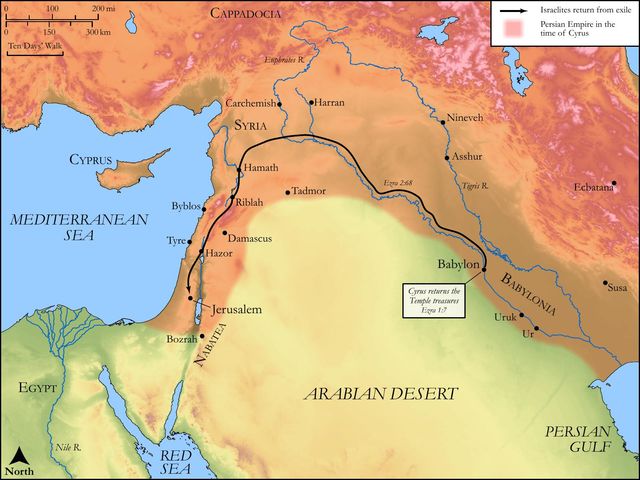
See on the biblical-era map
Study this verse
Public-domain commentary
Matthew Henry
From his Commentary on the Whole Bible. Henry comments on passages, not single verses — this entry covers Ezra 2:64–70. His two-level outline is real structure in the source text, so it is rendered as structure.
Here is, I. The sum total of the company that returned out of Babylon. The particular sums before mentioned amount not quite to 30,000 (29,818), so that there were above 12,000 that come out into any of those accounts, who, it is probable, were of the rest of the tribes of Israel, besides Judah and Benjamin, that could not tell of what particular family or city they were, but that they were Israelites, and of what tribe. Now, 1. This was more than double the number that were carried captive into Babylon by Nebuchadnezzar, so that, as in Egypt, the time of their affliction was the time of their increase. 2. These were but few to begin a nation with, and yet, by virtue of the old promise made to their fathers, they multiplied so as before their last destruction by the Romans, about 500 years after, to be a very numerous people. When God says, "Increase and multiply," a little one shall become a thousand.
II.Their retinue.
They were themselves little better than servants, and therefore no wonder that their servants were comparatively but few (Ezr 2:65) and their beasts of burden about as many, Ezr 2:66, Ezr 2:67. It was not with them now as in days past. But notice is taken of 200 singing-men and women whom they had among them, who, we will suppose, were intended (as those Ch2 35:25) to excite their mourning, for it was foretold that they should, upon this occasion, go weeping (Jer 50:4), with ditties of lamentation.
III.Their oblations. It is said (Ezr 2:68, Ezr 2:69),
1.That they came to the house of the Lord at Jerusalem; and yet that house, that holy and beautiful house, was now in ruins, a heap of rubbish. But, like their father Abraham, when the altar was gone they came with devotion to the place of the altar (Gen 13:4); and it is the character of the genuine sons of Zion that they favour even the dust thereof, Psa 102:14.
2.That they offered freely towards the setting of it up in its place. That, it seems, was the first house they talked of setting up; and though they came off a journey, and were beginning the world (two chargeable things), yet they offered, and offered freely, towards the building of the temple. Let none complain of the necessary expenses of their religion, but believe that when they come to balance the account they will find that it clears the cost. Their offering was nothing in comparison with the offerings of the princes in David's time; then they offered by talents (Ch1 29:7), now by drams, yet these drams, being after their ability, were as acceptable to God as those talents, like the widow's two mites. The 61,000 drams of gold amount, by Cumberland's calculation, to so many pounds of our money and so many groats. Every maneh, or pound of silver, he reckons to be sixty shekels (that is, thirty ounces), which we may reckon 7l. 10s. of our money, so that this 5000 pounds of silver will be above 37,000l. of our money. It seems, God had blessed them with an increase of their wealth, as well as of their numbers, in Babylon; and, as God had prospered them, they gave cheerfully to the service of his house.
3.That they dwelt in their cities, Ezr 2:70. Though their cities were out of repair, yet, because they were their cities, such as God had assigned them, they were content to dwell in them, and were thankful for liberty and property, though they had little of pomp, plenty, or power. Their poverty was a bad cause, but their unity and unanimity were a good effect of it. Here was room enough for them all and all their substance, so that there was no strife among them, but perfect harmony, a blessed presage of their settlement, as their discords in the latter times of that state were of their ruin.
Historical interpretation
Historical reception
1 surviving comment on this verse from the historical church.
“A canticle of David, when the house was built after the captivity.” So far as the literal sense is concerned, the heading points to the time when the temple at Jerusalem is known to have been refurbished by Zerubbabel, son of Salathiel, after it had been leveled to the ground by a hostile band of Chaldeans. But since he says nothing of this kind in what follows, and since the headings of psalms are never at variance with their content, it remains for us to investigate it in the spiritual sense. A destroyed house is built up when a soul following the captivity of sin begins to return to an understanding of the truth through the generosity of the Lord. This house, which is the universal church in which Christ dwells, is always raised up on living stones, because every day it gains increase in building from its confessors and does not cease to be built up until the number of the predestined is attained at the end of the world. We must store this psalm in our minds as the second of those proclaiming the first and the second coming of the Lord.
Continue studying Ezra 2:69 across the web’s major study libraries — every link below opens this exact verse, chapter, or book on the destination site.
Read & Compare
 BibleGatewayThis verse in more than 200 translations and 70 languages.
 Bible.comThe YouVersion reader — hundreds of translations, reading plans, and highlights.
 ESV.orgCrossway's official English Standard Version reader.
 NET BibleThe NET translation with 60,000+ translators' notes on every rendering decision.
 STEP BibleTyndale House's free study tool — original text, vocabulary, and scholarly resources.
 BibliaLogos Bible Software's free web reader.
 USCCBThe New American Bible (Revised Edition) with the U.S. bishops' study notes.
Commentaries
 BibleHub CommentariesDozens of classic commentaries on this verse, gathered on one page.
 StudyLightMore than 100 commentary sets — the largest collection on the web.
 BibleRefPlain-English commentary on what this verse means, verse by verse.
 Enduring WordDavid Guzik's free commentary on this chapter, widely used by Bible teachers.
 Bible Study ToolsVerse commentary alongside Greek and Hebrew study aids.
Original Language & Research
- BibleHub InterlinearThe verse word by word — original language, transliteration, and English.
- BibleHub LexiconEvery word's original-language definition and Strong's entry.
 Blue Letter BibleDeep-study tools — Strong's numbers, concordance, and word studies.
 SefariaThe Hebrew text with Rashi and centuries of Jewish commentary.
Sermons, Hymns & Audio


TrulyRandomVerse is not affiliated with these sites and doesn’t control their content. They’re linked because they’re genuinely useful.
Summary
Ezra 2:69 provides a tangible and remarkable account of the immense generosity and unwavering commitment demonstrated by the Jewish exiles who had just returned to Jerusalem from their Babylonian captivity. This verse meticulously details the substantial material contributions—specifically, vast quantities of gold, silver, and essential priestly garments—that the community collectively offered towards the monumental and sacred task of rebuilding the Lord's house, the Temple, in Jerusalem. It underscores their profound dedication to restoring their spiritual center and covenant relationship with God immediately upon their return.
Context
ShowHideLiterary Context
Ezra 2:69 serves as the climactic conclusion to a lengthy and meticulously detailed register in Ezra 2, which enumerates the families, numbers, and leaders of the Jewish exiles who returned from Babylon under the leadership of Zerubbabel and Jeshua. Following this comprehensive census (Ezra 2:1-67), verses 68-69 pivot from the identification of the returnees to their immediate and collective action upon arriving in Jerusalem. Verse 68 notes that "some of the chief of the fathers, when they came to the house of the LORD which is at Jerusalem, offered freely for the house of God to set it up in his place." Verse 69 then provides the specific, impressive details of these offerings, transitioning the narrative from the who of the return to the what and how of their initial, spontaneous act of worship and dedication. This act of sacrificial giving sets the stage for the subsequent efforts to lay the foundation of the Temple in Ezra 3 and its eventual completion, as described in later chapters of Ezra and the prophetic books of Haggai and Zechariah.
Historical & Cultural Context
The return described in Ezra occurred in the first year of Cyrus, King of Persia (538 BC), following the seventy-year Babylonian captivity, as prophesied by Jeremiah (Jeremiah 29:10). The Jewish exiles were returning to a devastated Jerusalem, with the First Temple, built by Solomon, having been destroyed by Nebuchadnezzar in 586 BC. Their return was sanctioned by a decree from Cyrus, which not only permitted their return but also encouraged the rebuilding of the Temple and even returned sacred vessels that had been plundered (Ezra 1:1-11). The financial contributions mentioned in Ezra 2:69 reflect the economic realities of the Achaemenid Persian Empire, which had established a standardized currency. The "dram" (daric) was a widely recognized Persian gold coin, and the "pound" (mina) was a common unit of weight for silver. The act of giving was not merely a financial transaction but a profound religious and national statement, signifying their commitment to re-establishing their identity as God's covenant people through the restoration of their central place of worship.
Key Themes
ShowHideThis verse powerfully contributes to several overarching themes within the book of Ezra and the broader post-exilic narrative. Firstly, it highlights Generosity and Sacrifice, demonstrating that the people "gave after their ability," emphasizing voluntary and proportionate giving despite the economic challenges inherent in resettling a ruined homeland. This profound dedication to God's work, even in hardship, underscores their faith. Secondly, it exemplifies Corporate Effort and Unity. The rebuilding of the Temple was an endeavor that transcended individual families, requiring the collective contributions of gold, silver, and practical items like priestly garments. This unity of purpose was essential for the daunting task ahead, reflecting the communal nature of their covenant relationship with God. Thirdly, it reveals the Priority of Worship. The immediate and substantial nature of these offerings for the Temple treasury, even before significant resettlement, clearly indicates that re-establishing proper worship and restoring the physical dwelling place of God among them was their foremost concern. For the returning exiles, the Temple was not merely a building but the very heart of their faith, their national identity, and the visible sign of God's presence among His people, echoing the importance of the tabernacle in the wilderness (Exodus 35:4-9).
Exposition and Analysis
ShowHideKey Word Analysis
ShowHideDrams (Persian, darkᵉmôwn', H1871): This term refers to the Persian gold coin known as the "daric." The Strong's definition notes its Persian origin, identifying it as a 'drachma' or coin. "Threescore and one thousand drams" (61,000 darics) represents an enormous sum of gold, indicative of both the collective wealth among the returnees and the extraordinary scale of their dedication. This substantial amount underscores the profound commitment of the people to the Temple's reconstruction, reflecting a deep spiritual priority over personal comfort or immediate material needs.
Pound (Hebrew, mâneh', H4488): This refers to the "mina," a unit of weight, particularly for silver. The Strong's definition describes it as "a fixed weight or measured amount, i.e. (techn.) a maneh or mina." "Five thousand pound of silver" (5,000 minas) also signifies a very substantial quantity of silver, further illustrating the immense magnitude of the collective offering. The inclusion of both gold and silver highlights the comprehensive nature of the contributions, drawing from various levels of wealth and resources within the community.
Garments (Hebrew, kᵉthôneth', H3801): The Strong's definition for kᵉthôneth is "a shirt; coat, garment, robe." The mention of "one hundred priests' garments" (combining kᵉthôneth with kôhên for priest) is highly significant. These were not merely general clothes but specific vestments required for the Levitical priests to perform their duties in the Temple. Their inclusion indicates a practical foresight and a clear intention to immediately restore the prescribed rituals and worship services. It underscores the understanding that the Temple was not just a structure but a functional center for proper worship, requiring the right personnel equipped with the necessary attire.
Verse Breakdown
ShowHide"They gave after their ability"
This phrase emphasizes the voluntary and proportionate nature of the giving. It suggests that contributions were made according to what each individual or family possessed, not under compulsion or a fixed quota. This principle of giving from one's means highlights a spirit of willing sacrifice and devotion, indicating that the offerings were a genuine expression of faith and commitment to God's work, rather than a burdensome obligation.
"unto the treasure of the work"
This specifies the destination and purpose of the offerings. The "treasure" refers to the Temple treasury, and "the work" explicitly denotes the rebuilding of the house of God. This clarifies that the vast sums were not for personal gain or general community needs, but specifically earmarked for the sacred task of reconstructing the Temple, demonstrating the people's singular focus on restoring their spiritual center.
"threescore and one thousand drams of gold"
This quantifies the gold contribution as 61,000 Persian darics. This staggering amount of gold represents an extraordinary collective wealth and a profound level of generosity. It signifies the high value placed on the Temple's restoration and the deep desire of the returnees to provide ample resources for its construction.
"and five thousand pound of silver"
This quantifies the silver contribution as 5,000 minas. Like the gold, this is a very substantial sum, indicating a broad base of contributions from various economic levels within the community. The combined value of gold and silver underscores the immense material investment made by the people towards the sacred project.
"and one hundred priests' garments"
This specific item highlights the practical and spiritual needs for resuming Temple service. These garments were essential for the priests to perform their duties according to Mosaic Law. Their inclusion signifies a comprehensive understanding of what was required for the full restoration of Temple worship, not just the physical structure, but also the proper functioning of its sacred rituals and personnel.
Literary Devices
ShowHideEzra 2:69 primarily employs Enumeration and Symbolism. The detailed listing of specific quantities of gold (61,000 drams), silver (5,000 pounds), and priestly garments (100) serves as a powerful form of Enumeration, providing concrete evidence of the immense scale of the people's collective generosity. This precise accounting lends credibility and gravity to the narrative, emphasizing the tangible commitment of the returnees. Furthermore, the offerings themselves are rich in Symbolism. Gold and silver, historically precious metals, symbolize the highest value and dedication offered to God, reflecting the people's understanding that only the best was fitting for His house. The "priests' garments" are highly Symbolic of the restoration of proper worship and the re-establishment of the Levitical priesthood, signifying a return to covenant faithfulness and the resumption of the divinely ordained sacrificial system. This detailed enumeration of valuable and symbolic items underscores the depth of the community's piety and their unified resolve to rebuild not just a structure, but their spiritual identity.
Theological and Thematic Connections
ShowHideEzra 2:69 stands as a profound testament to the principle of sacrificial giving and corporate dedication to God's purposes, echoing timeless biblical themes. It illustrates that true devotion often manifests in tangible acts of generosity, where individuals contribute "after their ability" to advance God's kingdom, prioritizing His work above personal comfort or material accumulation. This collective outpouring of resources for the Temple's rebuilding demonstrates a deep understanding of God's centrality in their national and spiritual life, recognizing that the restoration of His dwelling place was paramount to their identity as a covenant people. It highlights the divine principle that significant spiritual undertakings are often accomplished through the unified, willing participation of God's people, reflecting their shared faith and common vision. This act of giving is not merely financial but an expression of profound trust in God's provision and a commitment to His covenant.
Reflection and Application
ShowHideThe profound generosity exhibited by the returning exiles in Ezra 2:69 offers a powerful and enduring model for believers today. Despite having just returned to a desolate homeland and facing immense challenges of resettlement, their immediate and substantial contributions for the Temple underscore a clear prioritization of God's work. They understood that investing in the spiritual infrastructure—the place of worship and divine encounter—was not merely an expense but a vital act of faith and an essential step in re-establishing their covenant relationship with God. For contemporary disciples, this verse challenges us to examine our own priorities and stewardship. It calls us to contribute generously, "after our ability," to ministries, churches, and missions that advance God's kingdom, recognizing that our resources are ultimately His. This giving encompasses not only financial support but also the willing dedication of our time, talents, and energy. Furthermore, it reminds us that significant spiritual endeavors are often achieved through the collective, unified effort of God's people, fostering a spirit of communal responsibility and shared purpose in building up the body of Christ and extending His influence in the world.
Questions for Reflection
ShowHideFAQ
ShowHideHow significant were the amounts of gold and silver mentioned in Ezra 2:69 in ancient terms?
ShowHideThe amounts mentioned—61,000 drams of gold and 5,000 pounds of silver—were extraordinarily significant. A "dram" (daric) was a Persian gold coin weighing about 8.4 grams. This means 61,000 darics amounted to over 500 kilograms (or half a metric ton) of pure gold. A "pound" (mina) of silver was roughly 500 grams, so 5,000 minas equaled about 2,500 kilograms (2.5 metric tons) of silver. To put this in perspective, these were vast sums, representing immense wealth. This collective contribution would have been a staggering amount for a group of people who had just returned from exile to a desolate land. It speaks volumes about their deep commitment, faith, and the value they placed on the restoration of God's house, demonstrating a level of sacrifice that was truly remarkable for their circumstances, akin to the generous offerings for the tabernacle in Exodus 36:3-7.
Why were "priests' garments" specifically included in the offerings, alongside gold and silver?
ShowHideThe inclusion of one hundred priests' garments alongside precious metals highlights the practical and spiritual foresight of the returning exiles. These were not just general clothes but specific, consecrated vestments required for the Levitical priests to perform their duties in the Temple according to the detailed instructions given in the Mosaic Law (Exodus 28). Their presence in the offerings signifies that the community understood that rebuilding the Temple was not merely about constructing a physical edifice; it was about fully restoring the prescribed system of worship, sacrifices, and priestly service. These garments were essential for the proper functioning of the Temple and the re-establishment of their covenant relationship with God through organized, ritual worship, ensuring that the spiritual life of the nation could resume immediately and correctly.
Christ-Centered Fulfillment
ShowHideEzra 2:69, with its depiction of a people's sacrificial giving for the rebuilding of God's physical dwelling place, finds its profound Christ-centered fulfillment in the New Testament. The immense value of the gold and silver offered for the earthly temple foreshadows the infinitely greater value of the sacrifice of Jesus Christ, who is the ultimate and perfect offering for the sins of humanity (Hebrews 9:11-14). Just as the physical temple was to be the place of God's presence among His people, Christ Himself is the true Temple, the very embodiment of God dwelling among us (John 1:14 and John 2:19-21). The offerings for the Temple in Ezra were meant to facilitate worship and atonement, but these were only shadows pointing to the reality found in Christ, who, through His single, perfect sacrifice, has provided eternal redemption and direct access to God for all who believe (Hebrews 10:1-14). Furthermore, the "priests' garments" for the Levitical priesthood point to Christ as our Great High Priest, who mediates a superior covenant (Hebrews 4:14-16 and Hebrews 8:6). Ultimately, the physical Temple, rebuilt by the exiles' generous gifts, gives way to the spiritual Temple, the Church, which is the body of Christ, built by the Holy Spirit and composed of believers who are living stones (1 Peter 2:4-5 and Ephesians 2:19-22). Our "giving after our ability" now transforms from material contributions for a physical structure to offering our very lives as living sacrifices in worship and service to the One who gave Himself for us (Romans 12:1-2).