


Ezra 8:25
Bible text: King James Version (1769 Blayney text) · Public domain
Bible text: King James Version with Strong's numbers · Public domain
Bible text: Berean Standard Bible · Public domain
Bible text: American Standard Version (1901) · Public domain
Bible text: World English Bible, Messianic edition · Public domain
Bible text: Geneva Bible (1599) · Public domain
Bible text: Young's Literal Translation · Public domain
- וָאֶשְׁקֳלָהva·'esh·ko·lahand I weighed out !H8254Conj-w ¦ V-Qal-ConsecImperf-1cs ¦ SfxVerb Qal Consecutive Imperfect 1st Singular common genderוָandאֶשְׁקֳלָI weighed outה!
- לָהֶםla·Hemto themPrep-l ¦ 3mpSuffix Personal 3rd Plural Masculineלָtoהֶםthem
- אֶת'et<obj.>H853DirObjMParticle Object Indicator
- הַכֶּסֶףha·Ke·sefthe silverH3701Art ¦ N-msNoun Singular Masculine Absoluteהַtheכֶּסֶףsilver
- וְאֶתve·'Etand <obj.>H853Conj-w ¦ DirObjMParticle Object Indicatorוְandאֶת<obj.>
- הַזָּהָבha·za·Havthe goldH2091Art ¦ N-msNoun Singular Masculine Absoluteהַtheזָּהָבgold
- וְאֶתve·'Etand <obj.>H853Conj-w ¦ DirObjMParticle Object Indicatorוְandאֶת<obj.>
- הַכֵּלִיםha·ke·Limthe vesselsH3627Art ¦ N-mpNoun Plural Masculine Absoluteהַtheכֵּלִיםvessels
- תְּרוּמַתte·ru·Mat[the] contribution ofH8641N-fscNoun Singular Feminine Construct
- בֵּיתbeit[the] house ofH1004N-mscNoun Singular Masculine Construct
- אֱלֹהֵינוּ'e·lo·Hei·nuour GodH430N-mpc ¦ 1cpNoun Plural Masculine ConstructאֱלֹהֵיGodנוּour
- הַהֵרִימוּha·he·Ri·muwhich they had offeredH7311Art ¦ V-Hiphil-Perf-3cpVerb Hiphil Perfect 3rd Plural common genderהַwhichהֵרִימוּthey had offered
- הַמֶּלֶךְha·Me·lekhthe kingH4428Art ¦ N-msNoun Singular Masculine Absoluteהַtheמֶּלֶךְking
- וְיֹעֲצָיוve·yo·'a·Tzavand his counselorsH3289Conj-w ¦ V-Qal-Prtcpl-mp ¦ 3msVerb Qal Participle Plural Masculine Constructוְandיֹעֲצָיcounselorsוhis
- וְשָׂרָיוve·sa·Ravand his officialsH8269Conj-w ¦ N-mpc ¦ 3msNoun Plural Masculine Constructוְandשָׂרָיofficialsוhis
- וְכָלve·kholand allH3605Conj-w ¦ N-mscNoun Singular Masculine Constructוְandכָלall
- יִשְׂרָאֵלYis·ra·'ElIsraelH3478N-properNoun Proper Location
- הַנִּמְצָאִיםha·nim·tza·'Imwho were foundH4672Art ¦ V-Niphal-Prtcpl-mpVerb Niphal Participle Plural Masculine Absoluteהַwhoנִּמְצָאִיםwere found
English is a literal word-by-word gloss of the Hebrew, not the KJV's wording. Why?
This is the original text the KJV's translators worked from — each Hebrew word with its own literal English meaning in this verse, prepared by scholars at Tyndale House, Cambridge. The KJV translates whole sentences, not word by word, so its wording differs: one Hebrew word can become several English words, and the KJV may choose “the LORD” where the gloss reads “Yahweh”. Both are faithful — they answer different questions. For the KJV's own rendering, switch to the KJV text.
Details
See on the biblical-era map
Study this verse
Public-domain commentary
Matthew Henry
From his Commentary on the Whole Bible. Henry comments on passages, not single verses — this entry covers Ezra 8:24–30.
We have here an account of the particular care which Ezra took of the treasure he had with him, that belonged to God's sanctuary, Observe, 1. Having committed the keeping of it to God, he committed the keeping of it to proper men, whose business it was to watch it, though without God they would have waked in vain. Note, Our prayers must always be seconded with our endeavours; the care of Christ's gospel, his church, and ordinances, must not be so left with him but that it must also be committed to faithful men, Ti2 2:2. 2. Having prayed to God to preserve all the substance they had with them, he shows himself especially solicitous for that part of it which belonged to the house of God and was an offering to him. Do we expect that God should, by his providence, keep that which belongs to us? Let us, by his grace, keep that which belongs to him. Let God's honour and interest be our care; and then we may expect that our lives and comforts will be his. Observe, (1.) The persons to whom he delivered the offerings of the house of God. Twelve chief priests, and as many Levites, he appointed to this trust (Ezr 8:24, Ezr 8:30), who were bound by their office to take care of the things of God, and were in a particular manner to have the benefit of these sacred treasures. Ezra tells them why he put those things into their hands (Ezr 8:28): You are holy unto the Lord, the vessels are holy also; and who so fit to take care of holy things as holy persons? Those that have the dignity and honour of the priesthood must take along with them the trust and duty of it. The prophet is foretelling the return of God's people and ministers out of Babylon, when he gives the solemn charge (Isa 52:11), Be you clean that bear the vessels of the Lord. (2.) The great exactness with which he lodged this trust in their hands: He weighed to them the silver, the gold, and the vessels (Ezr 8:25), because he expected to have it from them again by weight. In all trust, but especially sacred ones, we ought to be punctual, and preserve a right understanding on both sides. In Zerubbabel's time the vessels were delivered by number, here by weight, that all might be forth-coming and it might easily appear if any were missing, to intimate that such as are entrusted with holy things (as all the stewards of the mysteries of God are) are concerned to remember, both in receiving their trust and in discharging it, that they must shortly give a very particular account of it, that they may be faithful to it and so give up their account with joy. (3.) The charge he have them with these treasures (Ezr 8:29): "Watch you, and keep them, that they be not lost, nor embezzled, nor mingled with the other articles. Keep them together; keep them by themselves; keep them safely, till you weigh them in the temple, before the great men there," hereby intimating how much it was their concern to be careful and faithful and how much it would be their honour to be found so. Thus when Paul charges Timothy with the gospel treasure he bids him keep it until the appearing of Jesus Christ, and his appearing before him to give account of his trust, when his fidelity would be his crown.
Continue studying Ezra 8:25 across the web’s major study libraries — every link below opens this exact verse, chapter, or book on the destination site.
Read & Compare
 BibleGatewayThis verse in more than 200 translations and 70 languages.
 Bible.comThe YouVersion reader — hundreds of translations, reading plans, and highlights.
 ESV.orgCrossway's official English Standard Version reader.
 NET BibleThe NET translation with 60,000+ translators' notes on every rendering decision.
 STEP BibleTyndale House's free study tool — original text, vocabulary, and scholarly resources.
 BibliaLogos Bible Software's free web reader.
 USCCBThe New American Bible (Revised Edition) with the U.S. bishops' study notes.
Commentaries
 BibleHub CommentariesDozens of classic commentaries on this verse, gathered on one page.
 StudyLightMore than 100 commentary sets — the largest collection on the web.
 BibleRefPlain-English commentary on what this verse means, verse by verse.
 Enduring WordDavid Guzik's free commentary on this chapter, widely used by Bible teachers.
 Bible Study ToolsVerse commentary alongside Greek and Hebrew study aids.
Original Language & Research
- BibleHub InterlinearThe verse word by word — original language, transliteration, and English.
- BibleHub LexiconEvery word's original-language definition and Strong's entry.
 Blue Letter BibleDeep-study tools — Strong's numbers, concordance, and word studies.
 SefariaThe Hebrew text with Rashi and centuries of Jewish commentary.
Sermons, Hymns & Audio


TrulyRandomVerse is not affiliated with these sites and doesn’t control their content. They’re linked because they’re genuinely useful.
Summary
Ezra 8:25 meticulously records Ezra's public act of weighing and entrusting a substantial collection of silver, gold, and sacred vessels to a designated group of twelve chief priests and Levites. These valuable items represented a significant offering consecrated for the house of God in Jerusalem, contributed by King Artaxerxes, his advisors, his nobles, and all the Israelites who were present in Babylon. This precise and transparent transfer underscored the immense value and sacred nature of the Temple treasures, the inherent perils of their journey, and Ezra's unwavering commitment to integrity and accountability in the stewardship of divine resources.
Context
ShowHideLiterary Context
Ezra 8 is a pivotal chapter within the book of Ezra, detailing the second major return of Jewish exiles from Babylon to Jerusalem, occurring approximately 80 years after the initial return under Zerubbabel. This chapter serves as a crucial bridge between Ezra's divinely ordained commission and the authority granted to him by King Artaxerxes in Ezra 7, and the subsequent spiritual and reforms he initiates upon his arrival in Jerusalem. The narrative in Ezra 8 emphasizes the meticulous preparation for the perilous journey, the spiritual dedication of the returning exiles, and the profound experience of divine protection. Verse 25, specifically, is embedded within the account of Ezra's careful organization and public entrustment of the Temple treasures before the arduous journey, highlighting the profound seriousness and reverence with which these sacred resources were handled. It sets the stage for the safe arrival and subsequent delivery of these items, as meticulously recorded later in Ezra 8:33-34.
Historical & Cultural Context
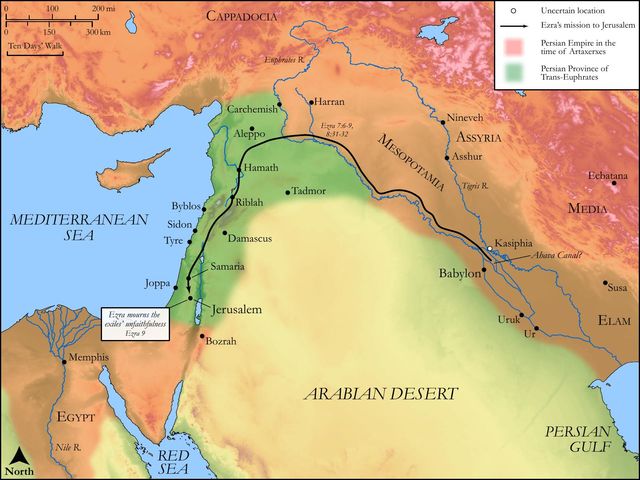
The events of Ezra 8:25 unfold during the zenith of the Persian Empire's rule, specifically in the seventh regnal year of King Artaxerxes I (c. 458 BC). The Jewish exiles, having endured several decades of dispersion in Babylon, were now afforded an unprecedented opportunity by a foreign monarch to return to their ancestral homeland and rebuild the Temple, which had been desecrated and destroyed. This journey was not merely a physical relocation but a sacred pilgrimage, fraught with significant dangers from opportunistic bandits and potentially hostile populations along the approximately 900-mile route from Babylon to Jerusalem. In that day, the public weighing of precious metals was a standard, indispensable practice for verifying value, ensuring authenticity, and establishing accountability, especially for large sums or highly valuable goods. This act was often performed in the presence of multiple witnesses to prevent any accusations of theft, fraud, or mismanagement. The extraordinary contributions from the Persian king and his court were remarkable, reflecting either a genuine respect for the God of Israel or a shrewd political strategy to maintain stability in a distant province, but in either case, demonstrably showcasing God's sovereign hand at work through unexpected channels, a theme also powerfully articulated in Isaiah 45:1-3.
Key Themes
ShowHideEzra 8:25 powerfully illustrates several foundational themes central to the book of Ezra and broader biblical theology. First, it underscores the theme of accountability and meticulous stewardship. Ezra's precise weighing and public entrustment of the offerings demonstrate a profound, unwavering commitment to transparency and integrity in handling resources consecrated to God. This meticulousness serves as an enduring model for all who are entrusted with sacred responsibilities, emphasizing that divine resources demand exceptional care. Second, the verse highlights the theme of divine provision and unexpected generosity. The substantial contributions from a pagan king, his high-ranking officials, and the Jewish exiles themselves powerfully showcase God's sovereign ability to move the hearts of diverse individuals—even those outside the covenant—to provide abundantly for His people's needs, particularly for the restoration of His worship. This echoes earlier acts of generous giving for the construction of the tabernacle and the first Temple, as vividly described in Exodus 35:20-29. Finally, the verse subtly reinforces the overarching theme of restoration and the re-establishment of proper worship. The very purpose of these treasures was to furnish, support, and sanctify the Temple, indicating a renewed focus on proper worship and faithful adherence to God's law after the period of exile, a core concern woven throughout the post-exilic books of Ezra and Nehemiah.
Exposition and Analysis
ShowHideKey Word Analysis
ShowHideThis verb (H8254) signifies a precise and deliberate act of measurement using scales, implying a thorough, exact, and verifiable accounting of the items. In the economies of that day, weighing was the equivalent of counting or auditing, essential for confirming value. Its use here emphasizes Ezra's commitment to transparency and meticulous stewardship, ensuring that the full value of the offering was acknowledged, recorded, and protected. This term is frequently employed in contexts of financial transactions or assessments, underscoring the high value and sacred trust placed upon these offerings.
This term (H8641), often translated as "heave offering" or "contribution," specifically refers to a sacred gift or portion lifted up and set apart from the common for God or for the support of the sanctuary and its personnel. It denotes something consecrated for a holy purpose. The use of tᵉrûwmâh here elevates the silver, gold, and vessels beyond mere material wealth; they are consecrated gifts dedicated to the "house of our God," underscoring their sacred purpose and the profound reverence with which they must be handled.
This general term (H3627) can refer to any kind of implement, article, or utensil. In the specific context of the Temple, it denotes the sacred implements and furnishings used in worship, sacrifice, and the daily functions of the sanctuary (e.g., bowls, basins, lamps, censers, altar tools). These vessels were not merely decorative items; they were integral to the Temple's function and symbolic of its sacred operations. Their return and restoration were crucial for the re-establishment of proper Temple service, as many had been plundered and carried off by Nebuchadnezzar during the Babylonian exile (Daniel 5:2-3).
Verse Breakdown
ShowHide"And weighed unto them the silver, and the gold, and the vessels"
This opening clause immediately establishes Ezra's proactive, deliberate, and precise action. He is not merely handing over the items but conducting a formal, measured transfer, emphasizing his commitment to accountability. The enumeration of "silver," "gold," and "vessels" highlights the sheer quantity, variety, and immense material wealth being entrusted, signaling the significant resources dedicated to the Temple's restoration. This public act of weighing served as a tangible demonstration of accountability, setting a rigorous standard for the Levites and priests who would receive and transport these treasures.
"[even] the offering of the house of our God"
This crucial phrase clarifies the sacred nature and ultimate destination of the treasures. They were not personal gifts or secular assets, but tᵉrûwmâh—a consecrated offering specifically designated for the Temple in Jerusalem. This designation underscores the profound spiritual significance of the wealth and the reverence required in its handling. It was a contribution intended to facilitate and support the worship and service of the Lord, emphasizing their holy purpose.
"which the king, and his counsellors, and his lords, and all Israel [there] present, had offered"
This final clause identifies the diverse and remarkably broad sources of the generous offering. The inclusion of "the king, and his counsellors, and his lords" is truly remarkable, demonstrating God's sovereign ability to move the hearts of pagan rulers and their highest officials to contribute substantially to His work. This extraordinary Gentile contribution, alongside that of "all Israel there present" (referring to the Jewish exiles still residing in Babylon who chose not to return but supported the mission), signifies a broad and significant outpouring of resources. It highlights both the divine favor upon Ezra's mission and the collective devotion towards the restoration and beautification of God's house.
Literary Devices
ShowHideEzra 8:25 employs several literary devices to convey its profound message and underscore the significance of the event. Emphasis is achieved through the meticulous enumeration of the contributors ("the king, and his counsellors, and his lords, and all Israel"), underscoring the extraordinary breadth and significance of the offering. This detailed listing serves to highlight the unprecedented nature of the provision and God's expansive influence. There is also a subtle but powerful use of Metonymy, where "the silver, and the gold, and the vessels" stand for the broader range of resources and provisions necessary for the full functioning, beautification, and sacred operations of the Temple. These items are not merely material wealth but represent the tangible means for restoring proper worship and the manifest presence of God among His people. Finally, the detailed account of weighing and entrusting the treasures can be seen as a form of Foreshadowing, subtly hinting at the paramount importance of accountability, integrity, and meticulous stewardship that will be a recurring and central theme throughout Ezra's leadership and in the subsequent spiritual and reforms he undertakes in Jerusalem.
Theological and Thematic Connections
ShowHideEzra 8:25 offers profound theological insights into God's character and the timeless principles of faithful stewardship. The meticulous weighing of the offerings reflects God's own character of divine order, precision, and unwavering accountability. He is a God who cares deeply about details, especially when it comes to resources dedicated to His name and purposes. This verse teaches us that integrity is not merely advisable but paramount in handling anything entrusted to us, particularly that which belongs to God or is designated for His sacred purposes. Ezra's actions set an exceptionally high standard for leaders and all believers, demonstrating that transparency, meticulousness, and careful management are not optional but essential components of faithful service. Furthermore, the diverse sources of the offering—ranging from a pagan king and his court to the returning exiles—underscore God's sovereign ability to provide for His people through unexpected means and to stir hearts, even those outside the covenant, for the advancement of His kingdom. This highlights the universal scope of God's providence and His omnipotent power to orchestrate events for His ultimate glory.
Reflection and Application
ShowHideEzra 8:25 serves as a timeless paradigm for integrity, accountability, and faithful stewardship in the life of every believer. While the immediate context is the handling of significant material wealth for the Temple, the underlying principles extend far beyond financial resources. We are all called to be diligent stewards of God's manifold grace—our precious time, unique talents, spiritual gifts, interpersonal relationships, and even the very breath we breathe. Just as Ezra meticulously weighed and entrusted the physical treasures, we are similarly called to manage all that God has graciously given us with diligence, transparency, and a profound sense of responsibility. This means using our gifts not for personal gain or self-glory, but primarily for the building up of the body of Christ and the advancement of His eternal kingdom. Our integrity in the small, seemingly insignificant things reflects our faithfulness in the larger, more significant ones, and our unwavering commitment to accountability demonstrates our deep reverence for the God who has entrusted us with so much. The extraordinary generosity of both the king and the Israelites also challenges us to prayerfully consider our own giving—not just financially, but in every area of our lives—as a joyful, sacrificial response to God's abundant provision and a tangible expression of our devoted love and worship.
Questions for Reflection
ShowHideFAQ
ShowHideWhy was Ezra so meticulous in weighing the treasures?
ShowHideEzra's meticulousness in weighing the silver, gold, and vessels was driven by several critical factors, all rooted in integrity and responsibility. First, it ensured accountability and transparency. In an era before standardized banking and detailed receipts, public weighing was the primary method of verifying the exact quantity and value of precious metals. This rigorous process prevented any accusations of theft or mismanagement, thereby protecting Ezra's reputation and the integrity of the entire mission. Second, the treasures were of immense material value and sacred significance, having been designated for the "house of our God." Their intrinsic worth and holy purpose demanded the utmost care and precision in their handling. Third, the journey from Babylon to Jerusalem was perilous, fraught with the significant risk of attacks from bandits and hostile groups. Knowing the exact amount entrusted to the priests and Levites provided a clear baseline for verifying that everything arrived safely in Jerusalem, as meticulously detailed in Ezra 8:33-34. Finally, it underscored Ezra's profound commitment to divine command and personal integrity, setting an exemplary standard for all who would handle sacred resources.
What is the significance of the "king, counsellors, and lords" contributing to the Temple?
ShowHideThe contribution from King Artaxerxes, his counsellors, and his lords is highly significant as it powerfully demonstrates God's sovereign power to work through unexpected channels, even through pagan rulers, to accomplish His divine purposes. This highlights divine providence—God's active and purposeful involvement in human affairs, moving the hearts of those in positions of authority to bless His people and facilitate the rebuilding of His Temple. It echoes similar instances throughout biblical history where Gentile rulers, such as King Cyrus of Persia (Ezra 1:1-4), were divinely used by God to restore and protect Israel. This also underscores the universal scope of God's dominion, showing that even the most powerful kings of vast empires are ultimately subject to His will and can be instruments in His hands. Furthermore, their extraordinary generosity provided substantial material support, which was absolutely crucial for the Temple's restoration and the re-establishment of proper worship in Jerusalem, indicating a remarkable level of favor extended to the Jewish exiles.
Christ-Centered Fulfillment
ShowHideEzra's meticulous stewardship of the Temple treasures in Ezra 8:25 finds its ultimate fulfillment and deepest theological meaning in the person and work of Jesus Christ. Just as Ezra was entrusted with precious physical offerings for the earthly Temple, Christ was perfectly entrusted by the Father with the ultimate spiritual "treasures"—the souls of humanity and the flawless execution of God's redemptive plan. Jesus perfectly fulfilled the role of the faithful steward, declaring, "I have glorified You on the earth, having accomplished the work which You have given Me to do". He was the ultimate and perfect "offering" for the house of God, not in perishable silver or gold, but in His own spotless body and precious blood, offered once for all on the cross to atone for sin, thereby making us a holy dwelling for God (Hebrews 10:10). The "vessels" of the old covenant Temple find their spiritual counterpart in believers, who are now the living "temples of the Holy Spirit" (1 Corinthians 6:19-20), entrusted with the invaluable treasure of the Gospel and spiritual gifts for the building up of the church. Christ's perfect stewardship calls us to emulate His integrity and faithfulness in handling the spiritual and material resources He has entrusted to us, recognizing that we are now His ambassadors, carrying the glorious "ministry of reconciliation" (2 Corinthians 5:18-20) to a lost and broken world.