


Ezra 8:24
Bible text: King James Version (1769 Blayney text) · Public domain
Bible text: Berean Standard Bible · Public domain
Bible text: American Standard Version (1901) · Public domain
Bible text: World English Bible, Messianic edition · Public domain
Bible text: Geneva Bible (1599) · Public domain
Bible text: Young's Literal Translation · Public domain
- וָאַבְדִּילָהva·'av·Di·lahand I set apart !H914Conj-w ¦ V-Hiphil-ConsecImperf-1cs ¦ SfxVerb Hiphil Consecutive Imperfect 1st Singular common genderוָandאַבְדִּילָI set apartה!
- מִשָּׂרֵיmi·sa·Reiof [the] leaders ofH8269Prep-m ¦ N-mpcNoun Plural Masculine Constructמִofשָּׂרֵי[the] leaders of
- הַכֹּהֲנִיםha·ko·ha·Nimthe priestsH3548Art ¦ N-mpNoun Plural Masculine Absoluteהַtheכֹּהֲנִיםpriests
- שְׁנֵיםshe·Neimtwo [plus]H8147Adj-cdAdjective Numerical Dual common gender Absolute
- עָשָׂר'a·SartenH6240Adj-csAdjective Numerical Singular common gender Absolute
- לְשֵׁרֵבְיָהle·she·re·ve·Yahto SherebiahH8274Prep-l ¦ N-proper-mNoun Proper MasculineלְtoשֵׁרֵבְיָהSherebiah
- חֲשַׁבְיָהcha·shav·YahHashabiahH2811N-proper-mNoun Proper Masculine
- וְעִמָּהֶםve·'i·ma·Hemand with themH5973Conj-w ¦ Prep ¦ 3mpPrepositionוְandעִמָּwithהֶםthem
- מֵאֲחֵיהֶםme·'a·chei·Hemof their brothersH251Prep-m ¦ N-mpc ¦ 3mpNoun Plural Masculine Constructמֵofאֲחֵיbrothersהֶםtheir
- עֲשָׂרָה'a·sa·RahtenH6235N-fsNoun Singular Feminine Absolute
English is a literal word-by-word gloss of the Hebrew, not the KJV's wording. Why?
This is the original text the KJV's translators worked from — each Hebrew word with its own literal English meaning in this verse, prepared by scholars at Tyndale House, Cambridge. The KJV translates whole sentences, not word by word, so its wording differs: one Hebrew word can become several English words, and the KJV may choose “the LORD” where the gloss reads “Yahweh”. Both are faithful — they answer different questions. For the KJV's own rendering, switch to the KJV text.
Details
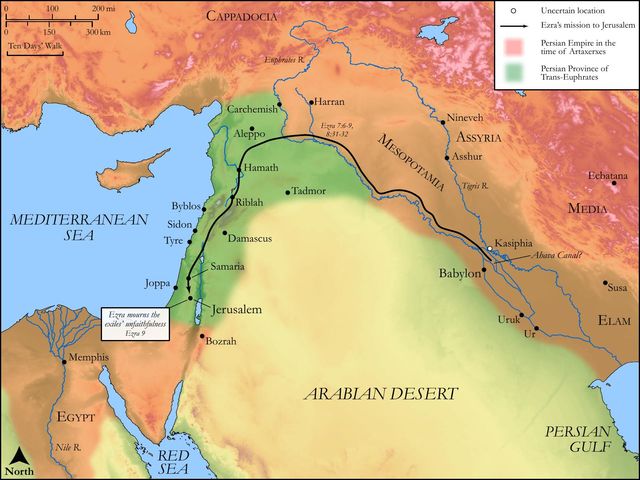
See on the biblical-era map
Study this verse
Public-domain commentary
Matthew Henry
From his Commentary on the Whole Bible. Henry comments on passages, not single verses — this entry covers Ezra 8:24–30.
We have here an account of the particular care which Ezra took of the treasure he had with him, that belonged to God's sanctuary, Observe, 1. Having committed the keeping of it to God, he committed the keeping of it to proper men, whose business it was to watch it, though without God they would have waked in vain. Note, Our prayers must always be seconded with our endeavours; the care of Christ's gospel, his church, and ordinances, must not be so left with him but that it must also be committed to faithful men, Ti2 2:2. 2. Having prayed to God to preserve all the substance they had with them, he shows himself especially solicitous for that part of it which belonged to the house of God and was an offering to him. Do we expect that God should, by his providence, keep that which belongs to us? Let us, by his grace, keep that which belongs to him. Let God's honour and interest be our care; and then we may expect that our lives and comforts will be his. Observe, (1.) The persons to whom he delivered the offerings of the house of God. Twelve chief priests, and as many Levites, he appointed to this trust (Ezr 8:24, Ezr 8:30), who were bound by their office to take care of the things of God, and were in a particular manner to have the benefit of these sacred treasures. Ezra tells them why he put those things into their hands (Ezr 8:28): You are holy unto the Lord, the vessels are holy also; and who so fit to take care of holy things as holy persons? Those that have the dignity and honour of the priesthood must take along with them the trust and duty of it. The prophet is foretelling the return of God's people and ministers out of Babylon, when he gives the solemn charge (Isa 52:11), Be you clean that bear the vessels of the Lord. (2.) The great exactness with which he lodged this trust in their hands: He weighed to them the silver, the gold, and the vessels (Ezr 8:25), because he expected to have it from them again by weight. In all trust, but especially sacred ones, we ought to be punctual, and preserve a right understanding on both sides. In Zerubbabel's time the vessels were delivered by number, here by weight, that all might be forth-coming and it might easily appear if any were missing, to intimate that such as are entrusted with holy things (as all the stewards of the mysteries of God are) are concerned to remember, both in receiving their trust and in discharging it, that they must shortly give a very particular account of it, that they may be faithful to it and so give up their account with joy. (3.) The charge he have them with these treasures (Ezr 8:29): "Watch you, and keep them, that they be not lost, nor embezzled, nor mingled with the other articles. Keep them together; keep them by themselves; keep them safely, till you weigh them in the temple, before the great men there," hereby intimating how much it was their concern to be careful and faithful and how much it would be their honour to be found so. Thus when Paul charges Timothy with the gospel treasure he bids him keep it until the appearing of Jesus Christ, and his appearing before him to give account of his trust, when his fidelity would be his crown.
Historical interpretation
Historical reception
1 surviving comment on this verse from the historical church.
And I separated twelve of the chiefs of the priests, etc. It has been frequently said that the silver and gold and vessels sent from Babylon to Jerusalem signify souls, which are converted to the Lord from the confusion and errors of this world. Hence, Ezra appropriately entrusts such vessels to the priests, who are to carry them to Jerusalem; for it is necessary that through the hands of the priests, those who desire to reach the companionship of the holy Church are washed in baptism and consecrated to the Lord. Likewise, those who have separated themselves from the society of the Church through sin, and have fallen into the service of the devil, into the captivity of the Babylonian king by persevering in sins, must be reconciled to the holy Church through repentance by the ministry of the priests. And fittingly, there are twelve priests to whom this duty is assigned, on account of the twelve apostles, through whose teaching the Church was initially founded throughout the world, and who continue to build it up through their successors until the end of the age. To whom applies the statement that Ezra made to those same priests:
Continue studying Ezra 8:24 across the web’s major study libraries — every link below opens this exact verse, chapter, or book on the destination site.
Read & Compare
 BibleGatewayThis verse in more than 200 translations and 70 languages.
 Bible.comThe YouVersion reader — hundreds of translations, reading plans, and highlights.
 ESV.orgCrossway's official English Standard Version reader.
 NET BibleThe NET translation with 60,000+ translators' notes on every rendering decision.
 STEP BibleTyndale House's free study tool — original text, vocabulary, and scholarly resources.
 BibliaLogos Bible Software's free web reader.
 USCCBThe New American Bible (Revised Edition) with the U.S. bishops' study notes.
Commentaries
 BibleHub CommentariesDozens of classic commentaries on this verse, gathered on one page.
 StudyLightMore than 100 commentary sets — the largest collection on the web.
 BibleRefPlain-English commentary on what this verse means, verse by verse.
 Enduring WordDavid Guzik's free commentary on this chapter, widely used by Bible teachers.
 Bible Study ToolsVerse commentary alongside Greek and Hebrew study aids.
Original Language & Research
- BibleHub InterlinearThe verse word by word — original language, transliteration, and English.
- BibleHub LexiconEvery word's original-language definition and Strong's entry.
 Blue Letter BibleDeep-study tools — Strong's numbers, concordance, and word studies.
 SefariaThe Hebrew text with Rashi and centuries of Jewish commentary.
Sermons, Hymns & Audio


TrulyRandomVerse is not affiliated with these sites and doesn’t control their content. They’re linked because they’re genuinely useful.
Summary
Ezra 8:24 records a crucial act of leadership and spiritual diligence by Ezra: the careful selection and separation of twelve chief priests, including Sherebiah and Hashabiah, along with ten of their brethren. This meticulous delegation was a foundational step for the safe transport of the vast and sacred Temple treasures from Babylon to Jerusalem. Undertaken not with a military escort but in profound reliance upon God's divine protection, this action embodies a deep commitment to faithful stewardship, accountable leadership, and the sanctity of divine provisions.
Context
ShowHideLiterary Context
This verse is strategically placed within Ezra's narrative of the second return from exile, immediately following his pivotal decision to forgo a royal military escort, opting instead for a posture of humble reliance on God's protection through fasting and prayer at the river Ahava (Ezra 8:21-23). Having committed the journey to divine providence, Ezra now demonstrates that spiritual reliance does not negate human responsibility and meticulous preparation. The act of "separating" these priests sets the stage for the detailed inventory and weighing of the sacred Temple offerings described in the subsequent verses (Ezra 8:25-30), highlighting Ezra's blend of profound faith and practical, accountable administration. This careful delegation underscores the immense value and sacredness of the cargo, emphasizing the need for trustworthy custodians.
Historical & Cultural Context
Ezra was leading a significant contingent of Jewish exiles returning to Judah, roughly 80 years after the initial return under Zerubbabel. The journey from Babylon to Jerusalem was notoriously dangerous, covering over 900 miles through desolate terrain frequently plagued by bandits and hostile groups. Transporting an immense quantity of gold, silver, and sacred vessels destined for the rebuilt Temple made the caravan an exceptionally attractive target. In that day, such valuable cargo would invariably be accompanied by a substantial armed guard. Ezra's conscious decision to refuse the king's escort, rooted in his desire to honor God's name and demonstrate unwavering trust, was a bold and counter-cultural act of faith. The selection of priests and Levites as custodians was culturally appropriate and deeply significant, as these individuals were traditionally responsible for the care, transport, and safeguarding of sacred objects related to the Tabernacle and Temple, emphasizing the holy nature of the cargo and the high integrity required of its handlers.
Key Themes
ShowHideEzra 8:24 significantly contributes to several overarching themes present throughout the book of Ezra and the broader biblical narrative. It powerfully illustrates the theme of Stewardship of Sacred Gifts, demonstrating the meticulous care, integrity, and accountability required when handling resources dedicated to God's house. Ezra's actions exemplify Leadership and Delegation, showcasing a wise leader who understands the necessity of entrusting critical tasks to qualified, trustworthy, and spiritually mature individuals, rather than attempting to bear the entire burden alone. Furthermore, the deliberate selection of priests highlights the theme of Holiness and Accountability, emphasizing that those who deal with God's possessions must be set apart for integrity and purity. This reflects the sacredness of the task and the need for transparent oversight, a principle consistently echoed in biblical passages concerning the integrity of leaders and the handling of sacred trusts, such as Paul's exhortation in 1 Corinthians 4:2 that "it is required in stewards that one be found faithful."
Exposition and Analysis
ShowHideKey Word Analysis
ShowHideThis verb carries profound theological weight, meaning "to divide," "to distinguish," or "to set apart." It is frequently used in the Old Testament to describe the act of consecrating something or someone for a specific, often sacred, purpose. For instance, God "separated" light from darkness in Genesis 1:4, and Israel was "separated" from other nations as God's peculiar people. Here, Ezra's act of "separating" implies a deliberate, purposeful act of choosing individuals who were not merely selected for a logistical task but were consecrated or deemed fit for a holy trust, emphasizing their integrity, spiritual standing, and suitability for handling sacred objects.
This term denotes a "head person," "prince," "ruler," or "principal officer" of any rank or class. In this context, "chief" indicates individuals of high rank, authority, and likely, proven spiritual maturity and integrity within the priestly lineage. Ezra did not choose just any priests but those recognized as leaders, further underscoring the immense value and sacredness of the treasures being entrusted to them. Their position implied a deep understanding of the sanctity of the Temple vessels and the gravity of their responsibility.
This word refers to "one officiating," a "priest," or even a "prince" or "principal officer." It designates individuals set apart for sacred service, mediating between God and humanity, and responsible for the rituals and upkeep of the Tabernacle and Temple. Their role inherently involved handling holy things. Ezra's selection of priests for this task was not arbitrary but rooted in their divinely ordained function as custodians of sacred items, ensuring that the treasures were handled with the utmost reverence and according to prescribed norms.
Verse Breakdown
ShowHide"Then I separated twelve of the chief of the priests,"
This opening clause emphasizes Ezra's direct, intentional, and authoritative action. The number "twelve" is highly significant in biblical numerology, often representing completeness, divine order, and the totality of Israel (e.g., the twelve tribes of Israel, the twelve apostles in the New Testament). Ezra's choice of this specific number for the custodians of the Temple treasures implies a comprehensive and representative oversight, ensuring accountability and shared responsibility across the community's spiritual leadership. It signifies a carefully chosen, foundational group.
"Sherebiah, Hashabiah,"
The specific naming of these two individuals indicates their prominence, trustworthiness, and likely, their established reputation within the community. Sherebiah and Hashabiah appear elsewhere in Ezra and Nehemiah as key Levites involved in Temple service, teaching the Law, and leading in worship and covenant renewal (e.g., Nehemiah 8:7, Nehemiah 9:5). Their inclusion by name authenticates the account and underscores that Ezra entrusted this vital task to known, respected, and capable spiritual leaders, adding a layer of personal accountability to the delegation.
"and ten of their brethren with them,"
This phrase completes the group of twelve, indicating that Ezra meticulously assembled a full team. "Their brethren" signifies other priests or Levites who shared their lineage, calling, and presumably, their commitment to the sacred task. This inclusive delegation was not merely logistical but also spiritual, ensuring that a sufficient number of spiritually qualified individuals were dedicated to safeguarding the sacred offerings on their perilous journey, fostering a sense of collective responsibility and mutual support.
Literary Devices
ShowHideThe verse employs Enumeration and Specific Naming to lend credibility and emphasize the meticulousness and intentionality of Ezra's actions. By stating the precise number "twelve" and explicitly naming two prominent individuals (Sherebiah and Hashabiah), the text highlights the deliberate and careful nature of the selection process. This precision underscores the immense value and sacredness of the treasures, implying that only a carefully chosen, accountable group could be entrusted with such a weighty responsibility. Furthermore, the act of "separating" (Hebrew: bâdal) itself functions as a powerful form of Symbolism, representing not just a physical division or selection but a spiritual consecration. It signifies setting these individuals apart for a holy task, mirroring God's own acts of setting apart people and things for His divine purposes.
Theological and Thematic Connections
ShowHideEzra 8:24 profoundly illustrates the biblical principle of faithful stewardship, especially concerning resources dedicated to God's kingdom. Ezra, as a wise and godly leader, understood that divine protection did not negate human responsibility. His careful selection of trustworthy priests and Levites for the sacred treasures demonstrates a deep commitment to integrity, accountability, and the proper handling of holy things. This act serves as a timeless example that while we trust in God's overarching providence, we are also called to exercise wisdom, diligence, and prudent management in our responsibilities, particularly when dealing with what belongs to the Lord. It underscores that spiritual tasks require spiritually qualified and accountable individuals, highlighting the importance of character and competence in leadership.
Reflection and Application
ShowHideEzra's actions in this verse provide a powerful blueprint for believers today, particularly in the context of leadership, personal integrity, and the management of God-given resources. Just as Ezra meticulously "separated" trustworthy individuals for a sacred task, we are called to be faithful stewards of all that God has entrusted to us—our time, talents, spiritual gifts, material possessions, relationships, and the very message of the Gospel. This verse reminds us that genuine faith in God's protection does not excuse us from exercising wisdom, diligence, and meticulous preparation in our responsibilities. It challenges us to identify and empower trustworthy individuals within our communities and ministries, delegating tasks with accountability and transparency, fostering a culture of shared responsibility and integrity. Ultimately, it calls us to approach all our endeavors, especially those undertaken for the Lord, with a blend of profound spiritual reliance and meticulous practical preparation, recognizing that our integrity in handling earthly responsibilities reflects our reverence for heavenly realities and our commitment to God's glory.
Questions for Reflection
ShowHideFAQ
ShowHideWhy did Ezra choose priests and Levites specifically for this task?
ShowHideEzra chose priests and Levites because they were the divinely appointed custodians of sacred objects and Temple service according to the Mosaic Law. Their lineage and calling inherently involved handling holy things with reverence and meticulous care. Furthermore, their spiritual standing and integrity were crucial, as they were expected to be examples of purity and honesty, reflecting the sanctity of the items they carried. This choice emphasized the sacred nature of the treasures, not merely their monetary value, and ensured that the individuals responsible were spiritually qualified and accountable to God for their trust, a principle deeply rooted in passages like Numbers 1:50-53.
What was the significance of the number "twelve" in Ezra's selection?
ShowHideThe number "twelve" holds significant symbolic weight in biblical tradition, often representing completeness, divine order, and the totality of Israel (e.g., the twelve tribes of Israel, the twelve springs of Elim in Exodus 15:27, the twelve apostles of Jesus). By selecting twelve chief priests, Ezra likely intended to represent the whole community of Israel, ensuring comprehensive oversight and shared responsibility for the sacred offerings. It also provided a robust and symbolically complete team for the immense logistical and security challenges of transporting the vast wealth.
What specific treasures were these priests entrusted with, and how valuable were they?
ShowHideThe treasures entrusted to these priests consisted of a vast quantity of gold, silver, and various sacred vessels for the Temple in Jerusalem. Ezra 8:26-27 details the immense value: 650 talents of silver, 100 talents of silver articles, 100 talents of gold, 20 gold bowls worth 1,000 darics, and two vessels of fine polished bronze, precious as gold. To put this into perspective, a talent was a significant weight (approximately 75 pounds or 34 kilograms). In modern terms, this would amount to hundreds of millions of dollars, making the careful stewardship and protection of these items an undertaking of monumental importance and risk.
Christ-Centered Fulfillment
ShowHideEzra's meticulous separation of twelve chief priests to safeguard the sacred Temple treasures profoundly foreshadows the ultimate stewardship of a far greater treasure: the Gospel and the people of God, entrusted to Christ and subsequently to His Church. Just as Ezra carefully selected those "set apart" (Hebrew: bâdal) for a holy task, Jesus Christ is the ultimate "separated" one, consecrated by God for the singular mission of redemption (John 17:19). He is the true and faithful High Priest, not merely guarding spiritual treasures but being the treasure Himself, the Lamb of God who takes away the sin of the world. The Church, as His body, is now entrusted with the "treasure in jars of clay"—the glorious message of Christ and the ministry of reconciliation (2 Corinthians 4:7 and 2 Corinthians 5:18-20). We, as a "royal priesthood" (1 Peter 2:9), are called to steward this spiritual wealth with the same integrity, accountability, and profound reliance on divine protection that Ezra exemplified, knowing that the ultimate security and preservation of this treasure rests in the hands of our faithful Lord, who is building His Church and the gates of hell shall not prevail against it (Matthew 16:18).