


Exodus 15:27
Bible text: King James Version (1769 Blayney text) · Public domain
Bible text: Berean Standard Bible · Public domain
Bible text: American Standard Version (1901) · Public domain
Bible text: World English Bible, Messianic edition · Public domain
Bible text: Geneva Bible (1599) · Public domain
Bible text: Young's Literal Translation · Public domain
- וַיָּבֹאוּvai·ya·Vo·'uand they cameH935Conj-w ¦ V-Qal-ConsecImperf-3mpVerb Qal Consecutive Imperfect 3rd Plural Masculineוַandיָּבֹאוּthey came
- אֵילִמָה'ei·Li·mahElim towardsH362N-proper ¦ SfxNoun Proper LocationאֵילִמָElimהtowards
- וְשָׁםve·Shamand [were] thereH8033Conj-w ¦ AdvAdverbוְandשָׁם[were] there
- שְׁתֵּיםshe·Teimtwo [plus]H8147Adj-fdAdjective Numerical Dual Feminine Absolute
- עֶשְׂרֵה'es·RehtenH6240Adj-cscAdjective Numerical Singular common gender Construct
- עֵינֹת'ei·Notsprings ofH5869N-fpcNoun Plural Feminine Construct
- מַיִםMa·yimwaterH4325N-mpNoun Plural Masculine Absolute
- וְשִׁבְעִיםve·shiv·'Imand seventyH7657Conj-w ¦ Adj-mpAdjective Numerical Plural Masculine Absoluteוְandשִׁבְעִיםseventy
- תְּמָרִיםte·ma·Rimpalm treesH8558N-mpNoun Plural Masculine Absolute
- וַיַּחֲנוּvai·ya·cha·nuand they encampedH2583Conj-w ¦ V-Qal-ConsecImperf-3mpVerb Qal Consecutive Imperfect 3rd Plural Masculineוַandיַּחֲנוּthey encamped
- שָׁםshamthereH8033AdvAdverb
- עַל'alatH5921PrepPreposition
- הַמָּיִםha·Ma·yimthe waterH4325Art ¦ N-mpNoun Plural Masculine Absoluteהַtheמָּיִםwater
English is a literal word-by-word gloss of the Hebrew, not the KJV's wording. Why?
This is the original text the KJV's translators worked from — each Hebrew word with its own literal English meaning in this verse, prepared by scholars at Tyndale House, Cambridge. The KJV translates whole sentences, not word by word, so its wording differs: one Hebrew word can become several English words, and the KJV may choose “the LORD” where the gloss reads “Yahweh”. Both are faithful — they answer different questions. For the KJV's own rendering, switch to the KJV text.
Details
See on the biblical-era maps

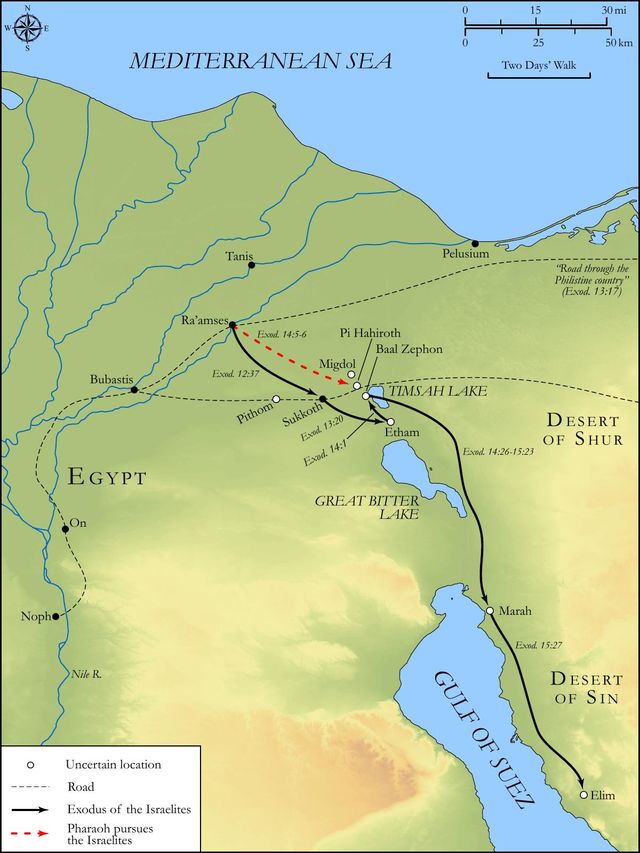
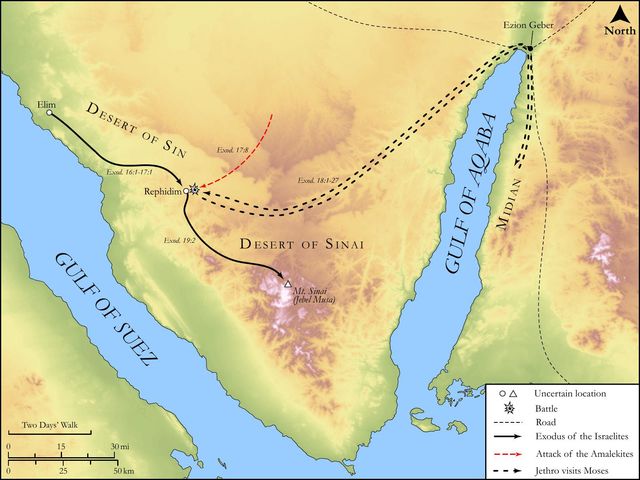
Study this verse
Public-domain commentary
Matthew Henry
From his Commentary on the Whole Bible. Henry comments on passages, not single verses — this entry covers Exodus 15:22–27. His three-level outline is real structure in the source text, so it is rendered as structure.
It should seem, it was with some difficulty that Moses prevailed with Israel to leave that triumphant shore on which they sang the foregoing song. They were so taken up with the sight, or with the song, or with the spoiling of the dead bodies, that they cared not to go forward, but Moses with much ado brought them from the Red Sea into a wilderness. The pleasures of our way to Canaan must not retard our progress, but quicken it, though we have a wilderness before us. Now here we are told,
I.That in the wilderness of Shur they had no water, Exo 15:22.
This was a sore trial to the young travellers, and a diminution to their joy; thus God would train them up to difficulties. David, in a dry and thirsty land where no water is, reaches forth towards God, Psa 63:1.
II.That at Marah they had water, but it was bitter, so that though they had been three days without water they could not drink it, because it was extremely unpleasant to the taste or was likely to be prejudicial to their health, or was so brackish that it rather increased their thirst than quenched it, Exo 15:23. Note, God can embitter that to us from which we promise ourselves most satisfaction, and often does so in the wilderness of this world, that our wants and disappointments in the creature may drive us to the Creator, in whose favour alone true comfort is to be had. Now in this distress,
1.The people fretted and quarrelled with Moses, as if he had done ill by them. What shall we drink? is all their clamour, Exo 15:24. Note, The greatest joys and hopes are soon turned into the greatest griefs and fears with those that live by sense only, and not by faith.
2.Moses prayed: He cried unto the Lord, Exo 15:25. The complaints which they brought to him he brought to God, on whom, notwithstanding his elevation, Moses owned a constant dependence. Note, It is the greatest relief of the cares of magistrates and ministers, when those under their charge make them uneasy, that they may have recourse to God by prayer: he is the guide of the church's guides and to him, as the Chief Shepherd, the under-shepherds must upon all occasions apply.
3.God provided graciously for them. He directed Moses to a tree, which he cast into the waters, in consequence of which, all of a sudden, they were made sweet. Some think this wood had a peculiar virtue in it for this purpose, because it is said, God showed him the tree. God is to be acknowledged, not only in the creating of things useful for man, but in discovering their usefulness. Or perhaps this was only a sign, and not at all a means, of the cure, any more than the brazen serpent, or Elisha's casting one cruse full of salt into the waters of Jericho. Some make this tree typical of the cross of Christ, which sweetens the bitter waters of affliction to all the faithful, and enables them to rejoice in tribulation. The Jews' tradition is that the wood of this tree was itself bitter, yet it sweetened the waters of Marah; the bitterness of Christ's sufferings and death alters the property of ours.
4.Upon this occasion, God came upon terms with them, and plainly told them, now that they had got clear of the Egyptians, and had entered into the wilderness, that they were upon their good behaviour, and that according as they carried themselves so it would be well or ill with them: There he made a statute and an ordinance, and settled matters with them. There he proved them, that is, there he put them upon the trial, admitted them as probationers for his favour. In short, he tells them, Exo 15:26,
(1.)What he expected from them, and that was, in one word, obedience. They must diligently hearken to his voice, and give ear to his commandments, that they might know their duty, and not transgress through ignorance; and they must take care in every thing to do that which was right in God's sight, and to keep all his statutes. They must not think, now that they were delivered from their bondage in Egypt, that they had no lord over them, but were their own masters; no, therefore they must look upon themselves as God's servants, because he had loosed their bonds, Psa 116:16; Luk 1:74, Luk 1:75.
(2.)What they might then expect from him: I will put none of these diseases upon thee, that is, "I will not bring upon thee any of the plagues of Egypt." This intimates that, if they were rebellious and disobedient, the very plagues which they had seen inflicted upon their enemies should be brought upon them; so it is threatened, Deu 28:60. God's judgments upon Egypt, as they were mercies to Israel, opening the way to their deliverance, so they were warnings to Israel, and designed to awe them into obedience. Let not the Israelites think, because God had thus highly honoured them in the great things he had done for them, and had proclaimed them to all the world his favourites, that therefore he would connive at their sins and let them do as they would. No, God is no respecter of persons; a rebellious Israelite shall fare no better than a rebellious Egyptian; and so they found, to their cost, before the got to Canaan. "But, if thou wilt be obedient, thou shalt be safe and happy;" the threatening is implied only, but the promise is expressed: "I am the Lord that healeth thee, and will take care of thy comfort wherever thou goest." Note, God is the great physician. If we be kept well, it is he that keeps us; if we be made well, it is he that restores us; he is our life, and the length of our days.
III.That at Elim they had good water, and enough of it, Exo 15:27.
Though God may, for a time, order his people to encamp by the waters of Marah, yet that shall not always be their lot. See how changeable our condition is in this world, from better to worse, from worse to better. Let us therefore learn both how to be abased and how to abound, to rejoice as though we rejoiced not when we are full, and to weep as though we wept not when we are emptied. Here were twelve wells for their supply, one for every tribe, that they might not strive for water, as their fathers had sometimes done; and, for their pleasure, there were seventy palm-trees, under the shadow of which their great men might repose themselves. Note, God can find places of refreshment for his people even in the wilderness of this world, wells in the valley of Baca, lest they should faint in their mind with perpetual fatigue: yet, whatever our delights may be in the land of our pilgrimage, we must remember that we do but encamp by them for a time, that here we have no continuing city.
Historical interpretation
Three Centuries of Reception
2 surviving comments on this verse. Each one is dated, so this reads as a timeline rather than a list.
Select a marker to jump to its quote. Markers stagger vertically where authors wrote within a few decades of each other.
They arrived at a place called Elim, where there were twelve very pure springs of water and a multitude of seventy flourishing palm trees. See the mystery of God—how, after the bitterness of the law, the richness of gospel piety abounds. There the one spring is harsh to drink, but here the many are all sweet to imbibe. Once there was no refreshment after weariness, but now there is refreshment after labor. For springs are at the disposal of the thirsty, and palms are offered to victors. Palms are offered to victors, I say, because after the hardness of the law it is a victory to have arrived at the grace of the gospel. For part of the victor’s reward is to moisten his mouth from a flowing spring and to take the triumphal palm in his hand. With the spring the confessor’s tongue is purified, and with the palm the martyr’s hand is honored—the former because it has praised the glory of Christ, the latter because it has refused the altar of sacrilege.
When the people of God went out from Egypt, their sixth resting place, in which “there were twelve fountains of water and seventy palm trees,” was called Elim (that is, “of rams”), so that both by its name and by its appearance it might contain the figure of the apostles and the apostolic men.
Continue studying Exodus 15:27 across the web’s major study libraries — every link below opens this exact verse, chapter, or book on the destination site.
Read & Compare
 BibleGatewayThis verse in more than 200 translations and 70 languages.
 Bible.comThe YouVersion reader — hundreds of translations, reading plans, and highlights.
 ESV.orgCrossway's official English Standard Version reader.
 NET BibleThe NET translation with 60,000+ translators' notes on every rendering decision.
 STEP BibleTyndale House's free study tool — original text, vocabulary, and scholarly resources.
 BibliaLogos Bible Software's free web reader.
 USCCBThe New American Bible (Revised Edition) with the U.S. bishops' study notes.
Commentaries
 BibleHub CommentariesDozens of classic commentaries on this verse, gathered on one page.
 StudyLightMore than 100 commentary sets — the largest collection on the web.
 BibleRefPlain-English commentary on what this verse means, verse by verse.
 Enduring WordDavid Guzik's free commentary on this chapter, widely used by Bible teachers.
 Bible Study ToolsVerse commentary alongside Greek and Hebrew study aids.
Original Language & Research
- BibleHub InterlinearThe verse word by word — original language, transliteration, and English.
- BibleHub LexiconEvery word's original-language definition and Strong's entry.
 Blue Letter BibleDeep-study tools — Strong's numbers, concordance, and word studies.
 SefariaThe Hebrew text with Rashi and centuries of Jewish commentary.
Sermons, Hymns & Audio


TrulyRandomVerse is not affiliated with these sites and doesn’t control their content. They’re linked because they’re genuinely useful.
Summary
Exodus 15:27 marks a significant turning point in the Israelites' wilderness journey, describing their arrival at Elim, a lush oasis providing abundant water and shade. This arrival, immediately following the bitter waters of Marah, serves as a powerful testament to God's unfailing provision and compassionate care for His people, demonstrating His faithfulness to sustain them even amidst the harsh realities of their pilgrimage. It represents a divinely appointed period of much-needed rest and refreshment, symbolizing divine grace and restoration after a season of intense trial and complaint.
Context
ShowHideLiterary Context
This verse is strategically placed within the narrative, immediately following the Israelites' miraculous deliverance through the Red Sea (Exodus 14) and their subsequent "Song of the Sea" (Exodus 15:1-21). Their initial journey into the Wilderness of Shur brought immediate hardship, culminating in three days without potable water, leading to their grumbling at Marah, where the water was undrinkable. There, God miraculously intervened, making the bitter waters sweet (Exodus 15:23-25), establishing a covenant of healing and obedience. The arrival at Elim directly after Marah provides a stark and welcome contrast, illustrating God's consistent pattern of providing abundant relief and refreshment immediately following a period of testing and hardship. This sequence emphasizes God's immediate and generous response to His people's needs and His unwavering commitment to sustaining them on their journey.
Historical & Cultural Context
The Israelites, newly liberated from centuries of bondage in Egypt, were embarking on a transformative journey through a desolate and unforgiving wilderness. This environment was inherently hostile, characterized by extreme temperatures, scarcity of water, and lack of natural sustenance, rendering their survival entirely dependent on divine intervention. Oases like Elim were crucial waypoints, serving as vital sources of life-sustaining water and shade, enabling travelers and their livestock to recover and replenish. The specific numbers "twelve wells of water" and "threescore and ten palm trees" (seventy) were not arbitrary; they held significant symbolic weight in ancient Israelite culture. "Twelve" often represented the twelve tribes of Israel, signifying God's comprehensive provision for all His people. "Seventy" was a number of completeness or universality, seen in the seventy nations listed in Genesis 10 or the seventy elders appointed to assist Moses. These numbers underscore the abundant, holistic, and divinely ordained nature of God's provision at Elim.
Key Themes
ShowHideThis verse powerfully contributes to several overarching themes within the book of Exodus and the broader Pentateuch. Foremost is the theme of Divine Provision and Sustenance, highlighting God's faithfulness to meet His people's needs in the wilderness, even when they grumble or doubt. It also reinforces the theme of God's Sovereignty and Guidance, as He meticulously leads Israel through challenging terrain to specific places of rest and restoration. The sequence of Marah and Elim underscores the theme of Testing and Faith, where trials serve to reveal human dependence and God's miraculous power. Furthermore, the detailed description of Elim's resources, particularly the symbolic numbers, points to the theme of Covenant Faithfulness, demonstrating God's commitment to His covenant people, providing comprehensively for their physical and spiritual well-being as they journey towards the Promised Land. This divine care is a consistent thread, from the manna and quail to the water from the rock, illustrating God's constant presence and provision throughout their wilderness experience, as seen in passages like Exodus 16 and Exodus 17.
Exposition and Analysis
ShowHideKey Word Analysis
ShowHideThe name of this location, a plural form, likely derives from a root meaning "strong trees" or "oaks," which aptly describes an oasis abundant with vegetation. The presence of numerous palm trees aligns with this etymology, suggesting a place of established growth and natural strength, offering substantial shade and resources. This name itself suggests a place of robust life and stability in contrast to the barren wilderness.
While primarily meaning "eye," this word is used by analogy to refer to a "fountain" or "spring" of water, as the eye is a source of sight, so a fountain is a source of water for the landscape. In this context, it signifies a natural, abundant source of life-sustaining water, crucial for survival in the desert. The plural "wells" indicates multiple, distinct sources, further emphasizing the richness of the provision.
This primitive root means "to incline," and by implication, "to decline" (as the sun's rays at evening) or, more specifically, "to pitch a tent." Generally, it means "to encamp" for abode or siege. Here, it denotes the act of settling down, establishing a temporary dwelling, and resting. It signifies a halt in their arduous journey, allowing for recovery and replenishment in a secure and hospitable environment.
Verse Breakdown
ShowHide"And they came to Elim"
This opening clause signifies a divinely guided arrival at a specific, designated location. It implies not a random discovery but a purposeful leading by God, bringing His people to a place of relief and restoration after their recent trials and the bitter experience at Marah. It highlights God's active involvement in their journey.
"where [were] twelve wells of water"
This detail highlights the primary and most vital provision in the desert: water. The specific number "twelve" emphasizes that this provision was not merely adequate but perfectly suited and abundantly sufficient for the entire nation of Israel, symbolizing God's comprehensive care for each of the twelve tribes. It speaks to the completeness of God's supply.
"and threescore and ten palm trees"
This specifies the presence of numerous palm trees, which would have provided essential shade from the scorching desert sun, as well as potential dates for food. The archaic "threescore and ten" (seventy) underscores the extraordinary abundance of this resource, further emphasizing the lavishness and generosity of God's provision beyond mere necessity.
"and they encamped there by the waters"
This final clause indicates the act of settling down, finding rest, and establishing a temporary home in this oasis. It signifies a period of respite and recovery, allowing the people to be refreshed physically and spiritually before continuing their arduous journey. The proximity to the water emphasizes the centrality of this life-giving resource to their rest.
Literary Devices
ShowHideExodus 15:27 employs several significant literary devices to convey its profound message. The most prominent is Contrast, as Elim stands in stark opposition to the preceding bitter waters of Marah (Exodus 15:23). This juxtaposition powerfully highlights God's ability to provide sweetness after bitterness and abundance after scarcity, reinforcing His sovereignty, compassion, and faithfulness. Symbolism is also heavily at play, with water representing life, sustenance, and divine provision, and palm trees symbolizing prosperity, shade, and refreshment in a desolate land. The specific numbers employed, a form of Numerology, "twelve" and "seventy," are not merely descriptive but carry deep symbolic weight, signifying comprehensive provision for the entire nation of Israel and emphasizing the completeness and abundance of God's grace. The narrative also exhibits Narrative Progression, moving from the trial and complaint at Marah to the immediate and generous provision at Elim, illustrating a divine pattern of testing followed by profound demonstrations of care and restoration.
Theological and Thematic Connections
ShowHideExodus 15:27 profoundly illustrates the theological theme of God's unfailing provision and His compassionate response to the needs of His people. After the test at Marah, Elim serves as a powerful demonstration of God's faithfulness to sustain and refresh those who depend on Him, even in the most desolate circumstances. It underscores the wilderness as a crucible for faith, where human weakness and dependence on God are brought into sharp relief, and where divine power and care are most clearly revealed. The abundance at Elim signifies that God's provision is not merely sufficient but generous, meeting not only their immediate physical needs but also offering spiritual and emotional restoration. It is a tangible sign of God's covenant loyalty and His desire for His people's well-being.
Reflection and Application
ShowHideThe journey to Elim offers a timeless message for believers navigating the "wilderness" seasons of their own lives. Just as the Israelites faced periods of intense hardship and scarcity, we too encounter moments of exhaustion, bitterness, or spiritual dryness. Elim reminds us that God is intimately aware of our struggles and faithfully provides "oases" of refreshment and renewed strength precisely when we need them most. These oases may manifest as unexpected breakthroughs, supportive communities, moments of profound spiritual peace, or simply the quiet grace to persevere through challenging circumstances. This verse encourages us to cultivate a posture of trust, knowing that even after our "Marah" experiences, God is preparing a place of rest and abundance. It calls us to recognize and receive His provision, allowing ourselves to be refreshed and restored before continuing our faith journey, always remembering that His timing is perfect and His care is unfailing. It is a call to lean into divine grace, finding our true rest and sustenance in Him.
Questions for Reflection
ShowHideFAQ
ShowHideWhy are the numbers "twelve" and "seventy" specifically mentioned in this verse?
ShowHideThe numbers "twelve" and "seventy" are highly significant and not arbitrary. "Twelve" consistently symbolizes the completeness and totality of God's people, representing the twelve tribes of Israel descended from Jacob's sons. Its presence here signifies that God's provision was sufficient and perfectly tailored for the entire nation. "Seventy" (threescore and ten) often denotes completeness or universality in biblical contexts, such as the seventy nations of the world listed in Genesis 10 or the seventy elders appointed to assist Moses. Together, these numbers emphasize the abundant, comprehensive, and perfectly adequate nature of God's provision for all His people, underscoring His lavish care and attention to detail.
What is the spiritual significance of Elim following Marah in the Israelites' journey?
ShowHideThe sequence of Marah (bitterness and testing) followed by Elim (abundance and rest) is a profound spiritual pattern. It illustrates God's pedagogical method: trials and periods of testing often precede and highlight profound demonstrations of His grace and provision. At Marah, the Israelites' faith was tested, and they learned to depend on God for healing and sustenance, even grumbling in their distress. Immediately afterward, Elim provided a lavish oasis, teaching them that God is faithful to provide refreshment and abundance after hardship. This pattern reinforces the lesson that God is faithful to sustain His people through every stage of their journey, transforming moments of bitterness into seasons of blessing and rest, ultimately building their trust in His unfailing character.
Christ-Centered Fulfillment
ShowHideThe oasis of Elim, with its abundant water and shade, serves as a powerful Old Testament foreshadowing of Jesus Christ, the ultimate source of spiritual refreshment and rest. Just as Elim provided vital sustenance in the physical wilderness, Christ offers living water that quenches all spiritual thirst and provides profound rest for weary souls. The Israelites' journey through the wilderness, marked by trials and divine provision, mirrors the Christian's pilgrimage through a fallen world, where true sustenance is found not in earthly resources but in Christ alone. He is the bread of life and the true vine, offering spiritual nourishment that surpasses any physical oasis. The comprehensive provision at Elim, sufficient for all twelve tribes, points to the superabundant grace found in Christ, who freely offers salvation and eternal life to all who believe. He is the ultimate fulfillment of God's promise to provide an oasis in the desert of humanity's sin and brokenness, leading His redeemed people to springs of living water in the new creation where there will be no more thirst or sorrow.