


Genesis 10:32
Bible text: King James Version (1769 Blayney text) · Public domain
Bible text: King James Version with Strong's numbers · Public domain
Bible text: Berean Standard Bible · Public domain
Bible text: American Standard Version (1901) · Public domain
Bible text: World English Bible, Messianic edition · Public domain
Bible text: Geneva Bible (1599) · Public domain
Bible text: Young's Literal Translation · Public domain
- אֵלֶּה'E·lehtheseH428PrtParticle Demonstrative
- מִשְׁפְּחֹתmish·pe·Chot[were] [the] clans ofH4940N-fpcNoun Plural Feminine Construct
- בְּנֵיbe·nei[the] sons ofH1121N-mpcNoun Plural Masculine Construct
- נֹחַNo·achNoahH5146N-proper-mNoun Proper Masculine
- לְתוֹלְדֹתָםle·tol·do·Tamto their descendantsH8435Prep-l ¦ N-fpc ¦ 3mpNoun Plural Feminine Constructלְtoתוֹלְדֹתָdescendantsםtheir
- בְּגוֹיֵהֶםbe·go·ye·Hemin their nationsH1471Prep-b ¦ N-mpc ¦ 3mpNoun Plural Masculine Constructבְּinגוֹיֵnationsהֶםtheir
- וּמֵאֵלֶּהu·me·'E·lehand from theseH428Conj-w ¦ Prep-m ¦ PrtParticle Demonstrativeוּandמֵfromאֵלֶּהthese
- נִפְרְדוּnif·re·Duthey separatedH6504V-Niphal-Perf-3cpVerb Niphal Perfect 3rd Plural common gender
- הַגּוֹיִםha·go·Yimthe nationsH1471Art ¦ N-mpNoun Plural Masculine Absoluteהַtheגּוֹיִםnations
- בָּאָרֶץba·'A·retzon the earthH776Prep-b ¦ N-fsNoun Singular Feminine Absoluteבָּon theאָרֶץearth
- אַחַר'a·CharafterH310Adj-mscAdjective Numerical Singular Masculine Construct
- הַמַּבּוּלha·ma·Bulthe floodH3999Art ¦ N-msNoun Singular Masculine Absoluteהַtheמַּבּוּלflood
English is a literal word-by-word gloss of the Hebrew, not the KJV's wording. Why?
This is the original text the KJV's translators worked from — each Hebrew word with its own literal English meaning in this verse, prepared by scholars at Tyndale House, Cambridge. The KJV translates whole sentences, not word by word, so its wording differs: one Hebrew word can become several English words, and the KJV may choose “the LORD” where the gloss reads “Yahweh”. Both are faithful — they answer different questions. For the KJV's own rendering, switch to the KJV text.
Details
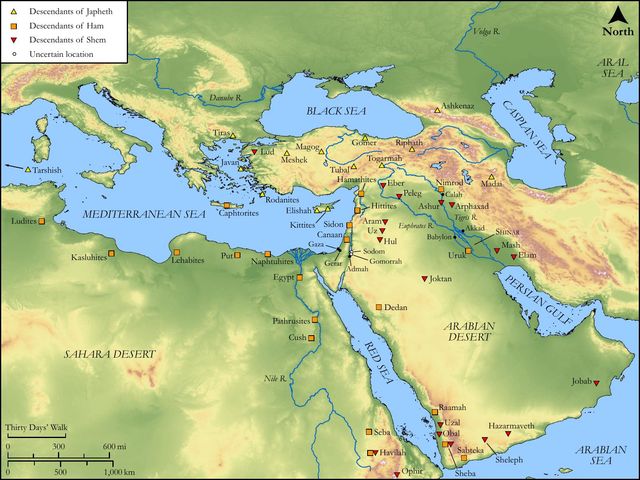
See on the biblical-era maps


Study this verse
Public-domain commentary
Matthew Henry
From his Commentary on the Whole Bible. Henry comments on passages, not single verses — this entry covers Genesis 10:21–32. His three-level outline is real structure in the source text, so it is rendered as structure.
Two things especially are observable in this account of the posterity of Shem: -
I.The description of Shem, Gen 10:21.
We have not only his name, Shem, which signifies a name, but two titles to distinguish him by: -
1.He was the father of all the children of Eber. Eber was his great grandson; but why should he be called the father of all his children, rather than of all Arphaxad's, or Salah's, etc.? Probably because Abraham and his seed, God's covenant-people, not only descended from Heber, but from him were called Hebrews; Gen 14:13, Abram the Hebrew. Paul looked upon it as his privilege that he was a Hebrew of the Hebrews, Phi 3:5. Eber himself, we may suppose, was a man eminent for religion in a time of general apostasy, and a great example of piety to his family; and, the holy tongue being commonly called from him the Hebrew, it is probable that he retained it in his family, in the confusion of Babel, as a special token of God's favour to him; and from him the professors of religion were called the children of Eber. Now, when the inspired penman would give Shem an honourable title, he calls him the father of the Hebrews. Though when Moses wrote this, they were a poor despised people, bond-slaves in Egypt, yet, being God's people, it was an honour to a man to be akin to them. As Ham, though he had many sons, is disowned by being called the father of Canaan, on whose seed the curse was entailed (Gen 9:22), so Shem, though he had many sons, is dignified with the title of the father of Eber, on whose seed the blessing was entailed. Note, a family of saints is more truly honourable than a family of nobles, Shem's holy seed than Ham's royal seed, Jacob's twelve patriarchs than Ishmael's twelve princes, Gen 17:20. Goodness is true greatness.
2.He was the brother of Japheth the elder, by which it appears that, though Shem is commonly put first, he was not Noah's first-born, but Japheth was older. But why should this also be put as part of Shem's title and description, that he was the brother of Japheth, since it had been, in effect, said often before? And was he not as much brother to Ham? Probably this was intended to signify the union of the Gentiles with the Jews in the church. The sacred historian had mentioned it as Shem's honour that he was the father of the Hebrews; but, lest Japheth's seed should therefore be looked upon as for ever shut out from the church, he here reminds us that he was the brother of Japheth, not in birth only, but in blessing; for Japheth was to dwell in the tents of Shem. Note,
(1.)Those are brethren in the best manner that are so by grace, and that meet in the covenant of God and in the communion of saints.
(2.)God, in dispensing his grace, does not go by seniority, but the younger sometimes gets the start of the elder in coming into the church; so the last shall be first and the first last.
II.The reason of the name of Peleg (Gen 10:25):
Because in his days (that is, about the time of his birth, when his name was given him), was the earth divided among the children of men that were to inhabit it; either when Noah divided it by an orderly distribution of it, as Joshua divided the land of Canaan by lot, or when, upon their refusal to comply with that division, God, in justice, divided them by the confusion of tongues: whichsoever of these was the occasion, pious Heber saw cause to perpetuate the remembrance of it in the name of his son; and justly may our sons be called by the same name, for in our days, in another sense, is the earth, the church, most wretchedly divided.
Historical interpretation
Historical reception
1 surviving comment on this verse from the historical church.
These are the families of Noah according to their peoples and nations. From these were the nations divided on the earth after the flood. Let the diligent reader review in order the names of the men or peoples who are said to have been born from the three sons, and they will be found to number seventy-one: namely, thirteen from Japheth, thirty-one from Ham, twenty-six from Shem, from whom they are believed to have filled the world with as many languages and nations, or rather seventy-two, as clearer tradition holds, since there was one among them from whom afterward two nations and peoples were born; unless perhaps it is to be understood that there are two Asshurs, who created two peoples: one who, having gone out from the land of Shinar, built Nineveh, and the other a son of Shem; and thus the number of seventy-two nations is completed. Neither does it seem irrelevant that the Lord therefore sent seventy-two disciples to preach, because there were as many nations and languages to whom the word of preaching was to be committed, just as he first chose twelve apostles for the same number of tribes of Israel to be called to faith; so afterward he designated seventy-two teachers to indicate the salvation of all nations, which were encompassed by the same number.
Continue studying Genesis 10:32 across the web’s major study libraries — every link below opens this exact verse, chapter, or book on the destination site.
Read & Compare
 BibleGatewayThis verse in more than 200 translations and 70 languages.
 Bible.comThe YouVersion reader — hundreds of translations, reading plans, and highlights.
 ESV.orgCrossway's official English Standard Version reader.
 NET BibleThe NET translation with 60,000+ translators' notes on every rendering decision.
 STEP BibleTyndale House's free study tool — original text, vocabulary, and scholarly resources.
 BibliaLogos Bible Software's free web reader.
 USCCBThe New American Bible (Revised Edition) with the U.S. bishops' study notes.
Commentaries
 BibleHub CommentariesDozens of classic commentaries on this verse, gathered on one page.
 StudyLightMore than 100 commentary sets — the largest collection on the web.
 BibleRefPlain-English commentary on what this verse means, verse by verse.
 Enduring WordDavid Guzik's free commentary on this chapter, widely used by Bible teachers.
 Bible Study ToolsVerse commentary alongside Greek and Hebrew study aids.
Original Language & Research
- BibleHub InterlinearThe verse word by word — original language, transliteration, and English.
- BibleHub LexiconEvery word's original-language definition and Strong's entry.
 Blue Letter BibleDeep-study tools — Strong's numbers, concordance, and word studies.
 SefariaThe Hebrew text with Rashi and centuries of Jewish commentary.
Sermons, Hymns & Audio


TrulyRandomVerse is not affiliated with these sites and doesn’t control their content. They’re linked because they’re genuinely useful.
Summary
Genesis 10:32 serves as the concluding statement for the "Table of Nations," a comprehensive genealogical record detailing the descendants of Noah's three sons—Shem, Ham, and Japheth. This verse succinctly summarizes that all the diverse families and nations inhabiting the earth after the Great Flood originated from these specific lineages, underscoring humanity's common ancestry and the divine orchestration of their global dispersion.
Context
ShowHideLiterary Context
Genesis chapter 10, often termed the "Table of Nations," meticulously enumerates the descendants of Noah's sons, providing a foundational account of the post-Flood repopulation of the earth. This chapter fulfills God's post-diluvian command to Noah and his sons to "be fruitful and multiply and fill the earth". Genesis 10:32 acts as a powerful summary and concluding statement for this entire genealogical record, asserting the comprehensive nature of the preceding list. It serves as a crucial narrative bridge, setting the stage for the events of Genesis chapter 11, particularly the account of the Tower of Babel, which further explains the linguistic and geographical divisions among these newly formed nations.
Historical & Cultural Context
In Israel, genealogies were not merely lists of names but vital records that established identity, lineage, land rights, and historical continuity. The "Table of Nations" in Genesis 10, culminating in verse 32, reflects this cultural importance by providing a universal genealogy for all humanity from a single source family. This was a significant theological claim in a polytheistic world often characterized by tribalism and ethnocentrism, as it posited a common origin for all peoples. The phrase "after the flood" firmly grounds this historical development in the immediate post-diluvian era, emphasizing the new beginning for humanity and the divine mandate for its expansion across the globe.
Key Themes
ShowHideGenesis 10:32 encapsulates several profound themes developed throughout the chapter and the broader book of Genesis. Foremost is the common ancestry of all humanity, tracing every nation back to Noah's family, which counters any notion of inherent racial superiority. It also highlights divine sovereignty and providence in the ordering and distribution of peoples, demonstrating God's active hand in fulfilling His command to "be fruitful and multiply and fill the earth". Furthermore, the verse underscores the theme of unity amidst diversity, showing how a single family branched out into distinct nations, setting the stage for God's redemptive plan that encompasses all peoples. This verse also functions as a narrative and theological bridge to the subsequent account of the Tower of Babel, which explains a further, divinely-imposed division of languages and accelerated dispersion.
Exposition and Analysis
ShowHideGenesis 10:32 serves as a pivotal summary statement, drawing together the extensive genealogies of the preceding chapter and highlighting the foundational truth of humanity's common origin. The verse states: "These [are] the families of the sons of Noah, after their generations, in their nations: and by these were the nations divided in the earth after the flood." This concise declaration encapsulates the divine plan for the repopulation and organization of the post-diluvian world.
Key Word Analysis
ShowHideThis term refers to a "circle of relatives," extending to a "tribe or people." In Genesis 10:32, "families" signifies the foundational social and kinship units from which all larger groups, tribes, and eventually nations emerged. It emphasizes the organic, familial growth and branching out that characterized the early repopulation of the earth, reinforcing the idea of a shared lineage.
This word primarily denotes a "foreign nation" or "Gentile," but also broadly refers to a "people." Its repeated use in this verse highlights the emergence of distinct, identifiable people groups from the singular post-Flood family of Noah. The term underscores the development of unique cultural, linguistic, and territorial identities among the descendants, setting the stage for the diverse global landscape.
This primitive root means "to break through," "spread," "separate (oneself)," "disperse," or "sunder." The use of "divided" here indicates an active process of separation and distribution of the nations across the earth. While some division might have been natural expansion, the term also foreshadows the more abrupt and divinely orchestrated division seen in the Tower of Babel narrative, emphasizing that the global distribution of peoples was not merely random but part of a larger divine design.
Verse Breakdown
ShowHide"These [are] the families of the sons of Noah, after their generations, in their nations:"
This opening clause acts as a conclusive summary of the entire Genesis chapter 10. It explicitly states that the detailed lineages of Shem, Ham, and Japheth, presented throughout the chapter, represent the foundational "families" from which all subsequent "nations" developed. The phrase "after their generations" (Hebrew: toledoth) reinforces the comprehensive and authoritative nature of the preceding genealogical record, establishing a clear historical progression from Noah's immediate family to the burgeoning diversity of peoples, each with its own distinct identity and territory.
"and by these were the nations divided in the earth after the flood."
This second clause emphasizes the active process of dispersion and differentiation. The verb "divided" (Hebrew: parad) conveys a sense of separation, spreading out, or branching off. It indicates that the various peoples, identified by their families and nations, did not merely grow in number but were intentionally distributed across the earth. This division, though later intensified by the judgment at the Tower of Babel, is presented here as an organic outcome of the post-Flood expansion, fulfilling God's earlier command to be fruitful and multiply and fill the earth. The concluding phrase "after the flood" firmly anchors this historical development within the post-diluvian era, establishing a clear timeline for the formation of global human diversity.
Literary Devices
ShowHideGenesis 10:32 functions primarily as a Summary Statement and Concluding Formula for the "Table of Nations." It provides a concise wrap-up, reinforcing the chapter's main point: the comprehensive origin of all peoples from Noah's family. The chapter itself is structured as a Genealogy, a common literary form in Genesis, emphasizing lineage and historical progression. The implicit reference back to the initial toledoth (generations) formula at the beginning of the chapter (Genesis 10:1) creates a subtle Inclusio, framing the entire "Table of Nations" as a complete and authoritative account. Furthermore, the Repetition of the term "nations" (Hebrew: goyim) underscores the central theme of the chapter—the formation and distribution of distinct people groups across the earth.
Theological and Thematic Connections
ShowHideGenesis 10:32 provides a foundational theological truth: all humanity shares a common origin, tracing its lineage back to Noah's three sons. This establishes a universal brotherhood and sisterhood, challenging any notion of inherent racial or ethnic superiority. It affirms God's sovereign hand in history, orchestrating the repopulation and distribution of humanity across the globe in fulfillment of His divine command to "fill the earth." While detailing the division into various nations, the chapter and this concluding verse implicitly affirm the underlying unity of all humanity, stemming from a single post-Flood family. This common origin lays the groundwork for God's universal plan of redemption, which extends to "every tribe and tongue and people and nation."
Reflection and Application
ShowHideGenesis 10:32 offers a profound biblical lens through which to understand the origins and diversity of human populations. It asserts a common origin for all peoples, rooting them in the family of Noah, thereby challenging any notion of inherent racial superiority or fundamental difference that would negate shared humanity. For believers today, this verse underscores the unity of all people under God's creative and providential hand, despite cultural, linguistic, and national distinctions. It calls us to recognize our shared heritage and to embrace the global scope of God's redemptive plan, fostering a spirit of unity and mission towards all nations, knowing that all derive from a single source and are equally objects of God's love and salvation. This understanding should inspire compassion, dismantle prejudice, and fuel our participation in God's worldwide mission to draw all peoples to Himself.
Questions for Reflection
ShowHideFAQ
ShowHideDoes Genesis 10:32 imply a common origin for all humanity?
ShowHideYes, absolutely. The verse explicitly states that "These [are] the families of the sons of Noah... and by these were the nations divided in the earth after the flood." This directly establishes Noah's family as the single source from which all subsequent nations and peoples descended, affirming a common biological and historical origin for all humanity. This foundational truth is echoed in the New Testament, such as in Acts 17:26, where Paul states that God "made from one man every nation of mankind to live on all the face of the earth."
How does this verse relate to the Tower of Babel narrative in Genesis 11?
ShowHideGenesis 10:32 serves as a summary of the natural, divinely-ordained spread and division of nations following the Flood, fulfilling God's command to "fill the earth". The Tower of Babel in Genesis 11 describes a subsequent, distinct event where humanity, in defiance of God's command to scatter, attempts to consolidate and build a city and a tower to make a name for themselves. God then intervenes by confusing their languages, leading to a more abrupt and forced dispersion, further solidifying the divisions mentioned in Genesis 10. Thus, Genesis 10:32 describes the result of the natural spread and initial divisions, while Genesis 11 explains a specific cause for accelerated linguistic and geographical division due to human rebellion and divine judgment.
What is the significance of the Hebrew word "toledoth" (generations) in this context?
ShowHideThe Hebrew word toledoth (תּוֹלְדֹת), translated "generations," is a key structural term in Genesis, often marking new sections detailing "the generations of" a patriarch or a significant event. It introduces the entire "Table of Nations" in Genesis 10:1. Its recurrence in Genesis 10:32 as a concluding summary reinforces the idea that the chapter is a complete and authoritative account of the historical development and lineage of nations from Noah's family. This literary device emphasizes the orderly progression of human history under God's providence and highlights the comprehensive nature of the genealogical record.
Christ-Centered Fulfillment
ShowHideGenesis 10:32, by establishing the common origin of all nations from Noah's family, lays a crucial theological foundation for the universal scope of Christ's redemptive work. If all humanity shares a single ancestry, then the salvation offered through Jesus Christ is inherently for all peoples, transcending national, ethnic, or linguistic boundaries. The division of nations, though a consequence of sin and God's judgment (as seen in the scattering from Babel), ultimately serves as a backdrop for God's grand plan to gather a people for Himself "from every tribe and language and people and nation" (Revelation 5:9). Christ's Great Commission to "make disciples of all nations" (Matthew 28:19) directly addresses the diverse peoples enumerated in the Table of Nations, demonstrating that the one family of humanity, dispersed after the flood, is now called to be reunited in the one family of God through faith in His Son, Jesus Christ.