


Genesis 10:25
Bible text: King James Version (1769 Blayney text) · Public domain
Bible text: Berean Standard Bible · Public domain
Bible text: American Standard Version (1901) · Public domain
Bible text: World English Bible, Messianic edition · Public domain
Bible text: Geneva Bible (1599) · Public domain
Bible text: Young's Literal Translation · Public domain
- וּלְעֵבֶרul·'E·verand to EberH5677Conj-w ¦ Prep-l ¦ N-proper-mNoun Proper MasculineוּandלְtoעֵבֶרEber
- יֻלַּדyu·Lad<it> was bornH3205V-Pual-Perf-3msVerb Pual Perfect 3rd Singular Masculine
- שְׁנֵיshe·NeitwoH8147Adj-cdcAdjective Numerical Dual common gender Construct
- בָנִיםva·NimsonsH1121N-mpNoun Plural Masculine Absolute
- שֵׁםshem[the] name ofH8034N-mscNoun Singular Masculine Construct
- הָאֶחָדha·'e·Chadthe oneH259Art ¦ Adj-fsAdjective Numerical Singular Feminine Absoluteהָtheאֶחָדone
- פֶּלֶגPe·leg[was] PelegH6389N-proper-mNoun Proper Masculine
- כִּיkiforH3588PrtParticle Conditional
- בְיָמָיוve·ya·Mavin his daysH3117Prep-b ¦ N-mpc ¦ 3msNoun Plural Masculine Constructבְinיָמָיdaysוhis
- נִפְלְגָהnif·le·Gah<it> was dividedH6385V-Niphal-Perf-3fsVerb Niphal Perfect 3rd Singular Feminine
- הָאָרֶץha·'A·retzthe earthH776Art ¦ N-fsNoun Singular Feminine Absoluteהָtheאָרֶץearth
- וְשֵׁםve·Shemand [the] name ofH8034Conj-w ¦ N-mscNoun Singular Masculine Constructוְandשֵׁם[the] name of
- אָחִיו'a·Chivhis brotherH251N-msc ¦ 3msNoun Singular Masculine Constructאָחִיbrotherוhis
- יָקְטָןya·ke·Tan[was] JoktanH3355N-proper-mNoun Proper Masculine
English is a literal word-by-word gloss of the Hebrew, not the KJV's wording. Why?
This is the original text the KJV's translators worked from — each Hebrew word with its own literal English meaning in this verse, prepared by scholars at Tyndale House, Cambridge. The KJV translates whole sentences, not word by word, so its wording differs: one Hebrew word can become several English words, and the KJV may choose “the LORD” where the gloss reads “Yahweh”. Both are faithful — they answer different questions. For the KJV's own rendering, switch to the KJV text.
Details
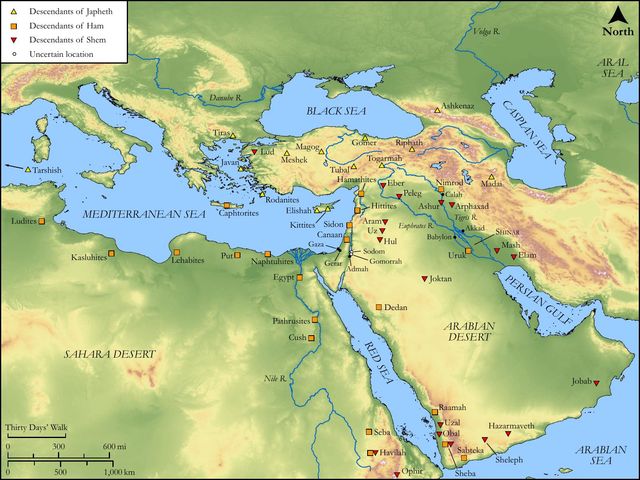
See on the biblical-era maps


Study this verse
Public-domain commentary
Matthew Henry
From his Commentary on the Whole Bible. Henry comments on passages, not single verses — this entry covers Genesis 10:21–32. His three-level outline is real structure in the source text, so it is rendered as structure.
Two things especially are observable in this account of the posterity of Shem: -
I.The description of Shem, Gen 10:21.
We have not only his name, Shem, which signifies a name, but two titles to distinguish him by: -
1.He was the father of all the children of Eber. Eber was his great grandson; but why should he be called the father of all his children, rather than of all Arphaxad's, or Salah's, etc.? Probably because Abraham and his seed, God's covenant-people, not only descended from Heber, but from him were called Hebrews; Gen 14:13, Abram the Hebrew. Paul looked upon it as his privilege that he was a Hebrew of the Hebrews, Phi 3:5. Eber himself, we may suppose, was a man eminent for religion in a time of general apostasy, and a great example of piety to his family; and, the holy tongue being commonly called from him the Hebrew, it is probable that he retained it in his family, in the confusion of Babel, as a special token of God's favour to him; and from him the professors of religion were called the children of Eber. Now, when the inspired penman would give Shem an honourable title, he calls him the father of the Hebrews. Though when Moses wrote this, they were a poor despised people, bond-slaves in Egypt, yet, being God's people, it was an honour to a man to be akin to them. As Ham, though he had many sons, is disowned by being called the father of Canaan, on whose seed the curse was entailed (Gen 9:22), so Shem, though he had many sons, is dignified with the title of the father of Eber, on whose seed the blessing was entailed. Note, a family of saints is more truly honourable than a family of nobles, Shem's holy seed than Ham's royal seed, Jacob's twelve patriarchs than Ishmael's twelve princes, Gen 17:20. Goodness is true greatness.
2.He was the brother of Japheth the elder, by which it appears that, though Shem is commonly put first, he was not Noah's first-born, but Japheth was older. But why should this also be put as part of Shem's title and description, that he was the brother of Japheth, since it had been, in effect, said often before? And was he not as much brother to Ham? Probably this was intended to signify the union of the Gentiles with the Jews in the church. The sacred historian had mentioned it as Shem's honour that he was the father of the Hebrews; but, lest Japheth's seed should therefore be looked upon as for ever shut out from the church, he here reminds us that he was the brother of Japheth, not in birth only, but in blessing; for Japheth was to dwell in the tents of Shem. Note,
(1.)Those are brethren in the best manner that are so by grace, and that meet in the covenant of God and in the communion of saints.
(2.)God, in dispensing his grace, does not go by seniority, but the younger sometimes gets the start of the elder in coming into the church; so the last shall be first and the first last.
II.The reason of the name of Peleg (Gen 10:25):
Because in his days (that is, about the time of his birth, when his name was given him), was the earth divided among the children of men that were to inhabit it; either when Noah divided it by an orderly distribution of it, as Joshua divided the land of Canaan by lot, or when, upon their refusal to comply with that division, God, in justice, divided them by the confusion of tongues: whichsoever of these was the occasion, pious Heber saw cause to perpetuate the remembrance of it in the name of his son; and justly may our sons be called by the same name, for in our days, in another sense, is the earth, the church, most wretchedly divided.
Historical interpretation
Six Centuries of Reception
3 surviving comments on this verse. Each one is dated, so this reads as a timeline rather than a list.
Select a marker to jump to its quote. Markers stagger vertically where authors wrote within a few decades of each other.
Shem, the third son of Noah, had five sons, who inhabited the land that began at Euphrates, and reached to the Indian Ocean. For Elam left behind him the Elamites, the ancestors of the Persians. Ashur lived at the city Nineve; and named his subjects Assyrians, who became the most fortunate nation, beyond others. Arphaxad named the Arphaxadites, who are now called Chaldeans. Aram had the Aramites, which the Greeks called Syrians; as Laud founded the Laudites, which are now called Lydians. Of the four sons of Aram, Uz founded Trachonitis and Damascus: this country lies between Palestine and Celesyria. Ul founded Armenia; and Gather the Bactrians; and Mesa the Mesaneans; it is now called Charax Spasini. Sala was the son of Arphaxad; and his son was Heber, from whom they originally called the Jews Hebrews. (18) Heber begat Joetan and Phaleg: he was called Phaleg, because he was born at the dispersion of the nations to their several countries; for Phaleg among the Hebrews signifies division. Now Joctan, one of the sons of Heber, had these sons, Elmodad, Saleph, Asermoth, Jera, Adoram, Aizel, Decla, Ebal, Abimael, Sabeus, Ophir, Euilat, and Jobab. These inhabited from Cophen, an Indian river, and in part of Asia adjoining to it. And this shall suffice concerning the sons of Shem.
Eber, from whom the Hebrews descended, because of a prophecy gave his son the name Peleg, which means “division,” on account of the fact that in his days the languages were divided up in Babylon.
And there were born to Heber two sons: the name of one was Peleg, because in his days the earth was divided, and the name of his brother was Joktan. He calls this the division of the earth, which occurred in the confusion of languages. He named his son Peleg, that is, Division, to leave a perpetual memory of his devotion to his descendants, because, indeed, when the languages of the faithless were divided due to their pride, he, by the merit of his faith, preserved the original language of the human race.
Continue studying Genesis 10:25 across the web’s major study libraries — every link below opens this exact verse, chapter, or book on the destination site.
Read & Compare
 BibleGatewayThis verse in more than 200 translations and 70 languages.
 Bible.comThe YouVersion reader — hundreds of translations, reading plans, and highlights.
 ESV.orgCrossway's official English Standard Version reader.
 NET BibleThe NET translation with 60,000+ translators' notes on every rendering decision.
 STEP BibleTyndale House's free study tool — original text, vocabulary, and scholarly resources.
 BibliaLogos Bible Software's free web reader.
 USCCBThe New American Bible (Revised Edition) with the U.S. bishops' study notes.
Commentaries
 BibleHub CommentariesDozens of classic commentaries on this verse, gathered on one page.
 StudyLightMore than 100 commentary sets — the largest collection on the web.
 BibleRefPlain-English commentary on what this verse means, verse by verse.
 Enduring WordDavid Guzik's free commentary on this chapter, widely used by Bible teachers.
 Bible Study ToolsVerse commentary alongside Greek and Hebrew study aids.
Original Language & Research
- BibleHub InterlinearThe verse word by word — original language, transliteration, and English.
- BibleHub LexiconEvery word's original-language definition and Strong's entry.
 Blue Letter BibleDeep-study tools — Strong's numbers, concordance, and word studies.
 SefariaThe Hebrew text with Rashi and centuries of Jewish commentary.
Sermons, Hymns & Audio


TrulyRandomVerse is not affiliated with these sites and doesn’t control their content. They’re linked because they’re genuinely useful.
Summary
Genesis 10:25 succinctly records the lineage of Eber, noting the birth of his two sons, Peleg and Joktan. The verse's profound significance lies in the etymological explanation for Peleg's name: "for in his days was the earth divided." This statement serves as a pivotal historical marker within the biblical narrative, alluding to a foundational event of human dispersion, most commonly understood as the linguistic and geographical partitioning of humanity following the events at the Tower of Babel.
Context
ShowHideLiterary Context
Genesis 10:25 is situated within the "Table of Nations" (Genesis 10), a remarkable genealogical and ethnographic document detailing the descendants of Noah's three sons—Japheth, Ham, and Shem—after the Great Flood. This chapter meticulously traces the origins and early distribution of the world's peoples and nations, providing a comprehensive framework for understanding post-diluvian human history. The specific lineage of Eber, a descendant of Shem, is particularly significant as he is considered the eponymous ancestor of the Hebrew people. The brief, almost parenthetical, note concerning the earth's division in Peleg's days serves as a crucial chronological and thematic link, anticipating the narrative of the Tower of Babel in Genesis 11, which immediately follows this genealogical record. This careful structuring highlights the theological importance of the division event.
Historical & Cultural Context
The "Table of Nations" reflects an ancient understanding of ethnography, organizing peoples according to patriarchal descent and geographical distribution. In Israel, genealogies were not merely lists of names but served as vital historical, legal, and theological documents, establishing identity, rights, and relationships. The naming of children often carried deep significance, frequently commemorating events or expressing hopes and prophecies. The note that "in his days was the earth divided" points to a memory or tradition of a profound societal shift. While modern geological theories suggest continental drift occurred over vast eons, the biblical text, from a historical and cultural perspective, refers to a human-centric division—likely the separation of peoples into distinct linguistic and cultural groups, leading to their migration and settlement across different regions. This understanding aligns with the biblical worldview where human actions and divine interventions shape history.
Key Themes
ShowHideGenesis 10:25 contributes to several overarching themes within the book of Genesis and the broader biblical narrative. Firstly, it underscores the theme of Divine Sovereignty and Providence, demonstrating God's active hand in shaping human history, including the formation and distribution of nations. Secondly, it introduces the theme of Human Diversity, providing a biblical explanation for the multiplicity of languages, cultures, and peoples globally, rooting it in a specific historical act of divine judgment and dispersion, as elaborated in the Tower of Babel account. Thirdly, despite the division, the "Table of Nations" reinforces the theme of Shared Human Ancestry, tracing all humanity back to a common source (Noah, and ultimately Adam), emphasizing the fundamental unity and shared heritage of all peoples as created in God's image. This verse also subtly introduces the theme of Consequences of Rebellion, hinting at the divine response to humanity's unified defiance against God's command to "fill the earth" (see Genesis 9:1).
Exposition and Analysis
ShowHideGenesis 10:25, though a brief genealogical entry, carries immense historical and theological weight, providing a critical detail in the post-Flood narrative. It introduces two sons of Eber, Peleg and Joktan, with the former's name directly linked to a major historical event, a common biblical motif where a child's name reflects a significant occurrence during their lifetime.
Key Word Analysis
ShowHideMeaning "earthquake; Peleg, a son of Shem." The name itself is derived from the root H6385 (pâlag), meaning "to split" or "divide." This direct correlation between the name and the event "the earth was divided" highlights the etymological significance and reinforces the historical veracity of the recorded event, suggesting a profound, impactful division.
A primitive root meaning "to split (literally or figuratively)." This word is crucial as it describes the nature of the "division." While it can mean a physical splitting, in this context, especially when read in conjunction with Genesis 11, it is most widely understood as a figurative splitting or partitioning of humanity, primarily through linguistic and subsequent geographical dispersion.
Meaning "a day (as the warm hours), whether literal (from sunrise to sunset, or from one sunset to the next), or figurative (a space of time defined by an associated term)." The phrase "in his days" indicates that this significant division occurred during Peleg's lifetime, tying the event to a specific period in early human history rather than an abstract or timeless concept. This temporal marker grounds the event within the chronological framework of Genesis.
Verse Breakdown
ShowHide"And unto Eber were born two sons:"
This clause continues the genealogical record, establishing Eber's direct lineage and setting the stage for the introduction of his offspring. Eber's position is significant as a progenitor of the Hebrew people.
"the name of one [was] Peleg;"
This identifies the first son and immediately prepares the reader for the explanation of his name, which is central to the verse's meaning. The naming convention is a deliberate literary device.
"for in his days was the earth divided;"
This is the pivotal explanatory clause, providing the etymological reason for Peleg's name. The phrase "the earth was divided" (Hebrew: נִפְלְגָה הָאָרֶץ, niphlegah ha'aretz) is most widely understood not as a geological or continental split, but as the linguistic and geographical dispersion of humanity, elaborated upon in the Tower of Babel narrative. This division marks a significant turning point in early human history, leading to the formation of distinct nations and language groups.
"and his brother's name [was] Joktan."
This concludes the naming of Eber's two sons, providing the name of Peleg's sibling. While Joktan's lineage also leads to various peoples (Genesis 10:26-29), the focus of this particular verse remains on Peleg due to the profound event associated with his lifetime.
Literary Devices
ShowHideThe primary literary device employed in Genesis 10:25 is Etiology, the explanation of the origin of a name, custom, or phenomenon. Peleg's name is explicitly linked to the division of the earth that occurred "in his days," providing a foundational explanation for the diversification of humanity. This verse also functions as a Proleptic Statement or Foreshadowing, subtly hinting at the events of the Tower of Babel in Genesis 11 before they are fully narrated. The concise, almost parenthetical, nature of the "earth divided" phrase within a genealogical list also demonstrates Conciseness and Economical Language, packing profound historical and theological meaning into a few words.
Theological and Thematic Connections
ShowHideGenesis 10:25 serves as a profound theological statement on God's active governance over human history and the origins of global diversity. It affirms that the vast tapestry of languages, cultures, and nations is not merely a random outcome but is intricately woven into God's sovereign plan, partly as a response to human rebellion and partly to facilitate the unfolding of His redemptive purposes. This verse, when read alongside the Tower of Babel account, provides a biblical framework for understanding the origins of human ethnological differences while simultaneously upholding the foundational unity of humanity, all descended from a common ancestor. This divine division prevented a unified human rebellion from reaching its full, destructive potential, ensuring that humanity would spread across the earth as originally commanded (Genesis 9:1).
Reflection and Application
ShowHideGenesis 10:25, though brief, offers profound insights for contemporary understanding of human diversity and God's sovereign hand in history. It challenges us to look beyond superficial differences and recognize the divine origin of the multiplicity of languages and cultures, understanding them as part of God's intricate design and a response to humanity's trajectory. This verse encourages us to appreciate the shared humanity that binds us all, despite our linguistic and cultural distinctions, fostering a call for unity and understanding among peoples under the one Creator. It reminds us that God is actively involved in the affairs of nations, shaping their destinies and guiding their movements, ultimately for His glory and the fulfillment of His redemptive plan.
Questions for Reflection
ShowHideFAQ
ShowHideWhat does "the earth was divided" mean in Genesis 10:25?
ShowHideWhile some historical interpretations have suggested a literal geological or continental split, the prevailing and most biblically consistent understanding links this division to the linguistic and subsequent geographical dispersion of peoples following the events at the Tower of Babel. As described in Genesis chapter 11, God confused humanity's languages, leading to the formation of distinct linguistic and cultural groups that then spread across the globe, fulfilling the divine command to "fill the earth." This "division" therefore primarily refers to the fracturing of human unity into diverse nations and tongues.
Christ-Centered Fulfillment
ShowHideThe division of humanity into diverse nations and languages, initiated in Peleg's days and solidified at Babel, finds its ultimate reversal and redemptive fulfillment in Jesus Christ. Where humanity was scattered by judgment, Christ gathers and unifies. Through His atoning work on the cross, Jesus breaks down the dividing walls of hostility that separate peoples (Ephesians 2:14-16). He creates one new humanity, a spiritual family drawn from "every nation, from all tribes and peoples and languages" (Revelation 7:9). The miraculous outpouring of the Holy Spirit at Pentecost, where disciples spoke in diverse languages and were understood by people from every nation under heaven (Acts 2:6-11), serves as a powerful foretaste and symbol of God's plan to reverse the effects of Babel, uniting a global people in worship and fellowship through the Gospel. This gathering of a multi-ethnic, multi-lingual church demonstrates God's sovereign purpose to reconcile all things to Himself in Christ, restoring the unity lost in humanity's rebellion.