


Luke 3:36
Bible text: King James Version (1769 Blayney text) · Public domain
Bible text: Berean Standard Bible · Public domain
Bible text: American Standard Version (1901) · Public domain
Bible text: World English Bible, Messianic edition · Public domain
Bible text: Geneva Bible (1599) · Public domain
Bible text: Young's Literal Translation · Public domain
- τοῦtou<the>G3588T-GSMDefinite article Genitive Singular Masculine
- ΚαϊνὰμKainamof CainanG2536N-GSM-PNoun Genitive Singular Masculine Individual
- τοῦtou<the>G3588T-GSMDefinite article Genitive Singular Masculine
- ἈρφαξὰδArphaxadof ArphaxadG742N-GSM-PNoun Genitive Singular Masculine Individual
- τοῦtou<the>G3588T-GSMDefinite article Genitive Singular Masculine
- ΣὴμSēmof ShemG4590N-GSM-PNoun Genitive Singular Masculine Individual
- τοῦtou<the>G3588T-GSMDefinite article Genitive Singular Masculine
- ΝῶεNōeof NoahG3575N-GSM-PNoun Genitive Singular Masculine Individual
- τοῦtou<the>G3588T-GSMDefinite article Genitive Singular Masculine
- ΛάμεχLamechof LamechG2984N-GSM-PNoun Genitive Singular Masculine Individual
English is a literal word-by-word gloss of the Greek, not the KJV's wording. Why?
This is the original text the KJV's translators worked from — each Greek word with its own literal English meaning in this verse, prepared by scholars at Tyndale House, Cambridge. The KJV translates whole sentences, not word by word, so its wording differs: one Greek word can become several English words, and the KJV may choose “charity” where the gloss reads “love”. Both are faithful — they answer different questions. For the KJV's own rendering, switch to the KJV text.
Details
See on the biblical-era maps
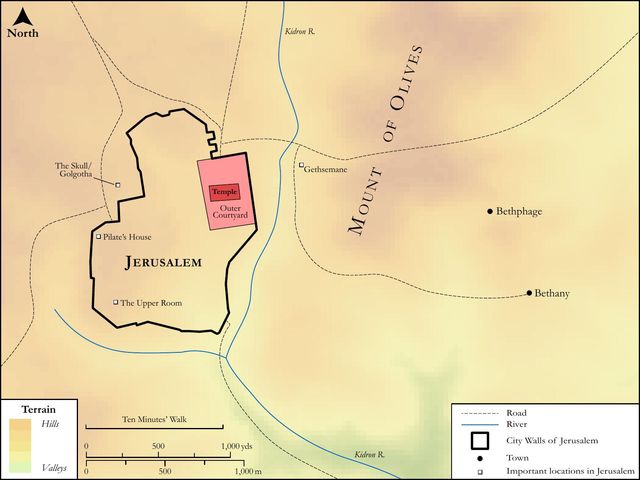
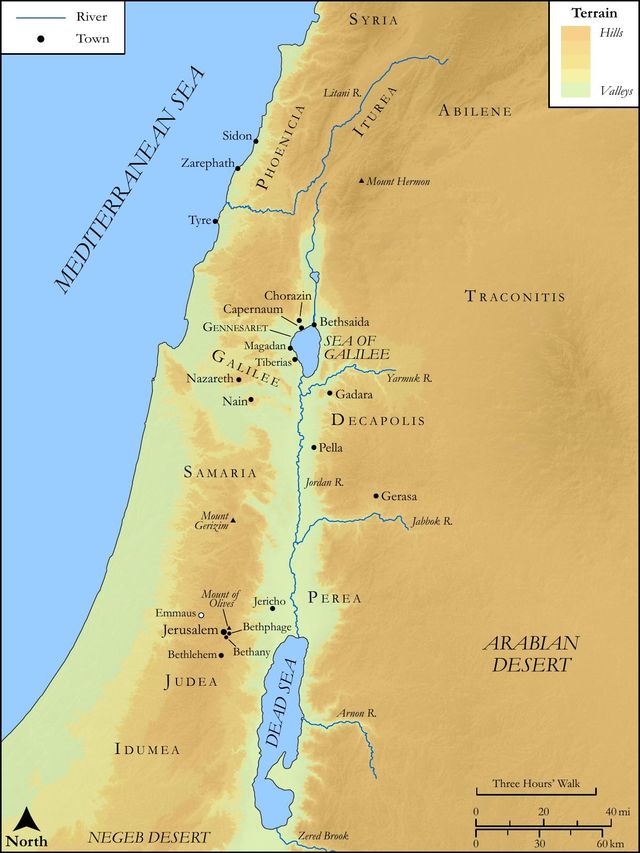
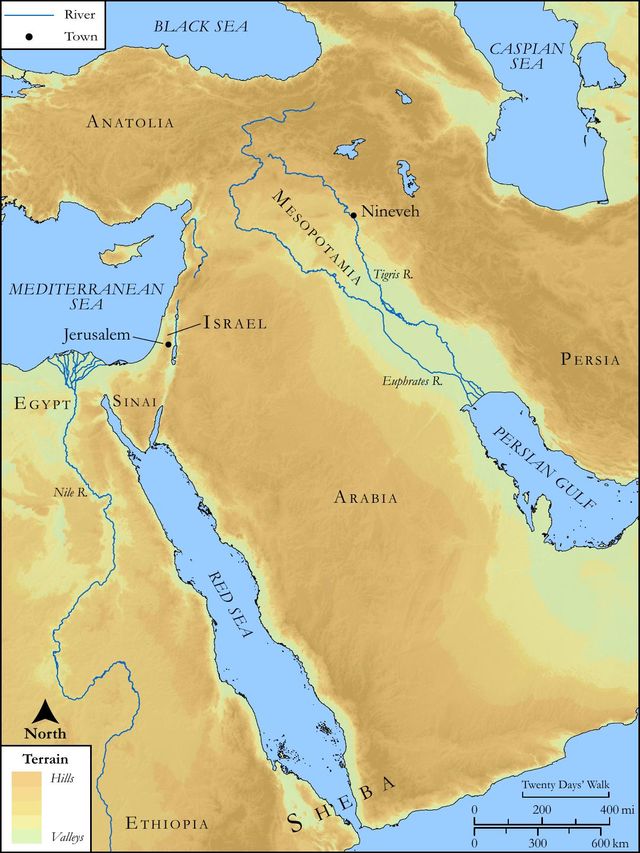
Study this verse
Public-domain commentary
Matthew Henry
From his Commentary on the Whole Bible. Henry comments on passages, not single verses — this entry covers Luke 3:21–38. His two-level outline is real structure in the source text, so it is rendered as structure.
The evangelist mentioned John's imprisonment before Christ's being baptized, though it was nearly a year after it, because he would finish the story of John's ministry, and then introduce that of Christ. Now here we have,
I.A short account of Christ's baptism, which had been more fully related by St. Matthew. Jesus came, to be baptized of John, and he was so, Luk 3:21, Luk 3:22.
1.It is here said that, when all the people were baptized, then Jesus was baptized: all that were then present. Christ would be baptized last, among the common people, and in the rear of them; thus he humbled himself, and made himself of no reputation, as one of the least, nay, as less than the least. He saw what multitudes were hereby prepared to receive him, and then he appeared.
2.Notice is here taken of Christ's praying when he was baptized, which was not in Matthew: being baptized, and praying. He did not confess sin, as others did, for he had none to confess; but he prayed, as others did, for he would thus keep up communion with his Father. Note, The inward and spiritual grace of which sacraments are the outward and visible signs must be fetched in by prayer; and therefore prayer must always accompany them. We have reason to think that Christ now prayed for this manifestation of God's favour to him which immediately followed; he prayed for the discovery of his Father's favour to him, and the descent of the Spirit. What was promised to Christ, he must obtain by prayer: Ask of me and I will give thee, etc. Thus he would put an honour upon prayer, would tie us to it, and encourage us in it.
3.When he prayed, the heaven was opened. He that by his power parted the waters, to make a way through them to Canaan, now by his power parted the air, another fluid element, to open a correspondence with the heavenly Canaan. Thus was there opened to Christ, and by him to us, a new and living way into the holiest; sin had shut up heaven, but Christ's prayer opened it again. Prayer is an ordinance that opens heaven: Knock, and it shall be opened unto you.
4.The Holy Ghost descended in a bodily shape like a dove upon him; our Lord Jesus was now to receive greater measures of the Spirit than before, to qualify him for his prophetical office, Isa 61:1. When he begins to preach, the Spirit of the Lord is upon him. Now this is here expressed by a sensible evidence for his encouragement in his work, and for the satisfaction of John the Baptist; for he was told before that by this sign it should be notified to him which was the Christ. Dr. Lightfoot suggests that the Holy Ghost descended in a bodily shape, that he might be revealed to be a personal substance, and not merely an operation of the Godhead: and thus (saith he) was made a full, clear, and sensible demonstration of the Trinity, at the beginning of the gospel; and very fitly is this done at Christ's baptism, who was to make the ordinance of baptism a badge of the profession of that faith in the doctrine of the Trinity, Father, Son, and Holy Ghost.
5.There came a voice from heaven, from God the Father, from the excellent glory (so it is expressed, Pe2 1:17), Thou art my beloved Son. Here, and in Mark, it is expressed as spoken to Christ; in Matthew as spoken of him: This is my beloved Son. It comes all to one; it was intended to be a notification to John, and as such was properly expressed by, This is my beloved Son; and likewise an answer to his prayer, and so it is most fitly expressed by. Thou art. It was foretold concerning the Messiah, I will be his Father, and he shall be my Son, Sa2 7:14. I will make him my First-born, Psa 89:27. It was also foretold that he should be God's elect, in whom his soul delighted (Isa 42:1); and, accordingly, it is here declared, Thou art my beloved Son, in whom I am well pleased.
II.A long account of Christ's pedigree, which had been more briefly related by St. Matthew. Here is,
1.His age: He now began to be about thirty years of age. So old Joseph was when he stood before Pharaoh (Gen 41:46), David when he began to reign (Sa2 5:4), and at this age the priests were to enter upon the full execution of their office, Num 4:3. Dr. Lightfoot thinks that it is plain, by the manner of expression here, that he was just twenty-nine years old complete, and entering upon his thirtieth year, in the month Tisri; that, after this, he lived three years and a half, and died when he was thirty-two years and a half old. Three years and a half, the time of Christ's ministry, is a period of time very remarkable in scripture. Three years and six months the heavens were shut up in Elijah's time, Luk 4:25; Jam 5:17. This was the half week in which the Messiah was to confirm the covenant, Dan 9:27. This period is expressed in the prophetical writings by a time, times, and half a time (Dan 12:7; Rev 12:14); and by forty-two months, and a thousand two hundred and threescore days, Rev 11:2, Rev 11:3. It is the time fixed for the witnesses' prophesying in sackcloth, in conformity to Christ's preaching in his humiliation just so long.
2.His pedigree, Luk 3:23, etc. Matthew had given us somewhat of this. He goes no higher than Abraham, but Luke brings it as high as Adam. Matthew designed to show that Christ was the son of Abraham, in whom all the families of the earth are blessed, and that he was heir to the throne of David; and therefore he begins with Abraham, and brings the genealogy down to Jacob, who was the father of Joseph, and heir-male of the house of David: but Luke, designing to show that Christ was the seed of the woman, that should break the serpent's head, traces his pedigree upward as high as Adam, and begins it with Ei, or Heli, who was the father, not of Joseph, but of the virgin Mary. And some suggest that the supply which our translators all along insert here is not right, and that it should not be read which, that is, which Joseph was the son of Heli, but which Jesus; he was the son of Joseph, of Eli, of Matthat, etc., and he, that is, Jesus, was the son of Seth, of Adam, of God, Luk 3:38. The difference between the two evangelists in the genealogy of Christ has been a stumbling-block to infidels that cavil at the word, but such a one as has been removed by the labours of learned men, both in the early ages of the church and in latter times, to which we refer ourselves. Matthew draws the pedigree from Solomon, whose natural line ending in Jechonias, the legal right was transferred to Salathiel, who was of the house of Nathan, another son of David, which line Luke here pursues, and so leaves out all the kings of Judah. It is well for us that our salvation doth not depend upon our being able to solve all these difficulties, nor is the divine authority of the gospels at all weakened by them; for the evangelists are not supposed to write these genealogies either of their own knowledge or by divine inspiration, but to have copied them out of the authentic records of the genealogies among the Jews, the heralds' books, which therefore they were obliged to follow; and in them they found the pedigree of Jacob, the father of Joseph, to be as it is set down in Matthew; and the pedigree of Heli, the father of Mary, to be as it is set down here in Luke. And this is the meaning of hōs enomizeto (Luk 3:23), not, as it was supposed, referring only to Joseph, but uti sancitum est lege - as it is entered into the books, as we find it upon record; by which is appeared that Jesus was both by father and mother's side the Son of David, witness this extract out of their own records, which any one might at that time have liberty to compare with the original, and further the evangelists needed not to go; nay, had they varied from that, they had not gained their point. Its not being contradicted at that time is satisfaction enough to us now that it is a true copy, as it is further worthy of observation, that, when those records of the Jewish genealogies had continued thirty or forty years after these extracts out of them, long enough to justify the evangelists therein, they were all lost and destroyed with the Jewish state and nation; for now there was no more occasion for them.
One difficulty occurs between Abraham and Noah, which gives us some perplexity, Luk 3:35, Luk 3:36. Sala is said to be the son of Cainan, and he the son of Arphaxad, whereas Sala was the son of Arphaxad (Gen 10:24; Gen 11:12), and there is no such man as Cainan found there. But, as to that, it is sufficient to say that the Seventy Interpreters, who, before our Saviour's time, translated the Old Testament into Greek, for reasons best known to themselves inserted that Cainan; and St. Luke, writing among the Hellenist Jews, was obliged to make use of that translation, and therefore to take it as he found it.
The genealogy concludes with this, who was the son of Adam, the son of God. (1.) Some refer it to Adam; he was in a peculiar manner the son of God, being, more immediately than any of his offspring, the offspring of God by creation. (2.) Others refer it to Christ, and so make the last words of this genealogy to denote his divine and human nature. He was both the Son of Adam and the Son of God that he might be a proper Mediator between God and the sons of Adam, and might bring the sons of Adam to be, through him, the sons of God.
Historical interpretation
Ten Centuries of Reception
20 surviving comments on this verse. Each one is dated, so this reads as a timeline rather than a list.
Select a marker to jump to its quote. Markers stagger vertically where authors wrote within a few decades of each other.
(Aug. Quæst. Nov. ac Vet. Test. 56.) Or in another way; Matthew descends from David through Salomon to Joseph: but Luke beginning from Eli, who was in the line of our Saviour, ascends through the line of Nathan the son of David, and joins the tribes of Eli and Joseph, showing that they are both of the same family, and thereby that the Saviour was not only the Son of Joseph, but also of Eli. For by the same reason by which the Saviour is called the son of Joseph, he is also the son of Eli, and of all the rest who are of the same tribe. Hence that which the Apostle says, Of whom are the fathers, and from whom Christ came according to the flesh. (Rom. 9:5.)
Having related our Lord's baptism, he next enters upon the generation of the Lord, not bringing it down from the higher to the lower, but beginning with Christ, he carries it up to God Himself. Hence he says, And Jesus Himself began. For when He was baptized, and had Himself undergone the mystery of the second birth, then He is said to have begun, that thou also mightest destroy this first birth and be born in the second.
The Lord descending into the world took upon Him the person of all sinners, and was willing to be born of the stock of Solomon, (as Matthew relates,) whose sins have been written down, and of the rest, many of whom did evil in the sight of God. But when He ascended, and is described as being born a second time in baptism, (as Luke relates,) He is not born through Salomon, but Nathan, who reproves the father for the death of Uriah, and the birth of Solomon.
Matthew, who makes him descend from the heavenly regions, mentions women—not any women at all, but sinners, and those whom Scripture had reproved. But Luke, who tells of Jesus at his baptism, mentions no woman. Matthew, as we said, names Tamar, who by deception lay with her father-in-law. Ruth was not from the race of Israel. I cannot discover where Rahab was taken from. The wife of Uriah violated her husband's bed. For our Lord and Savior had come for this end, to take upon himself humankind's sins. God "made him who had committed no sin to be sin for our sake." For this reason, he came down into the world and took on the person of sinners and depraved people. He willed to be born from the stock of Solomon, whose sins have been recorded, and from Rehoboam, whose transgressions are reported,and from the rest of them, many of whom "did evil in the sight of the Lord."
Let us then more carefully explain the meaning of the words themselves. For if when Matthew affirmed Joseph to be the son of Jacob, Luke had in like manner affirmed that Joseph was the son of Eli, there would be some dispute. But seeing the case is that Matthew gives his opinion, Luke repeats the common opinion of many, not his own, saying, as was supposed, I do not think that there is any room for doubt. For since there were among the Jews different opinions of the genealogy of Christ, and yet all traced Him up to David because to him the promises were made, while many affirmed that Christ would come through Solomon and the other kings, some shunned this opinion because of the many crimes related of their kings, and because Jeremiah said of Jechonias that "a man should not rise of his seed to sit on the throne of David." (Jer. 22:30.) This last view Luke takes, though conscious that Matthew gives the real truth of the genealogy. This is the first reason. The next is a deeper one. For Matthew when he began to write of the things before the conception of Mary and the birth of Jesus in the flesh, very fitly as in a history commences with the ancestry in the flesh, and descending from thence deduces His generation from those who went before. For when the Word of God became flesh, He descended. But Luke hastens forward to the regeneration which takes place in baptism, and then gives another succession of families, and rising up from the lowest to the highest, keeps out of sight those sinners of whom Matthew makes mention, (because that he who is born again in God is separated from his guilty parents, being made the son of God,) and relates those who have led a virtuous life in the sight of God. For thus it was said to Abraham, Thou shalt set out to thy fathers, (Gen. 15:15.) not fathers in the flesh, but in God, on account of their likeness in virtue. To him therefore fore who is born in God he ascribes parents who are according to God on account of this resemblance in character.
(Orat. 39.) We must therefore consider who He was who was baptized, and by whom and when: seeing He was pure, baptized by John, and at a time when His miracles had begun, that we might thence derive the lesson of purifying ourselves beforehand, and of embracing humility, and of not beginning to preach until the maturity of our spiritual and natural life. The first of these was said for their sakes who are receiving baptism; for although the gift of baptism brings remission, yet we must fear lest we return again to our vomit. The second is pointed at those who exalt themselves against the stewards of the mysteries, whom they may excel in rank. The third was uttered for those who trust in their youth, and imagine that any age is fit for promotion and teaching. Jesus is cleansed, and dost thou despise purification? By John, and dost thou say ought against thy teacher. At thirty years old, but dost thou in teaching precede thy elders? But the example of Daniel and the like are ready in thy mouth, for every guilty person is ready with an answer. But that is not the law of the Church which seldom happens, as neither does a single swallow make the spring.
(Orat. 40.) Still must a child be baptized if necessity demands it. For it is better to be insensibly sanctified, than to pass from this life unsealed. But you will say, Christ is baptized at thirty years old, and He was God, but thou biddest us to hasten our baptism. In that thou saidst God, the objection was done away: He needed no cleansing, nor was any danger hanging over Him while He put off His baptism. But with thee it extends to no slight calamity, if thou passest from this life born in corruption, but not if thou hast put on the robe of incorruption. And truly it is a blessed thing to keep unsullied the clean robe of baptism, but it is better at times to be slightly stained, than to be altogether devoid of grace.
(Carm. 18.) But some say that there is one succession from David to Joseph, which each Evangelist relates under different names. But this is absurd, since at the beginning of this genealogy, two brothers come in Nathan and Salomon, from whom the lines are carried in different ways.
(ubi sup.) From David upwards according to each Evangelist there is an unbroken line of descent; as it follows, Who was the son of Jesse.
You see that the description of descent is connected by the old custom from the fathers to the sons and from the sons to the fathers. You see that the family is everywhere listed through the generations of the husband. Do not marvel if Matthew reports the order of the generations from Abraham to Joseph, and Luke from Joseph to Adam and to God. Do not marvel that Joseph’s lineage is described. Indeed, being born according to the flesh, he must follow the usage of the flesh, and he who came into the world must be described in the custom of the world, particularly as the lineage of Mary is also in the lineage of Joseph. For since Joseph was a righteous man, he took a wife from his own tribe and his own country, nor could a righteous man contravene what is prescribed in the law. “The inheritance of the people of Israel shall not be transferred from one tribe to another. For every one of the people of Israel shall cleave to the inheritance of the tribe of his fathers. Every daughter who possesses an inheritance in any tribe of the people of Israel shall be wife to one of the family of the tribe of her father, so that every one of the people of Israel may possess the inheritance of his fathers.” Therefore, also at the time of the enrollment, Joseph went up from his house and the country of David to be enrolled with Mary his wife. She who enrolls from the same house and the same country surely signifies that she is of this same tribe and this same country.
Therefore Luke also thought that his origin should be traced back to God. Because God is the true Father of Christ, either the Father according to the true generation or the Author of the mystical gift—according to the regeneration of baptism. Furthermore, he did not start by describing his generation but first set forth his baptism. He desired to show him as God, the Author of all, weaving everything together through baptism. He also stated that Christ derived from God in the order of succession, in order to prove him the Son of God according to nature, according to grace and according to the flesh. Then what clearer evidence is there of divine generation than that before speaking of Jesus’ generation, Luke has the Father himself saying, “This is my beloved Son, in whom I am well pleased”?
Here too some … raise issues: that Matthew counted forty-two generations from Abraham to Christ, but Luke fifty, and that Matthew reported that the generation descended through some persons, and Luke mentioned others. In this matter, you can test what we said. Although Matthew wove some forefathers of the divine lineage, but Luke others, into the order of generation, nevertheless each indicated that the remaining ancestors were from the race of Abraham and David. Matthew thought the generation should be derived through Solomon, but Luke through Nathan. This fact seems to show both a royal and a priestly family of Christ. We should not consider one account truer than the other, but that the one agrees with the other in equal faith and truth. According to the flesh, Jesus was truly of a royal and priestly family, King from kings, Priest from priests. Although the prophecy pertains not to the carnal but the celestial, since a King exults in the power of God, to whom judgment is committed by the King, his Father, and a Priest is forever. Accordingly it is written, “You are a priest forever after the order of Melchizedek.” Then, each fittingly kept faith, so that Matthew established his origin led through kings, and Luke, by deriving the lineage of his race transmitted through priests from God to Christ, declared his very descent the more holy. At the same time, the image of a calf is indicated, in so much as he thinks the priestly mystery must be preserved.
Rightly as was supposed, since in reality He was not, but was supposed to be so, because Mary who was espoused to Joseph was His mother. But we might doubt why the descent of Joseph is described rather than that of Mary, (seeing that Mary brought forth Christ of the Holy Spirit, while Joseph seemed to be out of the line of our Lord's descent,) were we not informed of the custom of the Holy Scripture, which always seeks the origin of the husband, and especially in this case, since in Joseph's descent we also find that of Mary. For Joseph being a just man took a wife really from his own tribe and country, and so at the time of the taxing Joseph went up from the family and country of David to be taxed with Mary his wife. She who gives in the returns from the same family and country, shows herself to be of that family and country. Hence He goes on in the descent of Joseph, and adds, Who was the son of Eli. But let us consider the fact, that St. Matthew makes Jacob, who was the father of Joseph, to be son of Nathan, but Luke says that Joseph (to whom Mary was espoused) was the son of Eli. How then could there be two fathers, (namely, Eli and Jacob,) to one man.
For it is related that Matthas, who was descended from Salomon, begat Jacob as his son, and died leaving his wife living, whom Melchi took unto him as wife, and from her Eli was born. Again, Eli, when his brother Jacob died without children, was joined to his brother's wife, and begot a son Joseph, who according to law is called the son of Jacob, since Eli raised up seed to his deceased brother, according to the order of the ancient law. (Deut. 25:5.)
Luke rightly thought, seeing that he could not embrace more of the sons of Jacob, lest he should seem to be wandering from the line of descent in a superfluous course, that the ancient names of the Patriarchs though occurring in others far later, Joseph, Judah, Simeon, and Levi, should not be omitted. For we recognise in these four kinds of virtue; in Judah, the mystery of our Lord's Passion prophesied by figure; in Joseph, an example of chastity going before; in Simeon, the punishment of injured modesty; in Levi, the priestly office. Hence it follows, Who was the son of Melchi, i. e. "my King." Who was the son of Janna, i. e. "a right hand." Who was the son ofJoseph, i. e. "growing up;" but this was a different Joseph. Who was the son of Mattathias, i. e. "the gift of God," or "sometimes." Who was the son of Amos, i. e. "loading, or he loaded." Who was the son of Naum, i. e. "help me." Who was the son of Matthat, i. e. "desire." Who was the son of Mattathias, as above. Who was the son of Simei, i. e. "obedient." Who was the son ofJoseph, i. e. "increase." Who was the son of Judah, i. e. "confessing." Joanna, "the Lord, his grace," or "the gracious Lord." Resa, "merciful." Zorobabel, "chief or master of Babylon." Salathiel, "God my petition." Neri, "my lanthern." Melchi, "my kingdom." Addi, "strong or violent." Cosam, "divining." Her, "watching, or watch, or of skins." Who was the son of Jesus, i. e. "Saviour." Eliezer, i. e. "God my helper." Joarim, i. e. "God exalting, or, is exalting." Matthat, as above. Levi, as above. Simeon, i. e. "He has heard the sadness, or the sign." Juda, as above. Joseph, as above. Jonah, a dove, or wailing. Eliachim, i. e. "the resurrection of God." Melchi, i. e. "his king." Menan, i. e. "my bowels." Mattathias, i. e. "gift." Nathan, i. e. "He gave, or, of giving."
But by Nathan we perceive expressed the dignity of Prophecy, that as Christ Jesus alone fulfilled all things, in each of His ancestors different kinds of virtue might precede Him. It follows, Who was the son of David.
The mention of just Noah ought not to be omitted among our Lord's generations, that as our Lord was born the builder of His Church, He might seem to have sent Noah beforehand, the author of His race, who had before founded the Church under the type of an ark. Who was the son of Lamech.
His years are numbered beyond the deluge, that since Christ is the only one whose life experiences no age, in His ancestors also He might seem to have felt not the deluge. Who was the son of Enoch. And here is a manifest declaration of our Lord's piety and divinity, since our Lord neither experienced death, and returned to heaven, the founder of whose race was taken up into heaven. Whence it is plain that Christ could not die, but was willing that His death should profit us. And Enoch indeed was taken, that his heart might not change by wickedness, but the Lord, whom the wickedness of the world could not change, returned to that place whence He had come by the greatness of His own nature.
What could better agree than that the holy generation should commence from the Son of God, and be carried up even to the Son of God; and that he who was created should precede in a figure, in order that he who was born might follow in substance, so that he who was made after the image of God might go before, for whose sake the image of God was to descend. For Luke thought that the origin of Christ should be referred to God, because God is the true progenitor of Christ, or the Father according to the true birth, or the Author of the mystical gift according to baptism and regeneration, and therefore he did not from the first begin to describe His generation, but not till after he had unfolded His baptism, that both by nature and by grace, he might declare Him to be the Son of God. But what more evident sign of His divine generation than that when about to speak of it St. Luke introduces first the Father, saying, Thou art my beloved Son?
Nor do the Evangelists seem so to differ who have followed the old order, nor can you wonder if from Abraham down to Christ there are more successions according to Luke, fewer according to Matthew, since you must admit the line to have been traced through different persons. But it might be that some men have passed a very long life, but the men of the next generation have died at an early age, since we see how many old men live to see their grandchildren, while others depart as soon as they have sons born to them.
It benefits no one to change what is written: “Who was thought to be the son of Joseph.” For it was right that he was “thought” so, because he was not the Joseph’s son by nature but was thought to be his Son, because he was born of Mary, who was engaged to Joseph, her husband. So you have: “Is not this Joseph the carpenter’s son?”
He could not include more sons of Jacob, lest he seem to digress outside the generations in an irrelevant series. Of course, in the case of other, that is, distant, descendants of the patriarchs, Luke did not think the names should be omitted, but that those of Joseph, Judah, Simeon and Levi should be preferred beyond the rest. We know that there were four kinds of virtues in those from whom they were descended. In Judah, the mystery of the Lord’s passion was prefigured. In Joseph, an example of chastity went before. In Simeon, the payment for violated virginity was represented. In Levi, the office of a priest was symbolized. We observe the dignity of prophecy manifested also through Nathan so that because Christ Jesus is one and all, diverse kinds of virtues went before also in individual forefathers.
Yet it seems needful to explain why St. Matthew began to enumerate the descent of Christ from Abraham but St. Luke led it from Christ up to God. But first I think we should not set aside by any means the question why St. Matthew, when he began the order of descent from Abraham, did not say, “The Book of the Generation of Abraham,” but “The Book of the Generation of Jesus Christ, the Son of David, the Son of Abraham.” Why he named these two in particular.…The Evangelist selected those two authors of the race, the one who received the promise concerning the congregation of the nations, the other who obtained the prophecy of the generation of Christ. Although he is later in the order of the succession, yet he is described before Abraham in the generation of the Lord, because it is more to have received the promise concerning Christ than that concerning the church, since the church itself is through Christ. Then there is one prince of the race according to the flesh, and another according to the spirit. The one is a prince by grace of children, the other through the faith of the peoples. For greater is he who saves than he who is saved. Hence he is called “the Son of David,” “the Book of the Generation of Jesus Christ, the Son of David.”
Or, He waited accomplishing the whole law until that age which takes in every sin, that none might say that He abrogated the law because He was not able to fulfil it.
(Hom. 31, in Ep. ad Rom.) But because this part of the Gospel consists of a series of names, men think there is nothing valuable to be derived therefrom. Lest then we should feel this, let us try to examine every step. For from the mere name we may extract an abundant treasure, for names are indicative of many things. For they savour of the Divine mercy and the offerings of thanks by women, who when they obtained sons gave a name significant of the gift.
(Hom. in Matt 1.) Matthew, who wrote as for the Jews, had no further object than to show that Christ proceeded from Abraham and David, for this was most grateful to the Jews. Luke however, as speaking to all men in common, carried his account beyond as far even as Adam. Hence it follows, Who was the son of Thara.
What do you say about the sacred words of Luke
When he the genealogy repeats,
The fleshly line retracing through old sires?
Up generations seventy-two
Christ mounts—so many teachers into the world
He sent—and by the steps down to his birth
Goes back to Adam, head of earthly flesh.
The Father then receives his Son and us,
And Adam son of God becomes through Christ.
Nothing now remains but that you deem this race
Unreal, Levi, Judah, Simeon,
King David, other mighty kings, unreal,
The virgin’s swelling womb itself grown big
With lying vapor, flimsy clouds and mist.
That airy blood dissolves, the bones grow soft
And melt, the trembling muscles disappear.
That every deed the idle wind dispels,
The breezes scatter, all an empty tale.
(Quæst. Ev. ii. qu. 5.) Or there occur three reasons, by one of which the Evangelist was led. For either one Evangelist has mentioned the father by whom Joseph was begotten, but the other his maternal grandfather, or some one of his ancestors. Or one of the fathers mentioned was the natural father of Joseph, the other his father who had adopted him. Or after the manner of the Jews, when a man has died without children, the next of kin taking his wife ascribes to his dead kinsman the son whom he has himself begotten.
(de Con. Ev. lib. ii. c. 3.) It is most probable that Luke took the origin by adoption, as not being willing to say that Joseph, was begotten by him whose son he related him to be. For more easily is a man said to be his son by whom he was adopted, than to be begotten by him from whose flesh he was not born. But Matthew saying, "Abraham begat lsaac, and Isaac begat Jacob," and continuing in the word "begat," until at last he says, but "Jacob begat Joseph," has sufficiently expressed that he has carried through the succession of the fathers, to that father by whom Joseph was not adopted, but begotten. Although even supposing that Luke should say that Joseph was begotten by Eli, neither ought that word to perplex us. For it is not absurd to say that a man has begotten not in the flesh but in love the Son whom he has adopted. But rightly has Luke taken the origin by adoption, for by adoption are we made the sons of God, by believing on the Son of God, but by His birth in the flesh, the Son of God has rather for our sakes become the Son of man.
(Retract. i. c. 26.) But it must be confessed that a prophet of this same name reproves David, that he might be thought to be the same man, whereas he was different.
(de Con. Ev. lib. ii. c. 3.) He sufficiently declared by this that he called not Joseph the son of Eli because he was begotten by him, but rather because he was adopted by him, for he has called also Adam himself son, since though made by God, yet by grace (which he forfeited by sin) he was placed as a son in paradise.
(ubi sup. c. 4.) Matthew indeed wished to set forth God descending to our mortality; accordingly at the beginning of the Gospel he recounted the generations from Abraham to the birth of Christ in a descending scale. But Luke, not at the beginning, but after the baptism of Christ, relates the generation not descending but ascending, as if marking out rather the high priest in the expiation of sins, of whom John bore testimony, saying, Behold, who taketh away the sins of the world. But by ascending he comes to God, to whom we are reconciled, being cleansed and expiated.
(Quæst. Ev. lib. ii. qu. 6.) But most fitly with regard to our baptized Lord does Luke reckon the generations through seventy-seven persons. For both the ascent to God is expressed, to whom we are reconciled by the abolition of sins, and by baptism is brought to man the remission of all his sins, which are signified by that number. For eleven times seven are seventy-seven. But by the tenth number is meant perfect happiness. Hence it is plain that the going beyond the tenth marks the sin of one through pride coveting to have more. But this is said to be seven times to signify that the transgression was caused by the moving of man. For by the third number the immortal part of man is represented, but by the fourth the body. But motion is not expressed in numbers, as when we say, one, two, three; but when we say, once, twice, thrice. And so by seven times eleven, is signified a transgression wrought by man's action.
Who was Sela, who was Cainan, who was Arphaxad. The name and generation of Cainan, according to Hebrew truth, is found neither in Genesis nor in the Words of the Days; but it is claimed that Arphaxad begat Sela or Sale as a son without any intermediary; for it is written: Now Arphaxad lived thirty years and begot Sale (Gen. XI). And likewise in Chronicles: Arphaxad begot Sala, who also begot Heber (1 Chronicles I). Therefore, understand that blessed Luke took this genealogy from the edition of the seventy interpreters, where it is written that Arphaxad at the age of one hundred and thirty-five begat Cainan, and Cainan, when he was one hundred and thirty years old, begat Sela. But which of these is true, or if both can be true, God knows. We simply remind the reader that such a great discrepancy exists between the two codes in the series of time that from the flood to the birth of Abraham in Hebrew truth there are found to be 292 years, but in the translation of the seventy interpreters, 1,077 years are comprehended. And some chronographers, taking a middle course, removing only the generation of Cainan, and without correcting the other years according to the Hebrew example, describe 942 years of the same period.
The thrice ten years also which our Saviour had passed when He was baptized might intimate also the mystery of our baptism, because of the faith in the Trinity, and the obedience to the Decalogue.
Or else, Jacob, taking the wife of his brother Eli who had died without children according to the command of the law, begot Joseph, by natural parentage his own son, but by the ordinance of the law the son of Eli.
The name and generation of Cainan, according to the Hebrew reading, is found neither in Genesis, nor in the Chronicles, (dierum Vulg. verbis.) but Arphaxad is stated to have begot Sala his son, without any one intervening. Know then that Luke borrowed this generation from the Septuagint, where it is written, that Arphaxad at a hundred and thirty-five years old begot Cainan, but he at a hundred and thirty years begot Sala. It follows, Who was the son of Arphaxad.
But rightly rising up from the baptized Son of God to God the Father, he places Enoch in the seventy-seventh step, who, having put off death, was translated unto Paradise, that he might signify that those, who by the grace of adoption of sons are born again of water and the Holy Spirit, are in the mean time (after the dissolution of the body) to be received into eternal rest, for the number seventy, because of the seventh of the sabbath, signifies the rest of those who, the grace of God assisting them, have fulfilled the decalogue of the aw.
For this reason he closes the generations in God, that we may learn that those fathers who intervene, Christ will raise up to God, and make them sons of God, and that it might be believed also that the birth of Christ was without seed; as if he said, If thou believest not that the second Adam was made without seed, you must come to the first Adam, and you will find that he was made by God without seed.
(Severus.) For this reason also He came at thirty years to be baptized, to show that spiritual regeneration makes men perfect as far as regards their spiritual life.
(interlin.) By interpretation then Eli means, "My God," or "climbing," Who was the son of Matthat, i. e. "forgiving sins." Who was the son of Levi, i. e. "being added."
(ubi sup.) David is interpreted, "with a mighty arm, strong in fight." Obith, i. e. "slavery." Booz, i. e. "strong." Salmon, i. e. "capable of feeling, or peace-making." Naasson, i. e. "augury, or belonging to serpents." Aminadab, "the people being willing." Aram, i. e. "upright, or lofty." Esrom, i. e. "an arrow." Phares, i. e. "division." Judah, i. e. "confessing." Who was the son of Jacob, i. e. "supplanted." Isaac, i. e. "laughing or joy." Abraham, i. e. "the father of many nations, or the people."
(ubi sup.) Which is interpreted, "finding out," or "wickedness." Nachor, i. e. "the light rested." Sarug, i. e. "correction," or "holding the reins," or "perfection." Ragan, i. e. "sick," or "feeding." Phares, i. e. "dividing," or "divided." Heber, i. e. "passing over." Sala, i. e. "taking away." Canaan, i. e. "lamentation," or "their possession."
(ubi sup.) i. e. "healing the laying waste." Sem, i. e. "a name," or being "named." Who was the son of Noe, i. e. "rest."
(ubi sup.) i. e. "humility, or striking, or struck, or humble." Who was the son of Mathusalem, i. e. "the sending forth of death," or "he died," also "he asked."
Enoch is interpreted "dedication." Jared, i. e. descending or "holding together." Malaleleel, i. e. "the praised of God," or" praising God." Cainan, as above. Enos, i. e. "man," or "despairing," or "violent." Seth, i. e. "placing," "settling," "he hath placed." Seth, the last son of Adam, is not omitted, that as there were two generations of people, it might be signified under a figure that Christ was to be reckoned rather in the last than the first.
It follows, Who was the son of Adam.
(ubi sup.) Which is "man," or "of the earth," or "needy." Who was the son of God.
Continue studying Luke 3:36 across the web’s major study libraries — every link below opens this exact verse, chapter, or book on the destination site.
Read & Compare
 BibleGatewayThis verse in more than 200 translations and 70 languages.
 Bible.comThe YouVersion reader — hundreds of translations, reading plans, and highlights.
 ESV.orgCrossway's official English Standard Version reader.
 NET BibleThe NET translation with 60,000+ translators' notes on every rendering decision.
 STEP BibleTyndale House's free study tool — original text, vocabulary, and scholarly resources.
 BibliaLogos Bible Software's free web reader.
 USCCBThe New American Bible (Revised Edition) with the U.S. bishops' study notes.
Commentaries
 BibleHub CommentariesDozens of classic commentaries on this verse, gathered on one page.
 StudyLightMore than 100 commentary sets — the largest collection on the web.
 BibleRefPlain-English commentary on what this verse means, verse by verse.
 Enduring WordDavid Guzik's free commentary on this chapter, widely used by Bible teachers.
 Bible Study ToolsVerse commentary alongside Greek and Hebrew study aids.
Original Language & Research
- BibleHub InterlinearThe verse word by word — original language, transliteration, and English.
- BibleHub LexiconEvery word's original-language definition and Strong's entry.
 Blue Letter BibleDeep-study tools — Strong's numbers, concordance, and word studies.
 CNTR CollationThe earliest Greek manuscripts of this verse, collated letter by letter.
Sermons, Hymns & Audio


TrulyRandomVerse is not affiliated with these sites and doesn’t control their content. They’re linked because they’re genuinely useful.
Summary
Luke 3:36 is a pivotal verse within Jesus Christ's extensive genealogy, meticulously recorded by Luke. This verse traces five generations of Jesus's ancestry, moving backward in time from Cainan to Lamech, connecting the post-Flood patriarchs—specifically Arphaxad and Shem—to the pre-Flood world through Noah and Lamech. It underscores the historical continuity of God's redemptive plan and establishes Jesus's deep roots within the broader human story, emphasizing His connection not just to Israel but to all of humanity.
Context
ShowHideLiterary Context
Luke 3:36 is embedded within the comprehensive genealogy of Jesus Christ, which spans from Luke 3:23 to Luke 3:38. Unlike Matthew's genealogy, which traces Jesus's lineage forward from Abraham to Joseph, Luke's account uniquely traces it backward from Joseph (or possibly Mary, though the text states "as was supposed, the son of Joseph") all the way to Adam and ultimately to God Himself. This particular verse forms a crucial link in this descending chain, bridging the gap between the immediate post-Flood generations (Cainan, Arphaxad, Sem) and the pre-Flood world (Noe, Lamech), thereby establishing a continuous historical narrative from the earliest days of humanity to the advent of Christ. The meticulous listing of names here serves to authenticate Jesus's humanity and His place within God's unfolding plan of salvation.
Historical & Cultural Context
Genealogies were of paramount importance in Israel, serving not merely as historical records but as vital documents for establishing identity, inheritance rights, social standing, and legitimacy. For a claimant to messianic status, a verifiable lineage was essential. Luke's presentation of Jesus's genealogy, particularly its backward trajectory to Adam, reflects a broader theological purpose beyond merely establishing Jewish credentials. By connecting Jesus to Adam, Luke appeals to a Hellenistic audience and emphasizes Jesus's role as the Savior of all humanity, not just Israel. The names listed in this verse—Cainan, Arphaxad, Sem, Noe, and Lamech—are figures from the early chapters of Genesis, spanning the period from the pre-Flood world through the immediate post-Flood era, thus grounding Jesus's lineage in the foundational narratives of human history. The inclusion of Cainan, a point of textual divergence between the Septuagint and Masoretic texts, also highlights Luke's likely reliance on the Greek Septuagint, which was the common Old Testament translation used by many early Christians.
Key Themes
ShowHideThis verse, as part of Luke's broader genealogy, contributes significantly to several key themes. Firstly, it underscores the Universal Humanity of Jesus. By tracing Jesus's lineage back to Adam, the common ancestor of all humanity, Luke emphasizes that Jesus is not merely the Messiah for Israel but the Savior of all people, a theme consistent with the Gospel's outreach to Gentiles. This contrasts with Matthew's genealogy, which focuses on Jesus as the Jewish King, tracing His line to Abraham and David. Secondly, it highlights Historical Continuity and Divine Plan. The meticulous listing of generations demonstrates God's unwavering faithfulness and His sovereign hand guiding history through countless ages. Each name represents a deliberate link in God's unfolding plan of redemption, showing that Jesus's arrival was not a random event but the culmination of a divinely orchestrated lineage, as seen in the broader sweep of biblical history from Genesis to the New Testament. Finally, it reinforces the Legitimacy and Identity of Jesus. Among the Jews, genealogies were crucial for establishing one's rightful place. Luke's detailed lineage affirms Jesus's genuine human identity and His rightful connection to the covenant promises made through figures like Noah and Abraham, demonstrating His authentic claim as the Christ.
Exposition and Analysis
ShowHideKey Word Analysis
ShowHideOf Hebrew origin (קֵינָן), this name refers to Cainan (or Kenan), a patriarch. In the context of Luke 3:36, Cainan is listed as the son of Arphaxad and the father of Shelah (mentioned in Luke 3:35). The inclusion of Cainan here is notable because while he appears in the Septuagint (the ancient Greek translation of the Old Testament), he is absent from the Masoretic Text (the standard Hebrew text of the Old Testament) in the genealogies of Genesis 10:24 and Genesis 11:12. This discrepancy is widely understood as Luke's reliance on the Septuagint, which was a primary scriptural source for many early Christians.
Of Hebrew origin (נֹחַ), this is the Greek form of Noah, the patriarch famous for building the ark and surviving the Great Flood (Genesis 6-9). Noah represents a pivotal figure in biblical history, marking a new beginning for humanity after the judgment of the Flood. His inclusion in Jesus's genealogy connects Christ directly to this foundational event and the re-establishment of humanity, underscoring Jesus's role as the bringer of a new covenant and a new creation.
Of Hebrew origin (שֵׁם), this is the Greek form of Shem, one of Noah's three sons (Genesis 5:32). Shem is significant because the lineage of Abraham, and thus the Israelite nation, descends through him. His inclusion in Jesus's genealogy highlights the continuity of God's covenant promises, tracing the line of blessing through which the Messiah would eventually come. Shem's name itself means "name" or "reputation," perhaps foreshadowing the "name" that would be above all names through his descendant, Jesus.
Verse Breakdown
ShowHide"Which was [the son] of Cainan,"
This phrase indicates that the individual previously mentioned (Shelah, in the preceding verse Luke 3:35) was the direct descendant of Cainan. As noted in the Key Word Analysis, the inclusion of Cainan here reflects Luke's use of the Septuagint, which contains this name, unlike the Masoretic Text of Genesis. This detail highlights Luke's meticulous, though sometimes textually variant, approach to historical record-keeping.
"which was [the son] of Arphaxad,"
This continues the backward lineage, establishing Cainan as the son of Arphaxad. Arphaxad is a significant post-Flood patriarch, identified in Genesis 10:22 as one of the sons of Shem. This connection firmly places Jesus's ancestry within the generations immediately following the global deluge, linking Him to the re-population of the earth.
"which was [the son] of Sem,"
This clause traces the line further back, identifying Arphaxad as the son of Sem (Shem). Shem is one of Noah's three sons and is crucial in biblical history as the progenitor of the Semitic peoples, including Abraham and, by extension, the Israelites. This connection emphasizes Jesus's deep roots within the lineage through which God's covenant promises were progressively revealed and preserved.
"which was [the son] of Noe,"
This brings the genealogy to Noah, identifying Shem as Noah's son. Noah is a pivotal figure, chosen by God to survive the Great Flood and become the father of a new humanity. Linking Jesus to Noah underscores His connection to the very beginning of the post-diluvian world and highlights a theme of new creation and divine preservation that culminates in Christ.
"which was [the son] of Lamech,"
The final link in this verse connects Noah to his father, Lamech. This Lamech is the Lamech from the godly line of Seth (Genesis 5:25-29), not the Lamech from Cain's line. His inclusion extends Jesus's ancestry back into the pre-Flood world, demonstrating the unbroken chain of humanity from the earliest days to the coming of the Messiah.
Literary Devices
ShowHideThe primary literary device at play in Luke 3:36, and indeed throughout the entire genealogy, is Genealogy itself. This is not merely a list of names but a structured literary form designed to establish lineage, legitimacy, and historical continuity. The repeated phrase "which was [the son] of" (or simply "of" in the Greek, with "son" implied) is a form of Repetition that creates a rhythmic, almost hypnotic, effect, emphasizing the direct, unbroken chain of descent. This repetition underscores the meticulous and deliberate nature of God's unfolding plan through generations. Furthermore, the genealogy functions as a form of Historical Record, grounding Jesus's identity firmly within the known history of humanity, moving backward from His present reality to the earliest moments of creation. This backward progression also serves a Theological Purpose, demonstrating Jesus's universal connection to all people, tracing His roots not just to a specific nation but to the very first human, Adam.
Theological and Thematic Connections
ShowHideLuke's genealogy, particularly the portion found in Luke 3:36, profoundly emphasizes the historical reality and universal scope of Jesus's humanity. By meticulously tracing His lineage through figures like Noah and Shem, Luke grounds Jesus firmly within the foundational narratives of human history, demonstrating that His advent was not a random occurrence but the culmination of God's long-prepared plan for redemption. This backward trajectory to Adam, and ultimately to God, highlights Jesus's solidarity with all humanity, positioning Him as the Second Adam who reverses the effects of the first Adam's sin. It underscores God's faithfulness across generations, showing how His promises and purposes were meticulously woven into the fabric of human history, leading inexorably to the Christ.
Reflection and Application
ShowHideWhile a list of names might initially seem dry, Luke 3:36, as part of Jesus's genealogy, offers profound truths for reflection and application in our lives today. It serves as a powerful reminder of God's meticulous and sovereign planning throughout history. Just as every name in this ancient lineage was a deliberate link in God's grand design for redemption, so too are our own lives part of a larger, divinely orchestrated narrative. This verse grounds the reality of Jesus's humanity, affirming that He was truly one of us, with a genuine family tree and a deep connection to all of humanity through His ancestors. This makes His earthly ministry relatable and His sacrifice profoundly meaningful, as He fully entered into our human experience. Furthermore, the continuity of this lineage speaks volumes about God's enduring faithfulness to His promises across countless generations, offering us immense hope and assurance that He is faithful to His promises to us today. It encourages us to see our own lives, our families, and our historical moment as part of God's ongoing work in the world, inviting us to trust in His overarching plan, even when we cannot see its full scope.
Questions for Reflection
ShowHideFAQ
ShowHideWhy does Luke's genealogy include Cainan, while the Old Testament Hebrew text (Masoretic Text) does not?
ShowHideThe inclusion of Cainan in Luke 3:36 is a well-known textual variant. While the Masoretic Text of the Old Testament, specifically in Genesis 10:24 and Genesis 11:12, omits Cainan between Arphaxad and Shelah, the Septuagint (LXX), the ancient Greek translation of the Old Testament, does include him. Luke, writing in Greek and likely for a Hellenistic audience, frequently utilized the Septuagint as his primary Old Testament source. This discrepancy is generally attributed to Luke's reliance on the Septuagint's version of the genealogy, which was widely accepted and used by early Christians. It does not undermine the historical accuracy of Jesus's lineage but rather highlights the different textual traditions available in that day.
Christ-Centered Fulfillment
ShowHideLuke's genealogy, particularly the segment in Luke 3:36, finds its ultimate Christ-centered fulfillment in Jesus as the "Second Adam" and the universal Savior. By tracing Jesus's lineage backward through Noah and Shem to Adam, Luke emphasizes Jesus's solidarity with all humanity, not just a specific ethnic group. This sets the stage for understanding Jesus as the one who reverses the curse brought by the first Adam's disobedience (Romans 5:12-19). Where Adam's sin plunged humanity into condemnation and death, Christ, the perfect human, offers righteousness and life to all who believe. His deep roots in human history, as meticulously recorded by Luke, underscore the reality of the Incarnation—God becoming flesh (John 1:14), genuinely entering our broken world to redeem it. Thus, the seemingly mundane list of names in Luke 3:36 points powerfully to Jesus as the fulfillment of God's eternal plan to restore humanity to Himself, making Him the "Lamb of God who takes away the sin of the world" (John 1:29) and the ultimate reconciler of all things (Colossians 1:19-20).