


Revelation 11:2
- καὶkaiAndG2532CONJConjunction
- τὴνtēntheG3588T-ASFDefinite article Accusative Singular Feminine
- αὐλὴνaulēncourtyardG833N-ASFNoun Accusative Singular Feminine
- τὴνtēn<the>G3588T-ASFDefinite article Accusative Singular Feminine
- ἔξωθενexōthenoutsideG1855PREPPreposition
- τοῦtoutheG3588T-GSMDefinite article Genitive Singular Masculine
- ναοῦnaoutempleG3485N-GSMNoun Genitive Singular Masculine
- ἔκβαλεekbaledo leaveG1544V-2AAM-2SVerb 2nd Aorist Active Imperative 2nd Singular
- ἔξωθενexōthenoutsideG1855PREPPreposition
- καὶkaiandG2532CONJConjunction
- μὴmēnotG3361PRT-NNegative Particle Negative
- αὐτὴνautēnitG846P-ASFPersonal pronoun Accusative Singular Feminine
- μετρήσῃςmetrēsēsmay measureG3354V-AAS-2SVerb Aorist Active Subjunctive 2nd Singular
- ὅτιhotibecauseG3754CONJConjunction
- ἐδόθηedothēit has been given [up]G1325V-API-3SVerb Aorist Passive Indicative 3rd Singular
- τοῖςtoisto theG3588T-DPNDefinite article Dative Plural Neuter
- ἔθνεσιν·ethnesinnationsG1484N-DPNNoun Dative Plural Neuter
- καὶkaiandG2532CONJConjunction
- τὴνtēntheG3588T-ASFDefinite article Accusative Singular Feminine
- πόλινpolincityG4172N-ASFNoun Accusative Singular Feminine
- τὴνtēn<the>G3588T-ASFDefinite article Accusative Singular Feminine
- ἁγίανhagianholyG40A-ASFAdjective Accusative Singular Feminine
- πατήσουσινpatēsousinthey will trample uponG3961V-FAI-3PVerb Future Active Indicative 3rd Plural
- μῆναςmēnasmonthsG3376N-APMNoun Accusative Plural Masculine
- τεσσεράκονταtesserakontafortyG5062A-NUIAdjective
- καὶkaiandG2532CONJConjunction
- δύοduotwoG1417A-NUIAdjective
English is a literal word-by-word gloss of the Greek, not the KJV's wording. Why?
This is the original text the KJV's translators worked from — each Greek word with its own literal English meaning in this verse, prepared by scholars at Tyndale House, Cambridge. The KJV translates whole sentences, not word by word, so its wording differs: one Greek word can become several English words, and the KJV may choose “charity” where the gloss reads “love”. Both are faithful — they answer different questions. For the KJV's own rendering, switch to the KJV text.
Details
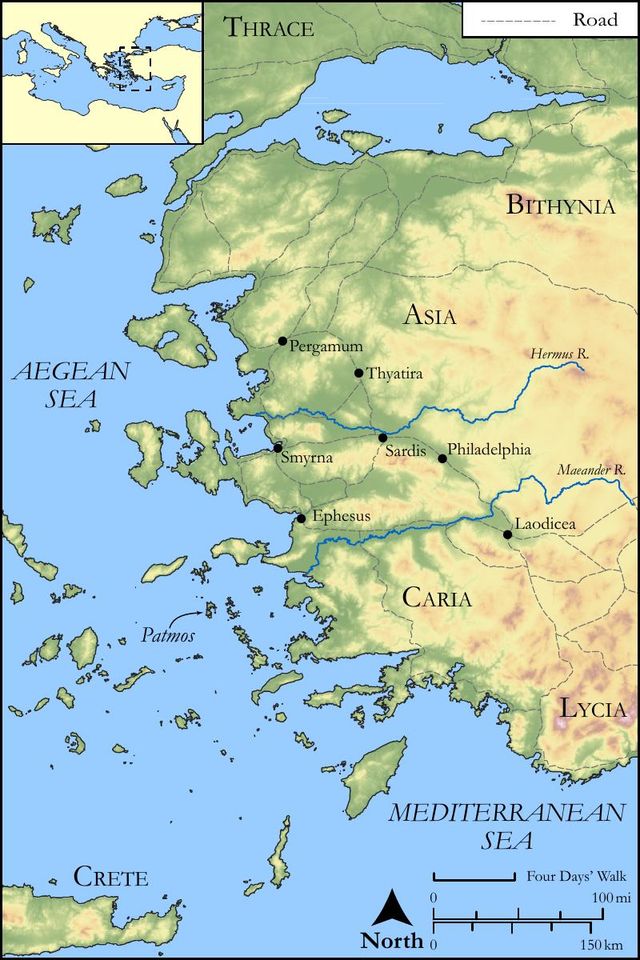
See on the biblical-era map

Study this verse
Public-domain commentary
Matthew Henry
From his Commentary on the Whole Bible. Henry comments on passages, not single verses — this entry covers Revelation 11:1–2. His three-level outline is real structure in the source text, so it is rendered as structure.
This prophetical passage about measuring the temple is a plain reference to what we find in Ezekiel's vision, Eze 40:3, etc. But how to understand either the one or the other is not so easy. It should seem the design of measuring the temple in the former case was in order to the rebuilding of it, and that with advantage; the design of this measurement seems to be either, 1. For the preservation of it in those times of public danger and calamity that are here foretold; or, 2. For its trial; that it may be seen how far it agrees with the standard, or pattern, in the mount; or, 3. For its reformation; that what is redundant, deficient, or changed, may be regulated according to the true model. Observe,
I.How much was to be measured.
1.The temple; the gospel church in general, whether it be so built, so constituted, as the gospel rule directs, whether it be too narrow or too large, the door too wide or too strait.
2.The altar. That which was the place of the most solemn acts of worship may be put for religious worship in general; whether the church has the true altars, both as to substance and situation: as to substance, whether they take Christ for their altar, and lay down all their offerings there; and in situation, whether the altar be in the holiest; that is, whether they worship God in the Spirit and in truth.
3.The worshippers too must be measured, whether they make God's glory their end and his word their rule, in all their acts of worship; and whether they come to God with suitable affections, and whether their conversation be as becomes the gospel.
II.What was not to be measured (Rev 11:2), and why it should be left out.
1.What was not to be measured: The court which is without the temple measure it not. Some say that Herod, in the additions made to the temple, built an outer court, and called it the court of the Gentiles. Some tell us that Adrian built the city and an outer court, and called it Aelia, and gave it to the Gentiles.
2.Why was not the outer court measured? This was no part of the temple, according to the model either of Solomon or Zerubbabel, and therefore God would have no regard to it. He would not mark it out for preservation; but as it was designed for the Gentiles, to bring pagan ceremonies and customs and to annex them to the gospel churches, so Christ abandoned it to them, to be used as they pleased; and both that and the city were trodden under foot for a certain time - forty and two months, which some would have to be the whole time of the reign of antichrist. Those who worship in the outer court are either such as worship in a false manner or with hypocritical hearts; and these are rejected of God, and will be found among his enemies.
3.From the whole observe,
(1.)God will have a temple and an altar in the world, till the end of time.
(2.)He has a strict regard to this temple, and observes how every thing is managed in it.
(3.)Those who worship in the outer court will be rejected, and only those who worship within the veil accepted.
(4.)The holy city, the visible church, is very much trampled upon in the world. But,
(5.)The desolations of the church are for a limited time, and for a short time, and she shall be delivered out of all her troubles.
Historical interpretation
Eight Centuries of Reception
10 surviving comments on this verse. Each one is dated, so this reads as a timeline rather than a list.
Select a marker to jump to its quote. Markers stagger vertically where authors wrote within a few decades of each other.
'(On this): The city is the Church ; and these months they are to persecute her and kill, when the false Christ [St. Matth. xxiv. 24] shall come, because she worships him not. Now of this said Daniel, He shall approve the covenant for many, one week; in the half of the week shall cease the sacrifice [Dan, ix. 27]. The half of the week: that is, three years and a-half; and these make the forty and two months which are mentioned. The sacrifice he speaks of is not that of sheep, but the prayers of the upright. And the holy city he speaks of is the righteous, i. e. [those] who are oppressed and trodden under foot by the horn that sprang up in the midst [Dan. vii. 8, 20, 21, 25], which is Antichrist, as Daniel said.
Hippolytus otherwise interprets that which is said in the Gospel, When indeed ye shall see the pollution of desolation [St. Matth. xxiv. 15] : for he says that it is not concerning the Jews, and the laying waste of Jerusalem, that these things are said, but concerning the end of Antichrist. The elect [ib. 22] he speaks of are the Christians who are in this conflict. And He says, Pray that ye fly not on the Sabbath or in winter [ib. 20] : i. e. He advises that we be not overtaken by those things that are coming on us, when we are unoccupied in righteousness, as the Jews [are unoccupied] on the Sabbath, or troubled with worldly cares and sins, as one that is in a winter storm. There shall be tribulation such as there was not like it since the beginning of the world, etc. [ib. 21 ; cp. Dan. xii. 1].
On this Hippolytus says, that in the siege of Vespasian this did not come to pass; for nothing new happened to the world in his days beyond the things that were before. If you speak of war, many times it has happened in former times : and if again of captives, there have not lacked massacres or blood-shedding that was more than that [of the siege]. And if of the eating of children and unclean beasts, lo also in the days of Ahab these things were [2 Kings, vi. 28]. Accordingly it is not concerning Jerusalem that the Lord said this; for when He willed to speak concerning her, He said, When ye shall see the army compassing the city, know that the desolation thereof is nigh [St. Luke, xxi. 20]. Hence the pollution of devastations He speaks of is Antichrist. And Daniel said, [In] the half of the week standeth the abomination in the sanctuary [Dan. ix. 27 ; cp. xi. 31]. Now "Vespasian did not set up in the temple an idol, but that Legion which Trajanus Quintus placed, a chief man of the Romans : he set up the idol there which is called Kôre.
Also the Apostle has written that these things are concerning Antichrist, Except if there come first a falling away, and the Man of iniquity be revealed, so that he as God shall sit in the temple, whom our Lord Jesus shall consume, etc. [2 Thess. ii. 3, 4, 8]. From these [words] it is evident that Vespasian did not call himself God, nor did he sit in the temple, nor was he killed by the Spirit of the Lord. Accordingly it is manifest that in the end tribulation arises against the Church, such as was none like it.'
The space which is called the court is the empty altar within the walls: these being such as were not necessary, he commanded to be ejected from the Church.
That is, to the men of this world, that it may be trodden under foot by the nations, or with the nations. Then he repeats about the destruction and slaughter of the last time.
When he says “Rise,” he arouses the church, for John, who is an image of the church, did not hear these things sitting down but standing up. “Measure,” it says, “the temple and the altar and those who worship there.” He did not command that everyone be measured; rather, he commanded that a portion be prepared unto the end [time], so that what is said in the Gospel might be fulfilled, “Many are called, but few are chosen.” “But do not measure the court outside the temple, leave that out.” The court, which is outside the temple, although it seems to belong to the temple, in fact is not the temple, for it has no relation to the holy of holies. These are those persons who appear to be in the church but are outside of it.… Those persons who are outside the temple are also the nations who have never believed the gospel of the Lord. Both groups will trample his church.
He commands that the teaching of a false faith and the contagion of a sinful way of life among the heretics, Jews and Gentiles be expelled, for it is not right that such persons approach the holy of holies. For the apostle says, “What have I to do with judging outsiders? Is it not those inside whom you are to judge?” When all the Jews, heretics, and Gentiles incessantly attack the church by all means available, it is as though they are trampling upon the church. The number of the months signifies not only the time of the last persecution but also the entire time of Christianity. For there are six ages of the world and seven days by which all time moves by passing away and returning. Six times seven makes forty-two, and I believe that the passage refers to both of these [numbers].
We think that the church is called the “temple of the living God,” for in it we offer spiritual sacrifices to God. And I think that the “court outside” is the assembly of the unbelieving Gentiles and Jews, and so by virtue of their impiety they are unworthy to be measured by the angel. “For the Lord knows those who are his,” as it says, but he who knows all things is said not to know the transgressors. That the holy city, whether that be the new Jerusalem or the catholic church, will be trampled by the nations for forty-two months signifies, I believe, that at the appearance of the antichrist those who are faithful and trustworthy will be trampled and persecuted for three and a half years.
And they will trample the holy city for forty-two months. Not only are they expelled from the Church, but they also, together with their Gentile allies, attack the same Church for three and a half years. It is not that they will trample it only during that time, that is, the time of the Antichrist, but because the entire body of the wicked, as if belonging to its own head, is already now working in the ministry of iniquity.
But the court which is outside the temple, cast out, etc. Those who are joined to the Church in name only, and neither approach the altar nor the holy of holies, are cast out from the rule of the Gospel and joined with the Gentiles. For all the glory of the king’s daughter is within (Psalm XLIV).
But the court, which is without the temple, cast out, and measure it not: because it is given unto the Gentiles. He says The court which is without, cast out with the same way of speaking as when we order to cast someone out if someone knocks at the door and we do not want to let them in. What then do we understand the court to mean but the Jews, heretics and Gentiles? It is said to be given unto the Gentiles because they all pass into the number of the incredulous nations. And the holy city they shall tread under foot two and forty months. The holy city is the temple and the altar, that is the heavenly Jerusalem, which is being built like a city. What does it mean, then, for the Church of the saints to be trodden underfoot by those who are without, if not to be persecuted with words and torments? Two and forty months signify a time and times, and half a time, [Rev. 12:14] that is the time of the Antichrist, yet also the whole time of this life because of its seven ages and the seven days that constitute its cycle; for six times seven make forty-two. This is also what was signified by the fact that the children of Israel entered the Land of Promise at the forty-second mansion. [Num. 33:1-49]
And he says that the outer court of the temple was cast out and should not be measured, because it was given to the Gentiles. Having measured the temple and the altar and those who were sacrificing within it, he heard that the court should be cast out to the outside and made wider, but not to be measured, as it was considered to have a superior measure.
He says that the court is given to the Gentiles, and it is held both within the temple and outside of it; and the New Covenant is held in place of the Old. For what is contained in it is fulfilled spiritually and truly in a shadowy manner, and it is different from the old one, according to the words of Jeremiah: "Behold, the days are coming," says the Lord, "when I will make a new covenant with the house of Israel and the house of Judah, not according to the covenant that I made with their fathers on the day I took hold of their hand to bring them out of the land of Egypt." (Jer. 31:31-32)
He therefore speaks of the new covenant as the court of the temple. Then, the vision subtly implies that the Lord of the Old Covenant has also been established, the one who in the New Covenant has appeared as Christ and Ruler, just as it seems to Paul when speaking about Israel, "for they drank from a spiritual rock that followed them; and that rock was Christ." (1 Cor. 10:4)
He called the New one the court of the old; for the court is the beginning and entrance of God, but not the temple. Therefore, he did not measure the court through which both it and those within it are revealed; for both the New one and those who have succeeded within it extend beyond the limit, the former due to their countless multitude, and the latter because of the elusiveness and height of the doctrines.
That it is said to have been given to the Gentiles, it was indeed also given to Israel the new blessings; but since those among the Gentiles were superior in number to the distinguished ones from Israel, it demonstrated that the whole was from the greater number, saying that the court was given to the Gentiles.
And he says that they will trample the holy city for forty-two months, the city (not the temple), calling the church a city, concerning which it has been said with glory about you: the city of God (Ps. 86:3), the heavenly Jerusalem (Heb. 12:22), the mother of the firstborn (Ps. 86:5), whose names are written in heaven. (Heb. 12:23)
What then does the measure of the forty-two months signify? It clearly indicates that the time of the new order on earth will be brief, and that the end will soon come. The number forty, composed of four tens, is not perfect, nor is the number two. From this, the argument shows that the new state will not endure long in the present life; therefore, the Scripture calls the final hour, and again the eleventh hour (Matt. 20:6, 9.), the time of the new era, during which the Only-Begotten came into the world; and in the future, it will be eternal.
To say that those from the Gentiles will trample the holy city, that is, the church, means that those dwelling within it will be persecuted.
Continue studying Revelation 11:2 across the web’s major study libraries — every link below opens this exact verse, chapter, or book on the destination site.
Read & Compare
 BibleGatewayThis verse in more than 200 translations and 70 languages.
 Bible.comThe YouVersion reader — hundreds of translations, reading plans, and highlights.
 ESV.orgCrossway's official English Standard Version reader.
 NET BibleThe NET translation with 60,000+ translators' notes on every rendering decision.
 STEP BibleTyndale House's free study tool — original text, vocabulary, and scholarly resources.
 BibliaLogos Bible Software's free web reader.
 USCCBThe New American Bible (Revised Edition) with the U.S. bishops' study notes.
Commentaries
 BibleHub CommentariesDozens of classic commentaries on this verse, gathered on one page.
 StudyLightMore than 100 commentary sets — the largest collection on the web.
 BibleRefPlain-English commentary on what this verse means, verse by verse.
 Enduring WordDavid Guzik's free commentary on this chapter, widely used by Bible teachers.
 Bible Study ToolsVerse commentary alongside Greek and Hebrew study aids.
Original Language & Research
- BibleHub InterlinearThe verse word by word — original language, transliteration, and English.
- BibleHub LexiconEvery word's original-language definition and Strong's entry.
 Blue Letter BibleDeep-study tools — Strong's numbers, concordance, and word studies.
 CNTR CollationThe earliest Greek manuscripts of this verse, collated letter by letter.
Sermons, Hymns & Audio


TrulyRandomVerse is not affiliated with these sites and doesn’t control their content. They’re linked because they’re genuinely useful.
Summary
Revelation 11:2 provides a stark distinction within John's vision of the temple, delineating between that which is divinely protected and that which is subject to external, hostile forces during a specified period of tribulation. It prophesies that while an inner sanctuary remains secure under God's watchful eye, the outer court and the holy city itself will be delivered into the hands of the Gentiles, who will oppress it for a precise duration of forty-two months, signifying a time of intense suffering and desecration before God's ultimate intervention.
Context
ShowHideLiterary Context
This verse is an integral part of the interlude between the sixth and seventh trumpet judgments in the Book of Revelation, specifically following the command given to John to measure the temple of God, the altar, and its worshipers in Revelation 11:1. The immediate literary flow establishes a clear dichotomy: what is measured is preserved, while what is excluded is exposed. This distinction sets the stage for the subsequent narrative concerning the two witnesses, whose prophetic ministry and suffering unfold during the same period of Gentile dominion, emphasizing God's continued witness even amidst global tribulation. The imagery of measuring and excluding is highly symbolic, pointing to divine preservation and permitted desecration.
Historical & Cultural Context
The imagery of the temple and the holy city would have resonated deeply with John's Jewish-Christian audience, who understood the significance of Jerusalem and its temple as the dwelling place of God and the center of their religious life. While the Jerusalem temple had been destroyed in AD 70, John's vision transcends a literal rebuilding, speaking to a spiritual reality. The "Gentiles" (Greek: éthnos) refer to non-Jewish nations, often depicted in prophetic literature as hostile powers. The concept of a city being "trodden under foot" was a common biblical metaphor for conquest, desecration, and humiliation by foreign invaders, as seen in the destruction of Jerusalem by Babylon and later by Rome. This cultural understanding underscores the severity of the prophesied oppression.
Key Themes
ShowHideRevelation 11:2 contributes significantly to several major themes within the book and broader biblical theology. Firstly, it highlights the theme of Divine Sovereignty and Preservation, demonstrating that even when evil appears to triumph, God maintains ultimate control, preserving a "remnant" or true spiritual worshipers (the "measured" temple) from complete destruction. Secondly, it underscores the theme of Tribulation and Persecution, detailing a period of intense suffering for God's people and the desecration of what is sacred, aligning with Jesus' own prophecies about Jerusalem being "trodden down by the Gentiles" in Luke 21:24. Lastly, the specific timeframe of "forty and two months" introduces the crucial theme of Prophetic Timeframes, which appears repeatedly in apocalyptic literature, such as the 1260 days for the two witnesses' prophecy in Revelation 11:3 and the woman in the wilderness in Revelation 12:6, signifying a divinely appointed, limited period of suffering.
Exposition and Analysis
ShowHideKey Word Analysis
ShowHideThis verb signifies "to give" or "to grant," often implying a transfer of authority or permission. Here, it indicates that the outer court and the holy city are not seized by the Gentiles through their own power alone, but rather "given" over to them by divine allowance. This highlights God's sovereign hand in permitting even tribulation and desecration, serving His ultimate purposes.
This term refers to "a race," "a tribe," or specifically, "a foreign (non-Jewish) one," often implying pagan nations. In this context, it denotes the non-believing, hostile powers of the world who are granted temporary authority to oppress the holy city, symbolizing the forces opposed to God and His people.
This powerful verb means "to trample" or "to tread down," literally or figuratively. It conveys a sense of severe oppression, desecration, and humiliation. It implies not merely occupation, but active subjugation and contempt for what is sacred, emphasizing the harshness and destructive nature of the Gentile dominion.
Verse Breakdown
ShowHide"But the court which is without the temple leave out, and measure it not;"
John is instructed to exclude the outer court from the divine measurement and protection applied to the inner temple, altar, and worshipers. This signifies a divine distinction, indicating that this specific area is not under God's immediate preservation in the same way, and is therefore vulnerable.
"for it is given unto the Gentiles:"
This clause provides the reason for the exclusion: the outer court has been divinely "given" or handed over to the Gentiles. This highlights God's sovereign permission for the non-believing nations to have authority over this symbolic space, implying a period of allowed dominion and desecration.
"and the holy city shall they tread under foot forty [and] two months."
This extends the Gentile dominion beyond the outer court to the entire "holy city" (Jerusalem), symbolizing the earthly representation of God's people or His spiritual dwelling. The phrase "tread under foot" denotes severe oppression and desecration. The duration of "forty and two months" (equivalent to 3.5 years or 1260 days) specifies a divinely appointed, limited period for this tribulation, emphasizing that the suffering has a set end.
Literary Devices
ShowHideRevelation 11:2 employs several potent literary devices to convey its prophetic message. Symbolism is paramount, with the "temple," "outer court," and "holy city" not necessarily referring to literal structures but representing spiritual realities—the true people of God, the broader community, or the earthly manifestation of God's presence. The act of "measuring" functions as a symbol of divine preservation and protection, while "leaving out" signifies divine permission for judgment or exposure. Contrast is evident in the sharp distinction between the measured (protected) and the unmeasured (exposed) areas, highlighting God's selective preservation amidst widespread tribulation. The phrase "tread under foot" is a vivid metaphor for severe oppression and desecration, evoking a powerful image of humiliation and conquest. Finally, the specific timeframe of "forty and two months" acts as a prophetic number, a recurring motif in apocalyptic literature that points to a limited period of tribulation, offering a sense of hope and a defined end to suffering.
Theological and Thematic Connections
ShowHideRevelation 11:2 profoundly illustrates the paradox of divine sovereignty amidst human suffering. It teaches that even when God's people or their symbolic representations face intense persecution and apparent defeat at the hands of hostile worldly powers, God remains utterly in control. The "giving over" of the outer court and the holy city to the Gentiles is not a sign of God's weakness or abandonment, but a divinely permitted act within His overarching plan, serving to refine His people and bring about His ultimate purposes. This passage underscores that tribulation has a divinely appointed limit, offering a powerful message of hope and endurance for believers throughout history, reminding them that the enemy's power is always circumscribed by God's decree.
Reflection and Application
ShowHideRevelation 11:2 offers profound spiritual nourishment for believers navigating challenging times. It assures us that even when the world seems to overwhelm, when sacred spaces or principles are desecrated, and when the forces of evil appear to hold sway, God's sovereign hand is still at work. The distinction between the "measured" and the "unmeasured" reminds us that while we may experience the same external tribulations as the world, there is a spiritual reality of divine protection and preservation for those who truly belong to Christ. Our inner sanctuary, our relationship with God, remains secure even when our outward circumstances are chaotic. The "forty and two months" serves as a powerful reminder that all suffering, all tribulation, and all evil dominion has a divinely appointed end. This should cultivate perseverance, encouraging us not to lose heart but to fix our gaze on God's ultimate victory and the establishment of His eternal kingdom, knowing that our present trials are temporary and serve a higher purpose.
Questions for Reflection
ShowHideFAQ
ShowHideWhat is the significance of "forty and two months" in biblical prophecy?
ShowHideThe "forty and two months" (equivalent to 3.5 years or 1260 days) is a crucial prophetic timeframe that appears multiple times in apocalyptic literature, particularly in the books of Daniel and Revelation. It symbolizes a specific, limited period of intense tribulation, persecution, and the dominion of hostile powers against God's people or His earthly kingdom. This duration is often associated with the "time, times, and half a time" mentioned in Daniel 7:25 and Daniel 12:7, and is reiterated in Revelation for the two witnesses' prophecy (Revelation 11:3) and the woman's flight into the wilderness (Revelation 12:6). While interpretations vary (literal vs. symbolic), its consistent use emphasizes that even the most severe periods of suffering are finite and under God's sovereign control, leading to His ultimate triumph.
Does "the holy city" refer to literal Jerusalem or something else?
ShowHideWhile "the holy city" (Greek: hágios pólis) historically refers to Jerusalem, in the apocalyptic context of Revelation, its meaning often transcends a purely literal geographical location. It can symbolize the earthly manifestation of God's people, the Church, or the spiritual community that represents God's dwelling place on earth. The "treading under foot" of this city by the Gentiles signifies the persecution and desecration of what is sacred to God, whether it be His physical people, their spiritual heritage, or the principles of His kingdom. This dual interpretation allows for both historical fulfillment and ongoing spiritual relevance, indicating that God's people (the spiritual "Jerusalem") will face opposition from worldly powers throughout history, culminating in a final period of intense tribulation.
Christ-Centered Fulfillment
ShowHideRevelation 11:2, while depicting a period of tribulation and Gentile dominion, finds its ultimate Christ-centered fulfillment in the broader narrative of God's redemptive plan, culminating in Jesus Christ. The distinction between the "measured" and "unmeasured" portions of the temple foreshadows Christ's work in establishing a new spiritual temple, not made with human hands, but comprised of believers. Jesus Himself is the true temple, the dwelling place of God among humanity (John 1:14, John 2:19-21). Through His atoning sacrifice, He consecrated a people for Himself, establishing a "holy nation" and "royal priesthood" (1 Peter 2:9), who are the true worshipers measured and protected by God's grace. The "treading under foot" of the holy city by the Gentiles, though a period of suffering, ultimately points to the temporary nature of evil's dominion, which Christ decisively broke through His death and resurrection. His triumph over sin and death ensures that while His followers may experience tribulation in this world (John 16:33), the gates of hell will not prevail against His Church (Matthew 16:18). The "forty and two months" signifies a limited season of suffering that will give way to Christ's eternal reign, when all enemies will be put under His feet (1 Corinthians 15:25). Thus, this verse ultimately testifies to Christ's sovereign authority, His preservation of His people, and His ultimate victory over all opposing powers, establishing His eternal kingdom where He will dwell with His redeemed forever (Revelation 21:3).