


Ezra 8:33
Bible text: King James Version (1769 Blayney text) · Public domain
Bible text: King James Version with Strong's numbers · Public domain
Bible text: Berean Standard Bible · Public domain
Bible text: American Standard Version (1901) · Public domain
Bible text: World English Bible, Messianic edition · Public domain
Bible text: Geneva Bible (1599) · Public domain
Bible text: Young's Literal Translation · Public domain
- וּבַיּוֹםu·vai·Yomand on the dayH3117Conj-w ¦ Prep-b ¦ N-msNoun Singular Masculine Absoluteוּandבַon theיּוֹםday
- הָרְבִיעִיha·re·vi·'I<the> fourthH7243Art ¦ Adj-msAdjective Numerical Position Singular Masculine Absoluteהָ<the>רְבִיעִיfourth
- נִשְׁקַלnish·Kalit was weighed outH8254V-Niphal-Perf-3msVerb Niphal Perfect 3rd Singular Masculine
- הַכֶּסֶףha·ke·Sefthe silverH3701Art ¦ N-msNoun Singular Masculine Absoluteהַtheכֶּסֶףsilver
- וְהַזָּהָבve·ha·za·Havand the goldH2091Conj-w ¦ Art ¦ N-msNoun Singular Masculine Absoluteוְandהַtheזָּהָבgold
- וְהַכֵּלִיםve·ha·ke·Limand the vesselsH3627Conj-w ¦ Art ¦ N-mpNoun Plural Masculine Absoluteוְandהַtheכֵּלִיםvessels
- בְּבֵיתbe·Veitin [the] house ofH1004Prep-b ¦ N-mscNoun Singular Masculine Constructבְּinבֵית[the] house of
- אֱלֹהֵינוּ'e·lo·Hei·nuour GodH430N-mpc ¦ 1cpNoun Plural Masculine ConstructאֱלֹהֵיGodנוּour
- עַל'alonH5921PrepPreposition
- יַדyad[the] hand ofH3027N-cscNoun Singular common gender Construct
- מְרֵמוֹתme·re·MotMeremothH4822N-proper-mNoun Proper Masculine
- בֶּןben[the] son ofH1121N-mscNoun Singular Masculine Construct
- אוּרִיָּה'u·ri·YahUriahH223N-proper-mNoun Proper Masculine
- הַכֹּהֵןha·ko·Henthe priestH3548Art ¦ N-msNoun Singular Masculine Absoluteהַtheכֹּהֵןpriest
- וְעִמּוֹve·'i·Moand with himH5973Conj-w ¦ Prep ¦ 3msPreposition Definiteוְandעִמּwithוֹhim
- אֶלְעָזָר'el·'a·ZarEleazarH499N-proper-mNoun Proper Masculine
- בֶּןben[the] son ofH1121N-mscNoun Singular Masculine Construct
- פִּינְחָסpin·ChasPhinehasH6372N-proper-mNoun Proper Masculine
- וְעִמָּהֶםve·'i·ma·Hemand with themH5973Conj-w ¦ Prep ¦ 3mpPreposition Definiteוְandעִמָּwithהֶםthem
- יוֹזָבָדyo·za·VadJozabadH3107N-proper-mNoun Proper Masculine
- בֶּןben[the] son ofH1121N-mscNoun Singular Masculine Construct
- יֵשׁוּעַye·Shu·a'JeshuaH3442N-proper-mNoun Proper Masculine
- וְנוֹעַדְיָהve·no·'ad·Yahand NoadiahH5129Conj-w ¦ N-proper-mNoun Proper MasculineוְandנוֹעַדְיָהNoadiah
- בֶןven[the] son ofH1121N-mscNoun Singular Masculine Construct
- בִּנּוּיbi·NuiBinnuiH1131N-proper-mNoun Proper Masculine
- הַלְוִיִּםhal·vi·Yimthe LevitesH3881Art ¦ N-mpNoun Gentilic Plural Masculine AbsoluteהַtheלְוִיִּםLevites
English is a literal word-by-word gloss of the Hebrew, not the KJV's wording. Why?
This is the original text the KJV's translators worked from — each Hebrew word with its own literal English meaning in this verse, prepared by scholars at Tyndale House, Cambridge. The KJV translates whole sentences, not word by word, so its wording differs: one Hebrew word can become several English words, and the KJV may choose “the LORD” where the gloss reads “Yahweh”. Both are faithful — they answer different questions. For the KJV's own rendering, switch to the KJV text.
Details
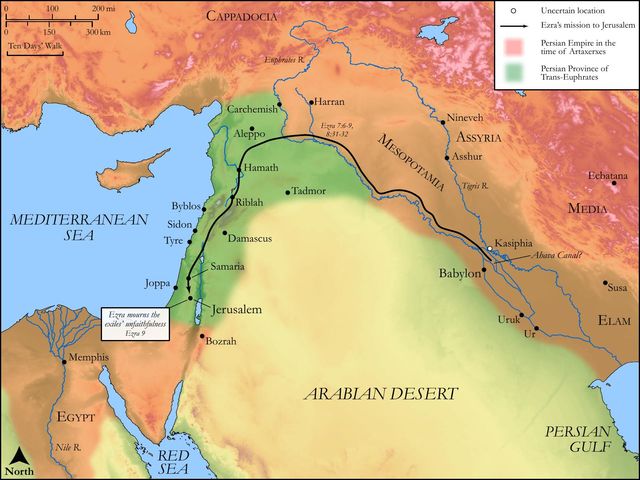
See on the biblical-era map
Study this verse
Public-domain commentary
Matthew Henry
From his Commentary on the Whole Bible. Henry comments on passages, not single verses — this entry covers Ezra 8:31–36. His two-level outline is real structure in the source text, so it is rendered as structure.
We are now to attend Ezra to Jerusalem, a journey of about four months in all; but his multitude made his marches slow and his stages short. Now here we are told,
I.That his God was good, and he acknowledged his goodness:
The hand of our God was upon us, to animate us for our undertaking. To him they owed it,
1.That they were preserved in their journey, and not all cut off; for there were enemies that laid wait for them by the way to do them a mischief, or at least, like Amalek, to smite the hindmost of them, but God protected them, Ezr 8:31. Even the common perils of journeys are such as oblige us to sanctify our going out with prayer and our returns in peace with praise and thanksgiving; much more ought God to be thus eyed in such a dangerous expedition as this was.
2.That they were brought in safety to their journey's end, Ezr 8:32. Let those that have stedfastly set their faces towards the new Jerusalem proceed and persevere to the end till they appear before God in Zion, and they shall find that he who has begun the good work will perform it.
II.That his treasurers were faithful.
When they had come to Jerusalem they were impatient to be discharged of their trust, and therefore applied to the great men of the temple, who received it from them and gave them an acquittance in full, Ezr 8:33, Ezr 8:34. It is a great ease to one's mind to be discharged from a trust, and a great honour to one's name to be able to make it appear that it has been faithfully discharged.
III.That his companions were devout.
As soon as they came to be near the altar they thought themselves obliged to offer sacrifice, whatever they had done in Babylon, Ezr 8:35. That will be dispensed with when we want opportunity which when the door is opened again will be expected from us. It is observable,
1.That among their sacrifices they had a sin-offering; for it is the atonement that sweetens and secures every mercy to us, which will not be truly comfortable unless iniquity be taken away and our peace made with God.
2.That the number of their offerings related to the number of the tribes, twelve bullocks, twelve he-goats, and ninety-six rams (that is, eight times twelve), intimating the union of the two kingdoms, according to what was foretold, Eze 37:22. They did not any longer go two tribes one way and ten another, but all the twelve met by their representatives at the same altar.
IV.That even the enemies of the Jews became their friends, bowed to Ezra's commission, and, instead of hindering the people of God, furthered them (Ezr 8:36), purely in complaisance to the king: when he appeared moderate they all coveted to appear so too. Then had the churches rest.
Continue studying Ezra 8:33 across the web’s major study libraries — every link below opens this exact verse, chapter, or book on the destination site.
Read & Compare
 BibleGatewayThis verse in more than 200 translations and 70 languages.
 Bible.comThe YouVersion reader — hundreds of translations, reading plans, and highlights.
 ESV.orgCrossway's official English Standard Version reader.
 NET BibleThe NET translation with 60,000+ translators' notes on every rendering decision.
 STEP BibleTyndale House's free study tool — original text, vocabulary, and scholarly resources.
 BibliaLogos Bible Software's free web reader.
 USCCBThe New American Bible (Revised Edition) with the U.S. bishops' study notes.
Commentaries
 BibleHub CommentariesDozens of classic commentaries on this verse, gathered on one page.
 StudyLightMore than 100 commentary sets — the largest collection on the web.
 BibleRefPlain-English commentary on what this verse means, verse by verse.
 Enduring WordDavid Guzik's free commentary on this chapter, widely used by Bible teachers.
 Bible Study ToolsVerse commentary alongside Greek and Hebrew study aids.
Original Language & Research
- BibleHub InterlinearThe verse word by word — original language, transliteration, and English.
- BibleHub LexiconEvery word's original-language definition and Strong's entry.
 Blue Letter BibleDeep-study tools — Strong's numbers, concordance, and word studies.
 SefariaThe Hebrew text with Rashi and centuries of Jewish commentary.
Sermons, Hymns & Audio


TrulyRandomVerse is not affiliated with these sites and doesn’t control their content. They’re linked because they’re genuinely useful.
Summary
Ezra 8:33 meticulously records the public and precise weighing of the substantial silver, gold, and sacred vessels in the Temple precinct in Jerusalem. This crucial event, occurring four days after Ezra and his company's arrival from Babylon, marked the transparent and accountable transfer of the precious contributions entrusted to Ezra for the rebuilding and furnishing of God's house, signifying the successful and divinely protected completion of their arduous journey.
Context
ShowHideLiterary Context
This verse serves as the climactic conclusion to a significant phase in the post-exilic return, specifically detailing the successful delivery and accounting of the vast treasures brought from Babylon. Ezra and his company arrived in Jerusalem on the first day of the fifth month (as noted in Ezra 7:9), and Ezra 8:33 specifies that "on the fourth day" after their arrival, the critical task of weighing the treasures took place. This immediate action underscores the profound urgency and immense importance of safeguarding and dedicating these sacred contributions. Earlier in the narrative, Ezra had made a pivotal decision to rely solely on God's protection for the journey, refusing a royal military escort and instead calling for a period of fasting and prayer at the river Ahava (Ezra 8:21-23). The safe arrival of the substantial wealth, which included silver, gold, and vessels generously donated by King Artaxerxes, his counselors, and the Israelites remaining in Babylon (Ezra 8:25-27), was a powerful testament to God's faithfulness and direct answer to their prayers. Prior to their departure, Ezra had meticulously appointed twelve leading priests and Levites to guard these treasures during the perilous journey (Ezra 8:29-30), emphasizing the principle of accountability that culminates in this public and verifiable weighing.
Historical & Cultural Context
The setting of Ezra 8:33 is post-exilic Jerusalem, a city still in the process of recovering from the devastating Babylonian destruction. While the Temple had been rebuilt under Zerubbabel, it remained in need of furnishing and consecrated items for proper worship. The treasures carried by Ezra were not merely secular wealth but sacred donations, specifically designated for the "house of our God," highlighting their immense religious and spiritual significance. Journeys from Babylon to Jerusalem in that era were notoriously perilous, fraught with dangers such as banditry and natural hazards, making the safe arrival of such a valuable cargo a remarkable and divinely orchestrated feat. In that day, the public weighing of precious metals was a common and essential practice to ensure transparency, prevent fraud, and establish trust, especially for large sums or items held in public trust. The involvement of designated priests and Levites was not merely administrative but culturally and religiously mandated, as they were the divinely appointed custodians of Temple property, responsible for maintaining ritual purity, order, and integrity within the sacred precincts. This public act adhered to established norms of accountability for public funds and sacred offerings.
Key Themes
ShowHideEzra 8:33 powerfully illustrates several core theological and narrative themes central to the book of Ezra and broader biblical principles. Firstly, Stewardship and Accountability are paramount; the meticulous weighing and public verification of the treasures demonstrate a profound commitment to handling God's resources with utmost care, integrity, and transparency. This act embodies the biblical principle that much is required from those to whom much is given, echoing the teaching found in Luke 12:48. Secondly, Integrity and Transparency are highlighted by the public nature of the weighing "in the house of our God" and the naming of specific, authoritative individuals. This open accounting prevented suspicion, affirmed the blamelessness of all involved in managing sacred property, and served as a powerful witness to the community. Thirdly, Divine Protection and Faithfulness are profoundly evident in the safe arrival of the vast wealth despite the inherent dangers of the journey. This outcome is presented as a direct answer to Ezra's earlier prayer and fasting for God's hand to be upon them (Ezra 8:21-23). Finally, the verse underscores the importance of Order and Process in sacred matters, emphasizing that God's work should be conducted with diligence, proper procedure, and adherence to established protocols, ensuring that His name is honored through meticulous and upright administration.
Exposition and Analysis
ShowHideKey Word Analysis
ShowHideThis verb (H8254) signifies a precise and careful measurement, often used in contexts of commercial transactions or, more specifically, the handling of precious metals like silver and gold. It implies verification, exactness, and a thorough inventory process, ensuring that the quantity received matched the quantity entrusted. The use of this word underscores the meticulousness, accountability, and legal transparency inherent in the transfer of these sacred treasures.
This noun (H1004) refers to the Temple in Jerusalem, specifically its precincts or treasury area. The location of the weighing was profoundly significant, as it was a sacred, public, and authoritative space. Conducting the weighing here lent an air of solemnity, divine oversight, and public legitimacy to the transaction, reinforcing its integrity and preventing any private or clandestine dealings. It was the designated place for sacred transactions and offerings.
While literally meaning "containers" or "implements," in this context, "vessels" (H3627) refers specifically to the sacred utensils and implements used in Temple worship and service. These were not merely valuable objects but consecrated items, essential for the proper functioning of the Temple rituals and offerings. Their careful weighing alongside the silver and gold emphasizes their intrinsic importance and their dedicated purpose for God's service, highlighting their sacred value beyond their material worth.
Verse Breakdown
ShowHide"Now on the fourth day"
This clause precisely dates the event, indicating that the weighing occurred promptly, just four days after Ezra and his company arrived in Jerusalem. This immediate action demonstrates a profound sense of urgency, responsibility, and commitment to fulfilling their sacred trust without delay, prioritizing the security and proper accounting of the Temple treasures.
"was the silver and the gold and the vessels weighed"
This clause details the central action and the specific objects involved. The passive verb "weighed" emphasizes the meticulous, precise, and verifiable accounting of the precious metals and sacred implements. It highlights the thoroughness of the inventory process, ensuring complete transparency and accountability for the vast wealth that had been transported from Babylon.
"in the house of our God"
This specifies the sacred location of the weighing. Conducting this vital transaction within the Temple precinct (likely the treasury chambers) underscored its sacred nature and public legitimacy. It was a place of divine presence and official authority, ensuring that the process was transparent, beyond reproach, and consecrated by its setting.
"by the hand of Meremoth the son of Uriah the priest; and with him [was] Eleazar the son of Phinehas; and with them [was] Jozabad the son of Jeshua, and Noadiah the son of Binnui, Levites;"
This enumerates the specific individuals entrusted with this crucial task. Meremoth and Eleazar are identified as priests, emphasizing their inherent authority and sacred role in handling Temple property. Jozabad and Noadiah are identified as Levites, who traditionally assisted the priests in Temple service, administration, and the handling of sacred offerings. The naming of these specific individuals underscores the principle of personal accountability, the official authorization, and the communal oversight of the weighing process, ensuring integrity through multiple witnesses.
Literary Devices
ShowHideEzra 8:33 employs several literary devices to convey its profound message of accountability and divine faithfulness. The most prominent device is Enumeration or Cataloging, evident in the precise listing of the items weighed ("the silver and the gold and the vessels") and, more significantly, the specific individuals responsible ("Meremoth the son of Uriah the priest; and with him [was] Eleazar the son of Phinehas; and with them [was] Jozabad the son of Jeshua, and Noadiah the son of Binnui, Levites"). This detailed listing emphasizes the meticulousness, thoroughness, and transparency of the process, leaving no room for ambiguity or suspicion regarding the handling of the sacred treasures. Furthermore, the act of "weighing" itself functions as Symbolism, representing not only physical measurement but also the spiritual principles of accountability, integrity, and the faithful fulfillment of a divine trust. It symbolizes the careful stewardship required for God's resources. The safe arrival and public accounting of these treasures also serve as a powerful Testimony to God's protective hand and faithfulness, providing a tangible demonstration of His answer to Ezra's earlier prayer for a safe journey and His provision for His people.
Theological and Thematic Connections
ShowHideEzra 8:33 provides a powerful theological lesson on the nature of stewardship and accountability before God. The meticulous weighing of the treasures underscores that all resources, especially those dedicated to God's service, must be handled with the utmost integrity and transparency. This act was not merely an administrative formality but a sacred duty, reflecting the understanding that these items were God's property, entrusted to human hands. The public nature of the weighing, overseen by designated priests and Levites, reinforces the biblical emphasis on blamelessness in ministry and the importance of avoiding even the appearance of impropriety. This commitment to integrity serves as a witness to God's character and His expectation that His people reflect His righteousness in all their dealings. The safe arrival of the treasures, followed by their careful accounting, also testifies to God's faithfulness in protecting those who trust in Him and His abundant provision for His work.
Reflection and Application
ShowHideEzra 8:33 offers timeless principles for believers today, particularly regarding our approach to stewardship and integrity in all aspects of life. Just as Ezra and his companions were meticulously accountable for the physical treasures entrusted to them, we are called to be faithful stewards of all that God has given us – our time, talents, spiritual gifts, financial resources, and even our relationships. This verse challenges us to consider how we manage what is not truly ours but belongs to God. Are we transparent in our dealings, both in our personal lives and in our service within the church or community? Do we conduct ourselves in a way that is above reproach, reflecting the integrity of Christ in every transaction and interaction? The public weighing serves as a powerful reminder that our actions are observed, and our integrity is a profound testimony to the character of the God we serve. Furthermore, the safe arrival of the treasures, a direct answer to prayer, encourages us to trust God for protection and provision in our own endeavors, knowing that He is faithful to those who commit their way to Him and seek to honor Him in all their responsibilities.
Questions for Reflection
ShowHideFAQ
ShowHideWhy was such a detailed weighing necessary?
ShowHideThe detailed weighing was necessary for several critical reasons, primarily centered on transparency and accountability. The treasures were immensely valuable and had been transported over a long, dangerous journey; a public, meticulous accounting prevented any suspicion of theft, loss, or mismanagement. Secondly, it served as a crucial verification process, confirming that the full amount of silver, gold, and vessels initially inventoried and entrusted to Ezra back in Babylon (Ezra 8:26-27) had indeed arrived safely and intact. Thirdly, it was a practical demonstration of integrity, both for Ezra and for the appointed guardians, reassuring the community and the Persian authorities that the sacred gifts were handled with the utmost care and honesty. This act provided a clear record and validated the faithfulness of those entrusted with God's resources, echoing the biblical principle of providing for what is honorable not only in the sight of the Lord but also in the sight of men (2 Corinthians 8:21).
What was the significance of the "fourth day"?
ShowHideThe "fourth day" signifies the promptness and urgency with which Ezra and his companions fulfilled their sacred duty upon arriving in Jerusalem. After a long and perilous journey, one might expect a period of rest, but the immediate attention to weighing the treasures demonstrates their deep commitment to stewardship and their understanding of the immense importance and sacred nature of these consecrated items. It highlights that the transfer and proper accounting of these sacred resources was a top priority, not to be delayed, reinforcing the theme of diligent and faithful service to God and His Temple.
Who were Meremoth, Eleazar, Jozabad, and Noadiah, and why were they chosen?
ShowHideMeremoth the son of Uriah and Eleazar the son of Phinehas were priests, while Jozabad the son of Jeshua and Noadiah the son of Binnui were Levites. These individuals were chosen for their specific roles and lineage within the Israelite community, particularly concerning Temple service. Priests and Levites were divinely appointed to oversee the sacred affairs of the Temple, including the handling of its finances and dedicated items. Their involvement ensured that the weighing process was conducted with proper religious protocol, authority, and integrity, as their lineage and office designated them as trustworthy custodians. Their presence also represented the broader community, adding another layer of transparency and accountability to the transaction. Their selection underscores the importance of entrusting sacred responsibilities to those who are both qualified by their calling and of proven character, as was the case with the Levites who were appointed to serve the tabernacle (Numbers 3:6-8).
Christ-Centered Fulfillment
ShowHideEzra 8:33, with its profound emphasis on meticulous stewardship, transparent accountability, and divine protection over sacred treasures, finds its ultimate and glorious fulfillment in Jesus Christ. While Ezra oversaw the physical treasures for a material temple, Christ is the ultimate steward of God's redemptive plan, faithfully executing His Father's will in every detail, declaring, "My food is to do the will of him who sent me and to accomplish his work" (John 4:34). His life was one of perfect integrity and absolute transparency, as testified by Peter: "He committed no sin, neither was deceit found in his mouth" (1 Peter 2:22), fulfilling the ideal of blamelessness that the priests and Levites in Ezra sought to embody. Moreover, Christ himself is the supreme "treasure" given by God to humanity, far surpassing any silver or gold, for in Him "are hidden all the treasures of wisdom and knowledge" (Colossians 2:3). Through His sacrifice and resurrection, we, believers, become the new "house of God," a spiritual temple not made with human hands (Ephesians 2:19-22), and we are entrusted with the immeasurable spiritual treasures of the Gospel and the gifts of the Holy Spirit (2 Corinthians 4:7). Just as the treasures in Ezra were meticulously weighed and accounted for, believers are called to be faithful stewards of these spiritual riches, knowing that one day we will all stand before Christ to give an account of what we have done with what He has entrusted to us (Romans 14:12).