


Ezra 8:32
Bible text: King James Version (1769 Blayney text) · Public domain
Bible text: Berean Standard Bible · Public domain
Bible text: American Standard Version (1901) · Public domain
Bible text: World English Bible, Messianic edition · Public domain
Bible text: Geneva Bible (1599) · Public domain
Bible text: Young's Literal Translation · Public domain
- וַנָּבוֹאva·na·Vo'and we cameH935Conj-w ¦ V-Qal-ConsecImperf-1cpVerb Qal Consecutive Imperfect 1st Plural common genderוַandנָּבוֹאwe came
- יְרוּשָׁלִָםye·ru·sha·LimJerusalemH3389N-properNoun Proper Location
- וַנֵּשֶׁבva·Ne·shevand we remainedH3427Conj-w ¦ V-Qal-ConsecImperf-1cpVerb Qal Consecutive Imperfect 1st Plural common genderוַandנֵּשֶׁבwe remained
- שָׁםshamthereH8033AdvAdverb
- יָמִיםya·MimdaysH3117N-mpNoun Plural Masculine Absolute
- שְׁלֹשָׁהshe·lo·ShahthreeH7969Adj-csAdjective Numerical Singular common gender Absolute
English is a literal word-by-word gloss of the Hebrew, not the KJV's wording. Why?
This is the original text the KJV's translators worked from — each Hebrew word with its own literal English meaning in this verse, prepared by scholars at Tyndale House, Cambridge. The KJV translates whole sentences, not word by word, so its wording differs: one Hebrew word can become several English words, and the KJV may choose “the LORD” where the gloss reads “Yahweh”. Both are faithful — they answer different questions. For the KJV's own rendering, switch to the KJV text.
Details
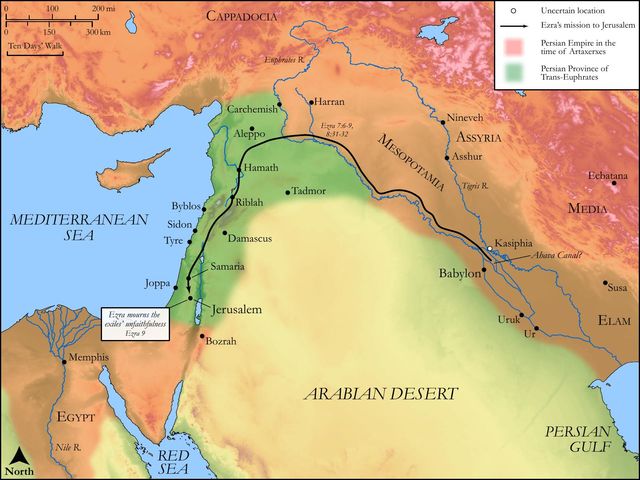
See on the biblical-era map
Study this verse
Public-domain commentary
Matthew Henry
From his Commentary on the Whole Bible. Henry comments on passages, not single verses — this entry covers Ezra 8:31–36. His two-level outline is real structure in the source text, so it is rendered as structure.
We are now to attend Ezra to Jerusalem, a journey of about four months in all; but his multitude made his marches slow and his stages short. Now here we are told,
I.That his God was good, and he acknowledged his goodness:
The hand of our God was upon us, to animate us for our undertaking. To him they owed it,
1.That they were preserved in their journey, and not all cut off; for there were enemies that laid wait for them by the way to do them a mischief, or at least, like Amalek, to smite the hindmost of them, but God protected them, Ezr 8:31. Even the common perils of journeys are such as oblige us to sanctify our going out with prayer and our returns in peace with praise and thanksgiving; much more ought God to be thus eyed in such a dangerous expedition as this was.
2.That they were brought in safety to their journey's end, Ezr 8:32. Let those that have stedfastly set their faces towards the new Jerusalem proceed and persevere to the end till they appear before God in Zion, and they shall find that he who has begun the good work will perform it.
II.That his treasurers were faithful.
When they had come to Jerusalem they were impatient to be discharged of their trust, and therefore applied to the great men of the temple, who received it from them and gave them an acquittance in full, Ezr 8:33, Ezr 8:34. It is a great ease to one's mind to be discharged from a trust, and a great honour to one's name to be able to make it appear that it has been faithfully discharged.
III.That his companions were devout.
As soon as they came to be near the altar they thought themselves obliged to offer sacrifice, whatever they had done in Babylon, Ezr 8:35. That will be dispensed with when we want opportunity which when the door is opened again will be expected from us. It is observable,
1.That among their sacrifices they had a sin-offering; for it is the atonement that sweetens and secures every mercy to us, which will not be truly comfortable unless iniquity be taken away and our peace made with God.
2.That the number of their offerings related to the number of the tribes, twelve bullocks, twelve he-goats, and ninety-six rams (that is, eight times twelve), intimating the union of the two kingdoms, according to what was foretold, Eze 37:22. They did not any longer go two tribes one way and ten another, but all the twelve met by their representatives at the same altar.
IV.That even the enemies of the Jews became their friends, bowed to Ezra's commission, and, instead of hindering the people of God, furthered them (Ezr 8:36), purely in complaisance to the king: when he appeared moderate they all coveted to appear so too. Then had the churches rest.
Continue studying Ezra 8:32 across the web’s major study libraries — every link below opens this exact verse, chapter, or book on the destination site.
Read & Compare
 BibleGatewayThis verse in more than 200 translations and 70 languages.
 Bible.comThe YouVersion reader — hundreds of translations, reading plans, and highlights.
 ESV.orgCrossway's official English Standard Version reader.
 NET BibleThe NET translation with 60,000+ translators' notes on every rendering decision.
 STEP BibleTyndale House's free study tool — original text, vocabulary, and scholarly resources.
 BibliaLogos Bible Software's free web reader.
 USCCBThe New American Bible (Revised Edition) with the U.S. bishops' study notes.
Commentaries
 BibleHub CommentariesDozens of classic commentaries on this verse, gathered on one page.
 StudyLightMore than 100 commentary sets — the largest collection on the web.
 BibleRefPlain-English commentary on what this verse means, verse by verse.
 Enduring WordDavid Guzik's free commentary on this chapter, widely used by Bible teachers.
 Bible Study ToolsVerse commentary alongside Greek and Hebrew study aids.
Original Language & Research
- BibleHub InterlinearThe verse word by word — original language, transliteration, and English.
- BibleHub LexiconEvery word's original-language definition and Strong's entry.
 Blue Letter BibleDeep-study tools — Strong's numbers, concordance, and word studies.
 SefariaThe Hebrew text with Rashi and centuries of Jewish commentary.
Sermons, Hymns & Audio


TrulyRandomVerse is not affiliated with these sites and doesn’t control their content. They’re linked because they’re genuinely useful.
Summary
Ezra 8:32 succinctly records the successful and divinely protected arrival of Ezra and his company in Jerusalem after a perilous four-month journey from Babylon. This brief statement marks the culmination of a significant phase of the post-exilic return, setting the stage for the crucial work of spiritual and administrative restoration. The mention of "three days" highlights a strategic period of rest, recuperation, and preparation, underscoring the prudence and intentionality before embarking on the monumental tasks awaiting them.
Context
ShowHideLiterary Context
Ezra 8:32 serves as the climactic conclusion to the detailed narrative of Ezra's journey, which begins with his divine commission in Ezra 7 and continues through the meticulous account of the gathering of exiles, the fasting, and the prayer for protection at the river Ahava in Ezra 8. The preceding verses emphasize Ezra's profound trust in God, particularly his decision to forgo a royal escort, stating his reliance on God's hand for protection (Ezra 8:22). The safe arrival in Jerusalem, therefore, is presented as the direct answer to their prayers and a testament to divine faithfulness (Ezra 8:23). This verse directly precedes the formal weighing of the temple treasures (Ezra 8:33-34) and the offering of sacrifices (Ezra 8:35), marking a crucial transition from the journey itself to the active work of restoration and worship in the Holy City.
Historical & Cultural Context
This verse describes the arrival of the second major wave of Jewish exiles returning from Babylon, occurring approximately 80 years after the initial return led by Zerubbabel and Jeshua (documented in Ezra 1-6). The journey itself, spanning hundreds of miles across arid and often dangerous terrain, was fraught with risks from bandits and hostile groups. Ezra's deliberate refusal of a military escort from King Artaxerxes, as recounted in Ezra 8:22, highlights his unwavering conviction in God's protective power, making their safe arrival a powerful testimony to divine faithfulness. The "three days" period of rest was a common and prudent practice in that day, allowing travelers to recover from the rigors of travel, assess their new surroundings, and prepare for significant undertakings before formally engaging with the local community or commencing official duties. This motif of a three-day pause or preparation is also seen in other biblical narratives, such as Genesis 42:17 and Esther 4:16.
Key Themes
ShowHideEzra 8:32 encapsulates several profound themes. The most prominent is Divine Providence and Protection, as the safe arrival of Ezra and his company directly testifies to God's faithfulness in answering their prayers for a secure journey, despite the inherent dangers. It powerfully illustrates the principle that those who trust in the Lord will be preserved, echoing sentiments found in Psalm 121:7-8. Another key theme is Faith and Dependence on God, highlighted by Ezra's courageous decision to forgo human protection in favor of divine safeguard. The "three days" period introduces the theme of Prudent Preparation and Strategic Pause. It underscores the wisdom of taking intentional time for rest, assessment, and planning after a major undertaking, before diving into new responsibilities. This period was essential for both physical recuperation and spiritual re-centering before the arduous work of implementing God's law and restoring proper worship, a mission central to Ezra's purpose as outlined in Ezra 7:10.
Exposition and Analysis
ShowHideKey Word Analysis
ShowHideThis primitive root verb, meaning "to go or come," is used here in its conjugated form ("we came"). It signifies the successful and divinely guided arrival of Ezra and his companions at their intended destination. The use of this word emphasizes the completion of their perilous journey and the fulfillment of God's promise of safe passage, marking the end of the travel phase and the beginning of their mission in Jerusalem.
This primitive root verb means "to sit down, dwell, or remain." In the context of "and abode there," it implies more than a fleeting stop; it suggests a deliberate, temporary establishment for a specific period. This choice of word reinforces the idea of an intentional pause for rest, recovery, and strategic preparation, rather than a mere transient halt, before embarking on the significant work ahead in Jerusalem.
Meaning "a day," this word is crucial in specifying the duration of their initial stay. The mention of "three days" (שְׁלֹשֶׁת יָמִים, from shâlôwsh and yôwm) is not arbitrary; it signifies a biblically significant period often associated with completion, transition, or the anticipation of a major event. This pause allowed for essential physical recuperation, spiritual discernment, and logistical organization before the demanding tasks of reform and restoration commenced.
Verse Breakdown
ShowHide"And we came to Jerusalem"
This clause marks the triumphant and divinely orchestrated culmination of a long, arduous, and perilous journey. It is a factual statement of arrival, yet it carries profound theological weight, signifying God's faithfulness to His promises and His protective hand over His people. The "we" includes Ezra, the priests, Levites, and all the people who had journeyed with him, emphasizing a communal achievement under divine guidance.
"and abode there three days"
This second clause describes the initial action upon arrival. The decision to "abide" for "three days" was not merely for physical recuperation, though that was certainly part of it. It was a strategic and culturally appropriate pause. This period allowed the travelers to recover from the exhaustion of the journey, to assess the situation in Jerusalem, to organize the valuable temple treasures they had brought, and to prepare themselves spiritually and logistically for the immense work of religious and reform that Ezra was commissioned to undertake. It demonstrates prudence and intentionality in their service to God.
Literary Devices
ShowHideEzra 8:32, though remarkably concise, employs several subtle literary devices. The most prominent is Narrative Economy or Understatement. The profound significance of a four-month, divinely protected journey, fraught with dangers, is condensed into a single, simple sentence. This brevity highlights the successful outcome without dwelling on the trials, implying God's sovereign control made the dangers insignificant in the face of His protection. The phrase "three days" functions as Symbolism, as the number three frequently denotes a period of completion, transition, or anticipation of a significant event in biblical narratives. Here, it symbolizes a necessary period of rest and preparation before the commencement of the monumental work of spiritual restoration. Furthermore, the verse serves as a Transition, bridging the narrative of the journey from Babylon to the subsequent actions of weighing treasures, offering sacrifices, and implementing reforms, thus setting the stage for the unfolding drama of post-exilic life in Jerusalem.
Theological and Thematic Connections
ShowHideEzra 8:32 stands as a powerful testament to God's unwavering faithfulness and protection for those who trust in Him. Ezra's deliberate choice to rely on divine escort rather than human military might underscores a profound theological principle: God honors and protects those who honor Him through radical faith. The safe arrival, after a journey fraught with dangers, serves as a tangible demonstration of God's providential care over His people, bringing them to their divinely appointed destination. The "three days" of rest also highlight the biblical wisdom of strategic pause and preparation, recognizing that even in God's work, prudence and recovery are essential for effective service. This verse reinforces the idea that God not only guides our paths but also sustains us through them, bringing us to the point where His purposes can be fulfilled.
Reflection and Application
ShowHideEzra 8:32 offers profound lessons for contemporary believers navigating their own journeys of faith and service. Just as Ezra and his company trusted God for protection through a dangerous physical journey, we are called to place our ultimate reliance on God for safe passage through the spiritual, emotional, and practical challenges of our lives. This verse reminds us that while we are to be diligent in our efforts, our security and success ultimately rest in God's sovereign hand. Furthermore, the "three days" period of rest and preparation is a vital reminder of the importance of spiritual and physical recuperation. In a world that often glorifies constant activity, Ezra's example teaches us the wisdom of pausing, reflecting, and intentionally preparing before embarking on significant tasks or ministries. This allows for renewed strength, clearer vision, and more effective service. Finally, the safe arrival should prompt us to pause and gratefully acknowledge God's faithfulness in bringing us through our own "journeys," recognizing His hand in every successful completion and transition.
Questions for Reflection
ShowHideFAQ
ShowHideWhy is the "three days" period specifically mentioned in this verse?
ShowHideThe mention of "three days" is significant for several reasons. Culturally, it was a common and prudent practice in that day for travelers to take a few days upon arrival to rest, recuperate from the journey's fatigue, and make initial preparations before engaging in official duties or public life. Biblically, the number three often symbolizes a period of transition, completion, or preparation before a major event or divine revelation (e.g., Jonah 1:17, Hosea 6:2). For Ezra, it was a strategic pause that allowed him and his company to organize the valuable temple treasures they had brought (Ezra 8:33), spiritually re-center, and plan for the monumental tasks of reform and restoration that lay ahead in Jerusalem.
What was Ezra's primary purpose in coming to Jerusalem, and how does this verse relate to it?
ShowHideEzra's primary purpose in coming to Jerusalem was deeply spiritual and administrative: to bring the Law of God, restore proper worship, and implement spiritual reforms among the returned exiles. As stated in Ezra 7:10, "For Ezra had set his heart to study the Law of the Lord, and to do it and to teach his statutes and rules in Israel." Ezra 8:32 marks the successful completion of the journey that was necessary for him to begin fulfilling this divine mandate. His safe arrival, after relying solely on God's protection, was a testament to God's faithfulness in enabling him to reach the place where his mission could commence. The "three days" of rest were a crucial period of preparation before he plunged into the demanding work of spiritual renewal.
Christ-Centered Fulfillment
ShowHideEzra 8:32, though a simple historical statement, resonates with profound Christ-centered fulfillment. Ezra's arduous journey, culminating in a divinely protected arrival in Jerusalem, foreshadows the ultimate journey of the Son of God, who "came to Jerusalem" not merely to dwell for three days, but to accomplish the greatest work of redemption. Just as Ezra brought the Law and sought to restore Israel, Jesus, the true and greater Ezra, is the embodiment and fulfillment of the Law, who came to redeem and restore His people to God. The "three days" of rest and preparation in Ezra's narrative find their ultimate, glorious echo in the three days Christ spent in the tomb, a period of profound transition and preparation before His triumphant resurrection. This resurrection, on the third day, marked the true and ultimate "arrival" – the inauguration of the New Covenant and the establishment of God's eternal kingdom, providing rest and new life for all who believe, as promised in Matthew 16:21 and fulfilled in Luke 24:46. Ezra's safe arrival in Jerusalem, enabling the restoration of a physical temple and a spiritual community, points forward to Christ's victory over sin and death, which establishes a spiritual temple of believers (1 Peter 2:5) and brings humanity into eternal rest and communion with God (Hebrews 4:9-10).