


Jonah 1:17
Bible text: King James Version (1769 Blayney text) · Public domain
Bible text: Berean Standard Bible · Public domain
Bible text: American Standard Version (1901) · Public domain
Bible text: World English Bible, Messianic edition · Public domain
Bible text: Geneva Bible (1599) · Public domain
Bible text: Young's Literal Translation · Public domain
- וַיְמַןvay·Manand he appointedH4487Conj-w ¦ V-Piel-ConsecImperf-3msVerb Piel Consecutive Imperfect 3rd Singular Masculineוַandיְמַןhe appointed
- יְהוָהYah·wehYahwehH3068N-properNoun Proper Title
- דָּגdaga fishH1709N-msNoun Singular Masculine Absolute
- גָּדוֹלga·DolgreatH1419Adj-msAdjective Singular Masculine Absolute
- לִבְלֹעַliv·Lo·a'to swallowH1104Prep-l ¦ V-Qal-InfVerb Qal Infinitive Constructלִtoבְלֹעַswallow
- אֶת'et<obj.>H853DirObjMParticle Object Indicator
- יוֹנָהyo·NahJonahH3124N-proper-mNoun Proper Masculine
- וַיְהִיvay·Hiand he wasH1961Conj-w ¦ V-Qal-ConsecImperf-3msVerb Qal Consecutive Imperfect 3rd Singular Masculineוַandיְהִיhe was
- יוֹנָהyo·NahJonahH3124N-proper-mNoun Proper Masculine
- בִּמְעֵיbim·'Eiin [the] inward parts ofH4578Prep-b ¦ N-mpcNoun Plural Masculine Constructבִּinמְעֵי[the] inward parts of
- הַדָּגha·Dagthe fishH1709Art ¦ N-msNoun Singular Masculine Absoluteהַtheדָּגfish
- שְׁלֹשָׁהshe·lo·ShahthreeH7969N-csNoun Singular common gender Absolute
- יָמִיםya·MimdaysH3117N-mpNoun Plural Masculine Absolute
- וּשְׁלֹשָׁהu·she·lo·Shahand threeH7969Conj-w ¦ N-csNoun Singular common gender Absoluteוּandשְׁלֹשָׁהthree
- לֵילוֹתlei·LotnightsH3915N-fpNoun Plural Feminine Absolute
English is a literal word-by-word gloss of the Hebrew, not the KJV's wording. Why?
This is the original text the KJV's translators worked from — each Hebrew word with its own literal English meaning in this verse, prepared by scholars at Tyndale House, Cambridge. The KJV translates whole sentences, not word by word, so its wording differs: one Hebrew word can become several English words, and the KJV may choose “the LORD” where the gloss reads “Yahweh”. Both are faithful — they answer different questions. For the KJV's own rendering, switch to the KJV text.
Details
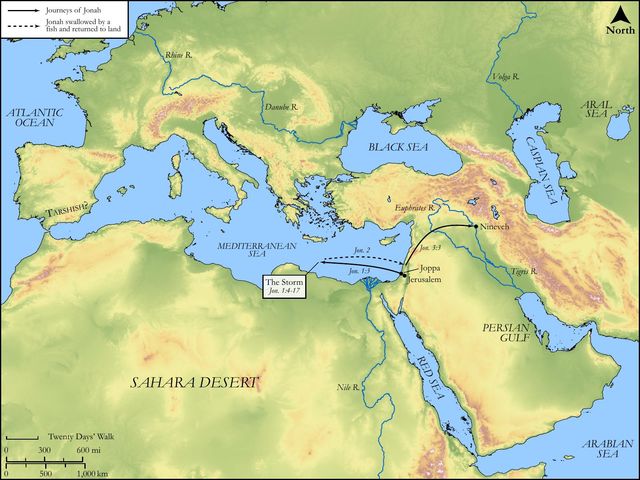
See on the biblical-era map
Study this verse
Public-domain commentary
Matthew Henry
From his Commentary on the Whole Bible. Henry comments on passages, not single verses — this entry covers Jonah 1:11–17. His two-level outline is real structure in the source text, so it is rendered as structure.
It is plain that Jonah is the man for whose sake this evil is upon them, but the discovery of him to be so was not sufficient to answer the demands of this tempest; they had found him out, but something more was to be done, for still the sea wrought and was tempestuous (Jon 1:11), and again (Jon 1:13), it grew more and more tempestuous (so the margin reads it); for if we discover sin to be the cause of our troubles, and do not forsake it, we do but make bad worse. Therefore they went on with the prosecution.
I.They enquired of Jonah himself what he thought they must do with him (Jon 1:11):
What shall we do unto thee, that the sea may be calm to us? They perceived that Jonah is a prophet of the Lord, and therefore will not do any thing, no, not in his own case, without consulting him. He appears to be a delinquent, but he appears also to be a penitent, and therefore they will not insult over him, nor offer him any rudeness. Note, We ought to act with great tenderness towards those that are overtaken in a fault and are brought into distress by it. They would not cast him into the sea if he could think of any other expedient by which to save the ship. Or, perhaps, thus they would show how plain the case was, that there was no remedy but he must be thrown overboard; let him be his own judge as he had been his own accuser, and he himself will say so. Note, When sin has raised a storm, and laid us under the tokens of God's displeasure, we are concerned to enquire what we shall do that the sea may be calm; and what shall we do? We must pray and believe, when we are in a storm, and study to answer the end for which it was sent, and then the storm shall become a calm. But especially we must consider what is to be done to the sin that raised the storm; that must be discovered, and penitently confessed; that must be detested, disclaimed, and utterly forsaken. What have I to do any more with it? Crucify it, crucify it, for this evil it has done.
II.Jonah reads his own doom (Jon 1:12):
Take me up, and cast me forth into the sea. He would not himself leap into the sea, but he put himself into their hands, to cast him into the sea, and assured them that then the sea would be calm, and not otherwise. He proposed this, in tenderness to the mariners, that the might no suffer for his sake. "Let thy hand be upon me" (says David, Ch1 21:17), "who am guilty; let me die for me own sin, but let not the innocent suffer for it." This is the language of true penitents, who earnestly desire that none but themselves may ever smart, or fare the worse, for their sins and follies. He proposed it likewise in submission to the will of God, who sent this tempest in pursuit of him; and therefore judged himself to be cast into the sea, because to that he plainly saw God judging him, that he might not be judged of the Lord to eternal misery. Note, Those who are truly humbled for sin will cheerfully submit to the will of God, even in a sentence of death itself. If Jonah sees this to be the punishment of his iniquity, he accepts it, he subjects himself to it, and justifies God in it. No matter though the flesh be destroyed, no matter how it is destroyed, so that the spirit may be but saved in the day of the Lord Jesus, Co1 5:5. The reason he gives is, For I know that for my sake this great tempest is upon you. See how ready Jonah is to take all the guilt upon himself, and to look upon all the trouble as theirs: "It is purely for my sake, who have sinned, that this tempest is upon you; therefore cast me forth into the sea; for," 1. "I deserve it. I have wickedly departed from my God, and it is upon my account that he is angry with you. Surely I am unworthy to breathe in that air which for my sake has been hurried with winds, to live in that ship which for my sake has been thus tossed. Cast me into the sea after the wares which for my sake you have thrown into it. Drowning is too good for me; a single death is punishment too little for such a complicated offence." 2. "Therefore there is no way of having the sea calm. If it is I that have raised the storm, it is not casting the wares into the sea that will lay it again; no, you must cast me thither." When conscience is awakened, and a storm raised there, nothing will turn it into a calm but parting with the sin that occasioned the disturbance, and abandoning that. It is not parting with our money that will pacify conscience; no, it is the Jonah that be thrown overboard. Jonah is herein a type of Christ, that he gives his life a ransom for many; but with this material difference, that the storm Jonah gave himself up to still was of his own raising, but that storm which Christ gave himself up to still was of our raising. Yet, as Jonah delivered himself up to be cast into a raging sea that it might be calm, so did our Lord Jesus, when he died that we might live.
III.The poor mariners did what they could to save themselves from the necessity of throwing Jonah into the sea, but all in vain (Jon 1:13):
They rowed hard to bring the ship to the land, that, if they must part with Jonah, they might set him safely on shore; but they could not. All their pains were to no purpose; for the sea wrought harder than they could, and was tempestuous against them, so that they could by no means make the land. If they thought sometimes that they had gained their point, they were quickly thrown off to sea again. Still their ship was overladen; their lightening it of the wares made it never the lighter as long as Jonah was in it. And, besides, they rowed against wind and tide, the wind of God's vengeance, the tide of his counsels; and it is in vain to contend with God, in vain to think of saving ourselves any other way than by destroying our sins. By this it appears that these mariners were very loth to execute Jonah's sentence upon himself, though they knew it was for his sake that this tempest was upon them. They were thus very backward to it partly from a dread of bringing upon themselves the guilt of blood, and partly from a compassion they could not but have for poor Jonah, as a good man, as a man in distress, and as a man of sincerity. Note, The more sinners humble and abase themselves, judge and condemn themselves, the more likely they are to find pity both with God and man. The more forward Jonah was to say, Cast me into the sea, the more backward they were to do it.
IV.When they found it necessary to cast Jonah into the sea they first prayed to God that the guilt of his blood might not lie upon them, nor be laid to their charge, Jon 1:14. When they found it in vain to row hard they quitted their oars and went to their prayers: Wherefore they cried unto the Lord, unto Jehovah, the true and living God, and no more to the gods many. and lords many, that the had cried to, Jon 1:5. They prayed to the God of Israel, being now convinced, by the providences of God concerning Jonah and the information he had given them, that he is God alone. Having determined to cast Jonah into the sea, they first enter a protestation in the court of heaven that they do not do it willingly, much less maliciously, or with any design to be revenged upon him because it was for his sake that this tempest was upon them. No; his god forgive him, as they do! But they are forced to do it se defendendo - in self-defence, having no other way to save their own lives; and they do it as ministers of justice, both God and himself having sentenced him to so great a death. They therefore present a humble petition to the God whom Jonah feared, that they might not perish for his life. See,
1.What a fear they had of contracting the guilt of blood, especially the blood of one that feared God, and worshipped him, and had fellowship with him, as they perceived Jonah had, though in a single instance he had been faulty. Natural conscience cannot but have a dread of blood-guiltiness, and make men very earnest in prayer, as David was, to be delivered from it, Psa 51:14. So they were here: We beseech thee, O Lord! we beseech thee, lay not upon us innocent blood. They are now as earnest in praying to be saved from the peril of sin as they were before in praying to be saved from the peril of the sea, especially because Jonah appeared to them to be no ordinary person, but a very good man, a man of God, a worshipper of the great Creator of heaven and earth, upon which account even these rude mariners conceived a veneration for him, and trembled at the thought of taking away his life. Innocent blood is precious, but saints' blood, prophets' blood, is much more precious, and so those will find to their cost that any way bring themselves under the guilt of it. The mariners saw Jonah pursued by divine vengeance, and yet could not without horror think of being his executioners. Though his God has a controversy with him, yet, think they, Let not our hand be upon him. The Israelites were at this time killing the prophets for doing their duty (witness Jezebel's late persecution), and were prodigal of their lives, which is aggravated by the tenderness these heathens had for one whom they perceived to be a prophet, though he was now out of the way of his duty.
2.What a fear they had of incurring the wrath of God; they were jealous lest he should be angry if they should be the death of Jonah, for he had said, Touch not my anointed, and do my prophets no harm; it is at your peril if you do. "Lord," say they, "let us not perish for this man's life. Let it not be such a fatal dilemma to us. We see we must perish if we spare his life; Oh let us not perish for taking away his life." And their plea is good: "For thou, O Lord! hast done as it pleased thee; thou had laid us under a necessity of doing it; the wind that pursued him, the lot that discovered him, were both under thy direction, which we are herein governed by; we are but the instruments of Providence, and it is sorely against our will that we do it; but we must say, The will of the Lord be done." Note, When we are manifestly led by Providence to do things contrary to our own inclinations, and quite beyond our own intentions, it will be some satisfaction to us to be able to say, Thou, O Lord! has done as it pleased thee. And, if God please himself, we ought to be satisfied though he do not please us.
V.Having deprecated the guilt they dreaded, they proceeded to execution (Jon 1:15):
They took up Jonah, and cast him forth into the sea. They cast him out of their ship, out of their company, and cast him into the sea, a raging stormy sea, that cried, "Give, give; surrender the traitor, or expect no peace." We may well think what confusion and amazement poor Jonah was in when he saw himself ready to be hurried into the presence of that God as a Judge whose presence as a Master he was now fleeing from. Note, Those know not what ruin they run upon that run away from God. Woe unto them! for they have fled from me. When sin is the Jonah that raises the storm, that must thus be cast forth into the sea; we must abandon it, and be the death of it, must drown that which otherwise will drown us in destruction and perdition. And if we thus by a thorough repentance and reformation cast our sins forth into the sea, never to recall them or return to them again, God will by pardoning mercy subdue our iniquities, and cast them into the depths of the sea too, Mic 7:19.
VI.The throwing of Jonah into the sea immediately put an end to the storm.
The sea has what she came for, and therefore rests contended; she ceases from her raging. It is an instance of the sovereign power of God that he can soon turn the storm into a calm, and of the equity of his government that when the end of an affliction is answered and attained the affliction shall immediately be removed. He will not contend for ever, will not contend any longer till we submit ourselves and give up the cause. If we turn from our sins, he will soon turn from his anger.
VII.The mariners were hereby more confirmed in their belief that Jonah's God was the only true God (Jon 1:16):
Then the men feared the Lord with a great fear, were possessed with a deep veneration for the God of Israel, and came to a resolution that they would worship him only for the future; for there is no other God that can destroy, that can deliver, after this sort. When they saw the power of God in raising and laying the tempest, when they saw his justice upon Jonah his own servant, and when they saw his goodness to them in saving them from the brink of ruin, then they feared the Lord, Jer 5:22. As an evidence of their fear of him, they offered sacrifice to him when they came ashore again in the land of Israel, and for the present made vows that they would do so, in thankfulness for their deliverance, and to make atonement for their souls. Or, perhaps, they had something yet on board which might be for a sacrifice to God immediately. Or it may be meant of the spiritual sacrifices of prayer and praise, with which God is better pleased than with that of an ox or bullock that has horns and hoofs. See Psa 107:2, etc. We must make vows, not only when we are in the pursuit of mercy, but, which is much more generous, when we have received mercy, as those that are still studying what we shall render.
VIII.Jonah's life, after all, is saved by a miracle, and we shall hear of him again for all this.
In the midst of judgment God remembers mercy. Jonah shall be worse frightened than hurt, not so much punished for his sin as reduced to his duty. Though he flees from the presence of the Lord, and seems to fall into his avenging hands, yet God has more work for him to do, and therefore has prepared a great fish to swallow up Jonah (Jon 1:17), a whale our Saviour calls it (Mat 12:40), one of the largest sorts of whales, that have wider throats than others, in the belly of which has sometimes been found the dead body of a man in armour. Particular notice is taken, in the history of creation, of God's creating great whales (Gen 1:21) and the leviathan in the waters made to play therein, Psa 104:26. But God finds work for this leviathan, has prepared him, has numbered him (so the word is), has appointed him to be Jonah's receiver and deliverer. Note, God has command of all the creatures, and can make any of them serve his designs of mercy to his people, even the fishes of the sea, that are most from under man's cognizance, even the great whales, that are altogether from under man's government. This fish was prepared, lay ready under water close by the ship, that he might keep Jonah from sinking to the bottom, and save him alive, though he deserved to die. Let us stand still and see this salvation of the Lord, and admire his power, that he could thus save a drowning man, and his pity, that he would thus save one that was running from him and had offended him. It was of the Lord's mercies that Jonah was not now consumed. The fish swallowed up Jonah, not to devour him, but to protect him. Out of the eater comes forth meat; for Jonah was alive and well in the belly of the fish three days and three nights, not consumed by the heat of the animal, nor suffocated for want of air. It is granted that to nature this was impossible, but not to the God of nature, with whom all things are possible. Jonah by this miraculous preservation was designed to be made,
1.A monument of divine mercy, for the encouragement of those that have sinned, and gone away from God, to return and repent.
2.A successful preacher to Nineveh; and this miracle wrought for his deliverance, if the tidings of it reached Nineveh, would contribute to his success.
3.An illustrious type of Christ, who was buried and rose again according to the scriptures (Co1 15:4), according to this scripture, for, as Jonah was three days and three nights in the whale's belly, so was the Son of man three days and three nights in the heart of the earth, Mat 12:40. Jonah's burial was a figure of Christ's. God prepared Jonah's grave, so he did Christ's, when it was long before ordained that he should make his grave with the rich, Isa 53:9. Was Jonah's grave a strange one, a new one? So was Christ's, one in which never man before was laid. Was Jonah there the best part of three days and three nights? So was Christ; but both in order to their rising again for the bringing of the doctrine of repentance to the Gentile world. Come, see the place where the Lord lay.
Historical interpretation
Two Centuries of Reception
5 surviving comments on this verse. Each one is dated, so this reads as a timeline rather than a list.
Select a marker to jump to its quote. Markers stagger vertically where authors wrote within a few decades of each other.
Did Jonah, then, on this account, think that repentance was unnecessary for the pagan Ninevites, when he tried to avoid his duty of preaching? Or was it not, rather, that he foresaw that the mercy of God would be poured out on the heathen also, and so feared it would prove him a false prophet? Actually it was because of a pagan city, which did not yet know God and which sinned in ignorance, that the prophet was almost lost. And he would have been lost, were it not for the fact that what he endured was a type of the Lord’s suffering, by which pagan penitents also would be redeemed.
It is also your duty, O bishop, to follow the examples of those that have gone before and to apply their judgments skillfully to the cases of those who want words of severity or of consolation. Besides, it is reasonable that in your administration of justice you should follow the will of God. As God deals with sinners and with those who return, you should act accordingly in your judging. Now did not God by Nathan admonish David for his offense? And yet as soon as he said he repented, God delivered him from death, saying, “Be of good cheer; you shall not die.” So also, when God had caused Jonah to be swallowed up by the sea and the whale upon his refusal to preach to the Ninevites, when yet he prayed to God out of the belly of the whale, he retrieved his life from corruption.
They further object: A dead man recently deceased was raised by the living; but show us that it is possible for a man dead and buried for three days to rise again. The testimony we seek is supplied by the Lord Jesus himself in the Gospels, when he says, “For even as Jonah was in the belly of the fish three days and three nights, so will the Son of man be three days and three nights in the heart of the earth.” Now when we study the story of Jonah the force of the resemblance becomes striking. Jesus was sent to preach repentance. So was Jonah. Though Jonah fled, not knowing what was to come, Jesus came willingly, to grant repentance for salvation. Jonah slumbered in the ship and was fast asleep amid the stormy sea; while Jesus by God’s will was sleeping, the sea was stirred up, for the purpose of manifesting thereafter the power of him who slept. They said to Jonah, “What are you doing asleep? Rise up, call upon your God, that God may save us,” but the apostles say, “Lord, save us!” In the first instance they said, Call upon your God, and in the second, save us. In the first Jonah said to them, “Pick me up and throw me into the sea, that it may quiet down for you”; in the other Christ himself “rebuked the wind and the sea, and there came a great calm.” Jonah was cast into the belly of a great fish, but Christ of his own will descended to the abode of the invisible fish of death. He went down of his own will to make death disgorge those it had swallowed up, according to the Scripture: “I shall deliver them from the power of the nether world, and I shall redeem them from death.”
"Now the LORD had prepared a great fish to swallow up Jonah." LXX: 'and the Lord ordered a great fish to swallow Jonah'. The Lord commanded death and the underworld to receive the prophet. To the eager jaws of death he seemed a prey: she had such joy in swallowing him, and such sadness in spitting him out. Thus happened what is written in Hosea: "I will be your death, O Death! I will be your bite, Hell!" [Hos. 13:14]. In the Hebrew we read "a great fish", which the Septuagint and the Lord in the Gospel call a whale, to explain the matter in short. For the Hebrew says dag gadol that we translate as 'a big fish'. Evidently this means a whale. We must note too that where he awaited death, he found his salvation. And when it says, "he had prepared", this is even right at the beginning of creation, the animal which is mentioned in the psalm: "this dragon which you have created to play with him" [Ps. 103:26]. Or even he makes a fish come near to the ship to take in its belly Jonah who has been thrown over board, and to provide his rescue not his death. So he who felt the wrath of God in the boat was to feel his benevolence in his death.
"And Jonah was in the belly of the fish three days and three nights." LXX: 'and Jonah was in the belly of the whale for three days and three nights'. The Lord shows in the Gospel the symbolism of this passage [Mt. 12:40], and it is superfluous to say in the same terms or even in other terms what he who has suffered has already said. But we ask ourselves this: how was he three days and three nights in the belly of the earth. Some scholars take the view according to paraskeuen, because of the solar eclipse from the sixth to the ninth hour when night followed day, this would be two days and nights, and adding the Sabbath, believe that we should count this as three days and three nights. But I prefer to understand this by reason of synecdoche, seeing the whole as a part: where he is dead in paraskeuen [Lk. 23:54], let us count one day and one night; two with the Sabbath; the third night which arises from the day of the Lord, let us take that as the beginning of the next day, for, in Genesis [Genesis 1:5-8] the night is not of the preceding day, but of the following day, that is to say the beginning of the next day, not the end of the previous. To understand this better I will say it more simply: if a man leaves his house at nine and the next day he arrives at his other house at three. And if I say that he has been two days in travelling, I will not be reprimanded as a liar, because he has not used all the hours of two days, but only a part for his journey. Nonetheless this seems to me to be the interpretation. If someone does not agree with this, and he can explain the meaning in a clearer way, then we should follow his interpretation.
The last question is about Jonah, and it is not put as if it were taken from Porphyry but as if it were a laughingstock of the pagans. It is expressed thus: “Please tell me what we are to think about Jonah, who is said to have been three days in the belly of a whale. It is improbable and unbelievable that he should have been swallowed up with his clothing and should have been inside the fish. If it is figuratively said, please explain it.… I have noticed that this sort of question is a matter of much jest and much laughter to pagans. The answer to this is that either all the divine miracles are to be disbelieved or there is no reason why they should not be believed. We should not believe in Christ himself and that he rose on the third day, if the faith of the Christians feared the laughter of the pagans.
Continue studying Jonah 1:17 across the web’s major study libraries — every link below opens this exact verse, chapter, or book on the destination site.
Read & Compare
 BibleGatewayThis verse in more than 200 translations and 70 languages.
 Bible.comThe YouVersion reader — hundreds of translations, reading plans, and highlights.
 ESV.orgCrossway's official English Standard Version reader.
 NET BibleThe NET translation with 60,000+ translators' notes on every rendering decision.
 STEP BibleTyndale House's free study tool — original text, vocabulary, and scholarly resources.
 BibliaLogos Bible Software's free web reader.
 USCCBThe New American Bible (Revised Edition) with the U.S. bishops' study notes.
Commentaries
 BibleHub CommentariesDozens of classic commentaries on this verse, gathered on one page.
 StudyLightMore than 100 commentary sets — the largest collection on the web.
 BibleRefPlain-English commentary on what this verse means, verse by verse.
 Enduring WordDavid Guzik's free commentary on this chapter, widely used by Bible teachers.
 Bible Study ToolsVerse commentary alongside Greek and Hebrew study aids.
Original Language & Research
- BibleHub InterlinearThe verse word by word — original language, transliteration, and English.
- BibleHub LexiconEvery word's original-language definition and Strong's entry.
 Blue Letter BibleDeep-study tools — Strong's numbers, concordance, and word studies.
 SefariaThe Hebrew text with Rashi and centuries of Jewish commentary.
Sermons, Hymns & Audio


TrulyRandomVerse is not affiliated with these sites and doesn’t control their content. They’re linked because they’re genuinely useful.
Summary
Jonah 1:17 records a profound act of divine intervention, where the LORD supernaturally prepared a "great fish" to swallow Jonah, saving him from certain death in the sea. This pivotal moment marks a dramatic shift in Jonah's journey, transforming his rebellious flight into a period of intense divine discipline, preservation, and ultimately, a crucible for repentance, setting the stage for his eventual obedience to God's prophetic call.
Context
ShowHideLiterary Context
This verse immediately follows Jonah's dramatic casting into the turbulent sea by the terrified pagan sailors. The storm, divinely sent to halt Jonah's flight from God's command, miraculously ceased the moment Jonah was thrown overboard, demonstrating God's absolute control over creation and His specific targeting of Jonah. Rather than allowing Jonah to perish in the depths, which would have been a just consequence for his blatant disobedience, God orchestrates a miraculous rescue. The "great fish" serves as both a divinely appointed prison and a vessel of preservation, preventing Jonah's death and providing a unique environment for him to confront his rebellion and seek God's face. This intervention underscores the narrative's central theme of God's relentless pursuit of His chosen servants and His unwavering commitment to His redemptive purposes, even through extraordinary means.
Historical & Cultural Context
The book of Jonah is unique among prophetic books, focusing less on the prophet's message and more on the prophet himself and God's interaction with him. While specific cultural norms are not directly highlighted in this verse, the historical context emphasizes the extraordinary nature of God's power. In a world where people often attributed natural phenomena to various deities, the LORD's direct control over the storm and marine life would have been a staggering display of His singular sovereignty. The concept of being swallowed by a large sea creature, while seemingly mythical to some, is presented as a literal, historical event, challenging human perceptions of what is possible and underscoring the miraculous character of divine intervention. This event transcends typical historical or cultural explanations, standing as a testament to God's ability to act outside the ordinary course of nature to achieve His will.
Key Themes
ShowHideJonah 1:17 encapsulates several profound themes that resonate throughout the book and the broader biblical narrative. First, it powerfully illustrates Divine Sovereignty and Providence, emphasizing that the LORD is actively and meticulously orchestrating events, even those involving rebellious individuals or natural forces, to accomplish His purposes. The phrase "the LORD had prepared" (Hebrew: manah) underscores God's deliberate and purposeful design, demonstrating His absolute control over creation, including the deepest parts of the sea and its inhabitants, as seen in Psalm 135:6. Second, it highlights God's Mercy and Deliverance even in the face of blatant disobedience. Despite Jonah's flight from his prophetic calling, God's immediate response is not ultimate destruction but a miraculous rescue, using the fish as a means of preservation rather than punishment, reflecting His compassionate nature (Lamentations 3:22-23). Third, the verse starkly portrays the Consequences of Disobedience, as Jonah's rebellion leads him to this extreme and uncomfortable predicament, a direct result of his attempt to evade God's will. Finally, this extraordinary event carries significant Symbolism and Foreshadowing, serving as a prophetic type that Jesus Himself would later reference as the sign of the prophet Jonah, pointing to His own death, burial, and resurrection.
Exposition and Analysis
ShowHideKey Word Analysis
ShowHideA primitive root meaning "to weigh out," and by implication, "to allot or constitute officially; also to enumerate or enroll." In this context, it signifies God's deliberate, purposeful, and sovereign appointment or designation of the fish for a specific task. It's not a chance occurrence but a meticulously planned divine act, highlighting God's active involvement in the unfolding drama.
Meaning "great (in any sense)." This adjective emphasizes the immense size of the fish, underscoring the miraculous nature of the event. It does not specify a particular species (like a whale), but rather denotes a creature of extraordinary proportions, capable of swallowing a man whole, thereby magnifying the power and specificity of God's preparation.
A primitive root meaning "to make away with (specifically by swallowing); generally, to destroy." Here, it describes the complete engulfment of Jonah by the fish. While the primary sense is absorption, the context makes it clear that this "swallowing" was for preservation, not destruction, a testament to God's unique purpose for the creature.
Verse Breakdown
ShowHide"Now the LORD had prepared a great fish to swallow up Jonah."
This opening clause immediately establishes divine agency. The phrase "the LORD had prepared" (Hebrew: YHWH manah) is crucial, asserting God's active, intentional, and sovereign role in this miraculous event. It was not a random occurrence, nor was it merely a large creature that happened to be in the vicinity. Rather, the Creator of all things specifically appointed and made ready a fish of immense size ("great fish") with the precise purpose of engulfing Jonah. This highlights God's power over creation and His direct intervention in human affairs, even to discipline and redirect His disobedient prophet.
"And Jonah was in the belly of the fish three days and three nights."
This second clause details the immediate consequence and duration of God's intervention. Jonah, who had fled from God's presence, now finds himself in an utterly inescapable and extraordinary confinement—the "belly of the fish." The specific duration of "three days and three nights" is highly significant, not only marking the length of Jonah's ordeal but also serving as a profound prophetic sign. This period of darkness, isolation, and near-death experience within the fish's belly becomes a metaphor for death and resurrection, a crucible for Jonah's repentance, and a direct foreshadowing of Christ's time in the tomb.
Literary Devices
ShowHideJonah 1:17 is rich with literary devices that amplify its theological weight. Divine Intervention is the most prominent, as the verse explicitly states "the LORD had prepared," signaling God's direct, supernatural, and purposeful action in the narrative. This is not a natural event but a miracle demonstrating God's absolute sovereignty over creation. Symbolism is also profoundly at play: the fish itself functions as a symbolic womb, a place of rebirth and transformation for Jonah, but also a tomb, representing a descent into death. The "three days and three nights" is a powerful motif that echoes throughout biblical literature, most notably in its Foreshadowing of Christ's death and resurrection. This specific temporal detail links Jonah's experience directly to Jesus's own prophecy concerning the "sign of Jonah," making the prophet's ordeal a divinely ordained prefigurement of the ultimate act of salvation. The entire scene can also be seen as an irony, where Jonah, who fled from God's presence, is paradoxically brought back into a profound encounter with God within the belly of a fish, a place of extreme isolation.
Theological and Thematic Connections
ShowHideJonah 1:17 is a profound testament to God's relentless pursuit of His purposes and His people, even in their rebellion. It underscores that divine discipline is often an expression of love, designed not for destruction but for restoration and redirection. God's sovereignty is vividly displayed as He controls not only the storm but also the creatures of the deep to achieve His will. This event demonstrates that there is no place, no matter how remote or dire, where one can escape God's presence or His redemptive plan. It also highlights God's patience and mercy, offering a second chance to a disobedient prophet, reflecting His desire for all to come to repentance.
Reflection and Application
ShowHideJonah 1:17 offers profound insights for believers navigating life's challenges and their own spiritual journeys. It serves as a powerful reminder that even when we stray from God's path, His grace and purposes relentlessly pursue us. Our "great fish" moments—those times of intense difficulty, isolation, or consequence for our disobedience—are often God's sovereign means of bringing us back into alignment with His will. These experiences, though uncomfortable and even terrifying, are not intended for our destruction but for our preservation and transformation. We learn to trust that God's power is limitless, capable of orchestrating seemingly impossible circumstances for our good and His glory. Just as Jonah's "belly of the fish" experience ultimately led to his repentance and renewed mission, our trials can become crucibles for deeper faith, humility, and a renewed commitment to God's calling on our lives. This verse encourages us to embrace God's discipline as an act of love, trusting that even in the darkest valleys, His hand is at work, preparing us for His greater purposes.
Questions for Reflection
ShowHideFAQ
ShowHideWhat kind of "great fish" was it, and is it literally possible for a person to survive being swallowed?
ShowHideThe Hebrew phrase "dâg gâdôwl" (דָּג גָּדוֹל) literally translates to "great fish" or "large marine creature." The text does not specify a particular species, such as a whale, shark, or any other known marine animal. The emphasis is on its immense size and, more importantly, on the fact that the LORD "prepared" it. This preparation implies a miraculous intervention, ensuring Jonah's survival and preservation. While the exact biological mechanism of survival is not detailed, the biblical account presents it as a supernatural act of God, making it possible for Jonah to endure this extraordinary ordeal. The focus is less on zoological classification and more on divine power and purpose.
Is the story of Jonah a literal historical event, or is it a parable or allegory?
ShowHideThe book of Jonah is presented in the biblical canon as a historical narrative, much like other prophetic books. Jewish and Christian traditions have historically understood it as a literal account. Crucially, Jesus Christ Himself refers to Jonah's experience as a historical event, using it as a direct parallel and prophetic sign of His own death and resurrection. In Matthew 12:40, Jesus states, "For just as Jonah was three days and three nights in the belly of the great fish, so will the Son of Man be three days and three nights in the heart of the earth." This affirmation by Jesus strongly supports the historical veracity of the account, indicating that the miraculous elements are not allegorical but demonstrate God's supernatural power within history.
Christ-Centered Fulfillment
ShowHideJonah 1:17 finds its ultimate and most profound fulfillment in the person and work of Jesus Christ. The "three days and three nights" Jonah spent in the belly of the great fish is explicitly cited by Jesus Himself as the "sign of Jonah", directly foreshadowing His own death, burial, and glorious resurrection. Just as Jonah's emergence from the fish signified a miraculous deliverance from the clutches of death, so too did Christ's resurrection from the tomb conquer death and the grave, offering new life to all who believe. Jonah's experience was a temporary rescue for one disobedient prophet, leading to the repentance of Nineveh; Christ's "resurrection" was the definitive, eternal victory over sin and death, providing salvation for all humanity. The fish, a means of preservation for Jonah, points to the tomb, which could not hold the Son of God. Thus, Jonah 1:17 is more than a miraculous escape; it is a powerful Old Testament type, a divinely orchestrated preview of the ultimate deliverance wrought by the Lamb of God who takes away the sin of the world, fulfilling the prophetic pattern in a way that far surpasses the original event, offering hope and eternal life through His triumph over death (1 Corinthians 15:3-4).