


Ezra 8:35
- הַבָּאִיםHa·ba·'imthose [who] had comeH935Art ¦ V-Qal-Prtcpl-mpVerb Qal Participle Plural Masculine Absoluteהַthoseבָּאִים[who] had come
- מֵהַשְּׁבִיme·ha·she·Vifrom the captivityH7628Prep-m ¦ Art ¦ N-msNoun Singular Masculine Absoluteמֵfromהַtheשְּׁבִיcaptivity
- בְנֵיve·nei[the] children ofH1121N-mpcNoun Plural Masculine Construct
- הַגּוֹלָהha·go·Lahthe exileH1473Art ¦ N-fsNoun Singular Feminine Absoluteהַtheגּוֹלָהexile
- הִקְרִיבוּhik·Ri·vuthey brought nearH7126V-Hiphil-Perf-3cpVerb Hiphil Perfect 3rd Plural common gender
- עֹלוֹתo·Lotburnt offeringsH5930N-fpNoun Plural Feminine Absolute
- לֵאלֹהֵיle·lo·Heito [the] God ofH430Prep-l ¦ N-mpcNoun Plural Masculine Constructלֵtoאלֹהֵי[the] God of
- יִשְׂרָאֵלYis·ra·'ElIsraelH3478N-properNoun Proper Location
- פָּרִיםpa·RimbullsH6499N-mpNoun Plural Masculine Absolute
- שְׁנֵיםshe·neimtwo [plus]H8147Adj-cdAdjective Numerical Dual common gender Absolute
- עָשָׂר'a·SartenH6240Adj-csAdjective Numerical Singular common gender Absolute
- עַל'alonH5921PrepPreposition
- כָּלkolallH3605N-mscNoun Singular Masculine Construct
- יִשְׂרָאֵלYis·ra·'ElIsraelH3478N-properNoun Proper Location
- אֵילִים'ei·LimramsH352N-mpNoun Plural Masculine Absolute
- תִּשְׁעִיםtish·'ImninetyH8673Adj-mpAdjective Numerical Plural Masculine Absolute
- וְשִׁשָּׁהve·shi·Shahand sixH8337Conj-w ¦ Adj-csAdjective Numerical Singular common gender Absoluteוְandשִׁשָּׁהsix
- כְּבָשִׂיםke·va·SimlambsH3532N-mpNoun Plural Masculine Absolute
- שִׁבְעִיםshiv·'ImseventyH7657Adj-mpAdjective Numerical Plural Masculine Absolute
- וְשִׁבְעָהve·shiv·'Ahand sevenH7651Conj-w ¦ Adj-csAdjective Numerical Singular common gender Absoluteוְandשִׁבְעָהseven
- צְפִירֵיtze·fi·Reihe-goats ofH6842N-mpcNoun Plural Masculine Construct
- חַטָּאתcha·Tatsin offeringH2403N-fsNoun Singular Feminine Absolute
- שְׁנֵיםshe·Neimtwo [plus]H8147Adj-cdAdjective Numerical Dual common gender Absolute
- עָשָׂר'a·SartenH6240Adj-csAdjective Numerical Singular common gender Absolute
- הַכֹּלha·Kol<the> everythingH3605Art ¦ N-msNoun Singular Masculine Absoluteהַ<the>כֹּלeverything
- עוֹלָהo·Lah[was] a burnt offeringH5930N-fsNoun Singular Feminine Absolute
- לַיהוָהla·Yah·wehto YahwehH3068Prep-l ¦ N-properNoun Proper TitleלַtoיהוָהYahweh
English is a literal word-by-word gloss of the Hebrew, not the KJV's wording. Why?
This is the original text the KJV's translators worked from — each Hebrew word with its own literal English meaning in this verse, prepared by scholars at Tyndale House, Cambridge. The KJV translates whole sentences, not word by word, so its wording differs: one Hebrew word can become several English words, and the KJV may choose “the LORD” where the gloss reads “Yahweh”. Both are faithful — they answer different questions. For the KJV's own rendering, switch to the KJV text.
Details
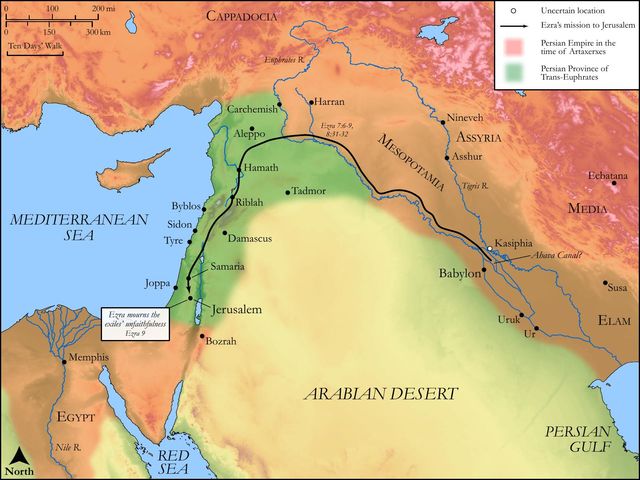
See on the biblical-era map
Study this verse
Public-domain commentary
Matthew Henry
From his Commentary on the Whole Bible. Henry comments on passages, not single verses — this entry covers Ezra 8:31–36. His two-level outline is real structure in the source text, so it is rendered as structure.
We are now to attend Ezra to Jerusalem, a journey of about four months in all; but his multitude made his marches slow and his stages short. Now here we are told,
I.That his God was good, and he acknowledged his goodness:
The hand of our God was upon us, to animate us for our undertaking. To him they owed it,
1.That they were preserved in their journey, and not all cut off; for there were enemies that laid wait for them by the way to do them a mischief, or at least, like Amalek, to smite the hindmost of them, but God protected them, Ezr 8:31. Even the common perils of journeys are such as oblige us to sanctify our going out with prayer and our returns in peace with praise and thanksgiving; much more ought God to be thus eyed in such a dangerous expedition as this was.
2.That they were brought in safety to their journey's end, Ezr 8:32. Let those that have stedfastly set their faces towards the new Jerusalem proceed and persevere to the end till they appear before God in Zion, and they shall find that he who has begun the good work will perform it.
II.That his treasurers were faithful.
When they had come to Jerusalem they were impatient to be discharged of their trust, and therefore applied to the great men of the temple, who received it from them and gave them an acquittance in full, Ezr 8:33, Ezr 8:34. It is a great ease to one's mind to be discharged from a trust, and a great honour to one's name to be able to make it appear that it has been faithfully discharged.
III.That his companions were devout.
As soon as they came to be near the altar they thought themselves obliged to offer sacrifice, whatever they had done in Babylon, Ezr 8:35. That will be dispensed with when we want opportunity which when the door is opened again will be expected from us. It is observable,
1.That among their sacrifices they had a sin-offering; for it is the atonement that sweetens and secures every mercy to us, which will not be truly comfortable unless iniquity be taken away and our peace made with God.
2.That the number of their offerings related to the number of the tribes, twelve bullocks, twelve he-goats, and ninety-six rams (that is, eight times twelve), intimating the union of the two kingdoms, according to what was foretold, Eze 37:22. They did not any longer go two tribes one way and ten another, but all the twelve met by their representatives at the same altar.
IV.That even the enemies of the Jews became their friends, bowed to Ezra's commission, and, instead of hindering the people of God, furthered them (Ezr 8:36), purely in complaisance to the king: when he appeared moderate they all coveted to appear so too. Then had the churches rest.
Historical interpretation
Historical reception
1 surviving comment on this verse from the historical church.
But also those who came from the captivity, the sons of the exile, etc. A great devotion and religiosity is shown by those who, when they came from captivity, arriving at the temple and altar of the Lord, first of all offered burnt offerings, not only for themselves but also for all Israel, that is, both for those who had already returned home and for those who were still enduring exile from their homeland, so that the mercy of their creator might protect them all. The spiritual meaning is also evident, that those who truly and perfectly escaped the captivity of the ancient enemy, by sinning they were held, but by repenting they freed themselves, who with firm intention submit to divine service, who wholly detach themselves from low desires, and are inflamed by the flame of heavenly desire to ascend to the heights. This is to offer burnt offerings, that is, wholly burned sacrifices or victims to the Lord, thinking or doing nothing but His will in all things. It is also a sign of a perfect mind when someone sacrifices for all Israel, that is, for the general well-being of all the faithful, as if mindful of unity and brotherhood in all, he supplicates the heavenly piety.
Continue studying Ezra 8:35 across the web’s major study libraries — every link below opens this exact verse, chapter, or book on the destination site.
Read & Compare
 BibleGatewayThis verse in more than 200 translations and 70 languages.
 Bible.comThe YouVersion reader — hundreds of translations, reading plans, and highlights.
 ESV.orgCrossway's official English Standard Version reader.
 NET BibleThe NET translation with 60,000+ translators' notes on every rendering decision.
 STEP BibleTyndale House's free study tool — original text, vocabulary, and scholarly resources.
 BibliaLogos Bible Software's free web reader.
 USCCBThe New American Bible (Revised Edition) with the U.S. bishops' study notes.
Commentaries
 BibleHub CommentariesDozens of classic commentaries on this verse, gathered on one page.
 StudyLightMore than 100 commentary sets — the largest collection on the web.
 BibleRefPlain-English commentary on what this verse means, verse by verse.
 Enduring WordDavid Guzik's free commentary on this chapter, widely used by Bible teachers.
 Bible Study ToolsVerse commentary alongside Greek and Hebrew study aids.
Original Language & Research
- BibleHub InterlinearThe verse word by word — original language, transliteration, and English.
- BibleHub LexiconEvery word's original-language definition and Strong's entry.
 Blue Letter BibleDeep-study tools — Strong's numbers, concordance, and word studies.
 SefariaThe Hebrew text with Rashi and centuries of Jewish commentary.
Sermons, Hymns & Audio


TrulyRandomVerse is not affiliated with these sites and doesn’t control their content. They’re linked because they’re genuinely useful.
Summary
Ezra 8:35 chronicles a momentous act of worship by the returning exiles under Ezra's leadership, immediately following their divinely protected journey from Babylon to Jerusalem. This grand offering of burnt offerings and sin offerings for "all Israel" served as a profound expression of gratitude for God's faithfulness, a corporate rededication to the Mosaic covenant, and a powerful symbolic reassertion of national unity after decades of dispersion. It highlights the spiritual core of their return: to re-establish proper worship and restore their communal relationship with the God of Israel in their ancestral homeland.
Context
ShowHideLiterary Context
Ezra 8:35 marks the culminating spiritual event of Ezra's arduous journey from Babylon to Jerusalem, a narrative detailed across Ezra chapters 7 and 8. The preceding verses meticulously describe Ezra's divine commission from King Artaxerxes, his careful assembly of a second wave of exiles, and the critical decision to rely solely on God's protection for their perilous trek, foregoing a royal escort (Ezra 8:21-23). The safe arrival in Jerusalem, along with the precious temple treasures entrusted to them, is recounted in Ezra 8:31-32. The extensive sacrifices in verse 35 are therefore the immediate and climactic response to God's manifest faithfulness in preserving them and enabling the secure delivery of the sacred articles, which had been weighed and delivered in Ezra 8:33-34. This act of worship thus functions as the spiritual apex of their journey, setting the theological foundation for Ezra's subsequent reforms concerning the Law and the purity of the community, as elaborated in Ezra 9-10.
Historical & Cultural Context
The events of Ezra 8:35 are situated in the mid-5th century BCE, approximately 80 years after the initial return of exiles led by Zerubbabel and Joshua, and roughly 60 years following the dedication of the Second Temple. The Jewish people had endured seventy years of Babylonian captivity, a period prophesied by Jeremiah (Jeremiah 29:10), and their return was a tangible fulfillment of divine promise. This era was characterized by Persian imperial rule, which, unlike previous Assyrian and Babylonian policies, permitted conquered peoples to return to their homelands and rebuild their religious structures. The journey from Babylon to Jerusalem was notoriously dangerous, fraught with risks from bandits, wild animals, and the sheer logistical challenges of travel, making the exiles' safe arrival a profound cause for thanksgiving and a clear sign of divine favor. The sacrifices themselves meticulously adhered to the prescriptions of the Mosaic Law, which formed the bedrock of Israelite worship. Burnt offerings ('olah) and sin offerings (chatta't) were foundational sacrifices for expressing devotion, achieving atonement, and maintaining a right covenant relationship with God (Leviticus 1-7). The specific numbers of animals, particularly the twelve bullocks, would have resonated deeply with the historical memory and aspirations for the reunification of the twelve tribes of Israel.
Key Themes
ShowHideThis verse powerfully encapsulates several pivotal themes central to the book of Ezra and the broader post-exilic narrative. Firstly, it underscores Divine Providence and Faithfulness, as God's protective hand guided the exiles through peril, fulfilling His unwavering promise to restore His people to their land. Secondly, it highlights Restoration and Re-establishment of Worship, demonstrating the community's paramount purpose in returning: to renew their covenant with God through proper sacrifice and obedience, which had been severely disrupted during the exile. Thirdly, the explicit mention of "all Israel" points to a deep longing for National Unity and Corporate Identity, signifying a profound aspiration for the reunification of the twelve tribes, even in their fragmented post-exilic reality, echoing prophetic visions of a restored and unified Israel (e.g., Ezekiel 37:22). Finally, the act of offering sacrifices, particularly the sin offering, emphasizes the enduring need for Atonement and Cleansing to stand rightly before a holy God, a foundational principle of the Mosaic Covenant that would ultimately point to a greater, final sacrifice for all humanity (Hebrews 9:22).
Exposition and Analysis
ShowHideKey Word Analysis
ShowHideFrom the root meaning "to build," this word signifies a son or descendant, emphasizing lineage and continuity. In this context, it refers to the "children of those that had been carried away," highlighting the generational connection to the exiles and the continuation of the covenant community. It underscores that this act of worship is performed by the direct inheritors of Israel's covenant identity, those who are literally "building" the nation anew in the land.
Meaning "he will rule as God," this is the symbolic name given to Jacob and subsequently to his posterity, representing the covenant nation chosen by God. Its repeated appearance in Ezra 8:35 ("God of Israel," "for all Israel") emphasizes the corporate, national identity of the worshipers and the comprehensive scope of their offerings. It signifies that this sacrificial act is not merely individual but a collective rededication by the entire covenant people, affirming their unique relationship with Yahweh.
This term, derived from a root meaning "to go up," refers to a holocaust where the entire animal is consumed by fire on the altar, with the smoke ascending to God. The ʻôlâh was the most comprehensive offering, symbolizing complete surrender, devotion, and propitiation. It represented the worshiper's total dedication to God, with nothing held back, and was often offered as an act of thanksgiving or to make general atonement for sin. Here, it signifies the exiles' profound gratitude for their safe return and their renewed, wholehearted commitment to the God who had faithfully brought them home.
This offering was specifically prescribed for atonement, to cleanse from unintentional sins, ritual impurities, or breaches of the Law that might defile the community or individual. The chaṭṭâʼâh served to restore the offerer's ritual purity and fellowship with God, allowing them to remain in covenant relationship. Its inclusion here indicates the community's recognition of their corporate and individual sinfulness, acknowledging their need for purification and forgiveness before resuming full worship and covenant life in the land.
Verse Breakdown
ShowHide"[Also] the children of those that had been carried away, which were come out of the captivity, offered burnt offerings unto the God of Israel"
This clause identifies the participants as the second wave of Jewish exiles, the descendants of those who endured the trauma of captivity and were now miraculously returned. Their act of offering is explicitly directed "unto the God of Israel," underscoring their covenant relationship and acknowledging Yahweh as their sovereign Lord, distinct from the deities of Babylon or Persia. The immediate offering of burnt offerings signifies profound gratitude for their safe return and a public act of corporate rededication.
"twelve bullocks for all Israel"
The number twelve is profoundly symbolic, representing the twelve tribes of Israel. Despite the scattering and partial loss of many tribes during the exile, this offering of twelve bullocks on behalf of "all Israel" expresses a powerful longing for national unity and a corporate identity under God. It signifies a collective act of worship and dedication by the entire nation, affirming their shared heritage and destiny, regardless of their current geographical or tribal dispersion.
"ninety and six rams, seventy and seven lambs"
These specific numbers represent additional burnt offerings, indicating a substantial and generous sacrifice. Rams and lambs were common animals for burnt offerings, signifying further acts of devotion, thanksgiving, and propitiation. The large quantity underscores the magnitude of their gratitude and the seriousness of their rededication to God after their safe arrival.
"twelve he goats [for] a sin offering"
Again, the number twelve is significant, mirroring the bullocks offered for "all Israel." The inclusion of sin offerings alongside burnt offerings highlights the community's acute awareness of their need for atonement. These goats were offered to cleanse the community from impurities and unintentional sins, demonstrating their fervent desire to stand pure before God as they re-established covenant life and worship in Jerusalem.
"all [this was] a burnt offering unto the LORD."
This concluding phrase clarifies the overarching nature of the entire sacrificial event. While specific animals were designated for sin offerings, the entire collection of sacrifices is ultimately presented as a comprehensive "burnt offering unto the LORD." This emphasizes the complete dedication and wholehearted devotion of the returning exiles, signifying their total surrender and commitment to God as they re-established their lives and worship in the Promised Land.
Literary Devices
ShowHideEzra 8:35 employs several significant literary devices to convey its profound theological message. Symbolism is paramount, particularly in the repeated and deliberate use of the number twelve for both the bullocks and the he-goats. This number unequivocally symbolizes the twelve tribes of Israel, representing a deep aspiration for national unity and the corporate identity of God's people, even in their fragmented post-exilic state. The very act of offering sacrifices is symbolic of gratitude, purification, and renewed covenant commitment. Repetition is also evident in the phrase "burnt offering," which appears twice, first describing the general category of offerings and then as a concluding summary, emphasizing the overarching theme of complete dedication and devotion to the LORD. Furthermore, the detailed Enumeration of the animals (twelve bullocks, ninety-six rams, seventy-seven lambs, twelve he-goats) serves to highlight the magnitude and generosity of the sacrifice, underscoring the deep devotion and earnestness of the returning exiles. This precise listing lends a sense of historical accuracy and solemnity to the event, emphasizing the intentionality and significance of their worship.
Theological and Thematic Connections
ShowHideEzra 8:35 stands as a powerful testament to the enduring principles of gratitude, atonement, and covenant renewal in the life of God's people. The exiles' immediate response of lavish sacrifice upon their safe arrival underscores that true deliverance necessitates a corresponding dedication of life and worship to the Deliverer. Their recognition of corporate sin through the sin offerings, coupled with the comprehensive devotion of the burnt offerings, reflects a profound understanding of God's holiness and humanity's perpetual need for reconciliation. This act of worship was not merely ritualistic but a tangible expression of their desire to live in renewed obedience to the Mosaic Law, which had been neglected, leading to their exile. It foreshadows the ongoing need for a perfect sacrifice and a complete dedication that would ultimately be fulfilled in Christ.
Reflection and Application
ShowHideEzra 8:35 offers timeless lessons for believers today, transcending the specific ritual practices of the Old Covenant. Just as the returning exiles sought to re-establish their relationship with God through sacrifice and obedience, we are called to respond to God's deliverance and provision with wholehearted gratitude and dedication. Our "sacrifice" is no longer animal blood, but our very lives, presented as "living sacrifices" in worship (Romans 12:1). The emphasis on "all Israel" encourages profound unity within the body of Christ, reminding us that our identity and purpose are shared as God's people, transcending individual differences or denominational divides. We are to continually seek forgiveness, dedicate our lives to God's service, and strive for unity and holiness within the community of faith, recognizing that our safe passage through life's perils is ultimately due to God's guiding hand. This verse challenges us to consider what our immediate and comprehensive response is when God delivers us or fulfills His promises in our lives, prompting us to evaluate the depth of our gratitude and the completeness of our consecration.
Questions for Reflection
ShowHideFAQ
ShowHideWhy were so many animals sacrificed, and what was the significance of the numbers?
ShowHideThe large number of animals (12 bullocks, 96 rams, 77 lambs, 12 he-goats) signifies the magnitude of the exiles' gratitude and the profound importance of this act of worship. It was a lavish expression of thanksgiving for God's protection during their perilous journey and a solemn rededication to Him upon their safe arrival in Jerusalem. The specific numbers carry deep symbolic weight, especially the repeated "twelve." The "twelve bullocks for all Israel" and "twelve he goats for a sin offering" represent the twelve tribes of Israel. This powerfully underscored the desire for national unity and the corporate identity of God's people, even though many tribes had been scattered or assimilated during the exile. It was a symbolic act of inclusion and representation, signifying that the entire nation, past, present, and future, was being presented before God in worship and atonement. The inclusion of both burnt offerings (symbolizing complete devotion) and sin offerings (for atonement and cleansing) demonstrates a comprehensive approach to worship, acknowledging both gratitude and the ongoing need for purification before a holy God, as prescribed in the Mosaic Law (Leviticus 1-7).
Christ-Centered Fulfillment
ShowHideEzra 8:35, with its emphasis on corporate sacrifice for "all Israel" and the profound need for both complete devotion (burnt offerings) and atonement (sin offerings), finds its ultimate and perfect fulfillment in Jesus Christ. The numerous animal sacrifices under the Old Covenant, including those offered by the returning exiles, were but shadows pointing to the singular, once-for-all sacrifice of the Lamb of God, who takes away the sin of the world! (Hebrews 10:1-4). Jesus' death on the cross serves as the perfect and final burnt offering, representing His complete and unblemished obedience and devotion to God, and simultaneously as the ultimate sin offering, taking away the sin of the world (Hebrews 9:26). Through His precious blood, He secured eternal redemption, making unnecessary any further animal sacrifices (Hebrews 10:10-14). The corporate nature of the offerings for "all Israel" is now fulfilled in Christ's work for all who believe, forming a new spiritual Israel, the Church, drawn from every tribe and nation (Galatians 3:28-29 and Revelation 7:9). Our response to this ultimate deliverance is no longer animal sacrifice, but the offering of our lives as "living sacrifices, holy and pleasing to God" (Romans 12:1), a spiritual worship empowered by the indwelling Spirit (1 Peter 2:5).