


Ezra 2:1
Bible text: King James Version (1769 Blayney text) · Public domain
Bible text: King James Version with Strong's numbers · Public domain
Bible text: Berean Standard Bible · Public domain
Bible text: American Standard Version (1901) · Public domain
Bible text: World English Bible, Messianic edition · Public domain
Bible text: Geneva Bible (1599) · Public domain
Bible text: Young's Literal Translation · Public domain
- וְאֵלֶּהve·'E·lehand theseH428Conj-w ¦ PrtParticle Demonstrativeוְandאֵלֶּהthese
- בְּנֵיbe·Nei[are] [the] children ofH1121N-mpcNoun Plural Masculine Construct
- הַמְּדִינָהha·me·di·Nahthe provinceH4082Art ¦ N-fsNoun Singular Feminine Absoluteהַtheמְּדִינָהprovince
- הָעֹלִיםha·'o·Limwho came upH5927Art ¦ V-Qal-Prtcpl-mpVerb Qal Participle Plural Masculine Absoluteהָwhoעֹלִיםcame up
- מִשְּׁבִיmi·she·Vifrom [the] captivity ofH7628Prep-m ¦ N-mscNoun Singular Masculine Constructמִfromשְּׁבִי[the] captivity of
- הַגּוֹלָהha·go·Lahthe exileH1473Art ¦ N-fsNoun Singular Feminine Absoluteהַtheגּוֹלָהexile
- אֲשֶׁר'a·SherwhomH834RelParticle Relative
- הֶגְלָהheg·Lahhe had taken into exileH1540V-Hiphil-Perf-3msVerb Hiphil Perfect 3rd Singular Masculine
- נְבוּכַדְנֶצַּרne·vu·khad·ne·tzorNebuchadnezzarH5019N-proper-mNoun Proper Masculine
- מֶלֶךְMe·lekh[the] king ofH4428N-mscNoun Singular Masculine Construct
- בָּבֶלba·VelBabylonH894N-properNoun Proper Location
- לְבָבֶלle·va·Velto BabylonH894Prep-l ¦ N-properNoun Proper LocationלְtoבָבֶלBabylon
- וַיָּשׁוּבוּvai·ya·Shu·vuand they returnedH7725Conj-w ¦ V-Qal-ConsecImperf-3mpVerb Qal Consecutive Imperfect 3rd Plural Masculineוַandיָּשׁוּבוּthey returned
- לִירוּשָׁלִַםli·ru·sha·Limto JerusalemH3389Prep-l ¦ N-properNoun Proper LocationלִtoירוּשָׁלִַםJerusalem
- וִיהוּדָהvi·hu·Dahand JudahH3063Conj-w ¦ N-properNoun Proper LocationוִandיהוּדָהJudah
- אִישׁ'isheachH376N-msNoun Singular Masculine Absolute
- לְעִירוֹle·'i·Roto his own cityH5892Prep-l ¦ N-fsc ¦ 3msNoun Singular Feminine Constructלְtoעִירown cityוֹhis
English is a literal word-by-word gloss of the Hebrew, not the KJV's wording. Why?
This is the original text the KJV's translators worked from — each Hebrew word with its own literal English meaning in this verse, prepared by scholars at Tyndale House, Cambridge. The KJV translates whole sentences, not word by word, so its wording differs: one Hebrew word can become several English words, and the KJV may choose “the LORD” where the gloss reads “Yahweh”. Both are faithful — they answer different questions. For the KJV's own rendering, switch to the KJV text.
Details
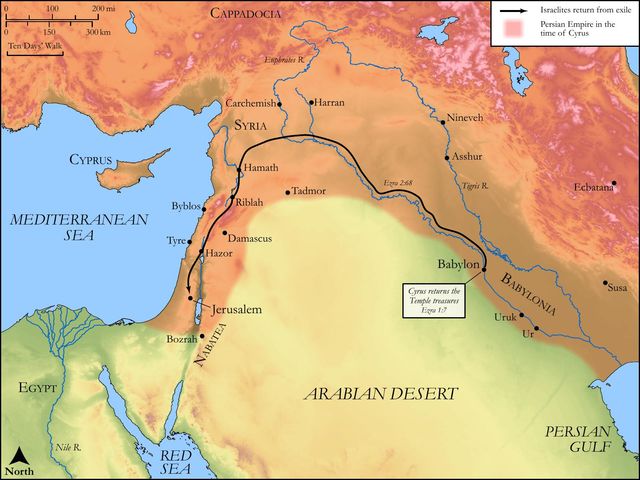
See on the biblical-era map
Study this verse
Public-domain commentary
Matthew Henry
From his Commentary on the Whole Bible. Henry comments on passages, not single verses — this entry covers Ezra 2:1–35.
We may observe here, 1. That an account was kept in writing of the families that came up out of captivity, and the numbers of each family. This was done for their honour, as part of their recompence for their faith and courage, their confidence in God and their affection to their own land, and to stir up others to follow their good example. Those that honour God he will thus honour. The names of all those Israelites indeed that accept the offer of deliverance by Christ shall be found, to their honour, in a more sacred record than this, even in the Lamb's book of life. The account that was kept of the families that came up from the captivity was intended also for the benefit of posterity, that they might know from whom they descended and to whom they were allied. 2. That they are called children of the province. Judah, which had been an illustrious kingdom, to which other kingdoms had been made provinces, subject to it and dependent on it, was now itself made a province, to receive laws and commissions from the king of Persia and to be accountable to him. See how sin diminishes and debases a nation, which righteousness would exalt. But by thus being made servants (as the patriarchs by being sojourners in a country which was theirs by promise) they were reminded of the better country, that is, the heavenly (Heb 11:16), a kingdom which cannot be moved, or changed into a province. 3. That they are said to come every one to his city, that is, the city appointed them, in which appointment an eye, no doubt, was had to their former settlement by Joshua; and to that, as near as might be, they returned: for it does not appear that any others, at least any that were able to oppose them, had possessed them in their absence. 4. That the leaders are first mentioned, v. 2. Zerubbabel and Jeshua were their Moses and Aaron, the former their chief prince, the latter their chief priest. Nehemiah and Mordecai are mentioned here; some think not the same with the famous men we afterwards meet with of those names: probably they were the same, but afterwards returned to court for the service of their country. 5. Some of these several families are named from the persons that were their ancestors, others from the places in which they had formerly resided; as with us many surnames are the proper names of persons, others of places. 6. Some little difference there is between the numbers of some of the families here and in Neh. 7, where this catalogue is repeated, which might arise from this, that some who had given in their names at first to come afterwards drew back - said, I go, Sir, but went not, which would lessen the number of the families they belonged to; others that declined, at first, afterwards repented and went, and so increased the number. 7. Here are two families that are called the children of Elam (one Ezr 2:7, another Ezr 2:31), and, which is strange, the number of both is the same, 1254. 8. The children of Adonikam, which signifies a high lord, were 666, just the number of the beast (Rev 13:18), which is there said to be the number of a man, which, Mr. Hugh Broughton thinks, has reference to this man. 9. The children of Bethlehem (Ezr 2:21) were but 123, though it was David's city; for Bethlehem was little among the thousands of Judah, yet there must the Messiah arise, Mic 5:2. 10. Anathoth had been a famous place in the tribe of Benjamin and yet here it numbered but 128 (v. 23), which is to be imputed to the divine curse which the men of Anathoth brought upon themselves by persecuting Jeremiah, who was of their city. Jer 11:21, Jer 11:23, There shall be no remnant of them, for I will bring evil upon the men of Anathoth. And see Isa 10:30, O poor Anathoth! Nothing brings ruin on a people sooner than persecution.
Historical interpretation
Historical reception
2 surviving comments on this verse. Each one is dated, so this reads as a timeline rather than a list.
And they returned to Jerusalem and Judah, etc. For when those who have strayed from the faith are freed from the power of Satan, along with those who have recently learned the faith, they return to Jerusalem of desired peace and to Judah of devoted confession or praise. Soon each one enters and returns to his own city, that is, he devoutly performs the keeping and practice of virtues, which divine largess has bestowed upon him according to the measure of faith. And it is well said, with general reference, that they have returned to Jerusalem and Judah, he immediately added: Each to his own city, because indeed each individual dwelt in their own cities, yet all generally pertained to Jerusalem and Judah. Therefore, Jerusalem signifies the universal state of the holy Church, which is throughout the world. The cities pertaining to it designate each of the virtues of the faithful, in which, as if by the protection of cities, they are fortified against the temptations and incursions of evil spirits. The cities in which those who came from captivity to Jerusalem and Judah dwelt can also be understood as the various Churches of Christ throughout the world, from all of which one Catholic Church is completed. In these Churches, whoever resides, each one professes himself as a child of the Catholic Church, as a citizen of Jerusalem. Moreover, they were led before others by Zerubbabel and Jesus, one from royal lineage, the other from priestly lineage, as is shown in many places of sacred history; both of them represented one and the same person of our Redeemer, namely the true King and High Priest. For He alone is the one through whom we ought to come to salvation. Hence He says: No one comes to the Father except through me (John 14). He gathers each of the elect, either through His own hidden inspiration or through the manifest teaching by holy preachers, from the confusion of present life to the vision of eternal peace and the confession of divine praise, as if from Babylon to Jerusalem and Judah. This vision of peace and this confession of thanksgiving, given by Him, begin indeed in the present but are perfected in the future.
Now these are the children of the province, who went up from the captivity, etc. He calls them the children of the province of Judea, not of Babylon. For to this belonged not only those who were transferred from it to Babylon, but also those who were born in Babylon from their stock. Even though they were born physically in Babylon, they longed with their whole mind for Judea and Jerusalem. Their notable leader Zerubbabel bore their figure, who by name indeed indicates that he was born in Babylon; but by intention and actions shows that he is a citizen of Jerusalem. In another sense, they are children of the Church, children of the heavenly fatherland, not only those who are already imbued with the sacraments of the Church, but also those who, although wandering outside, that is among the impious for some time, are yet by divine election preordained to life before the ages, to be consecrated in their time by the mysteries of divine grace. About whom it is aptly added:
Continue studying Ezra 2:1 across the web’s major study libraries — every link below opens this exact verse, chapter, or book on the destination site.
Read & Compare
 BibleGatewayThis verse in more than 200 translations and 70 languages.
 Bible.comThe YouVersion reader — hundreds of translations, reading plans, and highlights.
 ESV.orgCrossway's official English Standard Version reader.
 NET BibleThe NET translation with 60,000+ translators' notes on every rendering decision.
 STEP BibleTyndale House's free study tool — original text, vocabulary, and scholarly resources.
 BibliaLogos Bible Software's free web reader.
 USCCBThe New American Bible (Revised Edition) with the U.S. bishops' study notes.
Commentaries
 BibleHub CommentariesDozens of classic commentaries on this verse, gathered on one page.
 StudyLightMore than 100 commentary sets — the largest collection on the web.
 BibleRefPlain-English commentary on what this verse means, verse by verse.
 Enduring WordDavid Guzik's free commentary on this chapter, widely used by Bible teachers.
 Bible Study ToolsVerse commentary alongside Greek and Hebrew study aids.
Original Language & Research
- BibleHub InterlinearThe verse word by word — original language, transliteration, and English.
- BibleHub LexiconEvery word's original-language definition and Strong's entry.
 Blue Letter BibleDeep-study tools — Strong's numbers, concordance, and word studies.
 SefariaThe Hebrew text with Rashi and centuries of Jewish commentary.
Sermons, Hymns & Audio


TrulyRandomVerse is not affiliated with these sites and doesn’t control their content. They’re linked because they’re genuinely useful.
Summary
Ezra 2:1 serves as the foundational introduction to the meticulous census of the Jewish exiles returning from Babylonian captivity to their ancestral homeland. It succinctly establishes the historical context of their deportation by Nebuchadnezzar and their subsequent, divinely orchestrated return to Jerusalem and Judah, signifying the initial fulfillment of prophetic promises regarding restoration and the re-establishment of God's covenant people in their land, preparing the way for the rebuilding of the Temple and the community.
Context
ShowHideLiterary Context
This verse immediately follows the pivotal decree of Cyrus the Great in Ezra 1, which authorized and even encouraged the Jewish exiles to return to Jerusalem and rebuild the Temple. While Ezra 1:1-4 focuses on the divine impetus and the initial preparations, Ezra 2:1 transitions to the practical outworking of that decree, introducing the detailed register of those who actually made the arduous journey. The comprehensive list that follows in Ezra 2:2-67 is a crucial element, establishing the identity, lineage, and numerical strength of the returning community, which was vital for re-establishing social order, religious practices, and land claims in Judah. This precise enumeration underscores the theological significance of the remnant, highlighting God's faithfulness in preserving a people to fulfill His covenant purposes.
Historical & Cultural Context
The historical backdrop is the end of the Babylonian exile, a period of approximately 70 years following the destruction of Jerusalem and the First Temple in 586 BC by Nebuchadnezzar II. This exile was a traumatic but transformative period for the Jewish people, profoundly shaping their identity and religious practices, emphasizing monotheism and the importance of the Torah. The mention of "Nebuchadnezzar the king of Babylon" grounds the narrative firmly in this well-documented historical event, marking the end of a specific era of judgment. Culturally, the return was not merely a migration but a re-establishment of a national and religious identity under Persian imperial oversight. The "province" refers to Yehud Medinata, the Persian administrative district encompassing the former kingdom of Judah. The returnees, though free to go, were still subjects of a foreign empire, highlighting the complex political reality of their restoration and their continued reliance on divine favor amidst geopolitical realities.
Key Themes
ShowHideEzra 2:1 powerfully introduces several overarching themes. Firstly, it underscores Divine Faithfulness and Restoration, demonstrating God's unwavering commitment to His covenant people, even after a period of judgment and exile, as promised in passages like Deuteronomy 30:1-5. Secondly, it highlights the Fulfillment of Prophecy, particularly Jeremiah's seventy-year prophecy concerning the duration of the exile (Jeremiah 29:10). This return is a tangible demonstration of God's sovereignty over history and nations, using even pagan kings like Cyrus (Isaiah 44:28) to accomplish His purposes. Lastly, the emphasis on "children of the province" and their return "every one unto his city" points to the theme of Identity and Re-establishment, crucial for rebuilding a community rooted in its ancestral land and traditions, laying the groundwork for the spiritual and physical renewal of the nation.
Exposition and Analysis
ShowHideKey Word Analysis
ShowHideThis term refers to a son, or more broadly, descendants. Here, "the children of the province" signifies not just individual offspring but a collective body, the inheritors of a shared history and identity. It emphasizes the continuity of the covenant people, despite generations having passed in exile, highlighting God's preservation of a remnant.
This word denotes the state of being exiled or taken as prisoners. Its use here underscores the involuntary and punitive nature of their removal from the land, a direct consequence of their disobedience. The return "out of the captivity" therefore marks a reversal of this divinely ordained judgment, signifying a new chapter of grace and restoration.
The explicit naming of this Babylonian king serves as a precise historical anchor. His name evokes the trauma of the exile, the destruction of Jerusalem, and the Temple. By identifying him as the one who "had carried away" the people, the text firmly links the present restoration to the past judgment, underscoring the severity of what they had endured and the magnitude of God's redemptive work in bringing them back.
Verse Breakdown
ShowHide"Now these [are] the children of the province that went up out of the captivity,"
This opening clause immediately introduces the subject of the detailed list that follows: the descendants of those who had been forcibly removed from their land. "Children of the province" identifies them not merely as individuals but as a collective, a community linked by their shared past in exile and their present status as inhabitants of the Persian administrative region of Judah. Their "going up" signifies a pilgrimage, a return from a lower, foreign land to the elevated, sacred land of Israel, imbued with spiritual significance.
"of those which had been carried away, whom Nebuchadnezzar the king of Babylon had carried away unto Babylon,"
This phrase clarifies the identity of "the children of the province" by explicitly linking them to the historical event of the Babylonian exile. The repetition of the concept of being "carried away" (from H1540, gâlâh) emphasizes the definitive and traumatic nature of their deportation, directly attributing it to Nebuchadnezzar. This serves to remind the reader of the severity of the judgment that preceded this restoration, highlighting the depth of God's discipline.
"and came again unto Jerusalem and Judah, every one unto his city;"
This final clause describes the destination and the organized manner of their return. "Came again" (from H7725, shûwb) signifies a reversal of their previous forced departure, a turning back to their homeland. Their return to "Jerusalem and Judah" (from H3389, Yᵉrûwshâlaim and H3063, Yᵉhûwdâh) highlights the re-establishment of the spiritual and geographical heartland of their nation. The phrase "every one unto his city" (from H376, ʼîysh and H5892, ʻîyr) emphasizes the organized and purposeful nature of their return, indicating a desire to reclaim ancestral lands and re-establish community life at a local level, laying the groundwork for the rebuilding efforts described later in the book.
Literary Devices
ShowHideEzra 2:1 employs several key literary devices. Repetition is evident in the concept of "carried away" and "captivity," powerfully reinforcing the traumatic nature of the exile and its direct causation by Nebuchadnezzar. This repetition serves to underscore the historical reality and the depth of the suffering from which God is now delivering His people. The verse also functions as an Introduction to Enumeration, setting the stage for the extensive and meticulous list of returning families and individuals that follows. This detailed census is not merely a record but a testament to the re-establishment of identity and lineage, crucial for the post-exilic community's legal and religious standing. Furthermore, the explicit naming of "Nebuchadnezzar the king of Babylon" acts as a Historical Marker, firmly anchoring the narrative in a specific, well-known historical period. This precision lends authenticity and weight to the account, emphasizing the fulfillment of prophecy within concrete historical events.
Theological and Thematic Connections
ShowHideEzra 2:1 is a profound theological statement, not just a historical record. It powerfully illustrates God's unwavering faithfulness to His covenant promises, even in the face of His people's profound disobedience. The return from exile, initiated by a pagan king but orchestrated by divine providence, serves as a tangible demonstration that God's judgment is not His final word, and His commitment to His people endures. This verse sets the stage for the rebuilding of the Temple and the community, signifying a new beginning and a renewed opportunity for Israel to live in covenant relationship with God in their land. It underscores the theme of restoration, not merely as a physical return, but as a spiritual renewal, pointing to God's ultimate desire to dwell among His people.
Reflection and Application
ShowHideEzra 2:1 offers a powerful reminder that even after periods of profound brokenness, judgment, or seemingly insurmountable obstacles, God remains faithful to His promises. The exiles' return from Babylon, a seemingly impossible feat, testifies to God's sovereign hand working through human history, even through the decrees of pagan kings, to accomplish His redemptive purposes. For us today, this verse encourages us to trust in God's ability to bring restoration and new beginnings in our own lives, even when we feel far from Him or when circumstances seem dire. It challenges us to recognize God's providence in the unfolding of world events, knowing that He is ultimately in control and works all things for the good of those who love Him (Romans 8:28). Just as the Israelites were called to physically return and rebuild, we are called to actively participate in God's restorative work in our spiritual lives and communities, trusting that He will complete what He has begun, even when the path forward seems daunting or unclear.
Questions for Reflection
ShowHideFAQ
ShowHideWhy is the detailed list of names and numbers in Ezra 2 so important, introduced by this verse?
ShowHideThe detailed list introduced by Ezra 2:1 is critically important for several reasons. Firstly, it served as a vital record for establishing the identity and lineage of the returning community. In ancient Israel, tribal and family affiliation was crucial for land ownership, social structure, and particularly for determining who was eligible for priestly and Levitical service. Without this meticulous record, the purity of the priesthood and the proper functioning of the Temple worship would have been compromised, as seen in the disqualification of certain priests in Ezra 2:61-63. Secondly, it provided a numerical account of the initial wave of returnees, demonstrating the tangible fulfillment of God's promise to bring His people back to the land. This census validated their claim to the land and their right to rebuild Jerusalem and the Temple. Finally, it underscored the theme of divine faithfulness, showing that despite the devastation of exile, a remnant had indeed returned, preserving the continuity of God's covenant people. This detailed record is not merely administrative; it is a theological statement about God's preservation of His people and His commitment to their restoration, paralleling the meticulous records found elsewhere in Scripture, such as the census in Numbers 1.
Christ-Centered Fulfillment
ShowHideEzra 2:1, while detailing a physical return from literal captivity, profoundly foreshadows the spiritual liberation and restoration found in Jesus Christ. The Babylonian exile was a consequence of sin, separating God's people from His presence and their promised land. In a greater spiritual sense, all humanity is in "captivity" to sin and death, exiled from the presence of a holy God (Romans 3:23). Just as Nebuchadnezzar carried away the physical nation, sin holds humanity captive, leading to spiritual displacement. However, Christ is the ultimate "Cyrus," the one appointed by God to decree freedom and enable a return. Through His atoning sacrifice, Jesus pays the ransom for our spiritual captivity, allowing us to "go up out of" the bondage of sin and death (Colossians 1:13-14). He brings us back to "Jerusalem and Judah," not a geographical location, but a spiritual dwelling in God's presence, into the new covenant community, the church, which is the spiritual Israel (Galatians 6:16). Every believer, through faith in Christ, returns to their true "city," their eternal home in the heavenly Jerusalem, where they are citizens with the saints and members of God's household (Ephesians 2:19; Hebrews 12:22-24). Thus, Ezra 2:1 points to the grander narrative of redemption, where Christ is our deliverer, our restorer, and the one who brings us home to God, establishing a new and eternal covenant.