


2 Chronicles 36:1
- וַיִּקְחוּvai·yik·Chuand they tookH3947Conj-w ¦ V-Qal-ConsecImperf-3mpVerb Qal Consecutive Imperfect 3rd Plural Masculineוַandיִּקְחוּthey took
- עַם'am[the] people ofH5971N-mscNoun Singular Masculine Construct
- הָאָרֶץha·'A·retzthe landH776Art ¦ N-fsNoun Singular Feminine Absoluteהָtheאָרֶץland
- אֶת'et<obj.>H853DirObjMParticle Object Indicator
- יְהוֹאָחָזye·ho·'a·ChazJehoahazH3059N-proper-mNoun Proper Masculine
- בֶּןben[the] son ofH1121N-mscNoun Singular Masculine Construct
- יֹאשִׁיָּהוּyo·shi·Ya·huJosiahH2977N-proper-mNoun Proper Masculine
- וַיַּמְלִיכֻהוּvai·yam·li·Khu·huand they made king himH4427Conj-w ¦ V-Hiphil-ConsecImperf-3mp ¦ 3msVerb Hiphil Consecutive Imperfect 3rd Plural Masculineוַandיַּמְלִיכֻthey made kingהוּhim
- תַחַתta·chatin place ofH8478N-mscNoun Singular Masculine Construct
- אָבִיו'a·Vivhis fatherH1N-msc ¦ 3msNoun Singular Masculine Constructאָבִיfatherוhis
- בִּירוּשָׁלִָםbi·ru·sha·Limin JerusalemH3389Prep-b ¦ N-properNoun Proper LocationבִּinירוּשָׁלִָםJerusalem
English is a literal word-by-word gloss of the Hebrew, not the KJV's wording. Why?
This is the original text the KJV's translators worked from — each Hebrew word with its own literal English meaning in this verse, prepared by scholars at Tyndale House, Cambridge. The KJV translates whole sentences, not word by word, so its wording differs: one Hebrew word can become several English words, and the KJV may choose “the LORD” where the gloss reads “Yahweh”. Both are faithful — they answer different questions. For the KJV's own rendering, switch to the KJV text.
Details
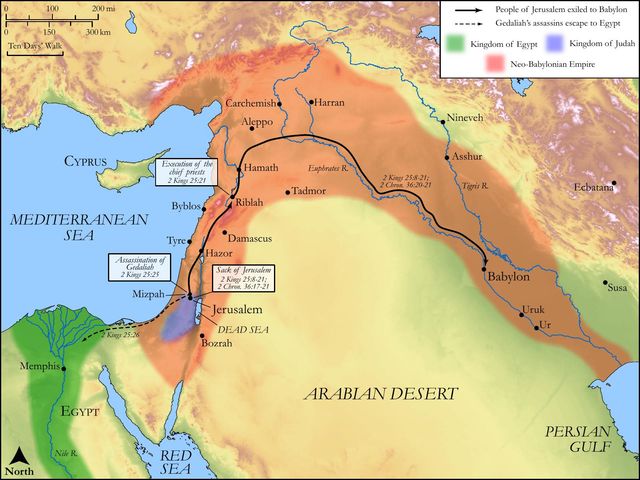
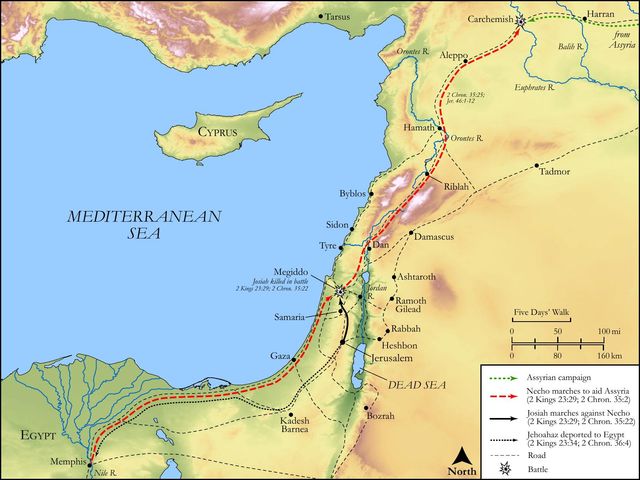
See on the biblical-era maps
Study this verse
Public-domain commentary
Matthew Henry
From his Commentary on the Whole Bible. Henry comments on passages, not single verses — this entry covers 2 Chronicles 36:1–10.
The destruction of Judah and Jerusalem is here coming on by degrees. God so ordered it to show that he has no pleasure in the ruin of sinners, but had rather they would turn and live, and therefore gives them both time and inducement to repent and waits to be gracious. The history of these reigns was more largely recorded in the last three chapters of the second of Kings. 1. Jehoahaz was set up by the people (Ch2 36:1), but in one quarter of a year was deposed by Pharaoh-necho, and carried a prisoner to Egypt, and the land fined for setting him up, Ch2 36:2-4. Of this young prince we hear no more. Had he trodden in the steps of his father's piety he might have reigned long and prospered; but we are told in the Kings that he did evil in the sight of the Lord, and therefore his triumphing was short and his joy but for a moment. 2. Jehoiakim was set up by the king of Egypt, an old enemy to their land, gave what king he pleased to the kingdom and what name he pleased to the king! Ch2 36:4. He made Eliakim king, and called him Jehoiakim, in token of his authority over him. Jehoiakim did that which was evil (Ch2 36:5), nay, we read of the abominations which he did (Ch2 36:8); he was very wild and wicked. Idolatries generally go under the name of abominations. We hear no more of the king of Egypt, but the king of Babylon came up against him (Ch2 36:6), seized him, and bound him with a design to carry him to Babylon; but, it seems, he either changed his mind, and suffered him to reign as his vassal, or death released the prisoner before he was carried away. However the best and most valuable vessels of the temple were now carried away and made use of in Nebuchadnezzar's temple in Babylon (Ch2 36:7); for, we may suppose, no temple in the world was so richly furnished as that of Jerusalem. The sin of Judah was that they had brought the idols of the heathen into God's temple; and now their punishment was that the vessels of the temple were carried away to the service of the gods of the nations. If men will profane God's institutions by their sins, it is just with God to suffer them to be profaned by their enemies. These were the vessels which the false prophets flattered the people with hopes of the return of, Jer 27:16. But Jeremiah told them that the rest should go after them (Jer 27:21, Jer 27:22), and they did so. But, as the carrying away of these vessels to Babylon began the calamity of Jerusalem, so Belshazzar's daring profanation of them there filled the measure of the iniquity of Babylon; for, when he drank wine in them to the honour of his gods, the handwriting on the wall presented him with his doom, Dan 5:3, etc. In the reference to the book of the Kings concerning this Jehoiakim mention is made of that which was found in him (Ch2 36:8), which seems to be meant of the treachery that was found in him towards the king of Babylon; but some of the Jewish writers understand it of certain private marks or signatures found in his dead body, in honour of his idol, such cuttings as God had forbidden, Lev 19:28. 3. Jehoiachin, or Jeconiah, the son of Jehoiakim, attempted to reign in his stead, and reigned long enough to show his evil inclination; but, after three months and ten days, the king of Babylon sent and fetched him away captive, with more of the goodly vessels of the temple. He is here said to be eight years old, but in Kings he is said to be eighteen when he began to reign, so that this seems to be a mistake of the transcriber, unless we suppose that his father took him at eight years old to join with him in the government, as some think.
Continue studying 2 Chronicles 36:1 across the web’s major study libraries — every link below opens this exact verse, chapter, or book on the destination site.
Read & Compare
 BibleGatewayThis verse in more than 200 translations and 70 languages.
 Bible.comThe YouVersion reader — hundreds of translations, reading plans, and highlights.
 ESV.orgCrossway's official English Standard Version reader.
 NET BibleThe NET translation with 60,000+ translators' notes on every rendering decision.
 STEP BibleTyndale House's free study tool — original text, vocabulary, and scholarly resources.
 BibliaLogos Bible Software's free web reader.
 USCCBThe New American Bible (Revised Edition) with the U.S. bishops' study notes.
Commentaries
 BibleHub CommentariesDozens of classic commentaries on this verse, gathered on one page.
 StudyLightMore than 100 commentary sets — the largest collection on the web.
 BibleRefPlain-English commentary on what this verse means, verse by verse.
 Enduring WordDavid Guzik's free commentary on this chapter, widely used by Bible teachers.
 Bible Study ToolsVerse commentary alongside Greek and Hebrew study aids.
Original Language & Research
- BibleHub InterlinearThe verse word by word — original language, transliteration, and English.
- BibleHub LexiconEvery word's original-language definition and Strong's entry.
 Blue Letter BibleDeep-study tools — Strong's numbers, concordance, and word studies.
 SefariaThe Hebrew text with Rashi and centuries of Jewish commentary.
Sermons, Hymns & Audio


TrulyRandomVerse is not affiliated with these sites and doesn’t control their content. They’re linked because they’re genuinely useful.
Summary
Second Chronicles 36:1 marks a pivotal and somber turning point in the history of the Kingdom of Judah, immediately following the tragic death of the righteous King Josiah. This verse chronicles the decisive, yet ultimately ill-fated, action by "the people of the land" to install Jehoahaz, Josiah's son, as monarch in Jerusalem, thereby initiating a rapid and irreversible descent towards national ruin and the Babylonian exile.
Context
ShowHideLiterary Context
This verse serves as an abrupt and critical transition point in the Chronicler's narrative, shifting from the hopeful, reform-driven reign of Josiah to the final, tragic unraveling of Judah. It directly follows the detailed and lamentable account of King Josiah's death in battle at Megiddo, as recorded in 2 Chronicles 35:20-27. Josiah, celebrated as Judah's last truly righteous king, had brought about significant spiritual revival and covenant faithfulness. His sudden demise created a profound power vacuum and plunged the nation into immediate crisis. The Chronicler, having meticulously highlighted Josiah's piety and the nation's brief return to God, now pivots to illustrate the swift and devastating decline of Judah's fortunes. The subsequent verses in 2 Chronicles 36:2-21 meticulously detail the short, ungodly reigns of Jehoahaz and his successors, each marked by increasing foreign domination, spiritual apostasy, and ultimately, the destruction of Jerusalem and the Babylonian exile. Thus, 2 Chronicles 36:1 is the very first step on Judah's final, tragic journey of judgment.
Historical & Cultural Context
The period immediately following Josiah's death in 609 BCE was characterized by immense geopolitical instability in the Near East. The once-dominant Assyrian Empire was in its terminal decline, creating a power vacuum that the rising empires of Egypt and Babylon fiercely contended to fill. Judah, strategically located as a land bridge, found itself caught between these two emerging superpowers. Josiah's death at the hands of Pharaoh Neco II of Egypt meant that Egypt now exerted significant influence over Judah. Culturally, the "people of the land" (Hebrew: 'am ha'aretz'), mentioned in this verse, were not merely the general populace, but rather a specific, influential socio-political group. They comprised free citizens, landowners, and prominent elders who held considerable sway in national affairs, particularly in matters of royal succession. Their intervention in choosing Jehoahaz, bypassing his older brother Eliakim (who would later be renamed Jehoiakim by Pharaoh Neco), was unusual and reflected a desire to assert national sovereignty and perhaps choose a leader perceived as more amenable to their interests or more capable in the volatile political climate. This act highlights a deviation from the traditional dynastic principle of primogeniture and underscores the desperation and political maneuvering characteristic of Judah's final, tumultuous years.
Key Themes
ShowHideThis verse introduces several crucial themes that will dominate the remainder of 2 Chronicles and indeed, the tragic conclusion of the kingdom. Firstly, it underscores the theme of royal succession and authority, demonstrating how, in a time of profound crisis, the power to choose a king shifted from divine appointment or strict dynastic primogeniture to the influential "people of the land." This human choice, however well-intentioned, ultimately proved disastrous for the nation's spiritual and political future. Secondly, 2 Chronicles 36:1 marks the definitive beginning of Judah's rapid decline. Josiah's death removed the last righteous anchor, and the subsequent reigns, starting with Jehoahaz, were characterized by ungodliness, foreign subjugation, and a complete abandonment of the Mosaic covenant, leading directly to the inevitable Babylonian exile. This highlights the pervasive theme of consequences for covenant unfaithfulness. Finally, the verse implicitly raises the tension between human agency and divine sovereignty. While the people exercised their right to choose a king, Jehoahaz's brief and ungodly reign, quickly terminated by foreign intervention, suggests that this popular choice did not align with God's long-term plan for the nation's stability or spiritual well-being, foreshadowing the divine judgment that was soon to fall upon Judah, as also prophesied by Jeremiah concerning Jehoahaz, who was also known as Shallum in Jeremiah 22:11-12.
Exposition and Analysis
ShowHideKey Word Analysis
ShowHideThis significant term, appearing frequently in the Old Testament, carries substantial socio-political weight. It does not refer to the entire general populace but rather to an influential class of land-owning citizens, often comprising elders, prominent figures, or local gentry, who played a crucial role in national affairs, including the installation of kings. Their active role here signifies a popular, albeit non-dynastic, mandate for Jehoahaz, reflecting a moment of significant political agency and perhaps a desire for a leader who would resist foreign domination, contrasting with the typical succession patterns or divine appointment seen elsewhere (e.g., 1 Samuel 10:24).
The verb lâqach means "to take," "to seize," or "to acquire." In this context, it emphasizes the active initiative and deliberate action of "the people of the land" in selecting and installing Jehoahaz. It suggests a forceful or decisive act of appropriation of power, rather than a passive acceptance of a divinely ordained or dynastically determined succession. This highlights the human agency at play in a moment of national crisis and the assertion of their will in the face of uncertainty.
This verb, a Hiphil form of mâlak ("to reign"), means "to cause to reign" or "to make king." It reinforces the agency of "the people of the land" in the enthronement process. They were not merely recognizing an heir but actively performing the ritual and political act of installing him as monarch. This underscores their significant political power and their direct involvement in shaping Judah's leadership at this critical juncture, demonstrating their capacity to influence the course of the kingdom's future.
Verse Breakdown
ShowHide"¶ Then the people of the land"
This opening phrase immediately introduces the key actors in this pivotal moment. As previously discussed, "the people of the land" represent a powerful and influential segment of Judahite society, acting collectively to determine the nation's leadership. Their intervention immediately after Josiah's death signals a vacuum of authority and a popular desire to quickly establish a new leader in the wake of national trauma.
"took Jehoahaz the son of Josiah"
This clause identifies the chosen successor and his lineage. Jehoahaz, also known as Shallum (Jeremiah 22:11), was indeed a son of Josiah, but notably not the eldest (that was Eliakim). The choice of Jehoahaz by the people, bypassing an older brother, suggests either a preference for his character, his political stance, or perhaps a perceived strength in leadership during a time of national vulnerability and foreign interference.
"and made him king in his father's stead in Jerusalem."
This final clause describes the formal act of enthronement and the location. The installation of Jehoahaz "in his father's stead" emphasizes the continuity of the Davidic line, even if the method of succession was irregular and driven by popular will rather than strict primogeniture or divine decree. "In Jerusalem" highlights the significance of the capital city as the center of power, the spiritual heart of the nation, and the place where the Davidic covenant was historically anchored, making the events unfolding there of paramount importance for the entire kingdom.
Literary Devices
ShowHideThe Chronicler masterfully employs several literary devices in this concise yet impactful verse. Foreshadowing is prominently featured, as the popular, non-traditional choice of Jehoahaz immediately after Josiah's death signals the ominous beginning of Judah's rapid decline. This act, seemingly an attempt to stabilize the kingdom, ironically sets the stage for a series of short, ungodly reigns and increasing foreign subjugation, culminating in exile. There is also an implicit contrast between the righteous, God-fearing, and covenant-keeping reign of Josiah, which has just concluded, and the ungodly, ill-fated reign of Jehoahaz that immediately begins. This stark contrast highlights the profound spiritual and political instability that has now gripped Judah. Furthermore, the Chronicler uses synecdoche through the phrase "people of the land," where a specific, influential segment of society stands in for the broader national will or collective agency in this critical decision, representing the nation's attempt to exert control over its destiny.
Theological and Thematic Connections
ShowHide2 Chronicles 36:1 stands as a stark reminder of the perils of human leadership when detached from divine wisdom and guidance, particularly in times of profound crisis. The "people of the land," acting with agency and perhaps good intentions to secure stability, chose a king based on their own assessment, bypassing both traditional succession and, implicitly, seeking God's specific will for the nation. This act, while demonstrating human responsibility in governance, ultimately initiated a series of events that led to national catastrophe. Theologically, it underscores the principle that true stability, blessing, and flourishing for a nation derive not merely from popular choice or political expediency, but from alignment with God's covenant and the leadership of those committed to His ways. The verse thus serves as a somber illustration of the consequences when a nation, even one with a history of divine favor and a divinely established covenant, begins to drift from its spiritual moorings, highlighting the fragility of even a divinely established kingdom when its people and leaders fail to uphold their covenant responsibilities.
Reflection and Application
ShowHideThe transition of power described in 2 Chronicles 36:1 offers profound and enduring lessons for every generation regarding leadership, community decision-making, and the critical importance of spiritual discernment. In times of profound loss, uncertainty, or rapid change, there is a natural human tendency to act quickly, to fill a void, and to seek immediate solutions based on popular opinion, perceived strength, or pragmatic considerations. However, this verse serves as a potent cautionary tale: even well-intentioned human choices, when not rooted in a deep reliance on God's wisdom and a steadfast commitment to His revealed principles, can inadvertently lead to further decline and unintended consequences. For individuals and communities today, this means that true leadership—whether in the church, family, business, or society—must prioritize spiritual integrity, covenant faithfulness, and divine guidance over mere popularity, political expediency, or human charisma. It calls us to pause in moments of crisis, to seek God's guidance earnestly through prayer and His Word, and to evaluate potential leaders not just by their perceived capabilities or immediate appeal, but by their demonstrated commitment to righteousness and their alignment with God's will. The ultimate health, flourishing, and resilience of any group or nation depend on its willingness to submit to divine wisdom, even when human logic or popular sentiment might suggest a different, seemingly easier, path.
Questions for Reflection
ShowHideFAQ
ShowHideWho were "the people of the land" and why were they significant here?
ShowHide"The people of the land" (Hebrew: 'am ha'aretz') were not the general populace but a specific, influential socio-political group within Judah. They typically comprised free citizens, landowners, and prominent elders who held considerable power and influence in national affairs, particularly in matters of royal succession. Their significance in 2 Chronicles 36:1 lies in their active and unusual role in royal succession. Traditionally, kings ascended through primogeniture or divine appointment. Here, in the vacuum left by Josiah's death, this powerful group asserted their authority by "taking" and "making" Jehoahaz king, bypassing his older brother. This act highlights their political clout and their attempt to stabilize the kingdom by choosing a leader they favored, rather than waiting for a dynastic or divinely sanctioned succession, underscoring a shift in the locus of power during a national crisis.
Why was Jehoahaz chosen over his older brothers?
ShowHideThe biblical text does not explicitly state why Jehoahaz was chosen over his older brothers (specifically Eliakim, who later became Jehoiakim). However, several factors likely contributed to this decision by "the people of the land." In the immediate aftermath of Josiah's sudden and tragic death in battle against Pharaoh Neco II, Judah was in a state of shock and profound political uncertainty. It's plausible that Jehoahaz, also known as Shallum in Jeremiah 22:11, was perceived as a stronger leader, perhaps more nationalistic or more willing to resist Egyptian influence, compared to Eliakim. His selection might have been a popular choice, reflecting the people's desire for a decisive figure to navigate the turbulent geopolitical landscape. This popular mandate, however, proved short-lived, as Pharaoh Neco soon intervened, deposing Jehoahaz and installing Eliakim (renamed Jehoiakim) in his place, as detailed in 2 Chronicles 36:3-4.
How does this verse set the stage for Judah's decline?
ShowHide2 Chronicles 36:1 is the crucial turning point that marks the beginning of Judah's rapid and irreversible decline towards exile. Josiah's death removed the last righteous king and the spiritual anchor of the nation. The subsequent choice of Jehoahaz by "the people of the land," while an assertion of human agency, was not a choice blessed by God for long-term stability or spiritual health. Jehoahaz's reign was brief (only three months, as noted in 2 Chronicles 36:2) and characterized by ungodliness (2 Kings 23:32). His swift deposition by Pharaoh Neco and subsequent exile to Egypt immediately signaled Judah's loss of sovereignty and its subjugation to foreign powers. This event initiated a chain of increasingly ungodly kings, escalating foreign interventions, and deepening covenant unfaithfulness that would culminate in the Babylonian destruction of Jerusalem and the exile of the people, as described throughout the remainder of 2 Chronicles 36.
Christ-Centered Fulfillment
ShowHideThe somber account of 2 Chronicles 36:1, detailing the human attempt to establish a king in a time of profound crisis, profoundly underscores the inherent limitations of human wisdom and power in governance, ultimately pointing to the desperate need for a divinely appointed and perfect King, a role perfectly fulfilled in Jesus Christ. The failure of "the people of the land" to choose a lasting, righteous leader, culminating in a succession of ungodly kings and national ruin, highlights the deep-seated inability of humanity to secure its own salvation or stability apart from God. Unlike Jehoahaz, who was chosen by men and quickly deposed, Jesus is the King chosen by God the Father, eternally enthroned, and whose kingdom shall have no end (Luke 1:33). The human desire for a strong leader in Judah's desperate hour points to the deeper, universal longing for a true shepherd and deliverer, a role perfectly embodied by Christ, the Good Shepherd who lays down His life for His sheep (John 10:11). While Judah's kings repeatedly failed to uphold the Davidic covenant and lead the people in righteousness, Jesus, the true Son of David, perfectly fulfills every aspect of that covenant, establishing an everlasting kingdom of justice, peace, and righteousness (2 Samuel 7:12-16). The tumultuous political landscape and the people's misguided choice in 2 Chronicles 36:1 serve as a powerful backdrop, illuminating the unparalleled wisdom, sovereignty, and saving power of God in providing His Son as the ultimate King, whose reign is not of this world (John 18:36), yet transforms it from within through His redemptive work on the cross and His ongoing reign from heaven.