


2 Kings 23:32
Bible text: King James Version (1769 Blayney text) · Public domain
Bible text: Berean Standard Bible · Public domain
Bible text: American Standard Version (1901) · Public domain
Bible text: World English Bible, Messianic edition · Public domain
Bible text: Geneva Bible (1599) · Public domain
Bible text: Young's Literal Translation · Public domain
- וַיַּעַשׂvai·Ya·'asand he didH6213Conj-w ¦ V-Qal-ConsecImperf-3msVerb Qal Consecutive Imperfect 3rd Singular Masculineוַandיַּעַשׂhe did
- הָרַעha·Ra'the evilH7451Art ¦ Adj-msAdjective Singular Masculine Absoluteהָtheרַעevil
- בְּעֵינֵיbe·'ei·Neiin [the] eyes ofH5869Prep-b ¦ N-fdcNoun Dual Feminine Constructבְּinעֵינֵי[the] eyes of
- יְהוָהYah·wehYahwehH3068N-properNoun Proper Title
- כְּכֹלke·Kholaccording to allH3605Prep-k ¦ N-msNoun Singular Masculine Absoluteכְּaccording toכֹלall
- אֲשֶׁר'a·SherthatH834RelParticle Relative
- עָשׂוּ'a·Suthey had doneH6213V-Qal-Perf-3cpVerb Qal Perfect 3rd Plural common gender
- אֲבֹתָיו'a·vo·Tavhis ancestorsH1N-fpc ¦ 3msNoun Plural Feminine Constructאֲבֹתָיancestorsוhis
English is a literal word-by-word gloss of the Hebrew, not the KJV's wording. Why?
This is the original text the KJV's translators worked from — each Hebrew word with its own literal English meaning in this verse, prepared by scholars at Tyndale House, Cambridge. The KJV translates whole sentences, not word by word, so its wording differs: one Hebrew word can become several English words, and the KJV may choose “the LORD” where the gloss reads “Yahweh”. Both are faithful — they answer different questions. For the KJV's own rendering, switch to the KJV text.
Details
See on the biblical-era maps
Study this verse
Public-domain commentary
Matthew Henry
From his Commentary on the Whole Bible. Henry comments on passages, not single verses — this entry covers 2 Kings 23:31–37. His two-level outline is real structure in the source text, so it is rendered as structure.
Jerusalem saw not a good day after Josiah was laid in his grave, but one trouble came after another, till within twenty-two years it was quite destroyed. Of the reign of two of his sons here is a short account; the former we find here a prisoner and the latter a tributary to the king of Egypt, and both so in the very beginning of their reign. This king of Egypt having slain Josiah, though he had not had any design upon Judah, yet, being provoked by the opposition which Josiah gave him, now, it should seem, he bent all his force against his family and kingdom. If Josiah's sons had trodden in his steps, they would have fared the better for his piety; but, deviating from them, they fared the worse for his rashness.
I.Jehoahaz, a younger son, was first made king by the people of the land, probably because he was observed to be of a more active warlike genius than his elder brother, and likely to make head against the king of Egypt and to avenge his father's death, which perhaps the people were more solicitous about, in point of honour, than the keeping up and carrying on of his father's reformation; and the issue was accordingly.
1.He did ill, Kg2 23:32. Though he had a good education and a good example given him, and many a good prayer, we may suppose, put up for him, yet he did that which was evil in the sight of the Lord, and, it is to be feared, began to do so in his father's lifetime, for his reign was so short that he could not, in that, show much of his character. He did according to all that his wicked fathers had done. Though he had not time to do much, yet he had chosen his patterns, and showed whom he intended to follow and whose steps he resolved to tread in; and, having done this, he is here reckoned to have done according to all the evil which those did whom he proposed to imitate. It is of great consequence to young people whom they choose to take for their patterns and whom they emulate. An error in this choice is fatal. Phi 3:17, Phi 3:18.
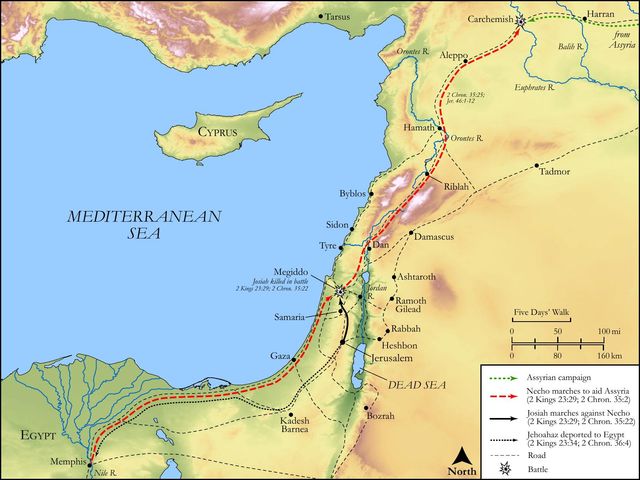
2.Doing ill, no wonder that he fared ill. He was but three months a prince, and was then made a prisoner, and lived and died so. The king of Egypt seized him, and put him in bands (Kg2 23:33), fearing lest he should give him disturbance, and carried him to Egypt, where he died soon after, Kg2 23:34. This Jehoahaz is that young lion whom Ezekiel speaks of in his lamentation for the princes of Israel, that learnt to catch the prey and devour men (that was the evil which he did in the sight of the Lord); but the nations heard of him, he was taken in their pit, and they brought him with chains into the land of Egypt, Eze 19:1-4. See Jer 22:10-12.
II.Eliakim, another son of Josiah, was made king by the king of Egypt, it is not said in the room of Jehoahaz (his reign was so short that it was scarcely worth taking notice of), but in the room of Josiah. The crown of Judah had hitherto always descended from a father to a son, and never, till now, from one brother to another; once the succession had so happened in the house of Ahab, but never, till now, in the house of David. The king of Egypt, having used his power in making him king, further showed it in changing his name; he called him Jehoiakim, a name that has reference to Jehovah, for he had no design to make him renounce or forget the religion of his country. "All people will walk in the name of their God, and let him do so." The king of Babylon did not do so by those whose names he changed, Dan 1:7. Of this Jehoiakim we are here told,
1.That the king of Egypt made him poor, exacted from him a vast tribute of 100 talents of silver and a talent of gold (Kg2 23:33), which, with much difficulty, he squeezed out of his subjects and gave to Pharaoh, Kg2 23:35. Formerly the Israelites had spoiled the Egyptians; now the Egyptians spoil Israel. See what woeful changes sin makes.
2.That which made him poor, yet did not make him good. Notwithstanding the rebukes of Providence he was under, by which he should have been convinced, humbled, and reformed, he did that which was evil in the sight of the Lord (Kg2 23:37), and so prepared against himself greater judgments; for such God will send if less do not do the work for which they are sent.
Historical interpretation
Historical reception
1 surviving comment on this verse from the historical church.
Jehoahaz, also called Shalom, reigned three months until the Egyptians came back from Mabboug. At that stage [Pharaoh] enchained him and brought him to Egypt. So [Jehoahaz] left his country and never came back, according to the prophecy that Jeremiah had spoken against him. Pharaoh appointed his brother Heliakim as the new king and gave him the name of Jehoiakim.
Continue studying 2 Kings 23:32 across the web’s major study libraries — every link below opens this exact verse, chapter, or book on the destination site.
Read & Compare
 BibleGatewayThis verse in more than 200 translations and 70 languages.
 Bible.comThe YouVersion reader — hundreds of translations, reading plans, and highlights.
 ESV.orgCrossway's official English Standard Version reader.
 NET BibleThe NET translation with 60,000+ translators' notes on every rendering decision.
 STEP BibleTyndale House's free study tool — original text, vocabulary, and scholarly resources.
 BibliaLogos Bible Software's free web reader.
 USCCBThe New American Bible (Revised Edition) with the U.S. bishops' study notes.
Commentaries
 BibleHub CommentariesDozens of classic commentaries on this verse, gathered on one page.
 StudyLightMore than 100 commentary sets — the largest collection on the web.
 BibleRefPlain-English commentary on what this verse means, verse by verse.
 Enduring WordDavid Guzik's free commentary on this chapter, widely used by Bible teachers.
 Bible Study ToolsVerse commentary alongside Greek and Hebrew study aids.
Original Language & Research
- BibleHub InterlinearThe verse word by word — original language, transliteration, and English.
- BibleHub LexiconEvery word's original-language definition and Strong's entry.
 Blue Letter BibleDeep-study tools — Strong's numbers, concordance, and word studies.
 SefariaThe Hebrew text with Rashi and centuries of Jewish commentary.
Sermons, Hymns & Audio


TrulyRandomVerse is not affiliated with these sites and doesn’t control their content. They’re linked because they’re genuinely useful.
Summary
Second Kings 23:32 introduces King Jehoahaz, the son and immediate successor of the righteous King Josiah, and tragically records his immediate spiritual departure from his father's godly legacy. Despite Josiah's extensive reforms and fervent efforts to restore pure worship, Jehoahaz quickly reverted to the wicked practices that had long plagued the kingdom of Judah, marking a swift and disheartening reversal in the nation's spiritual trajectory and accelerating its path toward inevitable divine judgment.
Context
ShowHideLiterary Context
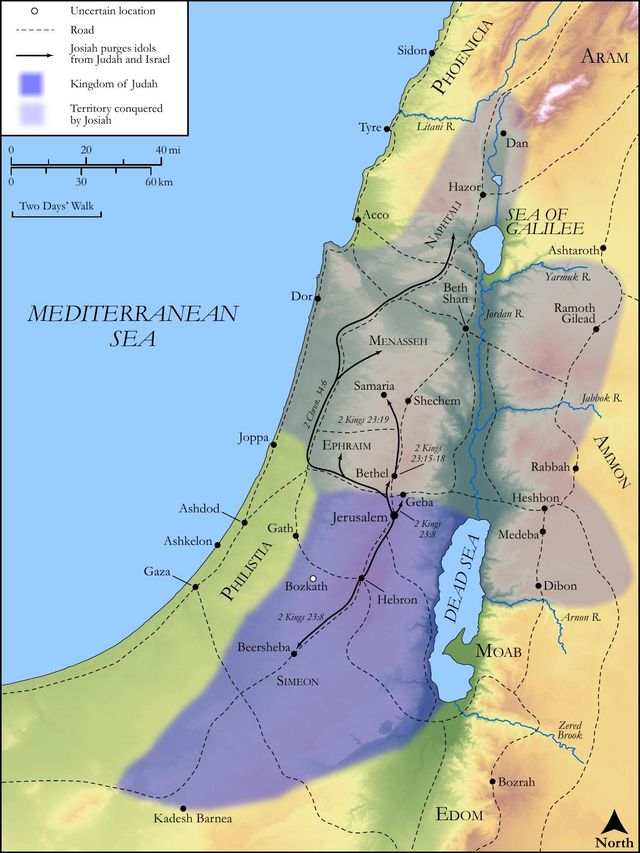
This verse serves as a stark and immediate theological judgment following the unparalleled reign of King Josiah, detailed in 2 Kings 22 and 2 Kings 23. Josiah was celebrated for his singular devotion to the LORD, leading sweeping reforms against idolatry and pagan practices throughout Judah, purging the land of all forms of apostasy (e.g., 2 Kings 23:4-20). His tragic death in battle against Pharaoh Necho of Egypt (2 Kings 23:29-30) marked a profound and immediate turning point. Jehoahaz, though chosen by "the people of the land" (2 Kings 23:30), reigned for a mere three months before being deposed and imprisoned by Pharaoh Necho (2 Kings 23:33-34), signifying the rapid decline of Judah's sovereignty and spiritual state after Josiah's protective influence was removed. The brevity of his reign and the immediate negative assessment underscore the swiftness of Judah's spiritual deterioration toward exile.
Historical & Cultural Context
Jehoahaz's brief reign occurred during an exceptionally tumultuous period among the kingdoms round about. The once-dominant Assyrian Empire was in its final throes of collapse, creating a significant power vacuum. Egypt, under Pharaoh Necho, aggressively sought to reassert its ancient influence in the Levant, while the burgeoning Babylonian Empire was rapidly expanding its control westward. Judah, strategically located and caught between these two rising superpowers, was politically vulnerable and increasingly became a pawn in their regional conflicts. Culturally, despite Josiah's fervent and extensive efforts, deeply entrenched idolatrous practices and syncretistic worship had persisted among the populace for generations, having been fueled by wicked kings like Manasseh and Amon. The people's choice of Jehoahaz, and his subsequent actions, reflect a widespread spiritual apathy or even a deep-seated resistance to the strict monotheism of the Mosaic covenant, preferring the more permissive and appealing pagan cults. This volatile historical backdrop highlights the immense external pressures and internal spiritual decay that contributed to Judah's rapid downfall.
Key Themes
ShowHideJehoahaz's actions, despite his father's righteous example, demonstrate a profound rejection of the covenant relationship with God and his father's legacy, embodying several critical themes. First, his reign signals the accelerating disobedience and spiritual decline in Judah that would ultimately lead to its downfall, confirming the dire warnings found in prophetic books like Jeremiah and Ezekiel. Second, the phrase "according to all that his fathers had done" refers not to Josiah, but to the long line of wicked kings before him (such as Manasseh and Amon, whose reigns are detailed in 2 Kings 21), who led Judah into deep idolatry. This highlights the powerful and insidious pull of established generational sin and influence and the profound difficulty of breaking cycles of unrighteousness, even after a period of significant revival. Finally, the recurring biblical judgment "evil in the sight of the LORD" underscores God's unwavering moral assessment of Jehoahaz's reign. This divine disapproval foreshadows the coming divine judgment and exile for Judah's persistent rebellion, as explicitly outlined in the covenant curses of Deuteronomy 28 and reiterated by the prophets.
Exposition and Analysis
ShowHideKey Word Analysis
ShowHideThis term, derived from the root raʻaʻ, is a comprehensive descriptor for actions or character that are morally corrupt, harmful, and fundamentally contrary to God's revealed will. In the context of the books of Kings, when applied to a monarch, raʻ most often signifies idolatry, the worship of foreign gods, and the failure to uphold the Mosaic Law, particularly regarding justice and righteousness. It implies a deliberate turning away from the covenant God and His commands, leading to both spiritual and often social decay.
While literally meaning "eye," in the phrase "in the sight of the LORD," ʻayin functions idiomatically to denote "outward appearance," "presence," or "regard." It emphasizes that God is the ultimate observer and judge, and His assessment is objective, authoritative, and based on His perfect moral standards. It's not a subjective human opinion but a divine verdict, indicating that the king's actions were an affront to God's holiness and sovereignty, performed openly before Him.
This primitive word refers to a "father," but can be used in a "literal and immediate, or figurative and remote application." In 2 Kings 23:32, though Jehoahaz's immediate father was the righteous Josiah, the plural "fathers" (ʼâbôt) in this context refers to the lineage of wicked kings who preceded Josiah, such as Manasseh and Amon. This usage highlights the deep-seated spiritual corruption that had permeated the royal line and the nation for generations, signifying that Jehoahaz did not emulate Josiah's reforms but rather reverted to the long-standing patterns of apostasy and idolatry that had characterized the majority of Judah's monarchy.
Verse Breakdown
ShowHide"And he did [that which was] evil in the sight of the LORD,"
This opening clause delivers a swift and damning theological assessment of Jehoahaz's reign, mirroring the condemnations found for many of Judah's previous kings. It immediately establishes his spiritual character as contrary to God's will. This "evil" would have primarily involved a rapid return to idolatrous practices, the re-establishment of pagan cults, or a general disregard for God's covenant laws, effectively undoing the reforms of his father Josiah. The phrase underscores God's objective moral judgment on the king's actions, emphasizing that his unrighteousness was not hidden from the divine gaze.
"according to all that his fathers had done."
This second clause specifies the nature and lineage of Jehoahaz's "evil." Crucially, "his fathers" here does not refer to his immediate father, Josiah, who was renowned for his righteousness and devotion to the LORD. Instead, it points to the long line of wicked kings who had preceded Josiah, particularly Manasseh and Amon, who led Judah into profound idolatry and moral depravity (2 Kings 21:1-23). This indicates that Jehoahaz actively chose to emulate the apostasy of his more distant, ungodly ancestors, demonstrating the powerful and persistent pull of established sinful patterns within the royal family and the nation. It highlights a profound rejection of Josiah's spiritual legacy and a swift return to the deep-seated spiritual corruption that marked Judah's history.
Literary Devices
ShowHideThe verse employs several potent literary devices that amplify its tragic message. The most prominent is formulaic judgment, as "did evil in the sight of the LORD" is a recurring phrase throughout the books of Kings, consistently applied to unfaithful monarchs. This repetition emphasizes a divine standard of kingship and the consistent failure to meet it, highlighting the theological message of God's unwavering judgment against disobedience. The verse also utilizes stark contrast with the preceding description of Josiah's unparalleled righteousness (2 Kings 23:25), making Jehoahaz's immediate reversion to wickedness all the more tragic and pronounced. There is a profound irony in the fact that the son of Judah's most righteous king would so quickly embrace the very practices his father had vehemently opposed, demonstrating that spiritual heritage does not guarantee personal faithfulness. Finally, the verse functions as foreshadowing, indicating that despite Josiah's reforms, the nation's spiritual trajectory was set on a path of irreversible decline, leading directly to the impending judgment and exile.
Theological and Thematic Connections
ShowHideJehoahaz's brief, wicked reign serves as a poignant illustration of several profound theological truths. It underscores the principle of individual accountability before God, demonstrating that even a righteous upbringing or a period of national revival does not negate personal responsibility for one's choices. His actions highlight the persistent human inclination towards sin and idolatry, even in the face of clear divine revelation and recent spiritual renewal. The phrase "according to all that his fathers had done" points to the pervasive nature of generational sin and the powerful influence of established patterns of apostasy, which can quickly reassert themselves if not actively resisted. Ultimately, this verse confirms the accelerating spiritual decay of Judah, a nation that consistently broke its covenant with God, thus solidifying the divine rationale for the impending judgment and exile as foretold by the prophets and outlined in the Mosaic Law.
Reflection and Application
ShowHideThe tragic account of Jehoahaz's reign offers sober and vital lessons for believers today. It serves as a powerful reminder that spiritual progress, whether personal or communal, is never automatic or guaranteed. Even with a strong spiritual heritage, exposure to profound revival, or the benefit of godly examples, each individual remains accountable for their own choices and their personal commitment to God. We must guard against spiritual complacency, recognizing that without continued vigilance, sincere devotion, and a deliberate turning away from sin, individuals and communities can quickly revert to former sinful ways or embrace patterns of unrighteousness. This verse challenges us to critically examine our own lives: are we truly following God's path, or are we, perhaps unconsciously, conforming to "what our fathers had done"—be it societal norms, family patterns, or cultural trends that contradict God's Word? We are called to break cycles of sin and disobedience, choosing instead to wholeheartedly follow God's path, regardless of past influences or present pressures, and to cultivate a deep, personal relationship with Him that transcends mere external conformity.
Questions for Reflection
ShowHideFAQ
ShowHideWas Jehoahaz a son of Josiah by birth, or simply a successor in the royal line?
ShowHideYes, Jehoahaz was indeed a biological son of King Josiah. He is also known by the name Shallum in the book of Jeremiah, specifically in Jeremiah 22:11. This familial connection makes his rapid spiritual decline and rejection of his father's righteous example even more tragic and poignant, highlighting the principle that spiritual heritage does not guarantee personal faithfulness.
Why did Judah decline so quickly after Josiah's extensive reforms?
ShowHideJosiah's reforms, while sweeping and thorough in their outward manifestation (e.g., destroying idols, restoring the temple), may not have produced deep, lasting heart change in the majority of the populace. The spiritual apathy and deep-seated idolatry, which had permeated Judah for generations, especially under kings like Manasseh, were profoundly ingrained. Once the strong, righteous hand of Josiah was removed, the true spiritual inclination of the nation quickly resurfaced. The phrase "according to all that his fathers had done" in 2 Kings 23:32 suggests that the underlying spiritual disposition of the people, and certainly of the new king, remained unchanged or quickly reverted to its former state, demonstrating that true revival requires more than external decree; it demands internal transformation and a genuine turning of the heart to God.
What does "evil in the sight of the LORD" specifically mean in this context for Jehoahaz?
ShowHideFor Jehoahaz, "evil in the sight of the LORD" primarily refers to his swift return to idolatrous practices, which would have included worshipping foreign gods, engaging in syncretistic worship, or allowing the re-establishment of pagan cults that Josiah had eradicated. Beyond idolatry, this phrase often encompassed injustice and oppression, which were frequently intertwined with spiritual apostasy in Israel. The prophet Jeremiah, who was contemporary with Jehoahaz, condemns him (as Shallum) for failing to uphold justice and righteousness, specifically for building his palace by unrighteousness and oppressing his people (Jeremiah 22:13-17). Thus, his evil was both spiritual (idolatry) and ethical (injustice), demonstrating a complete disregard for God's covenant demands.
Christ-Centered Fulfillment
ShowHideThe tragic account of Jehoahaz, a king who "did evil in the sight of the LORD, according to all that his fathers had done," powerfully underscores the desperate need for a perfect King, one who would not succumb to the cycles of sin and apostasy. The repeated failure of Judah's earthly monarchs, culminating in the swift spiritual demise under Jehoahaz after Josiah's righteous reign, highlights the inherent limitations of human leadership and the inability of any human king to truly break the pervasive power of sin. This broken lineage of kings ultimately points to Jesus Christ, the King of Kings, who alone perfectly fulfills God's will and never does "evil in the sight of the LORD." Unlike Jehoahaz, who reverted to the sins of his ancestors, Christ came to break the power of generational sin and the curse of the law (Galatians 3:13), establishing a new covenant based on grace and truth. He is the true Son of David who establishes an eternal kingdom of righteousness and justice (Isaiah 9:6-7), a kingdom that will never end or be corrupted. While Jehoahaz led Judah back into spiritual darkness, Jesus, the light of the world, brings genuine spiritual transformation, not merely outward reform (John 8:12). His perfect obedience and sacrificial death on the cross bear the judgment for humanity's "evil," offering forgiveness and the power to live a new life in His sight, truly pleasing to God (2 Corinthians 5:21, Romans 6:6-7). He is the King who perfectly embodies the will of the Father, ensuring that His reign is eternally "good in the sight of the LORD" (John 8:29), offering all who believe a share in His perfect righteousness.