


2 Kings 23:35
Bible text: King James Version (1769 Blayney text) · Public domain
Bible text: King James Version with Strong's numbers · Public domain
Bible text: Berean Standard Bible · Public domain
Bible text: American Standard Version (1901) · Public domain
Bible text: World English Bible, Messianic edition · Public domain
Bible text: Geneva Bible (1599) · Public domain
Bible text: Young's Literal Translation · Public domain
- וְהַכֶּסֶףve·ha·Ke·sefand the silverH3701Conj-w ¦ Art ¦ N-msNoun Singular Masculine Absoluteוְandהַtheכֶּסֶףsilver
- וְהַזָּהָבve·ha·za·Havand the goldH2091Conj-w ¦ Art ¦ N-msNoun Singular Masculine Absoluteוְandהַtheזָּהָבgold
- נָתַןna·Tanhe gaveH5414V-Qal-Perf-3msVerb Qal Perfect 3rd Singular Masculine
- יְהוֹיָקִיםye·ho·ya·KimJehoiakimH3079N-proper-mNoun Proper Masculine
- לְפַרְעֹהle·far·'Ohto PharaohH6547Prep-l ¦ N-msNoun Title Singular Masculine AbsoluteלְtoפַרְעֹהPharaoh
- אַךְ'akhonlyH389AdvAdverb
- הֶעֱרִיךְhe·'e·Rikhhe taxedH6186V-Hiphil-Perf-3msVerb Hiphil Perfect 3rd Singular Masculine
- אֶת'et<obj.>H853DirObjMParticle Object Indicator
- הָאָרֶץha·'A·retzthe landH776Art ¦ N-fsNoun Singular Feminine Absoluteהָtheאָרֶץland
- לָתֵתla·Tetto giveH5414Prep-l ¦ V-Qal-InfVerb Qal Infinitive Constructלָtoתֵתgive
- אֶת'et<obj.>H853DirObjMParticle Object Indicator
- הַכֶּסֶףha·Ke·sefthe silverH3701Art ¦ N-msNoun Singular Masculine Absoluteהַtheכֶּסֶףsilver
- עַל'alonH5921PrepPreposition
- פִּיpi[the] mouth ofH6310N-mscNoun Singular Masculine Construct
- פַרְעֹהfar·'OhPharaohH6547N-msNoun Title Singular Masculine Absolute
- אִישׁ'isheachH376N-msNoun Singular Masculine Absolute
- כְּעֶרְכּוֹke·'er·Koaccording to his valuationH6187Prep-k ¦ N-msc ¦ 3msNoun Singular Masculine Constructכְּaccording toעֶרְכּvaluationוֹhis
- נָגַשׂna·Gashe exactedH5065V-Qal-Perf-3msVerb Qal Perfect 3rd Singular Masculine
- אֶת'et<obj.>H853DirObjMParticle Object Indicator
- הַכֶּסֶףha·Ke·sefthe silverH3701Art ¦ N-msNoun Singular Masculine Absoluteהַtheכֶּסֶףsilver
- וְאֶתve·'Etand <obj.>H853Conj-w ¦ DirObjMParticle Object Indicatorוְandאֶת<obj.>
- הַזָּהָבha·za·Havthe goldH2091Art ¦ N-msNoun Singular Masculine Absoluteהַtheזָּהָבgold
- אֶת'et<obj.>H853DirObjMParticle Object Indicator
- עַם'am[the] people ofH5971N-mscNoun Singular Masculine Construct
- הָאָרֶץha·'A·retzthe landH776Art ¦ N-fsNoun Singular Feminine Absoluteהָtheאָרֶץland
- לָתֵתla·Tetto give [it]H5414Prep-l ¦ V-Qal-InfVerb Qal Infinitive Constructלָtoתֵתgive [it]
- לְפַרְעֹהle·far·'Ohto PharaohH6547Prep-l ¦ N-msNoun Title Singular Masculine AbsoluteלְtoפַרְעֹהPharaoh
- נְכֹהne·KhohNechoH5224N-proper-mNoun Proper Masculine
English is a literal word-by-word gloss of the Hebrew, not the KJV's wording. Why?
This is the original text the KJV's translators worked from — each Hebrew word with its own literal English meaning in this verse, prepared by scholars at Tyndale House, Cambridge. The KJV translates whole sentences, not word by word, so its wording differs: one Hebrew word can become several English words, and the KJV may choose “the LORD” where the gloss reads “Yahweh”. Both are faithful — they answer different questions. For the KJV's own rendering, switch to the KJV text.
Details
See on the biblical-era maps
Study this verse
Public-domain commentary
Matthew Henry
From his Commentary on the Whole Bible. Henry comments on passages, not single verses — this entry covers 2 Kings 23:31–37. His two-level outline is real structure in the source text, so it is rendered as structure.
Jerusalem saw not a good day after Josiah was laid in his grave, but one trouble came after another, till within twenty-two years it was quite destroyed. Of the reign of two of his sons here is a short account; the former we find here a prisoner and the latter a tributary to the king of Egypt, and both so in the very beginning of their reign. This king of Egypt having slain Josiah, though he had not had any design upon Judah, yet, being provoked by the opposition which Josiah gave him, now, it should seem, he bent all his force against his family and kingdom. If Josiah's sons had trodden in his steps, they would have fared the better for his piety; but, deviating from them, they fared the worse for his rashness.
I.Jehoahaz, a younger son, was first made king by the people of the land, probably because he was observed to be of a more active warlike genius than his elder brother, and likely to make head against the king of Egypt and to avenge his father's death, which perhaps the people were more solicitous about, in point of honour, than the keeping up and carrying on of his father's reformation; and the issue was accordingly.
1.He did ill, Kg2 23:32. Though he had a good education and a good example given him, and many a good prayer, we may suppose, put up for him, yet he did that which was evil in the sight of the Lord, and, it is to be feared, began to do so in his father's lifetime, for his reign was so short that he could not, in that, show much of his character. He did according to all that his wicked fathers had done. Though he had not time to do much, yet he had chosen his patterns, and showed whom he intended to follow and whose steps he resolved to tread in; and, having done this, he is here reckoned to have done according to all the evil which those did whom he proposed to imitate. It is of great consequence to young people whom they choose to take for their patterns and whom they emulate. An error in this choice is fatal. Phi 3:17, Phi 3:18.
2.Doing ill, no wonder that he fared ill. He was but three months a prince, and was then made a prisoner, and lived and died so. The king of Egypt seized him, and put him in bands (Kg2 23:33), fearing lest he should give him disturbance, and carried him to Egypt, where he died soon after, Kg2 23:34. This Jehoahaz is that young lion whom Ezekiel speaks of in his lamentation for the princes of Israel, that learnt to catch the prey and devour men (that was the evil which he did in the sight of the Lord); but the nations heard of him, he was taken in their pit, and they brought him with chains into the land of Egypt, Eze 19:1-4. See Jer 22:10-12.
II.Eliakim, another son of Josiah, was made king by the king of Egypt, it is not said in the room of Jehoahaz (his reign was so short that it was scarcely worth taking notice of), but in the room of Josiah. The crown of Judah had hitherto always descended from a father to a son, and never, till now, from one brother to another; once the succession had so happened in the house of Ahab, but never, till now, in the house of David. The king of Egypt, having used his power in making him king, further showed it in changing his name; he called him Jehoiakim, a name that has reference to Jehovah, for he had no design to make him renounce or forget the religion of his country. "All people will walk in the name of their God, and let him do so." The king of Babylon did not do so by those whose names he changed, Dan 1:7. Of this Jehoiakim we are here told,
1.That the king of Egypt made him poor, exacted from him a vast tribute of 100 talents of silver and a talent of gold (Kg2 23:33), which, with much difficulty, he squeezed out of his subjects and gave to Pharaoh, Kg2 23:35. Formerly the Israelites had spoiled the Egyptians; now the Egyptians spoil Israel. See what woeful changes sin makes.
2.That which made him poor, yet did not make him good. Notwithstanding the rebukes of Providence he was under, by which he should have been convinced, humbled, and reformed, he did that which was evil in the sight of the Lord (Kg2 23:37), and so prepared against himself greater judgments; for such God will send if less do not do the work for which they are sent.
Historical interpretation
Historical reception
1 surviving comment on this verse from the historical church.
Jehoahaz, also called Shalom, reigned three months until the Egyptians came back from Mabboug. At that stage [Pharaoh] enchained him and brought him to Egypt. So [Jehoahaz] left his country and never came back, according to the prophecy that Jeremiah had spoken against him. Pharaoh appointed his brother Heliakim as the new king and gave him the name of Jehoiakim.
Continue studying 2 Kings 23:35 across the web’s major study libraries — every link below opens this exact verse, chapter, or book on the destination site.
Read & Compare
 BibleGatewayThis verse in more than 200 translations and 70 languages.
 Bible.comThe YouVersion reader — hundreds of translations, reading plans, and highlights.
 ESV.orgCrossway's official English Standard Version reader.
 NET BibleThe NET translation with 60,000+ translators' notes on every rendering decision.
 STEP BibleTyndale House's free study tool — original text, vocabulary, and scholarly resources.
 BibliaLogos Bible Software's free web reader.
 USCCBThe New American Bible (Revised Edition) with the U.S. bishops' study notes.
Commentaries
 BibleHub CommentariesDozens of classic commentaries on this verse, gathered on one page.
 StudyLightMore than 100 commentary sets — the largest collection on the web.
 BibleRefPlain-English commentary on what this verse means, verse by verse.
 Enduring WordDavid Guzik's free commentary on this chapter, widely used by Bible teachers.
 Bible Study ToolsVerse commentary alongside Greek and Hebrew study aids.
Original Language & Research
- BibleHub InterlinearThe verse word by word — original language, transliteration, and English.
- BibleHub LexiconEvery word's original-language definition and Strong's entry.
 Blue Letter BibleDeep-study tools — Strong's numbers, concordance, and word studies.
 SefariaThe Hebrew text with Rashi and centuries of Jewish commentary.
Sermons, Hymns & Audio


TrulyRandomVerse is not affiliated with these sites and doesn’t control their content. They’re linked because they’re genuinely useful.
Summary
2 Kings 23:35 vividly portrays King Jehoiakim's immediate act of subjugation to Pharaoh Necho, forcing Judah into a burdensome financial obligation. This verse marks the beginning of Judah's definitive decline into foreign servitude following the tragic death of the righteous King Josiah, illustrating Jehoiakim's oppressive leadership as he exacted heavy taxes from his people to fulfill the demands of his Egyptian overlord, thereby cementing Judah's diminished sovereignty and foreshadowing its eventual demise.
Context
ShowHideLiterary Context
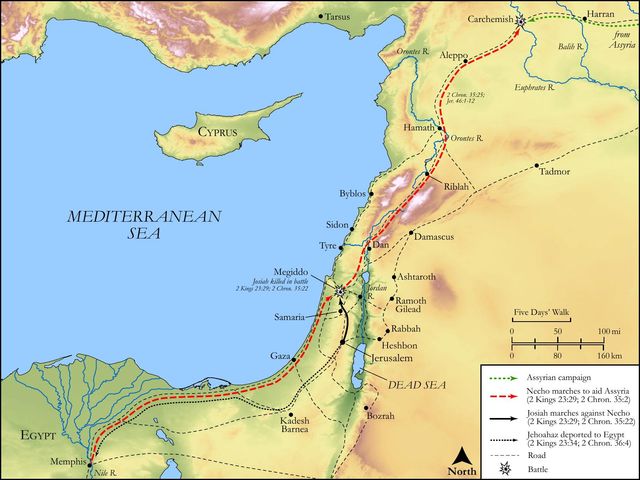
This verse immediately follows the tragic death of King Josiah, Judah's last righteous king, who was killed by Pharaoh Necho at Megiddo while attempting to intercept the Egyptian army on its way to assist Assyria against Babylon (2 Kings 23:29). After Josiah's death, the people of the land installed his son Jehoahaz as king (2 Kings 23:30). However, Pharaoh Necho, asserting his dominance, swiftly deposed Jehoahaz, imprisoned him, and took him to Egypt, where he died (2 Kings 23:31-34). Necho then appointed another of Josiah's sons, Eliakim, changing his name to Jehoiakim, as a puppet king over Judah. The financial tribute demanded in 2 Kings 23:35 is the direct consequence of this shift in power, establishing Judah as a tributary kingdom under Egyptian dominion and setting the stage for Jehoiakim's notoriously wicked reign, which would further hasten Judah's path to Babylonian exile (2 Kings 23:36-37).
Historical & Cultural Context
The events of 2 Kings 23:35 unfold in the late 7th century BCE, a tumultuous period marked by the decline of the Neo-Assyrian Empire and the rise of two new regional superpowers: the Neo-Babylonian Empire to the east and the revitalized Egyptian Empire under the Saite Dynasty (specifically Pharaoh Necho II) to the south. Judah, strategically located as a land bridge between these empires, found itself caught in the geopolitical struggle. After Josiah's death, Egypt, having asserted its dominance over the Levant, treated Judah as a conquered territory. The imposition of a heavy tribute or indemnity was a standard practice among the kings of that day for kingdoms in subjection. The newly appointed king, Jehoiakim, was expected to collect these funds from his populace, demonstrating his loyalty and the kingdom's submission. This act was not merely an economic transaction; it was a potent symbol of Judah's loss of independence and its integration into Egypt's sphere of influence, a precursor to the even greater subjugation by Babylon.
Key Themes
ShowHideThis verse powerfully contributes to several overarching themes within 2 Kings and the broader Deuteronomistic History. Firstly, it highlights the theme of Oppressive Leadership, contrasting Jehoiakim's self-serving rule with the righteous reign of his father, Josiah. Jehoiakim's willingness to burden his own people to satisfy a foreign power immediately signals his ungodly character and foreshadows the injustices that would mark his reign, as condemned by the prophet Jeremiah (Jeremiah 22:13-17). Secondly, the verse underscores the Loss of Sovereignty and national independence. The financial tribute is a tangible manifestation of Judah's reduced status from an independent kingdom to a mere tributary, its king a puppet of a foreign power. This loss of autonomy is a critical step towards the ultimate destruction of Jerusalem and the Babylonian exile. Finally, the events here implicitly connect to the theme of Consequences of Disobedience. While Jehoiakim's actions are the immediate cause of the people's burden, the broader narrative of 2 Kings consistently links national distress, foreign domination, and eventual exile to Judah's persistent idolatry and covenant unfaithfulness, demonstrating that God uses even the actions of unrighteous kings and foreign powers as instruments of divine judgment against a rebellious people.
Exposition and Analysis
ShowHideKey Word Analysis
ShowHideFrom a primitive root meaning "to set in a row, i.e. arrange, put in order." While its primary sense is arrangement, it extends to "tax" or "value," implying the systematic assessment and ordering of a levy. In this context, it signifies Jehoiakim's act of imposing a structured financial demand on the populace, aligning with the idea of setting a value or order for collection to meet Pharaoh's command.
A primitive root meaning "to drive (an animal, a workman, a debtor, an army); by implication, to tax, harass, tyrannize." This word carries strong connotations of compulsion, oppression, and forceful collection. Its use here emphasizes the severity and rigor with which Jehoiakim collected the tribute, portraying him as a taskmaster for Pharaoh, rather than a benevolent ruler for his own people. This term is often associated with oppressive figures, such as the Egyptian taskmasters over the Israelites (Exodus 5:6).
Of Egyptian derivation, referring to Pharaoh Necho II, a specific Egyptian king. The precise naming of this pharaoh grounds the narrative in a definite historical period and identifies the foreign power to whom Judah was now subservient. Necho II was a significant figure in late 7th-century BCE geopolitics, actively seeking to reassert Egyptian influence in the Levant, and his demands on Judah were part of this broader strategic ambition.
Verse Breakdown
ShowHide"And Jehoiakim gave the silver and the gold to Pharaoh;"
This opening clause immediately establishes Jehoiakim's subservient position. He is not a sovereign ruler making independent decisions but an agent fulfilling the demands of a foreign power. The "silver and the gold" represent the tribute or indemnity, a tangible symbol of Judah's servitude.
"but he taxed the land to give the money according to the commandment of Pharaoh:"
This clause reveals the source of the tribute: not Jehoiakim's personal wealth or the royal treasury, but the land itself—meaning the people of Judah. The phrase "according to the commandment of Pharaoh" underscores that the amount and the necessity of the collection were dictated by the Egyptian king, stripping Jehoiakim of any real authority or choice in the matter.
"he exacted the silver and the gold of the people of the land, of every one according to his taxation, to give [it] unto Pharaohnechoh."
This final, repetitive clause emphasizes the widespread and burdensome nature of the levy. The use of "exacted" highlights the harsh, compulsory collection. "Of every one according to his taxation" suggests a per capita or household assessment, ensuring that the burden was distributed across the populace, leaving no one untouched. The repetition of "silver and the gold" and the specific naming of "Pharaohnechoh" reinforce the financial burden and the specific foreign power to whom Judah was now enslaved.
Literary Devices
ShowHideThe passage employs several potent literary devices to convey its message. Repetition is prominently used with the phrase "silver and the gold" and the repeated mention of "Pharaoh" or "Pharaohnechoh." This repetition serves to emphasize the immense financial burden placed upon Judah and to highlight the persistent, oppressive presence of the foreign power. There is an implicit contrast drawn between the righteous reign of Josiah, who sought to purify the land and restore the covenant, and the immediate actions of Jehoiakim, who begins his rule by burdening his people for a foreign master. This contrast underscores the rapid moral and spiritual decline of Judah's leadership. The verse also employs foreshadowing, as this initial act of financial subjugation and oppressive leadership sets the stage for Jehoiakim's overall wicked reign and the inevitable, greater judgment of Babylonian exile that would follow. Finally, there is a subtle irony in the fact that a king, whose primary duty was to protect and shepherd his people, is here depicted as an instrument of their oppression, acting on behalf of a foreign power rather than for the welfare of his own kingdom.
Theological and Thematic Connections
ShowHideThe imposition of tribute on Judah by Pharaoh Necho, collected oppressively by King Jehoiakim, serves as a stark theological commentary on the consequences of covenant unfaithfulness and unrighteous leadership. Within the Deuteronomistic framework, foreign domination and economic hardship were understood as direct outcomes of Israel's departure from God's commands. This "taxation" was not merely a political reality but a tangible manifestation of divine judgment, signaling the loss of the blessings of independence and prosperity promised in the covenant. It underscores the principle that when a nation or its leaders forsake divine righteousness, they become vulnerable to external pressures and internal oppression. Jehoiakim's actions here are a prelude to the further injustices and idolatry that would characterize his reign, ultimately leading to God using Babylon as an even more severe instrument of discipline.
Reflection and Application
ShowHideThe account of Jehoiakim's oppressive taxation in 2 Kings 23:35 offers profound lessons for contemporary believers and societies. It serves as a powerful reminder that leadership, whether political, spiritual, or familial, carries immense responsibility. Jehoiakim's priority was not the welfare of his people or the glory of God, but rather the appeasement of a foreign power and the preservation of his own position, even at the cost of his subjects' suffering. This warns us against leaders who exploit their position for personal gain or external validation, burdening those under their care. For individuals, it calls for discernment in supporting leaders and systems, urging us to seek justice and righteousness. Furthermore, the narrative reminds us that national and collective choices have profound consequences; a departure from God's ways can lead to vulnerability, oppression, and loss of freedom. Even in times of hardship and injustice, the believer is called to trust in God's ultimate sovereignty, knowing that He works His purposes through all circumstances, and to pray for those in authority, that they may govern justly.
Questions for Reflection
ShowHideFAQ
ShowHideWhy did Pharaoh Necho demand this specific tribute from Judah?
ShowHidePharaoh Necho demanded this heavy tribute as a victor's right and a means of establishing Judah as a tributary kingdom within the Egyptian sphere of influence. After defeating Josiah at Megiddo and subsequently deposing Jehoahaz, Necho was asserting his dominance over the region. The tribute served multiple purposes: it compensated Egypt for its military endeavors, demonstrated Judah's submission, and provided ongoing revenue for the Egyptian empire. It was a standard practice for a conquering power to impose an indemnity or annual tribute on its newly subjugated territories, ensuring their loyalty and economic contribution to the empire.
How did Jehoiakim's actions here reflect his overall reign?
ShowHideJehoiakim's immediate act of taxing his people to pay Pharaoh Necho set a clear precedent for his entire reign, which was characterized by self-interest, injustice, and a profound disregard for God's law and the welfare of his people. Unlike his father Josiah, who initiated widespread reforms and sought to restore covenant faithfulness, Jehoiakim prioritized personal gain and political expediency. The prophet Jeremiah vehemently condemned Jehoiakim for his oppressive building projects, his shedding of innocent blood, and his general unrighteousness, famously stating, "Did not your father eat and drink and do justice and righteousness? Then it was well with him. He judged the cause of the poor and needy; then it was well. Is not this to know me? declares the Lord. But your eyes and heart are only on your dishonest gain, for shedding innocent blood and for practicing oppression and violence" (Jeremiah 22:15-17). Thus, the taxation in 2 Kings 23:35 was a foundational act of an ungodly and oppressive reign.
Was this taxation a form of divine judgment on Judah?
ShowHideYes, within the broader theological framework of the Old Testament, the oppression and loss of sovereignty experienced by Judah, including the heavy taxation by a foreign power, were understood as direct consequences of their persistent disobedience and idolatry. The Deuteronomistic history consistently portrays national distress and foreign domination as outworkings of God's covenant curses, which were promised for unfaithfulness (Deuteronomy 28:15-68). While Pharaoh Necho and Jehoiakim acted according to their own political and personal motivations, the biblical narrative interprets these events as God's sovereign hand allowing or orchestrating circumstances to discipline His rebellious people. The burden placed upon the people of Judah was a tangible sign of their spiritual decline and the breaking of their covenant relationship with God.
Christ-Centered Fulfillment
ShowHideThe oppressive taxation and subjugation depicted in 2 Kings 23:35 find their ultimate Christ-centered fulfillment in a profound contrast. While King Jehoiakim "exacted the silver and the gold of the people of the land" to satisfy a foreign power, Jesus, the true King of Judah and the world, came not to exact tribute but to pay the ultimate price. He did not burden His people but bore the crushing weight of their sin, a far greater "taxation" than any earthly levy. The prophet Isaiah foreshadowed this when he spoke of the Suffering Servant, upon whom "the Lord has laid on him the iniquity of us all" (Isaiah 53:6). Unlike Jehoiakim, who served himself and earthly powers, Jesus "did not come to be served, but to serve, and to give his life as a ransom for many" (Matthew 20:28). His self-sacrificial act on the cross paid the debt that humanity owed to divine justice, freeing us from the oppressive "exaction" of sin and death (Colossians 2:13-14). The reign of Christ is one of liberation and grace, not of burdensome tribute or oppressive rule, offering true freedom and peace to all who come under His benevolent kingship (John 8:36).