


2 Kings 23:31
Bible text: King James Version (1769 Blayney text) · Public domain
Bible text: King James Version with Strong's numbers · Public domain
Bible text: Berean Standard Bible · Public domain
Bible text: American Standard Version (1901) · Public domain
Bible text: World English Bible, Messianic edition · Public domain
Bible text: Geneva Bible (1599) · Public domain
Bible text: Young's Literal Translation · Public domain
- בֶּןben[was] a son ofH1121N-mscNoun Singular Masculine Construct
- עֶשְׂרִים'es·RimtwentyH6242N-mpNoun Plural Masculine Absolute
- וְשָׁלֹשׁve·sha·Loshand threeH7969Conj-w ¦ N-csNoun Singular common gender Absoluteוְandשָׁלֹשׁthree
- שָׁנָהsha·Nahyear[s]H8141N-fsNoun Singular Feminine Absolute
- יְהוֹאָחָזye·ho·'a·ChazJehoahazH3059N-proper-mNoun Proper Masculine
- בְּמָלְכוֹbe·ma·le·Khowhen he became kingH4427Prep-b ¦ V-Qal-Inf ¦ 3msVerb Qal Infinitive Constructבְּwhenמָלְכbecame kingוֹhe
- וּשְׁלֹשָׁהu·she·lo·Shahand threeH7969Conj-w ¦ N-csNoun Singular common gender Absoluteוּandשְׁלֹשָׁהthree
- חֳדָשִׁיםcho·da·ShimmonthsH2320N-mpNoun Plural Masculine Absolute
- מָלַךְma·Lakhhe reignedH4427V-Qal-Perf-3msVerb Qal Perfect 3rd Singular Masculine
- בִּירוּשָׁלִָםbi·ru·sha·Limin JerusalemH3389Prep-b ¦ N-properNoun Proper LocationבִּinירוּשָׁלִָםJerusalem
- וְשֵׁםve·Shemand [the] name ofH8034Conj-w ¦ N-mscNoun Singular Masculine Constructוְandשֵׁם[the] name of
- אִמּוֹ'i·Mohis motherH517N-fsc ¦ 3msNoun Singular Feminine Constructאִמּmotherוֹhis
- חֲמוּטַלcha·mu·Tal[was] HamutalH2537N-proper-fNoun Proper Feminine
- בַּתbat[the] daughter ofH1323N-fscNoun Singular Feminine Construct
- יִרְמְיָהוּyir·me·Ya·huJeremiahH3414N-proper-mNoun Proper Masculine
- מִלִּבְנָהmi·liv·Nahfrom LibnahH3841Prep-m ¦ N-properNoun Proper LocationמִfromלִּבְנָהLibnah
English is a literal word-by-word gloss of the Hebrew, not the KJV's wording. Why?
This is the original text the KJV's translators worked from — each Hebrew word with its own literal English meaning in this verse, prepared by scholars at Tyndale House, Cambridge. The KJV translates whole sentences, not word by word, so its wording differs: one Hebrew word can become several English words, and the KJV may choose “the LORD” where the gloss reads “Yahweh”. Both are faithful — they answer different questions. For the KJV's own rendering, switch to the KJV text.
Details
See on the biblical-era maps
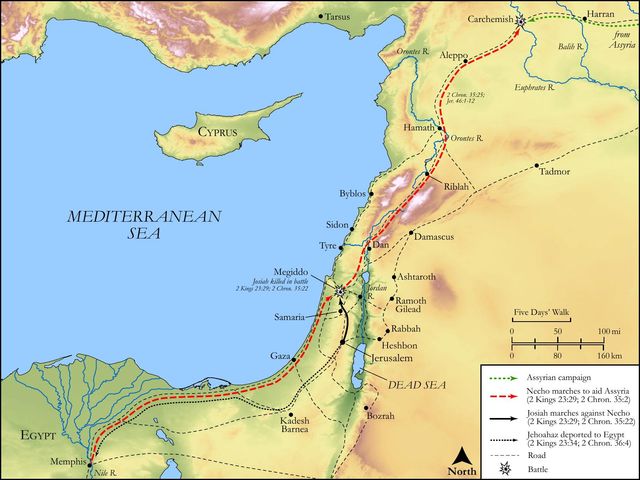
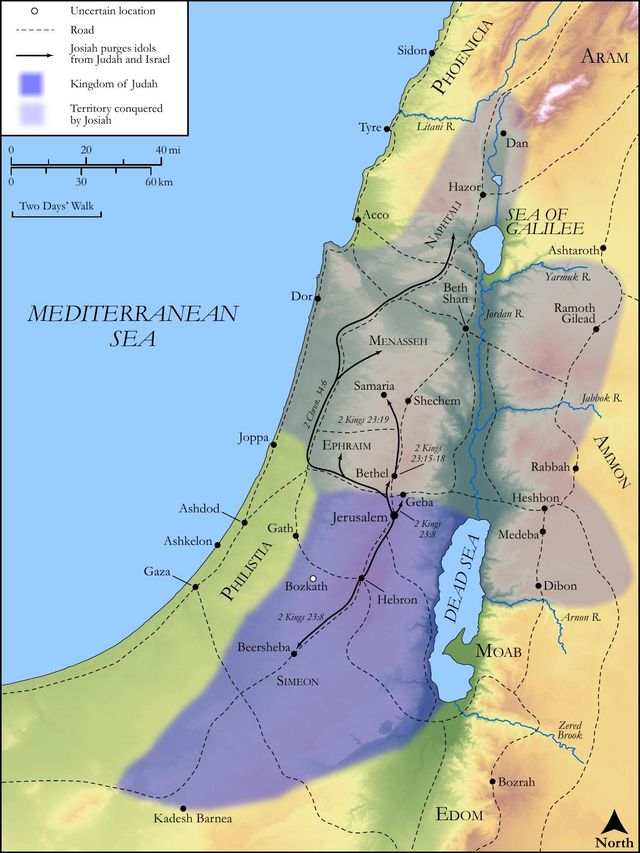
Study this verse
Public-domain commentary
Matthew Henry
From his Commentary on the Whole Bible. Henry comments on passages, not single verses — this entry covers 2 Kings 23:31–37. His two-level outline is real structure in the source text, so it is rendered as structure.
Jerusalem saw not a good day after Josiah was laid in his grave, but one trouble came after another, till within twenty-two years it was quite destroyed. Of the reign of two of his sons here is a short account; the former we find here a prisoner and the latter a tributary to the king of Egypt, and both so in the very beginning of their reign. This king of Egypt having slain Josiah, though he had not had any design upon Judah, yet, being provoked by the opposition which Josiah gave him, now, it should seem, he bent all his force against his family and kingdom. If Josiah's sons had trodden in his steps, they would have fared the better for his piety; but, deviating from them, they fared the worse for his rashness.
I.Jehoahaz, a younger son, was first made king by the people of the land, probably because he was observed to be of a more active warlike genius than his elder brother, and likely to make head against the king of Egypt and to avenge his father's death, which perhaps the people were more solicitous about, in point of honour, than the keeping up and carrying on of his father's reformation; and the issue was accordingly.
1.He did ill, Kg2 23:32. Though he had a good education and a good example given him, and many a good prayer, we may suppose, put up for him, yet he did that which was evil in the sight of the Lord, and, it is to be feared, began to do so in his father's lifetime, for his reign was so short that he could not, in that, show much of his character. He did according to all that his wicked fathers had done. Though he had not time to do much, yet he had chosen his patterns, and showed whom he intended to follow and whose steps he resolved to tread in; and, having done this, he is here reckoned to have done according to all the evil which those did whom he proposed to imitate. It is of great consequence to young people whom they choose to take for their patterns and whom they emulate. An error in this choice is fatal. Phi 3:17, Phi 3:18.
2.Doing ill, no wonder that he fared ill. He was but three months a prince, and was then made a prisoner, and lived and died so. The king of Egypt seized him, and put him in bands (Kg2 23:33), fearing lest he should give him disturbance, and carried him to Egypt, where he died soon after, Kg2 23:34. This Jehoahaz is that young lion whom Ezekiel speaks of in his lamentation for the princes of Israel, that learnt to catch the prey and devour men (that was the evil which he did in the sight of the Lord); but the nations heard of him, he was taken in their pit, and they brought him with chains into the land of Egypt, Eze 19:1-4. See Jer 22:10-12.
II.Eliakim, another son of Josiah, was made king by the king of Egypt, it is not said in the room of Jehoahaz (his reign was so short that it was scarcely worth taking notice of), but in the room of Josiah. The crown of Judah had hitherto always descended from a father to a son, and never, till now, from one brother to another; once the succession had so happened in the house of Ahab, but never, till now, in the house of David. The king of Egypt, having used his power in making him king, further showed it in changing his name; he called him Jehoiakim, a name that has reference to Jehovah, for he had no design to make him renounce or forget the religion of his country. "All people will walk in the name of their God, and let him do so." The king of Babylon did not do so by those whose names he changed, Dan 1:7. Of this Jehoiakim we are here told,
1.That the king of Egypt made him poor, exacted from him a vast tribute of 100 talents of silver and a talent of gold (Kg2 23:33), which, with much difficulty, he squeezed out of his subjects and gave to Pharaoh, Kg2 23:35. Formerly the Israelites had spoiled the Egyptians; now the Egyptians spoil Israel. See what woeful changes sin makes.
2.That which made him poor, yet did not make him good. Notwithstanding the rebukes of Providence he was under, by which he should have been convinced, humbled, and reformed, he did that which was evil in the sight of the Lord (Kg2 23:37), and so prepared against himself greater judgments; for such God will send if less do not do the work for which they are sent.
Historical interpretation
Historical reception
1 surviving comment on this verse from the historical church.
Jehoahaz, also called Shalom, reigned three months until the Egyptians came back from Mabboug. At that stage [Pharaoh] enchained him and brought him to Egypt. So [Jehoahaz] left his country and never came back, according to the prophecy that Jeremiah had spoken against him. Pharaoh appointed his brother Heliakim as the new king and gave him the name of Jehoiakim.
Continue studying 2 Kings 23:31 across the web’s major study libraries — every link below opens this exact verse, chapter, or book on the destination site.
Read & Compare
 BibleGatewayThis verse in more than 200 translations and 70 languages.
 Bible.comThe YouVersion reader — hundreds of translations, reading plans, and highlights.
 ESV.orgCrossway's official English Standard Version reader.
 NET BibleThe NET translation with 60,000+ translators' notes on every rendering decision.
 STEP BibleTyndale House's free study tool — original text, vocabulary, and scholarly resources.
 BibliaLogos Bible Software's free web reader.
 USCCBThe New American Bible (Revised Edition) with the U.S. bishops' study notes.
Commentaries
 BibleHub CommentariesDozens of classic commentaries on this verse, gathered on one page.
 StudyLightMore than 100 commentary sets — the largest collection on the web.
 BibleRefPlain-English commentary on what this verse means, verse by verse.
 Enduring WordDavid Guzik's free commentary on this chapter, widely used by Bible teachers.
 Bible Study ToolsVerse commentary alongside Greek and Hebrew study aids.
Original Language & Research
- BibleHub InterlinearThe verse word by word — original language, transliteration, and English.
- BibleHub LexiconEvery word's original-language definition and Strong's entry.
 Blue Letter BibleDeep-study tools — Strong's numbers, concordance, and word studies.
 SefariaThe Hebrew text with Rashi and centuries of Jewish commentary.
Sermons, Hymns & Audio


TrulyRandomVerse is not affiliated with these sites and doesn’t control their content. They’re linked because they’re genuinely useful.
Summary
Second Kings 23:31 introduces Jehoahaz as the immediate, yet tragically short-lived, successor to his father, the righteous King Josiah. This pivotal verse provides the essential identifying details of his accession at twenty-three years old, the startling brevity of his three-month reign in Jerusalem, and his maternal lineage from Hamutal, daughter of Jeremiah of Libnah. These concise biographical notes serve as a stark and somber harbinger of the profound instability and rapid decline into foreign subjugation that would define Judah's final years, marking a dramatic and irreversible departure from Josiah's era of reform and national revival.
Context
ShowHideLiterary Context
This verse immediately follows the devastating account of King Josiah's death in battle at Megiddo against Pharaoh Necho II of Egypt, as recorded in 2 Kings 23:29. Josiah's demise is portrayed as a profound national catastrophe, abruptly ending a period of significant religious reformation and covenant renewal. The narrative quickly transitions to the succession, underscoring the immediate political vacuum and instability that gripped Judah. Notably, Jehoahaz, though a younger son of Josiah, was chosen by "the people of the land" (2 Kings 23:30), a powerful socio-political entity often responsible for legitimizing the monarchy, especially in times of crisis or when bypassing the traditional line of succession. This choice, which overlooked his elder brother Eliakim (later Jehoiakim), hints at internal political machinations or a popular desire for a specific direction in the wake of Josiah's sudden death. The explicit mention of Jehoahaz's incredibly brief reign immediately sets a tone of impending doom and foreign subjugation, a theme that tragically dominates the remaining chapters of 2 Kings.
Historical & Cultural Context
The period immediately following Josiah's death in 609 BCE was one of intense geopolitical upheaval among the kingdoms of that day. The once-dominant Assyrian Empire had collapsed, creating a power vacuum that was rapidly filled by two emerging superpowers: Egypt to the south and Babylon to the north. Judah, strategically located as a land bridge between these empires, became an unfortunate pawn in their escalating rivalry. Pharaoh Necho II of Egypt was actively asserting his control over the Levant, and Josiah's ill-fated attempt to resist him proved fatal. Culturally, the succession of kings in Judah typically adhered to the principle of primogeniture (the eldest son inheriting the throne). However, the "people of the land" occasionally exercised their influence, particularly when a king died unexpectedly or when the designated heir was deemed unsuitable, as seen previously with Uzziah and Amon (2 Kings 14:21 and 2 Kings 21:24). The inclusion of the queen mother's name and her hometown was a standard practice in Judean royal records, providing a complete royal identity and sometimes subtly indicating regional influences or political alliances. Libnah, Jehoahaz's mother's hometown, was a Levitical city with a history of resisting Judean royal authority (2 Kings 8:22), adding a nuanced layer to the royal family's background.
Key Themes
ShowHideThough concise, this verse significantly contributes to several overarching themes within 2 Kings and the broader Deuteronomistic History. Firstly, it powerfully underscores the theme of divine judgment and the accelerating decline of Judah. Josiah's death marks the definitive end of an era of covenant faithfulness, and Jehoahaz's subsequent brief and unrighteous reign (2 Kings 23:32) immediately signals the irreversible trajectory towards national catastrophe and exile. Secondly, the verse highlights the theme of foreign dominance and the loss of Judean sovereignty. The fact that Jehoahaz's rule was so fleeting and abruptly terminated by a foreign power (Pharaoh Necho, as detailed in 2 Kings 23:33) vividly illustrates Judah's diminished status as a kingdom in servitude to a foreign power, no longer truly independent. Thirdly, the inclusion of the mother's name and hometown reinforces the crucial theme of lineage and succession, which is paramount throughout the Davidic narrative, emphasizing the continuity (or, in this case, the precarious discontinuity) of the Davidic line amidst profound political and spiritual turmoil. The stark contrast between Josiah's long, righteous reign and Jehoahaz's short, wicked one serves as a poignant setup for the final, tragic chapters of Judah's monarchy.
Exposition and Analysis
ShowHideKey Word Analysis
ShowHideThis theophoric name, meaning "Yahweh has grasped" or "Yahweh has held," incorporates the divine name Yahweh. Ironically, despite the name's implication of divine support or protection, Jehoahaz's reign was marked by divine displeasure and swift judgment, demonstrating that a name did not guarantee the character or fate of the individual. He is also identified as Shallum in Jeremiah 22:11, possibly his birth name, with Jehoahaz serving as his throne name upon accession.
This remarkably brief duration is profoundly significant within the context of royal reigns. A rule lasting only three months immediately signals extreme instability, foreign intervention, and a complete lack of legitimate, stable governance. It stands in sharp contrast to the typically much longer reigns of his predecessors, including his father Josiah, and serves as an immediate foreshadowing of the rapid succession of weak, puppet kings and the impending collapse of the Judean monarchy. The brevity powerfully emphasizes the fragility of Judah's sovereignty during this tumultuous period.
This name, possibly meaning "my kinsman is dew" or "my father-in-law is dew," is that of Jehoahaz's mother. The inclusion of the queen mother's name was a standard and consistent practice in the royal annals of Judah, appearing for nearly all kings from Rehoboam onward. This detail was not merely genealogical but could also subtly indicate her influence, her family's social or political status, or a connection to a specific region. Hamutal's origin from Libnah, a city that had previously rebelled against Judean royal authority (2 Kings 8:22), might hint at underlying regional currents or loyalties, though the text does not explicitly state its direct impact on Jehoahaz's reign.
Verse Breakdown
ShowHide"Jehoahaz [was] twenty and three years old when he began to reign;"
This initial clause provides the customary introductory information for a new king, establishing his age at the time of his accession to the throne. At twenty-three, Jehoahaz was a young adult, legally old enough to rule, yet his relative youth may have contributed to his inexperience in navigating the exceptionally complex and volatile geopolitical landscape of his era. This detail adheres to the formulaic regnal summary consistently found throughout the book of 2 Kings.
"and he reigned three months in Jerusalem."
This is the most striking and ominous detail within the verse. The incredibly short duration of his reign immediately communicates profound instability and the rapid unraveling of Judah's independence. It serves as a direct foreshadowing of his swift deposition by Pharaoh Necho, as elaborated in the subsequent verses (2 Kings 23:33). The specific mention of "in Jerusalem" anchors his brief rule to the traditional capital, underscoring the loss of sovereignty over the very heart of the kingdom.
"And his mother's name [was] Hamutal, the daughter of Jeremiah of Libnah."
This final clause provides the complete identity of the queen mother and her paternal lineage, a consistent feature in the biblical accounts of Judean kings. This detail serves to fully identify the king within his familial and geographical context, providing a complete royal profile. While the text does not elaborate on Hamutal's direct influence, her origin from Libnah, a city with a documented history of independence and rebellion, adds a subtle layer of background to the royal family's broader connections within Judah.
Literary Devices
ShowHideThe verse, despite its conciseness, employs several subtle yet powerful literary devices. The most prominent is foreshadowing, where the stated brevity of Jehoahaz's reign ("three months") immediately signals profound instability and impending doom for both the king and the kingdom, effectively setting a somber and urgent tone for the final, tragic chapters of Judah's monarchy. There is also a strong element of irony embedded in the king's name, "Jehoahaz" ("Yahweh has grasped"), as Yahweh's "grasp" on this particular king was one of swift judgment and removal, rather than protection or blessing, due to his unrighteous conduct (2 Kings 23:32). The verse further utilizes a standardized formula for introducing kings, including their age at accession, length of reign, and mother's name. This formulaic approach provides a sense of historical record-keeping while simultaneously highlighting deviations from the norm (such as an exceptionally short reign) through its very conciseness. Finally, the juxtaposition of Jehoahaz's brief, ill-fated reign with the preceding long and righteous reign of his father Josiah powerfully underscores the dramatic and tragic shift in Judah's spiritual and political fortunes, emphasizing the rapid decline after Josiah's death.
Theological and Thematic Connections
ShowHideSecond Kings 23:31 serves as a poignant theological marker, signifying the rapid acceleration of God's judgment upon Judah, even in the immediate aftermath of Josiah's extensive reforms. Jehoahaz's incredibly brief and ill-fated reign underscores the profound biblical principle that human leadership, no matter how chosen by the people, cannot ultimately avert divine judgment when it deviates from God's covenant. His swift removal by a foreign power vividly illustrates God's absolute sovereignty over nations and kings, demonstrating His capacity to use even pagan rulers as instruments of His will to bring about the consequences of Judah's persistent idolatry and unfaithfulness. This verse marks the definitive beginning of the end for the independent Davidic monarchy, highlighting the inherent transience of earthly power when it stands in opposition to divine decree and the tragic reality of a nation losing its spiritual and political moorings.
Reflection and Application
ShowHideThe brief, tragic reign of Jehoahaz in 2 Kings 23:31 offers profound and enduring lessons for contemporary believers. It serves as a stark reminder of the inherent transience of earthly power, human plans, and even popular acclaim, especially when these are not aligned with God's sovereign will and righteous standards. Despite being chosen by "the people of the land," Jehoahaz's rule was swiftly and decisively overturned, demonstrating that human strategy or popular support cannot ultimately override divine sovereignty or the inevitable consequences of unrighteousness. For us today, this narrative highlights the critical importance of diligently seeking God's will in all forms of leadership, whether within the church, our communities, or our personal spheres of influence, recognizing that true stability, lasting impact, and genuine flourishing come only from faithful obedience to Him. It also serves as a poignant reminder that even when surrounded by spiritual decline, political upheaval, or societal chaos, our personal walk with God remains paramount, as individual righteousness (or lack thereof) profoundly contributes to the collective spiritual health and destiny of a people. The story implicitly challenges us to consider our own "reigns"—the periods of influence, authority, or opportunities we are given—and how we are stewarding them in light of God's eternal purposes and His coming kingdom.
Questions for Reflection
ShowHideFAQ
ShowHideWhy was Jehoahaz chosen by "the people of the land" instead of his older brother Eliakim (Jehoiakim)?
ShowHideWhile the biblical text does not explicitly state the precise reasons for this choice, it is widely understood that "the people of the land" (likely a powerful socio-political group, influential elders, or a broad representation of the populace) chose Jehoahaz over his elder brother Eliakim for several plausible reasons. Jehoahaz may have been perceived as more aligned with the policies and reforms of his father Josiah, or perhaps more amenable to the influence of this powerful faction. Conversely, Eliakim might have been viewed as too pro-Egyptian, or Jehoahaz might have been preferred for his age, perceived strength of character, or simply popular appeal in the immediate aftermath of Josiah's unexpected death. This act of choosing a younger son over an elder was not entirely unprecedented in Israelite history (e.g., Solomon chosen over Adonijah in 1 Kings 1:11-40). However, this popular choice was quickly and decisively overturned by Pharaoh Necho, demonstrating the true locus of power and control over Judah at that moment (2 Kings 23:33-34).
What happened to Jehoahaz after his three-month reign?
ShowHideAs vividly detailed in the subsequent verses of 2 Kings 23:33-34, Pharaoh Necho II, who had been responsible for King Josiah's death, asserted his absolute authority over Judah. He swiftly deposed Jehoahaz, imprisoned him at Riblah in the land of Hamath (a strategic location in Syria), and subsequently carried him away as a captive to Egypt. Jehoahaz eventually died in exile in Egypt, never returning to his homeland. This event marked a significant and ominous turning point, as it was the first instance of a Judean king being forcibly removed from his throne and exiled by a foreign power, serving as a stark foreshadowing of the later, more extensive Babylonian exiles. The prophet Jeremiah lamented Jehoahaz's tragic fate, prophesying that he would indeed never return to his native land (Jeremiah 22:10-12).
Christ-Centered Fulfillment
ShowHideThe tragic brevity and unrighteousness of Jehoahaz's reign in 2 Kings 23:31, coupled with his swift and ignominious removal by a foreign power, stand in profound and illuminating contrast to the eternal, righteous, and utterly sovereign reign of Jesus Christ, the ultimate King of Judah and of all creation. Jehoahaz's abject failure as a human king, chosen by the people yet quickly deposed and exiled, powerfully highlights the inherent limitations, fragility, and brokenness of all earthly leadership, even within the divinely promised Davidic line. This narrative serves as a poignant pointer to humanity's desperate need for a perfect King, one whose reign would not be measured in mere months or years but would be everlasting, and whose divinely ordained authority would never be subject to any earthly empire or human caprice. Jesus, the true Son of David, fulfills this deep longing, establishing His kingdom not through political maneuvering or military might, but through His sacrificial death on the cross and His glorious resurrection, thereby inaugurating a spiritual kingdom that "will never be destroyed" (Daniel 2:44). Unlike Jehoahaz, who was led away captive to Egypt, Jesus, through His decisive victory over sin and death, leads His people out of spiritual captivity and into true freedom and light (Colossians 1:13-14). His rule is characterized by perfect righteousness (Hebrews 1:8-9), an eternal throne (Revelation 22:3), and a kingdom that brings ultimate peace, justice, and salvation, thereby perfectly fulfilling all the unfulfilled hopes and promises associated with the Davidic covenant and the yearning for a truly righteous king.