


2 Chronicles 36:2
Bible text: King James Version (1769 Blayney text) · Public domain
Bible text: Berean Standard Bible · Public domain
Bible text: American Standard Version (1901) · Public domain
Bible text: World English Bible, Messianic edition · Public domain
Bible text: Geneva Bible (1599) · Public domain
Bible text: Young's Literal Translation · Public domain
- בֶּןben[was] a son ofH1121N-mscNoun Singular Masculine Construct
- שָׁלוֹשׁsha·Lo·oshthreeH7969N-csNoun Singular common gender Absolute
- וְעֶשְׂרִיםve·'es·Rimand twentyH6242Conj-w ¦ N-mpNoun Plural Masculine Absoluteוְandעֶשְׂרִיםtwenty
- שָׁנָהsha·Nahyear[s]H8141N-fsNoun Singular Feminine Absolute
- יוֹאָחָזyo·'a·ChazJehoahazH3099N-proper-mNoun Proper Masculine
- בְּמָלְכוֹbe·ma·le·Khowhen he became kingH4427Prep-b ¦ V-Qal-Inf ¦ 3msVerb Qal Infinitive Constructבְּwhenמָלְכbecame kingוֹhe
- וּשְׁלֹשָׁהu·she·lo·Shahand threeH7969Conj-w ¦ N-csNoun Singular common gender Absoluteוּandשְׁלֹשָׁהthree
- חֳדָשִׁיםcho·da·ShimmonthsH2320N-mpNoun Plural Masculine Absolute
- מָלַךְma·Lakhhe reignedH4427V-Qal-Perf-3msVerb Qal Perfect 3rd Singular Masculine
- בִּירוּשָׁלִָםbi·ru·sha·Limin JerusalemH3389Prep-b ¦ N-properNoun Proper LocationבִּinירוּשָׁלִָםJerusalem
English is a literal word-by-word gloss of the Hebrew, not the KJV's wording. Why?
This is the original text the KJV's translators worked from — each Hebrew word with its own literal English meaning in this verse, prepared by scholars at Tyndale House, Cambridge. The KJV translates whole sentences, not word by word, so its wording differs: one Hebrew word can become several English words, and the KJV may choose “the LORD” where the gloss reads “Yahweh”. Both are faithful — they answer different questions. For the KJV's own rendering, switch to the KJV text.
Details
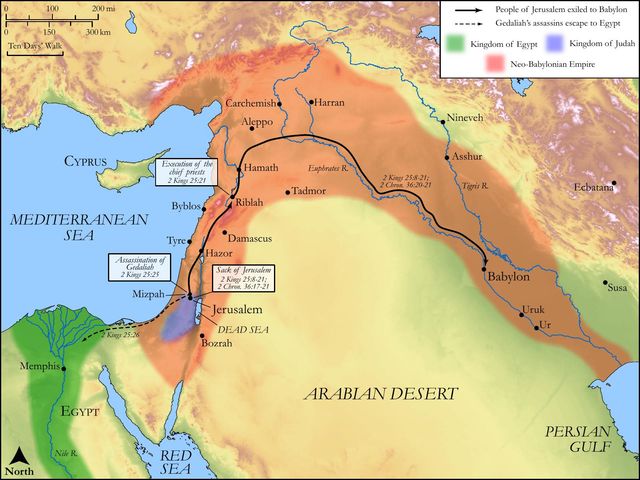
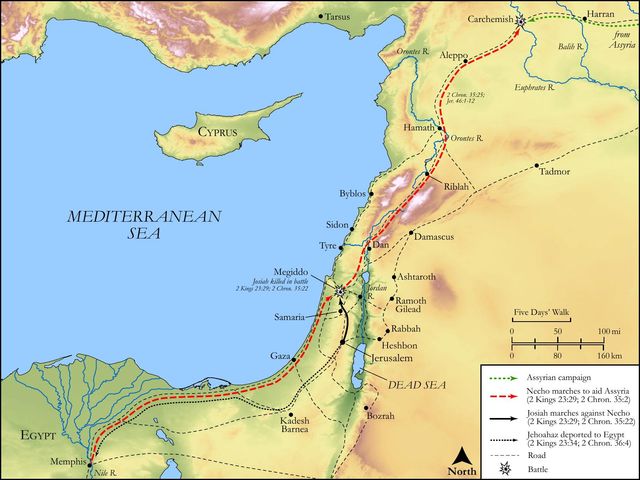
See on the biblical-era maps
Study this verse
Public-domain commentary
Matthew Henry
From his Commentary on the Whole Bible. Henry comments on passages, not single verses — this entry covers 2 Chronicles 36:1–10.
The destruction of Judah and Jerusalem is here coming on by degrees. God so ordered it to show that he has no pleasure in the ruin of sinners, but had rather they would turn and live, and therefore gives them both time and inducement to repent and waits to be gracious. The history of these reigns was more largely recorded in the last three chapters of the second of Kings. 1. Jehoahaz was set up by the people (Ch2 36:1), but in one quarter of a year was deposed by Pharaoh-necho, and carried a prisoner to Egypt, and the land fined for setting him up, Ch2 36:2-4. Of this young prince we hear no more. Had he trodden in the steps of his father's piety he might have reigned long and prospered; but we are told in the Kings that he did evil in the sight of the Lord, and therefore his triumphing was short and his joy but for a moment. 2. Jehoiakim was set up by the king of Egypt, an old enemy to their land, gave what king he pleased to the kingdom and what name he pleased to the king! Ch2 36:4. He made Eliakim king, and called him Jehoiakim, in token of his authority over him. Jehoiakim did that which was evil (Ch2 36:5), nay, we read of the abominations which he did (Ch2 36:8); he was very wild and wicked. Idolatries generally go under the name of abominations. We hear no more of the king of Egypt, but the king of Babylon came up against him (Ch2 36:6), seized him, and bound him with a design to carry him to Babylon; but, it seems, he either changed his mind, and suffered him to reign as his vassal, or death released the prisoner before he was carried away. However the best and most valuable vessels of the temple were now carried away and made use of in Nebuchadnezzar's temple in Babylon (Ch2 36:7); for, we may suppose, no temple in the world was so richly furnished as that of Jerusalem. The sin of Judah was that they had brought the idols of the heathen into God's temple; and now their punishment was that the vessels of the temple were carried away to the service of the gods of the nations. If men will profane God's institutions by their sins, it is just with God to suffer them to be profaned by their enemies. These were the vessels which the false prophets flattered the people with hopes of the return of, Jer 27:16. But Jeremiah told them that the rest should go after them (Jer 27:21, Jer 27:22), and they did so. But, as the carrying away of these vessels to Babylon began the calamity of Jerusalem, so Belshazzar's daring profanation of them there filled the measure of the iniquity of Babylon; for, when he drank wine in them to the honour of his gods, the handwriting on the wall presented him with his doom, Dan 5:3, etc. In the reference to the book of the Kings concerning this Jehoiakim mention is made of that which was found in him (Ch2 36:8), which seems to be meant of the treachery that was found in him towards the king of Babylon; but some of the Jewish writers understand it of certain private marks or signatures found in his dead body, in honour of his idol, such cuttings as God had forbidden, Lev 19:28. 3. Jehoiachin, or Jeconiah, the son of Jehoiakim, attempted to reign in his stead, and reigned long enough to show his evil inclination; but, after three months and ten days, the king of Babylon sent and fetched him away captive, with more of the goodly vessels of the temple. He is here said to be eight years old, but in Kings he is said to be eighteen when he began to reign, so that this seems to be a mistake of the transcriber, unless we suppose that his father took him at eight years old to join with him in the government, as some think.
Continue studying 2 Chronicles 36:2 across the web’s major study libraries — every link below opens this exact verse, chapter, or book on the destination site.
Read & Compare
 BibleGatewayThis verse in more than 200 translations and 70 languages.
 Bible.comThe YouVersion reader — hundreds of translations, reading plans, and highlights.
 ESV.orgCrossway's official English Standard Version reader.
 NET BibleThe NET translation with 60,000+ translators' notes on every rendering decision.
 STEP BibleTyndale House's free study tool — original text, vocabulary, and scholarly resources.
 BibliaLogos Bible Software's free web reader.
 USCCBThe New American Bible (Revised Edition) with the U.S. bishops' study notes.
Commentaries
 BibleHub CommentariesDozens of classic commentaries on this verse, gathered on one page.
 StudyLightMore than 100 commentary sets — the largest collection on the web.
 BibleRefPlain-English commentary on what this verse means, verse by verse.
 Enduring WordDavid Guzik's free commentary on this chapter, widely used by Bible teachers.
 Bible Study ToolsVerse commentary alongside Greek and Hebrew study aids.
Original Language & Research
- BibleHub InterlinearThe verse word by word — original language, transliteration, and English.
- BibleHub LexiconEvery word's original-language definition and Strong's entry.
 Blue Letter BibleDeep-study tools — Strong's numbers, concordance, and word studies.
 SefariaThe Hebrew text with Rashi and centuries of Jewish commentary.
Sermons, Hymns & Audio


TrulyRandomVerse is not affiliated with these sites and doesn’t control their content. They’re linked because they’re genuinely useful.
Summary
Second Chronicles 36:2 introduces Jehoahaz, also known as Shallum, as the immediate successor to his father, the righteous King Josiah. This verse, marking the beginning of the end for the Kingdom of Judah, highlights his brief and tragically short three-month reign in Jerusalem, setting a somber tone for the rapid decline and ultimate destruction of the southern kingdom due to its persistent unfaithfulness to God.
Context
ShowHideLiterary Context
This verse immediately follows the detailed account of King Josiah's tragic death at the Battle of Megiddo, as recorded in 2 Chronicles 35:20-24. The Chronicler, having just presented Josiah's extensive reforms and his final, ill-fated confrontation with Pharaoh Necho, abruptly shifts to the succession. The abruptness and the stated brevity of Jehoahaz's reign set a stark and somber tone for the remaining chapters of 2 Chronicles, which chronicle the rapid succession of four unrighteous kings and the inevitable Babylonian exile. This fleeting rule stands in sharp contrast to Josiah's long and righteous reign, emphasizing the swift and dramatic deterioration of Judah's spiritual and political state. The parallel account in 2 Kings 23:30-35 provides additional details, confirming the events and the king's unrighteous character, which the Chronicler implicitly assumes the reader knows or will soon learn.
Historical & Cultural Context
Jehoahaz ascended the throne in 609 BC, a period of profound geopolitical instability among Assyria, Babylon, and Egypt. The once-dominant Assyrian Empire had collapsed, and its remnants were being contested by the rising powers of Babylon to the east and Egypt to the southwest. Judah, strategically located, found itself caught between these two emerging giants. Following Pharaoh Necho's victory at Megiddo, Judah fell under Egyptian influence. The "people of the land" (עַם הָאָרֶץ, am ha'aretz), a significant socio-political group representing the landed gentry and populace, played a crucial role in installing Jehoahaz. This act bypassed his older brother, Eliakim (later renamed Jehoiakim), who was perhaps perceived as more pro-Egyptian. This suggests a desperate attempt by the Judean populace to assert some form of national independence or to install a king more aligned with their own aspirations after Josiah's unexpected death. However, this act of self-determination proved futile against the might of Egypt, leading to Jehoahaz's swift deposition and exile, as detailed in 2 Chronicles 36:3-4.
Key Themes
ShowHideThough concise, this verse contributes significantly to several overarching themes in the book of Chronicles. Firstly, it underscores the accelerated decline of Judah following the death of its last righteous king, Josiah. It illustrates how rapidly a nation can fall when its leadership deviates from God's covenant. Jehoahaz's unrighteousness, though not explicitly stated here but confirmed in 2 Kings 23:32, immediately negated Josiah's reforms and invited divine judgment. Secondly, the verse highlights the transience and vulnerability of earthly power when not aligned with God's will. A reign of merely three months dramatically illustrates the instability of human authority and the futility of political maneuvering apart from divine blessing and covenant faithfulness. Finally, it serves as an early and potent indicator of God's unfolding judgment upon Judah for its persistent idolatry and covenant breaking, setting the stage for the subsequent unrighteous kings and the inevitable Babylonian exile, a theme that dominates the remainder of the book of Chronicles, culminating in the detailed account of the captivity in 2 Chronicles 36:15-21.
Exposition and Analysis
ShowHideKey Word Analysis
ShowHideThis is the proper name of the king. The name יְהוֹאָחָז (Yôwʼâchâz), meaning "Yahweh has grasped" or "Yahweh has held," carries profound irony in light of the king's ultimate fate. While the name could imply divine protection or possession, Jehoahaz was quickly "grasped" and taken captive by Pharaoh Necho, highlighting God's sovereign control not in preserving him on the throne, but in orchestrating his swift removal as part of the unfolding judgment upon Judah. This irony underscores the ultimate futility of human plans when they run contrary to the divine will.
The Hebrew verb מָלַךְ (mâlak) means "to reign" or "to ascend the throne." Inceptively, it signifies the act of beginning to rule. The use of this verb here, immediately followed by the incredibly short duration of "three months," emphasizes the ephemeral nature of Jehoahaz's kingship. While he indeed ascended the throne and began to reign, his rule was so brief that it lacked any true stability or lasting impact, underscoring the precariousness of Judah's monarchy at this critical juncture.
The Hebrew word חֹדֶשׁ (chôdesh) refers to a "month," derived from the concept of the "new moon," which marked the beginning of a new lunar cycle. The precise mention of "three months" (שְׁלֹשָׁה חֳדָשִׁים) is a stark indicator of the extreme brevity and instability of Jehoahaz's reign. In biblical narratives, such specific, short durations often signify divine intervention, judgment, or a lack of legitimate, stable authority. It immediately signals that this king's rule was not blessed or sustained by God, and that external forces, orchestrated by divine providence, would quickly intervene to remove him.
Verse Breakdown
ShowHide"Jehoahaz [was] twenty and three years old when he began to reign"
This clause provides the age of the new king at his ascension. At twenty-three, Jehoahaz was relatively young, perhaps lacking the maturity or experience needed to navigate the complex geopolitical landscape of his time. His youth also contrasts sharply with the longer, more established reigns of earlier Judean kings, particularly his father Josiah, whose reign lasted thirty-one years (2 Chronicles 34:1). The immediate succession of a young, unrighteous king after a long, righteous one underscores the rapid spiritual and political deterioration of Judah.
"and he reigned three months"
This is the most striking detail of the verse, emphasizing the exceedingly short duration of Jehoahaz's rule. This brevity immediately signals that his reign was not stable or divinely sanctioned. It implies external intervention and a lack of true sovereignty, setting the stage for the events of the following verses where Pharaoh Necho swiftly deposes him. This short reign is a clear sign of Judah's accelerating decline and God's impending judgment.
"in Jerusalem"
This specifies the capital city as the seat of his brief reign. Jerusalem, the city of David, the place where the Temple stood, and the symbolic heart of the covenant people, serves as the backdrop for this fleeting and ultimately unrighteous rule. The fact that even from this sacred city, Jehoahaz could not establish a lasting or righteous reign highlights the deep spiritual corruption that had permeated the entire kingdom, from its very center, signaling that divine judgment would not spare even the holy city.
Literary Devices
ShowHideThe verse employs several literary devices to convey its profound meaning and foreshadow the impending doom of Judah. Irony is profoundly present in the name "Jehoahaz," meaning "Yahweh has grasped," as he was indeed grasped and taken captive by Pharaoh Necho, not by God for blessing but as an instrument of judgment. The extreme conciseness of the verse itself, particularly the abrupt statement of his three-month reign, acts as a literary mirror to the brevity and instability of his rule, reflecting the rapid unraveling of the Judean kingdom. Furthermore, the verse serves as a powerful instance of foreshadowing, hinting at the imminent collapse of the Davidic monarchy and the impending Babylonian exile. The rapid succession and short, unrighteous reign of Jehoahaz set a pattern for the final kings of Judah, each reign becoming progressively shorter and more disastrous, leading inevitably to the kingdom's destruction.
Theological and Thematic Connections
ShowHideThe account of Jehoahaz's brief reign serves as a stark theological commentary on divine sovereignty and human accountability, particularly within the context of the Mosaic covenant. Despite the "people of the land" choosing Jehoahaz, God's ultimate control over the rise and fall of kings and nations is powerfully demonstrated. His swift removal by Pharaoh Necho, though a human act, is presented within the broader narrative of Chronicles as part of God's unfolding judgment on Judah for its persistent unfaithfulness, even after Josiah's reforms. This highlights that true stability and lasting power do not derive from human will or political maneuvering, but from alignment with God's righteous standards. The brevity of his reign underscores the principle that unrighteous leadership, even in a divinely appointed lineage, cannot withstand the consequences of covenant disobedience.
Reflection and Application
ShowHideThe brief and ill-fated reign of Jehoahaz offers a poignant lesson for believers today regarding the nature of power, leadership, and divine sovereignty. It reminds us that earthly positions, no matter how elevated, are transient and ultimately subject to God's overarching plan. For those in positions of influence, Jehoahaz's example is a sober warning: true success and lasting impact are not measured by the duration of one's tenure or by human acclaim, but by faithfulness to God's will and righteous character. It challenges us to consider how we exercise any authority we are given, whether in our homes, workplaces, or communities, recognizing that all power is a stewardship from God. Furthermore, it encourages us to look beyond immediate political or social instability, trusting in God's ultimate control even when circumstances seem chaotic or unjust, knowing that His purposes will prevail and that His kingdom is the only one that truly endures.
Questions for Reflection
ShowHideFAQ
ShowHideWhy was Jehoahaz chosen as king instead of his older brother, Eliakim?
ShowHideAfter King Josiah's death, the "people of the land" (עַם הָאָרֶץ, am ha'aretz), a significant popular and nationalistic group, installed Jehoahaz (also called Shallum) as king. While the biblical text doesn't explicitly state their reasons for bypassing Eliakim, it's generally understood that this group preferred Jehoahaz, perhaps seeing him as more aligned with their desire for independence from foreign powers. Eliakim may have been perceived as more amenable to Egyptian influence, given that Pharaoh Necho later deposed Jehoahaz and installed Eliakim (renaming him Jehoiakim) in his place, as recorded in 2 Chronicles 36:3-4. The "people of the land" likely sought to maintain some autonomy or a continuation of Josiah's legacy, despite Jehoahaz's personal unrighteousness.
What happened to Jehoahaz after his three-month reign?
ShowHideJehoahaz's brief reign was abruptly ended by Pharaoh Necho of Egypt. After defeating Josiah at Megiddo, Necho asserted Egyptian control over Judah. He deposed Jehoahaz, put him in chains, and took him to Egypt, where he eventually died in exile. This swift and decisive action is detailed in 2 Chronicles 36:3-4 and paralleled in 2 Kings 23:33-34. Necho then installed Jehoahaz's older brother, Eliakim, on the throne, changing his name to Jehoiakim, and imposed a heavy tribute on Judah, firmly establishing Egyptian dominance.
Christ-Centered Fulfillment
ShowHideThe tragic brevity and unrighteousness of Jehoahaz's reign, marking the accelerating decline of the Davidic monarchy, powerfully underscore the urgent need for a true and eternal King. The human kings of Judah, even those from the lineage of David, ultimately failed to uphold God's covenant and secure lasting peace or righteousness for their people. Jehoahaz's swift deposition and exile highlight the frailty and transience of all earthly power and the brokenness of a kingdom alienated from its divine King. This narrative points forward to Jesus Christ, the ultimate Son of David, whose kingship stands in stark contrast to Jehoahaz's fleeting rule. Unlike Jehoahaz, whose reign was cut short by human powers and marked by unrighteousness, Jesus' kingdom is "not of this world" yet is eternal and unshakeable (John 18:36; Luke 1:32-33). He is the righteous King who perfectly fulfills the Davidic covenant, not by human election or political maneuvering, but by divine appointment and sacrificial love. Where Jehoahaz failed to deliver Judah from its enemies and its sins, Christ, the true Lamb of God, takes away the sin of the world, establishing a kingdom of righteousness and peace that will never end (Hebrews 7:23-25). His reign is not confined to Jerusalem for three months, but extends over all creation for eternity, offering true hope and salvation where human kings utterly failed.