


2 Chronicles 36:3
Bible text: King James Version (1769 Blayney text) · Public domain
Bible text: Berean Standard Bible · Public domain
Bible text: American Standard Version (1901) · Public domain
Bible text: World English Bible, Messianic edition · Public domain
Bible text: Geneva Bible (1599) · Public domain
Bible text: Young's Literal Translation · Public domain
- וַיְסִירֵהוּvay·si·Re·huand he removed himH5493Conj-w ¦ V-Hiphil-ConsecImperf-3ms ¦ 3msVerb Hiphil Consecutive Imperfect 3rd Singular Masculineוַandיְסִירֵhe removedהוּhim
- מֶלֶךְMe·lekh[the] king ofH4428N-mscNoun Singular Masculine Construct
- מִצְרַיִםmitz·Ra·yimEgyptH4714N-properNoun Proper Location
- בִּירוּשָׁלִָםbi·ru·sha·Limin JerusalemH3389Prep-b ¦ N-properNoun Proper LocationבִּinירוּשָׁלִָםJerusalem
- וַיַּעֲנֹשׁvai·ya·'a·Noshand he imposed a fine onH6064Conj-w ¦ V-Qal-ConsecImperf-3msVerb Qal Consecutive Imperfect 3rd Singular Masculineוַandיַּעֲנֹשׁhe imposed a fine on
- אֶת'et<obj.>H853DirObjMParticle Object Indicator
- הָאָרֶץha·'A·retzthe landH776Art ¦ N-fsNoun Singular Feminine Absoluteהָtheאָרֶץland
- מֵאָהme·'Ahone hundredH3967N-fsNoun Singular Feminine Absolute
- כִכַּרkhi·kartalent[s] ofH3603N-fscNoun Singular Feminine Construct
- כֶּסֶףKe·sefsilverH3701N-msNoun Singular Masculine Absolute
- וְכִכַּרve·khi·Karand a talent ofH3603Conj-w ¦ N-fscNoun Singular Feminine Constructוְandכִכַּרa talent of
- זָהָבza·HavgoldH2091N-msNoun Singular Masculine Absolute
English is a literal word-by-word gloss of the Hebrew, not the KJV's wording. Why?
This is the original text the KJV's translators worked from — each Hebrew word with its own literal English meaning in this verse, prepared by scholars at Tyndale House, Cambridge. The KJV translates whole sentences, not word by word, so its wording differs: one Hebrew word can become several English words, and the KJV may choose “the LORD” where the gloss reads “Yahweh”. Both are faithful — they answer different questions. For the KJV's own rendering, switch to the KJV text.
Details
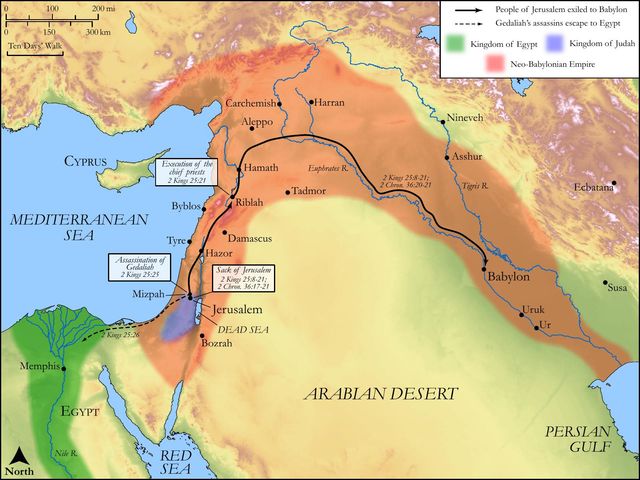
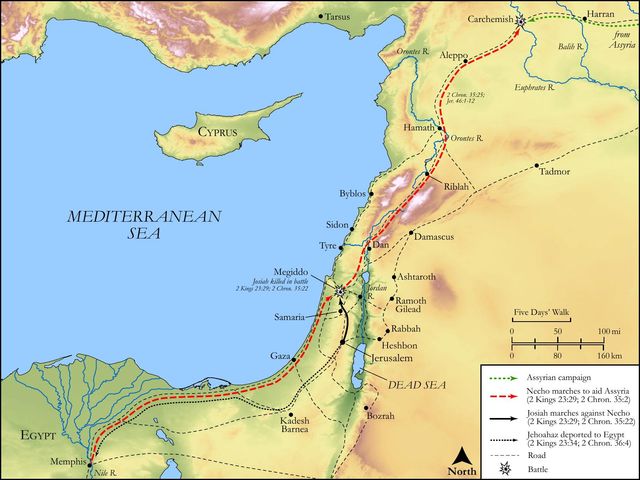
See on the biblical-era maps
Study this verse
Public-domain commentary
Matthew Henry
From his Commentary on the Whole Bible. Henry comments on passages, not single verses — this entry covers 2 Chronicles 36:1–10.
The destruction of Judah and Jerusalem is here coming on by degrees. God so ordered it to show that he has no pleasure in the ruin of sinners, but had rather they would turn and live, and therefore gives them both time and inducement to repent and waits to be gracious. The history of these reigns was more largely recorded in the last three chapters of the second of Kings. 1. Jehoahaz was set up by the people (Ch2 36:1), but in one quarter of a year was deposed by Pharaoh-necho, and carried a prisoner to Egypt, and the land fined for setting him up, Ch2 36:2-4. Of this young prince we hear no more. Had he trodden in the steps of his father's piety he might have reigned long and prospered; but we are told in the Kings that he did evil in the sight of the Lord, and therefore his triumphing was short and his joy but for a moment. 2. Jehoiakim was set up by the king of Egypt, an old enemy to their land, gave what king he pleased to the kingdom and what name he pleased to the king! Ch2 36:4. He made Eliakim king, and called him Jehoiakim, in token of his authority over him. Jehoiakim did that which was evil (Ch2 36:5), nay, we read of the abominations which he did (Ch2 36:8); he was very wild and wicked. Idolatries generally go under the name of abominations. We hear no more of the king of Egypt, but the king of Babylon came up against him (Ch2 36:6), seized him, and bound him with a design to carry him to Babylon; but, it seems, he either changed his mind, and suffered him to reign as his vassal, or death released the prisoner before he was carried away. However the best and most valuable vessels of the temple were now carried away and made use of in Nebuchadnezzar's temple in Babylon (Ch2 36:7); for, we may suppose, no temple in the world was so richly furnished as that of Jerusalem. The sin of Judah was that they had brought the idols of the heathen into God's temple; and now their punishment was that the vessels of the temple were carried away to the service of the gods of the nations. If men will profane God's institutions by their sins, it is just with God to suffer them to be profaned by their enemies. These were the vessels which the false prophets flattered the people with hopes of the return of, Jer 27:16. But Jeremiah told them that the rest should go after them (Jer 27:21, Jer 27:22), and they did so. But, as the carrying away of these vessels to Babylon began the calamity of Jerusalem, so Belshazzar's daring profanation of them there filled the measure of the iniquity of Babylon; for, when he drank wine in them to the honour of his gods, the handwriting on the wall presented him with his doom, Dan 5:3, etc. In the reference to the book of the Kings concerning this Jehoiakim mention is made of that which was found in him (Ch2 36:8), which seems to be meant of the treachery that was found in him towards the king of Babylon; but some of the Jewish writers understand it of certain private marks or signatures found in his dead body, in honour of his idol, such cuttings as God had forbidden, Lev 19:28. 3. Jehoiachin, or Jeconiah, the son of Jehoiakim, attempted to reign in his stead, and reigned long enough to show his evil inclination; but, after three months and ten days, the king of Babylon sent and fetched him away captive, with more of the goodly vessels of the temple. He is here said to be eight years old, but in Kings he is said to be eighteen when he began to reign, so that this seems to be a mistake of the transcriber, unless we suppose that his father took him at eight years old to join with him in the government, as some think.
Continue studying 2 Chronicles 36:3 across the web’s major study libraries — every link below opens this exact verse, chapter, or book on the destination site.
Read & Compare
 BibleGatewayThis verse in more than 200 translations and 70 languages.
 Bible.comThe YouVersion reader — hundreds of translations, reading plans, and highlights.
 ESV.orgCrossway's official English Standard Version reader.
 NET BibleThe NET translation with 60,000+ translators' notes on every rendering decision.
 STEP BibleTyndale House's free study tool — original text, vocabulary, and scholarly resources.
 BibliaLogos Bible Software's free web reader.
 USCCBThe New American Bible (Revised Edition) with the U.S. bishops' study notes.
Commentaries
 BibleHub CommentariesDozens of classic commentaries on this verse, gathered on one page.
 StudyLightMore than 100 commentary sets — the largest collection on the web.
 BibleRefPlain-English commentary on what this verse means, verse by verse.
 Enduring WordDavid Guzik's free commentary on this chapter, widely used by Bible teachers.
 Bible Study ToolsVerse commentary alongside Greek and Hebrew study aids.
Original Language & Research
- BibleHub InterlinearThe verse word by word — original language, transliteration, and English.
- BibleHub LexiconEvery word's original-language definition and Strong's entry.
 Blue Letter BibleDeep-study tools — Strong's numbers, concordance, and word studies.
 SefariaThe Hebrew text with Rashi and centuries of Jewish commentary.
Sermons, Hymns & Audio


TrulyRandomVerse is not affiliated with these sites and doesn’t control their content. They’re linked because they’re genuinely useful.
Summary
This verse vividly captures a critical juncture in the decline of the Kingdom of Judah, immediately following the tragic death of King Josiah. It details Pharaoh Neco II of Egypt's decisive assertion of imperial dominance by deposing King Jehoahaz, whom the people had recently enthroned in Jerusalem. This foreign intervention is further underscored by the imposition of an exorbitant financial tribute on the land, signifying Judah's swift transition from an independent kingdom to a land under tribute to Egypt, a direct precursor to its eventual Babylonian exile.
Context
ShowHideLiterary Context
This pivotal verse follows the profound national tragedy of King Josiah's death at Megiddo, as recounted in 2 Chronicles 35:20-24. Josiah's reign was a beacon of spiritual reform and faithfulness, making his demise a catastrophic turning point for Judah. Immediately after his death, the people of the land, in a display of national self-determination, appointed his son, Jehoahaz, to the throne (2 Chronicles 36:1). However, Jehoahaz's reign was remarkably brief—a mere three months—and marked by unrighteousness, as he "did that which was evil in the sight of the LORD" (2 Chronicles 36:2). Therefore, 2 Chronicles 36:3 describes the swift and forceful response of Pharaoh Neco, who, having recently defeated Josiah, now asserted his newly established authority over Judah. This act of deposing Jehoahaz and imposing a heavy fine sets the immediate stage for Judah's accelerated political and spiritual decline, leading inexorably towards the Babylonian exile under subsequent, equally unfaithful kings.
Historical & Cultural Context
The late 7th century BCE was a tumultuous period among the kingdoms of that day, characterized by a significant power vacuum left by the decaying Assyrian Empire. Egypt, under the ambitious Pharaoh Neco II, sought to re-establish its historical influence in the Levant, while the Neo-Babylonian Empire was rapidly ascending as the new dominant force. Neco's military campaign to aid the remnants of Assyria against Babylon led him through Judah's territory, culminating in the fateful confrontation with King Josiah at Megiddo. Upon his return journey, having achieved his immediate objectives, Neco consolidated his control over the region. His actions in Jerusalem—the unilateral removal of a king and the imposition of a substantial tribute—were standard imperial practices designed to assert dominion over a defeated or newly subjugated kingdom. The specified "hundred talents of silver and a talent of gold" represented an immense sum, functioning not merely as revenue but as a clear and punitive demonstration of Judah's new subjection to Egypt and a cost for the recent military engagements or perceived defiance.
Key Themes
ShowHideThis verse powerfully encapsulates several profound themes central to the Deuteronomistic History, which the Chronicler interprets for his audience. Firstly, it starkly illustrates the theme of divine judgment and sovereignty. While Pharaoh Neco acts as the immediate agent, the biblical narrative consistently frames such foreign subjugation as the direct consequence of Judah's persistent unfaithfulness and idolatry, despite Josiah's earlier reforms. This event underscores God's ultimate control over all nations and their rulers, even those who do not acknowledge Him, as seen in the divine orchestration of human affairs (e.g., Proverbs 21:1). Secondly, it highlights the loss of national sovereignty and the onset of servitude. Judah's cherished independence, a hallmark of its covenant relationship with God, is visibly eroded as a foreign king dictates its leadership and economic policy. This marks a critical and irreversible step towards the complete loss of autonomy and the impending Babylonian exile, a judgment frequently foretold by prophets like Jeremiah, who prophesied a seventy-year captivity for the nation (Jeremiah 25:11). Finally, the economic burden imposed by the tribute underscores the tangible and severe consequences of their spiritual decline and political subjugation.
Exposition and Analysis
ShowHideKey Word Analysis
ShowHideThis verb, derived from an unused root meaning "to turn off," conveys a forceful and decisive action of removal or deposition. It signifies that Pharaoh Neco's intervention was not a gentle request or a negotiated agreement, but a unilateral act of a conquering power asserting its authority. The swiftness of Jehoahaz's removal after only three months on the throne underscores Judah's complete lack of political agency and the overwhelming dominance of Egypt.
This primitive root means "to inflict a penalty," specifically "to fine" or "to amerce." It implies a punitive judgment rather than a simple tax or levy. Pharaoh Neco was not merely collecting revenue; he was imposing a penalty on the land of Judah, treating it as a conquered territory subject to his decree. This highlights the punitive aspect of the tribute, emphasizing Judah's subjugation and the direct consequences of its recent history and perceived insubordination.
This term refers to a "circle" and, by implication, a "large (round) coin" or a "talent," which was a substantial unit of weight and currency in Israel and among the nations round about. A talent typically weighed around 75 pounds (approximately 34 kilograms). Therefore, "an hundred talents of silver and a talent of gold" represented an immense sum of wealth—roughly 3.4 metric tons of silver and 34 kilograms of gold. This staggering amount underscores the crippling economic burden placed upon Judah, designed to drain its resources and ensure its continued subservience to Egypt.
Verse Breakdown
ShowHide"And the king of Egypt put him down at Jerusalem"
This clause describes Pharaoh Neco's direct and forceful intervention in Judah's internal affairs. "Him" refers to Jehoahaz, whom the people had appointed king. Neco's presence "at Jerusalem" signifies his complete authority over the capital and, by extension, the entire kingdom. This act demonstrates Judah's immediate loss of self-determination and the imposition of foreign rule, highlighting the vulnerability of a nation whose spiritual foundation has crumbled.
"and condemned the land"
This phrase indicates that Neco's action was not merely against the deposed king but against the entire nation of Judah. The "condemnation" implies a punitive measure, a fine levied as a consequence of their subjugation or perhaps as a cost for Neco's military campaign and the perceived resistance from Josiah. It signifies a collective burden and a clear mark of their new, subservient status, reflecting the Deuteronomic curses for disobedience.
"in an hundred talents of silver and a talent of gold"
This specifies the exact and enormous amount of the tribute imposed. The sheer quantity of silver and gold highlights the severity of the financial burden. This tribute would have severely impoverished the kingdom, draining its treasury and resources, further cementing its position as a land under Egyptian control and foreshadowing the deeper desolation of the impending exile.
Literary Devices
ShowHideThe verse employs several powerful literary devices that amplify its theological and historical significance. Foreshadowing is prominently featured, as this event serves as a clear and ominous precursor to the ultimate Babylonian captivity and the complete destruction of Jerusalem. The imposition of foreign rule and heavy tribute signals that Judah's independent existence is rapidly drawing to a close, with increasing external control. There is also a strong element of irony in the narrative: Josiah, a righteous king, dies heroically in battle against Pharaoh Neco, while his unrighteous son, Jehoahaz, is swiftly and effortlessly removed by the same foreign power without a fight. This stark contrast highlights the swiftness of divine judgment on a disobedient nation, emphasizing that external threats often become instruments of God's internal discipline. Furthermore, the contrast between Josiah's profound reform efforts and the rapid spiritual and political decline immediately following his death underscores the fragility of national righteousness when the hearts of the people are not truly turned to God, revealing a superficiality in the nation's repentance.
Theological and Thematic Connections
ShowHideThis verse stands as a stark and sobering reminder of the profound consequences of national apostasy and the sovereign hand of God in the unfolding of human history. While Pharaoh Neco acts as the immediate human agent, the biblical narrative consistently interprets such events as divine judgment for Judah's persistent sin and idolatry, despite fleeting periods of reform. It powerfully demonstrates that God, in His ultimate sovereignty, uses even foreign powers and their geopolitical ambitions as instruments of His will, bringing about His purposes of discipline and judgment upon His covenant people when they stray from Him. The loss of national sovereignty and the imposition of a crippling tribute are tangible manifestations of the covenant curses outlined in Deuteronomy, where disobedience leads inexorably to oppression by foreign nations and severe economic hardship. This event underscores the foundational truth that true national security, prosperity, and enduring peace are rooted not in political maneuvering, military strength, or economic prowess, but in unwavering faithfulness and obedience to God.
Reflection and Application
ShowHide2 Chronicles 36:3 offers a sobering historical lesson with profound and enduring contemporary relevance. It vividly illustrates the devastating consequences of spiritual drift and the insidious erosion of a nation's moral and spiritual foundation. Even after the significant and widespread revival under King Josiah, Judah's heart was not fully consecrated to the Lord, leading to swift judgment and the loss of its cherished independence. For believers today, this passage underscores the critical importance of consistent, wholehearted faithfulness, not merely outward religious observance or fleeting spiritual highs. It reminds us that our true security and prosperity, whether individually or corporately, are not found in political power, economic strength, or human wisdom, but in our unwavering allegiance and obedience to God. When we compromise our walk with Him, we open ourselves to various forms of "tribute" and "subjugation," whether spiritual, emotional, or even material. This verse calls us to a deep self-examination: Are we truly seeking God's kingdom first, or are we allowing the pressures and values of the world to subtly "condemn" and "put us down" from our walk of faith?
Questions for Reflection
ShowHideFAQ
ShowHideWhy did Pharaoh Neco intervene so directly in Judah's affairs?
ShowHidePharaoh Neco's intervention was a classic demonstration of imperial dominance among the kings of that day during a period of geopolitical flux. Having defeated King Josiah at Megiddo and established Egyptian control over the Levant, Neco was asserting his dominion over Judah. The people of Judah had appointed Jehoahaz as king without Neco's approval, which would have been seen as an act of defiance or at least a lack of submission to the newly established Egyptian hegemony. By removing Jehoahaz and installing a king of his own choosing (Eliakim, whom he renamed Jehoiakim, as recorded in 2 Chronicles 36:4), Neco solidified his political and economic control over the region, ensuring Judah's loyalty and its role as a buffer state or source of tribute, thereby protecting Egypt's northern flank.
What was the significance of the "hundred talents of silver and a talent of gold"?
ShowHideThis was an enormous sum, representing a crippling financial burden on the kingdom of Judah. A talent was a significant unit of weight, and this amount of silver and gold would have been equivalent to several tons of precious metals (approximately 3.4 metric tons of silver and 34 kilograms of gold). The significance was multifaceted: first, it served as a punitive fine, "condemning the land" for its perceived insubordination, its previous resistance under Josiah, or simply as a cost of war to the victor. Second, it was a clear demonstration of Judah's subjugation and tributary status, a tangible sign of their loss of independence. This heavy tribute would have severely depleted Judah's treasury, impoverished its people, and ensured its economic dependence on Egypt, further solidifying its loss of independent sovereignty. It tragically foreshadowed the even greater financial and human cost of the impending Babylonian exile and the ultimate desolation of the land.
Christ-Centered Fulfillment
ShowHideWhile 2 Chronicles 36:3 depicts the earthly king of Egypt "putting down" and "condemning" the land of Judah, imposing a heavy tribute, it ultimately points forward to the true King who would come to be "put down" and "condemned" for the sake of His people, but with a radically different outcome. Jesus, the Christ, was not deposed by a foreign power, but willingly laid down His life, allowing Himself to be "put down" from His position of glory and "condemned" by both earthly authorities and divine judgment—not for His own sin, but for ours (Isaiah 53:5-6). He became the ultimate "tribute" or "ransom," a perfect sacrifice to redeem humanity from the bondage of sin and death (Mark 10:45). Unlike the perishable silver and gold demanded from Judah, Christ's sacrifice was a spiritual payment, His precious blood, which alone could free His people from the immense debt of sin that no amount of earthly wealth could ever cover (1 Peter 1:18-19). The earthly kings of Judah were subject to foreign powers and their demands, but Christ's kingdom is not of this world (John 18:36), and He is the King over all kings, who will ultimately "put down" all opposing powers and establish His eternal reign, where no foreign entity will ever impose tribute or judgment on His redeemed people, for they are forever free in Him (Revelation 11:15).