


Ezra 8:34
Bible text: King James Version (1769 Blayney text) · Public domain
Bible text: Berean Standard Bible · Public domain
Bible text: American Standard Version (1901) · Public domain
Bible text: World English Bible, Messianic edition · Public domain
Bible text: Geneva Bible (1599) · Public domain
Bible text: Young's Literal Translation · Public domain
- בְּמִסְפָּרbe·mis·Parby numberH4557Prep-b ¦ N-msNoun Singular Masculine Absoluteבְּbyמִסְפָּרnumber
- בְּמִשְׁקָלbe·mish·Kalby weightH4948Prep-b ¦ N-msNoun Singular Masculine Absoluteבְּbyמִשְׁקָלweight
- לַכֹּלla·Kolfor <the> everythingH3605Prep-l ¦ N-msNoun Singular Masculine Absoluteלַfor <the>כֹּלeverything
- וַיִּכָּתֵבvai·yi·ka·Tevand it was written downH3789Conj-w ¦ V-Niphal-ConsecImperf-3msVerb Niphal Consecutive Imperfect 3rd Singular Masculineוַandיִּכָּתֵבit was written down
- כָּלkalallH3605N-mscNoun Singular Masculine Construct
- הַמִּשְׁקָלha·mish·Kalthe weightH4948Art ¦ N-msNoun Singular Masculine Absoluteהַtheמִּשְׁקָלweight
- בָּעֵתba·'Etat the timeH6256Prep-b ¦ N-csNoun Singular common gender Absoluteבָּat theעֵתtime
- הַהִיאha·Hi'<the> thatH1931Art ¦ Pro-3fsPronoun Personal 3rd Singular Feminineהַ<the>הִיאthat
English is a literal word-by-word gloss of the Hebrew, not the KJV's wording. Why?
This is the original text the KJV's translators worked from — each Hebrew word with its own literal English meaning in this verse, prepared by scholars at Tyndale House, Cambridge. The KJV translates whole sentences, not word by word, so its wording differs: one Hebrew word can become several English words, and the KJV may choose “the LORD” where the gloss reads “Yahweh”. Both are faithful — they answer different questions. For the KJV's own rendering, switch to the KJV text.
Details
See on the biblical-era map
Study this verse
Public-domain commentary
Matthew Henry
From his Commentary on the Whole Bible. Henry comments on passages, not single verses — this entry covers Ezra 8:31–36. His two-level outline is real structure in the source text, so it is rendered as structure.
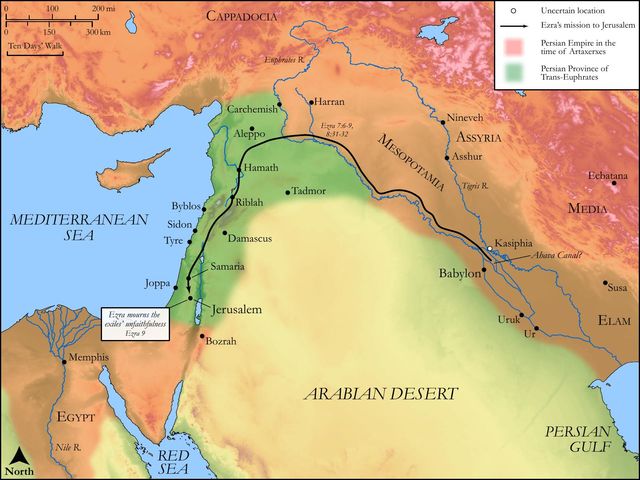
We are now to attend Ezra to Jerusalem, a journey of about four months in all; but his multitude made his marches slow and his stages short. Now here we are told,
I.That his God was good, and he acknowledged his goodness:
The hand of our God was upon us, to animate us for our undertaking. To him they owed it,
1.That they were preserved in their journey, and not all cut off; for there were enemies that laid wait for them by the way to do them a mischief, or at least, like Amalek, to smite the hindmost of them, but God protected them, Ezr 8:31. Even the common perils of journeys are such as oblige us to sanctify our going out with prayer and our returns in peace with praise and thanksgiving; much more ought God to be thus eyed in such a dangerous expedition as this was.
2.That they were brought in safety to their journey's end, Ezr 8:32. Let those that have stedfastly set their faces towards the new Jerusalem proceed and persevere to the end till they appear before God in Zion, and they shall find that he who has begun the good work will perform it.
II.That his treasurers were faithful.
When they had come to Jerusalem they were impatient to be discharged of their trust, and therefore applied to the great men of the temple, who received it from them and gave them an acquittance in full, Ezr 8:33, Ezr 8:34. It is a great ease to one's mind to be discharged from a trust, and a great honour to one's name to be able to make it appear that it has been faithfully discharged.
III.That his companions were devout.
As soon as they came to be near the altar they thought themselves obliged to offer sacrifice, whatever they had done in Babylon, Ezr 8:35. That will be dispensed with when we want opportunity which when the door is opened again will be expected from us. It is observable,
1.That among their sacrifices they had a sin-offering; for it is the atonement that sweetens and secures every mercy to us, which will not be truly comfortable unless iniquity be taken away and our peace made with God.
2.That the number of their offerings related to the number of the tribes, twelve bullocks, twelve he-goats, and ninety-six rams (that is, eight times twelve), intimating the union of the two kingdoms, according to what was foretold, Eze 37:22. They did not any longer go two tribes one way and ten another, but all the twelve met by their representatives at the same altar.
IV.That even the enemies of the Jews became their friends, bowed to Ezra's commission, and, instead of hindering the people of God, furthered them (Ezr 8:36), purely in complaisance to the king: when he appeared moderate they all coveted to appear so too. Then had the churches rest.
Historical interpretation
Historical reception
1 surviving comment on this verse from the historical church.
And every weight was recorded in that time. For the priests in the temple record all the weight of silver and gold, and of the vessels offered to the Lord, just as diligent teachers examine the lives of those under them, and discern by careful inquiry how much each one has progressed in faith or work, and according to the measure of their capacity, they arrange each in the house of God by their fitting steps. But even if now the laziness of overseers lies dormant and either ignores the lives of those entrusted to them or pretends not to know them, the internal judge is present, who keeps intact the number of believers and the weight of each one’s soul in the balance of His examination, so that He may render to each according to his work. It can also be said; because when holy preachers reach the heavenly Jerusalem with those whom they have instructed, all the weight of their good action is recorded at that time in the book of life and they are rewarded in heaven with deserving retribution.
Continue studying Ezra 8:34 across the web’s major study libraries — every link below opens this exact verse, chapter, or book on the destination site.
Read & Compare
 BibleGatewayThis verse in more than 200 translations and 70 languages.
 Bible.comThe YouVersion reader — hundreds of translations, reading plans, and highlights.
 ESV.orgCrossway's official English Standard Version reader.
 NET BibleThe NET translation with 60,000+ translators' notes on every rendering decision.
 STEP BibleTyndale House's free study tool — original text, vocabulary, and scholarly resources.
 BibliaLogos Bible Software's free web reader.
 USCCBThe New American Bible (Revised Edition) with the U.S. bishops' study notes.
Commentaries
 BibleHub CommentariesDozens of classic commentaries on this verse, gathered on one page.
 StudyLightMore than 100 commentary sets — the largest collection on the web.
 BibleRefPlain-English commentary on what this verse means, verse by verse.
 Enduring WordDavid Guzik's free commentary on this chapter, widely used by Bible teachers.
 Bible Study ToolsVerse commentary alongside Greek and Hebrew study aids.
Original Language & Research
- BibleHub InterlinearThe verse word by word — original language, transliteration, and English.
- BibleHub LexiconEvery word's original-language definition and Strong's entry.
 Blue Letter BibleDeep-study tools — Strong's numbers, concordance, and word studies.
 SefariaThe Hebrew text with Rashi and centuries of Jewish commentary.
Sermons, Hymns & Audio


TrulyRandomVerse is not affiliated with these sites and doesn’t control their content. They’re linked because they’re genuinely useful.
Summary
Ezra 8:34 meticulously concludes the perilous journey from Babylon, marking the precise accounting and transfer of the sacred temple treasures to Jerusalem. This verse underscores the culmination of a process initiated with prayer and careful stewardship, detailing how every item of gold, silver, and sacred vessel, entrusted to Ezra and the returning exiles for the rebuilt temple, was rigorously weighed, numbered, and formally documented upon its arrival. It stands as a testament to the profound commitment to integrity, diligence, and accountability in handling God's dedicated resources for His house.
Context
ShowHideLiterary Context
Ezra 8:34 serves as the climactic summary of the successful and meticulous delivery of the temple treasures, following the second wave of exiles' return from Babylon under Ezra's leadership. The preceding verses, particularly Ezra 8:31-33, detail the journey's safe completion after divine protection, a three-day rest period in Jerusalem, and the initial act of weighing the sacred items in the house of God by named priests and Levites. Verse 33 specifically mentions the weighing of the silver, gold, and vessels, identifying the responsible individuals. Ezra 8:34 then provides the definitive statement of completion, emphasizing the exhaustive nature of this accounting process—"by number and by weight of every one"—and the formal record-keeping: "all the weight was written at that time." This meticulousness contrasts sharply with the dangers of the journey, highlighting the successful and transparent fulfillment of a sacred trust. It sets the stage for the subsequent acts of worship, sacrifice, and purification in Jerusalem, reinforcing the overarching theme of restoration and proper worship in the post-exilic community.
Historical & Cultural Context
The events of Ezra 8 unfold during the mid-5th century BCE, approximately 80 years after the first return under Zerubbabel, a crucial period for the re-establishment of Jewish life and worship in Judah under the oversight of the Persian Empire. The temple, though rebuilt, still lacked many of its original sacred vessels and required further adornment. The treasures carried by Ezra were not mere commodities but sacred offerings from the Persian king Artaxerxes, his counselors, and the returning exiles themselves, explicitly dedicated to Yahweh for the temple's service as detailed in Ezra 7:15-16. The journey from Babylon to Jerusalem, spanning several months, was inherently perilous, fraught with risks from bandits and hostile groups, making the safe transport of such immense wealth a significant undertaking. The emphasis on "number" and "weight" reflects the common practice of meticulous inventory and accountability, especially for valuable or sacred goods. This rigorous process ensured transparency, prevented accusations of theft or mismanagement, and demonstrated a profound respect for the divine purpose of the offerings, aligning with the high standards of integrity expected in such matters.
Key Themes
ShowHideEzra 8:34 powerfully articulates several foundational themes within the book of Ezra and the broader biblical narrative. Firstly, it profoundly illustrates Stewardship and Accountability, demonstrating Ezra's unwavering commitment to handling God's resources with the utmost care and transparency. The meticulous counting and weighing underscore that sacred trust demands rigorous oversight, as seen in the broader biblical call for faithful management of all resources, spiritual and material, entrusted by God (Luke 16:10). Secondly, the verse highlights Diligence and Precision in divine service. The task was not performed casually but with painstaking attention to detail, reflecting a deep reverence for God and His temple. This diligence is a recurring motif, from the careful preparation for the journey (Ezra 8:24-30) to its culmination here. Thirdly, Integrity and Transparency are paramount. The act of "writing" down the weight publicly ensures that the process was verifiable and beyond reproach, fostering trust within the community and with the Persian authorities. This echoes the biblical call for honesty in all dealings, as seen in passages like Proverbs 11:1. Finally, the verse subtly points to God's Providence and Human Responsibility. While Ezra sought God's protection for the journey (Ezra 8:21-23) and God indeed granted it, human agents were still expected to exercise their utmost diligence and care in stewarding the divine provisions, demonstrating that divine blessing does not negate human responsibility.
Exposition and Analysis
ShowHideKey Word Analysis
ShowHideDerived from the root sâphar (to count, recount), this word signifies a precise, definite tally. In this context, it indicates that each individual item—every vessel, every piece of gold or silver—was accounted for, ensuring that nothing was missing. This level of detail speaks to the absolute thoroughness of the inventory process, reflecting a commitment to perfect accountability for every item entrusted for the temple's service. It implies an exact, itemized count rather than a mere estimation.
From the root shâqal (to weigh), "weight" refers to the measured mass of the precious metals and vessels. Beyond a simple count, the act of weighing ensured that the full, agreed-upon quantity and quality of gold and silver were present, preventing any substitution with lesser materials or partial removal. It was a quantitative verification of the intrinsic value and bulk of the sacred offerings, crucial for preventing fraud and ensuring the full endowment for the temple.
A primitive root meaning "to grave" or "to inscribe," this term denotes the creation of a formal, permanent record. The act of "writing" down the inventory signifies not just a verbal confirmation but a legally binding and verifiable documentation. It establishes an irrefutable record for future reference, demonstrating transparency and integrity to all parties involved, including the community, the temple authorities, and the Persian administration. This written record served as undeniable proof of faithful stewardship.
Verse Breakdown
ShowHide"By number [and] by weight of every one"
This foundational phrase describes the exhaustive and dual-method approach to inventorying the temple treasures. It means that each single item, whether a vessel or a quantity of precious metal, was individually counted ("by number") and then collectively or individually weighed ("by weight"). This dual verification process ensured maximum accuracy and accountability, leaving no room for error or suspicion. It underscores that the transfer was not a casual estimation but a precise, item-by-item audit, reflecting the sacredness and immense value of the items being transferred for God's house.
"and all the weight was written at that time."
This concluding clause emphasizes the formal and immediate documentation of the meticulously verified inventory. The total weight of all the treasures, confirmed by the counting and weighing, was promptly recorded in a permanent written form. The phrase "at that time" implies that the record was made concurrently with the transfer, ensuring that the documentation was fresh, accurate, and verifiable by all present parties. This written record served as irrefutable proof of the faithful stewardship of the temple treasures, preventing future disputes, accusations of misappropriation, and ensuring a clear audit trail for such a significant undertaking.
Literary Devices
ShowHideEzra 8:34 employs several literary techniques to underscore its message. The verse utilizes Emphasis through the dual specification of "number" and "weight," followed by the explicit statement that "all the weight was written." This repetition of the concept of meticulous accounting, though not a direct verbal repetition, creates a strong sense of absolute thoroughness and precision in the process. This meticulousness also contributes to a sense of Completeness and finality regarding the transfer of the treasures, signaling that the sacred task was fully and properly discharged. Furthermore, the verse employs Metonymy, where "number" and "weight" (and the act of "writing") stand in for the entire process of meticulous stewardship, accountability, and integrity. The physical acts of counting, weighing, and recording become symbols for the spiritual and ethical principles of faithfulness and transparency in handling sacred trusts. The stark, factual, and almost legalistic reporting style also lends an air of Verisimilitude, reinforcing the historical accuracy and reliability of the account and the serious nature of the responsibility.
Theological and Thematic Connections
ShowHideEzra 8:34 powerfully articulates the biblical principle of faithful stewardship, not merely as a practical necessity but as a spiritual imperative. It demonstrates that God's work, even in its material aspects, demands the highest standards of integrity, diligence, and transparency from His servants. This meticulous accountability for physical treasures foreshadows the even greater call to stewardship of spiritual gifts, time, and influence. The care taken with gold and silver for the physical temple prefigures the care required in building up the spiritual temple, the church. This verse reminds us that divine provision (the treasures from the king) is met with human responsibility, and that God delights in order and integrity in the execution of His will. It underscores that true reverence for God is demonstrated not only in worship but also in the scrupulous management of all that He entrusts to us, recognizing that every resource is ultimately His.
Reflection and Application
ShowHideEzra 8:34 offers profound lessons for contemporary believers, extending beyond the literal handling of temple treasures to every area of life. It calls us to cultivate a spirit of meticulous diligence and unwavering integrity in all our responsibilities, whether in personal finances, professional duties, or, especially, in church ministry. Just as Ezra ensured every "weight was written," we are to be transparent and accountable in our stewardship of God-given resources—be they financial, spiritual gifts, time, or relationships. This verse challenges us to consider if our actions reflect the same level of care and precision that Ezra demonstrated for the sacred things of God. It encourages leaders to establish clear processes for accountability and for all believers to embrace a posture of faithfulness, recognizing that even seemingly small acts of diligence contribute to the larger work of God's kingdom and bring Him glory. Our commitment to integrity in the "small things" reflects our readiness for greater responsibilities and honors the God who is Himself perfectly ordered and just.
Questions for Reflection
ShowHideFAQ
ShowHideWhy was such meticulous record-keeping necessary for the temple treasures?
ShowHideThe meticulous record-keeping for the temple treasures, as described in Ezra 8:34, was crucial for several reasons. Firstly, it ensured accountability to the Persian king who provided some of the treasures, to the Jewish community who contributed, and ultimately to God. This prevented any accusations of theft or mismanagement, establishing a clear chain of custody. Secondly, it demonstrated integrity on the part of Ezra and the priests entrusted with the valuable cargo, building trust within the community and with the authorities. Thirdly, it was a practical measure for restoration; these items were vital for the functioning and adornment of the rebuilt temple in Jerusalem, and their precise accounting ensured that the full intended complement arrived safely and could be properly allocated. Finally, it reflected the sacredness of the items; anything dedicated to God's service was to be handled with utmost reverence and care, leaving no room for negligence or ambiguity. This level of detail underscores the seriousness of their mission and the value placed on God's house.
What does this verse teach us about God's view of material possessions or stewardship?
ShowHideEzra 8:34 teaches us that God values order, integrity, and faithful stewardship even concerning material possessions, especially those dedicated to Him. While God is not dependent on human wealth, He cares deeply about how His people manage what He entrusts to them. The meticulousness here suggests that stewardship is not just about avoiding outright theft, but about exercising diligent care, precision, and transparency. It implies that God expects His people to be responsible and accountable with all resources, recognizing that they are ultimately His. This principle extends beyond temple treasures to all forms of wealth, time, talents, and opportunities, emphasizing that our management of these resources is a reflection of our reverence for God and our commitment to His kingdom. As 1 Corinthians 10:31 reminds us, whether we eat or drink or whatever we do, we should do it all for the glory of God, which includes our stewardship.
Christ-Centered Fulfillment
ShowHideWhile Ezra 8:34 details the meticulous accounting of physical treasures for a physical temple, it powerfully foreshadows the ultimate stewardship and the infinitely more precious "treasure" delivered in Christ. Just as the gold and silver were carefully weighed and documented, so too was the Son of God, the ultimate gift, "delivered up for us all" (Romans 8:32) according to the Father's perfect plan and precise timing (Galatians 4:4). Jesus Himself is the ultimate steward, perfectly fulfilling the Father's will in every detail, even to the point of death on the cross (Philippians 2:8). He is the true temple, the dwelling place of God among humanity (John 2:19-21), and through His sacrifice, He has entrusted to His church, the spiritual temple (Ephesians 2:21-22), the immeasurable riches of His grace and the ministry of reconciliation (2 Corinthians 5:18). Our call to faithful stewardship, diligence, and accountability in the New Covenant echoes Ezra's meticulousness, as we are now stewards of the mysteries of God (1 Corinthians 4:1) and called to present our bodies as living sacrifices (Romans 12:1), reflecting the perfect stewardship of the Lamb who was "counted" and "weighed" in every aspect of His life and death for our salvation, ensuring that not one of His sheep would be lost (John 17:12).