


Ezra 8:36
Bible text: King James Version (1769 Blayney text) · Public domain
Bible text: King James Version with Strong's numbers · Public domain
Bible text: Berean Standard Bible · Public domain
Bible text: American Standard Version (1901) · Public domain
Bible text: World English Bible, Messianic edition · Public domain
Bible text: Geneva Bible (1599) · Public domain
Bible text: Young's Literal Translation · Public domain
- וַיִּתְּנוּvai·yi·te·Nuand they gaveH5414Conj-w ¦ V-Qal-ConsecImperf-3mpVerb Qal Consecutive Imperfect 3rd Plural Masculineוַandיִּתְּנוּthey gave
- אֶת'et<obj.>H853DirObjMParticle Object Indicator
- דָּתֵיda·Tei[the] decrees ofH1881N-mpcNoun Plural Masculine Construct
- הַמֶּלֶךְha·Me·lekhthe kingH4428Art ¦ N-msNoun Singular Masculine Absoluteהַtheמֶּלֶךְking
- לַאֲחַשְׁדַּרְפְּנֵיla·'a·chash·dar·pe·Neito [the] satraps ofH323Prep-l ¦ N-mpcNoun Plural Masculine Constructלַtoאֲחַשְׁדַּרְפְּנֵי[the] satraps of
- הַמֶּלֶךְha·Me·lekhthe kingH4428Art ¦ N-msNoun Singular Masculine Absoluteהַtheמֶּלֶךְking
- וּפַחֲווֹתu·fa·cha·Votand [the] governors ofH6346Conj-w ¦ N-fpcNoun Plural Feminine Constructוּandפַחֲווֹת[the] governors of
- עֵבֶר'E·verbeyondH5676N-mscNoun Singular Masculine Construct
- הַנָּהָרha·na·Harthe RiverH5104Art ¦ N-properNoun Proper LocationהַtheנָּהָרRiver
- וְנִשְּׂאוּve·ni·se·'Uand they supportedH5375Conj-w ¦ V-Piel-ConsecPerf-3cpVerb Piel Consecutive Perfect 3rd Plural common genderוְandנִשְּׂאוּthey supported
- אֶת'et<obj.>H853DirObjMParticle Object Indicator
- הָעָםha·'Amthe peopleH5971Art ¦ N-msNoun Singular Masculine Absoluteהָtheעָםpeople
- וְאֶתve·'Etand <obj.>H853Conj-w ¦ DirObjMParticle Object Indicatorוְandאֶת<obj.>
- בֵּיתbeit[the] house ofH1004N-mscNoun Singular Masculine Construct
- הָאֱלֹהִיםha·'E·lo·Him<the> GodH430Art ¦ N-mpNoun Plural Masculine Absoluteהָ<the>אֱלֹהִיםGod
English is a literal word-by-word gloss of the Hebrew, not the KJV's wording. Why?
This is the original text the KJV's translators worked from — each Hebrew word with its own literal English meaning in this verse, prepared by scholars at Tyndale House, Cambridge. The KJV translates whole sentences, not word by word, so its wording differs: one Hebrew word can become several English words, and the KJV may choose “the LORD” where the gloss reads “Yahweh”. Both are faithful — they answer different questions. For the KJV's own rendering, switch to the KJV text.
Details
See on the biblical-era map
Study this verse
Public-domain commentary
Matthew Henry
From his Commentary on the Whole Bible. Henry comments on passages, not single verses — this entry covers Ezra 8:31–36. His two-level outline is real structure in the source text, so it is rendered as structure.
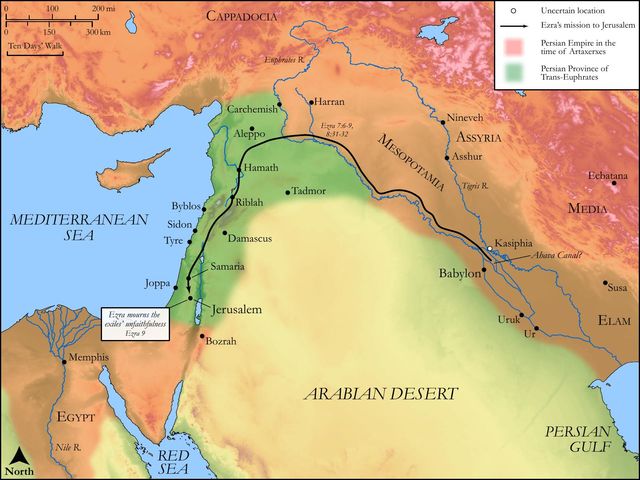
We are now to attend Ezra to Jerusalem, a journey of about four months in all; but his multitude made his marches slow and his stages short. Now here we are told,
I.That his God was good, and he acknowledged his goodness:
The hand of our God was upon us, to animate us for our undertaking. To him they owed it,
1.That they were preserved in their journey, and not all cut off; for there were enemies that laid wait for them by the way to do them a mischief, or at least, like Amalek, to smite the hindmost of them, but God protected them, Ezr 8:31. Even the common perils of journeys are such as oblige us to sanctify our going out with prayer and our returns in peace with praise and thanksgiving; much more ought God to be thus eyed in such a dangerous expedition as this was.
2.That they were brought in safety to their journey's end, Ezr 8:32. Let those that have stedfastly set their faces towards the new Jerusalem proceed and persevere to the end till they appear before God in Zion, and they shall find that he who has begun the good work will perform it.
II.That his treasurers were faithful.
When they had come to Jerusalem they were impatient to be discharged of their trust, and therefore applied to the great men of the temple, who received it from them and gave them an acquittance in full, Ezr 8:33, Ezr 8:34. It is a great ease to one's mind to be discharged from a trust, and a great honour to one's name to be able to make it appear that it has been faithfully discharged.
III.That his companions were devout.
As soon as they came to be near the altar they thought themselves obliged to offer sacrifice, whatever they had done in Babylon, Ezr 8:35. That will be dispensed with when we want opportunity which when the door is opened again will be expected from us. It is observable,
1.That among their sacrifices they had a sin-offering; for it is the atonement that sweetens and secures every mercy to us, which will not be truly comfortable unless iniquity be taken away and our peace made with God.
2.That the number of their offerings related to the number of the tribes, twelve bullocks, twelve he-goats, and ninety-six rams (that is, eight times twelve), intimating the union of the two kingdoms, according to what was foretold, Eze 37:22. They did not any longer go two tribes one way and ten another, but all the twelve met by their representatives at the same altar.
IV.That even the enemies of the Jews became their friends, bowed to Ezra's commission, and, instead of hindering the people of God, furthered them (Ezr 8:36), purely in complaisance to the king: when he appeared moderate they all coveted to appear so too. Then had the churches rest.
Historical interpretation
Historical reception
1 surviving comment on this verse from the historical church.
They also delivered the king's edicts to the satraps, etc. Another edition has: And they glorified the people and the house of God. Therefore, they uplifted the people by making royal authority, with which Ezra was exalted, honorable to all. They also uplifted the house of God by adorning it more splendidly with vessels and gifts which the king, his counselors, and his princes sent to it; and by freeing its ministers and priests from tributes and taxes, except to the Lord alone. Mystically, however, the people and the temple of God held one and the same figure of the holy Church; which Ezra and the sons of the exile uplift, by bringing from Babylon the vessels sacred to God, when holy preachers, gathering to it, by the Lord's gift, the assemblies of believers, make it honorable to all even strangers and show it as awe-inspiring. Likewise, the same preachers, when they elevate those whom they instruct either by their examples in good conduct or by words towards the perception of the heavenly rewards, they now uplift the people and the house of God, because they indeed bring great joy both to those dwelling in the heavenly homeland and to those still journeying on earth.
Continue studying Ezra 8:36 across the web’s major study libraries — every link below opens this exact verse, chapter, or book on the destination site.
Read & Compare
 BibleGatewayThis verse in more than 200 translations and 70 languages.
 Bible.comThe YouVersion reader — hundreds of translations, reading plans, and highlights.
 ESV.orgCrossway's official English Standard Version reader.
 NET BibleThe NET translation with 60,000+ translators' notes on every rendering decision.
 STEP BibleTyndale House's free study tool — original text, vocabulary, and scholarly resources.
 BibliaLogos Bible Software's free web reader.
 USCCBThe New American Bible (Revised Edition) with the U.S. bishops' study notes.
Commentaries
 BibleHub CommentariesDozens of classic commentaries on this verse, gathered on one page.
 StudyLightMore than 100 commentary sets — the largest collection on the web.
 BibleRefPlain-English commentary on what this verse means, verse by verse.
 Enduring WordDavid Guzik's free commentary on this chapter, widely used by Bible teachers.
 Bible Study ToolsVerse commentary alongside Greek and Hebrew study aids.
Original Language & Research
- BibleHub InterlinearThe verse word by word — original language, transliteration, and English.
- BibleHub LexiconEvery word's original-language definition and Strong's entry.
 Blue Letter BibleDeep-study tools — Strong's numbers, concordance, and word studies.
 SefariaThe Hebrew text with Rashi and centuries of Jewish commentary.
Sermons, Hymns & Audio


TrulyRandomVerse is not affiliated with these sites and doesn’t control their content. They’re linked because they’re genuinely useful.
Summary
Ezra 8:36 marks the successful culmination of Ezra's administrative efforts upon arriving in the Persian province of Judah, demonstrating how divine providence orchestrated support for the returning exiles and the rebuilding of the Temple. Having delivered King Artaxerxes' official decrees, the Jewish leaders secured the cooperation of regional Persian officials, who actively "furthered" the people and the sacred work of restoring the house of God in Jerusalem, underscoring God's ability to work through secular authorities to accomplish His redemptive purposes.
Context
ShowHideLiterary Context
This verse serves as the triumphant conclusion to the narrative of Ezra's perilous journey from Babylon to Jerusalem, detailed in Ezra 7-8. It immediately follows the successful arrival of Ezra and the exiles in Jerusalem, having previously committed themselves and the valuable Temple treasures to God's protection rather than requesting a military escort from the king, as recounted in Ezra 8:22. The delivery of the king's commissions signifies the official establishment of their authority and mission, setting the stage for the subsequent actions of purification and community restoration that unfold in the latter chapters of the book, particularly the handling of the mixed marriages in Ezra 9-10. This verse acts as a bridge, concluding the travel narrative and initiating the administrative phase of Ezra's work.
Historical & Cultural Context
The setting for Ezra 8:36 is the vast Persian Empire during the reign of Artaxerxes I (465-424 BC). The phrase "on this side the river" refers to the satrapy of Trans-Euphrates (Aramaic: Abar-Nahara), a significant administrative region west of the Euphrates River that encompassed Judah. The "king's lieutenants" (satraps) and "governors" were high-ranking Persian officials responsible for governing these provinces, collecting taxes, and enforcing royal decrees. The "king's commissions" were official royal edicts, carrying the full weight of the emperor's authority. In that day, such documents were crucial for securing safe passage, resources, and cooperation, demonstrating the practical wisdom of Ezra in leveraging secular authority even while maintaining profound trust in divine protection. This interaction highlights the intricate political landscape in which the returning exiles operated.
Key Themes
ShowHideEzra 8:36 powerfully illustrates several key themes central to the book of Ezra and broader biblical theology. Firstly, it highlights Divine Providence and Favor, showing God's sovereign hand at work, influencing powerful rulers like Artaxerxes to issue decrees that directly benefited His people and their sacred mission. This echoes the biblical truth that "The king's heart is in the hand of the LORD, as the rivers of water: he turneth it whithersoever he will," as stated in Proverbs 21:1. Secondly, it underscores the theme of Secular Authority Supporting Spiritual Endeavors. The compliance of the Persian officials meant that the Jewish returnees received official backing and resources, ensuring that the work of restoring the community and the Temple could proceed without hindrance, demonstrating how God can use even non-believing authorities to accomplish His purposes. Finally, it emphasizes the Importance of Official Recognition and Practical Wisdom. While Ezra's faith in God's protection was paramount, he also acted with shrewdness, utilizing the king's official decrees to navigate the political landscape, providing the legal authority needed to overcome potential opposition and secure cooperation from local administrators for the "house of God" in Jerusalem, a mission also supported by earlier decrees as seen in Ezra 6:14.
Exposition and Analysis
ShowHideKey Word Analysis
ShowHideThis term (H1881) refers to a royal edict or statute, a commandment, or a decree. In this context, it signifies the authoritative documents issued by King Artaxerxes I, granting Ezra and the Jewish returnees legal permission, protection, and resources for their journey and the rebuilding efforts in Jerusalem. The delivery of these commissions was a formal act, establishing the legitimacy of their mission within the Persian administrative structure and ensuring their activities were recognized and supported by the established secular authority.
This word (H323) refers to a satrap or governor of a main province of Persia. These were high-ranking provincial governors appointed by the Persian king, holding significant power and authority over vast regions of the empire. Their inclusion alongside "governors on this side the river" emphasizes the broad and high-level support Ezra received across the Trans-Euphrates satrapy, indicating that the royal decree was communicated to the highest levels of regional administration.
This verb (H5375) means to lift, bear, support, or assist. It implies active cooperation and practical help extended by the Persian officials to the Jewish people and their sacred task. It denotes more than mere passive permission; it indicates active facilitation, such as providing resources, ensuring safe passage, or removing administrative or local obstacles, thus enabling the spiritual and communal restoration to proceed unhindered.
Verse Breakdown
ShowHide"And they delivered the king's commissions unto the king's lieutenants, and to the governors on this side the river"
This clause describes the formal presentation of the royal decrees by Ezra and his delegates to the highest-ranking Persian officials in the Trans-Euphrates region. This act was crucial for legitimizing their presence and mission, ensuring that their activities were recognized and supported by the established secular authority, thereby preventing potential obstruction or conflict. It underscores the importance of proper administrative procedure even when operating under divine mandate, showcasing Ezra's practical wisdom alongside his faith.
"and they furthered the people, and the house of God."
This clause reveals the positive outcome of delivering the commissions. The Persian officials, compelled by the king's authority, actively provided assistance and support to the Jewish returnees ("the people") and, more specifically, to the work of rebuilding and re-establishing the Temple ("the house of God"). This "furthering" would have included ensuring safe passage, providing necessary resources, and removing any administrative or local obstacles, thus enabling the spiritual and communal restoration to proceed unhindered and demonstrating God's ability to work through unexpected channels.
Literary Devices
ShowHideEzra 8:36 employs several literary devices that enhance its meaning and impact. The phrase "the house of God" functions as a Metonymy, where the physical structure of the Temple stands in for the entire religious and communal life of Israel centered around worship and the divine presence. The verse also serves as a Narrative Climax and Resolution for the journey section of Ezra, providing a satisfying conclusion to the account of Ezra's trust in God's protection during the perilous trip. The successful delivery of the commissions and the subsequent support from pagan officials highlight a Divine Irony or Paradox: God's people, who relied solely on Him, are ultimately aided by the very secular powers that had previously held them captive. This demonstrates God's sovereign ability to use any means, even those seemingly opposed to His people, to accomplish His redemptive purposes.
Theological and Thematic Connections
ShowHideEzra 8:36 is a profound testament to God's sovereign control over all earthly powers and His faithfulness to His covenant people. It illustrates that divine providence is not limited to miraculous interventions but often works through the ordinary channels of human governance and administration. God can incline the hearts of kings and officials, even those who do not acknowledge Him, to serve His purposes, ensuring the advancement of His kingdom work. This challenges believers to recognize God's hand in unexpected places and to trust that He is orchestrating events behind the scenes, even in complex political or social landscapes. The support given to "the people, and the house of God" underscores God's commitment to the restoration of His community and the sanctity of His dwelling place, demonstrating His unwavering commitment to His covenant promises.
Reflection and Application
ShowHideEzra 8:36 offers timeless lessons for believers today. Firstly, it reminds us that God works through diverse channels, not just overtly spiritual ones. We should not limit our expectation of God's provision to only religious means; He can and does use secular systems, governments, and even individuals who do not acknowledge Him, to further His kingdom work. This calls for a broader perspective on divine activity in the world. Secondly, Ezra's example teaches us that wisdom and faith go hand-in-hand. While his faith in God's protection was paramount, he also exercised practical wisdom by securing the necessary civil authority through the king's commissions. Believers are called to be "wise as serpents and innocent as doves," as Jesus instructed in Matthew 10:16, combining deep trust in God with prudent action in the world. Finally, just as the Persian officials "furthered the people, and the house of God," we are called to support the work of the church and the spread of the Gospel, whether through our resources, time, or influence. This verse is a powerful reminder that God delights in the advancement of His kingdom, and He often uses His people, in conjunction with His sovereign orchestration of external circumstances, to achieve it.
Questions for Reflection
ShowHideFAQ
ShowHideWhat does "on this side the river" mean?
ShowHide"On this side the river" refers to the region west of the Euphrates River, known in Aramaic as Trans-Euphrates or Abar-Nahara. This was a significant satrapy (province) within the vast Persian Empire. The mention of officials from this region highlights the extensive reach of King Artaxerxes' authority and the broad geographical scope of the support Ezra received, ensuring his mission was recognized and aided across a vast territory. This geographical detail underscores the wide-ranging administrative cooperation Ezra secured.
Why did Ezra need "commissions" if he trusted God for protection?
ShowHideWhile Ezra famously demonstrated profound faith by refusing a military escort and trusting God for protection on the dangerous journey, as recorded in Ezra 8:22, he also exercised practical wisdom. The "commissions" were official royal decrees that provided legal authority and administrative recognition. These documents were crucial for navigating the political landscape, securing cooperation from local officials, and ensuring that the work of rebuilding the Temple and community could proceed without legal or bureaucratic hindrance, as outlined in Ezra 7:11-26. God often works through both supernatural provision and human prudence, and Ezra's actions exemplify this balance, showing that faith does not negate the need for responsible and wise action.
Christ-Centered Fulfillment
ShowHideEzra 8:36, with its depiction of pagan rulers unwittingly serving God's redemptive purposes, finds its ultimate Christ-centered fulfillment in the universal kingship of Jesus Christ. The earthly support provided by Artaxerxes' officials to the "house of God" foreshadows the ultimate building of the spiritual temple, the Church, through Christ's redemptive work. Christ's kingdom is not of this world, yet He holds all authority in heaven and on earth, as declared in Matthew 28:18, sovereignly using earthly means, including governments and societal structures, to advance His eternal purposes. The "furthering" of the people and the house of God in Ezra's day culminates in Christ's ongoing work of building His Church, which is His body and the new Temple of God, as described in Ephesians 1:22-23 and 1 Corinthians 3:16. Just as the Persian officials were instrumental in Ezra's mission, so too does Christ, the "King of kings and Lord of lords" (Revelation 19:16), orchestrate all things, even the actions of secular authorities and unexpected circumstances, to ensure the spiritual growth and global expansion of His Church, empowered by the Holy Spirit to be His witnesses to the ends of the earth, as promised in Acts 1:8.